Sixteenth Sunday in Ordinary Time – Lectionary: 106
When the Master of Might Chooses to Wait
There is a question that keeps honest believers awake at night: if God is all-powerful, why does He allow evil to keep growing right next to the good? The readings for this Sixteenth Sunday in Ordinary Time answer that question in a way no philosophy textbook ever could, and the answer is breathtaking. God’s patience is not a limit on His power. It is the fullest display of it.
The Book of Wisdom, written by a devout Jew in Alexandria barely a generation before Christ, makes the claim outright: God’s “mastery over all things” is precisely what makes Him “lenient to all.” Because nothing threatens Him, He can afford to wait, to warn, to give the wicked room to repent. Psalm 86 turns that theology into prayer, borrowing the very words God spoke to Moses on Sinai, calling on a God who is slow to anger and abounding in mercy. Saint Paul then shows how far that merciful power stoops: the Holy Spirit Himself enters human weakness and prays within the hearts of the faithful when words run out. And in the Gospel, Jesus gathers it all into one unforgettable image, a field where wheat and weeds grow tangled together, watched over by a Master who refuses a hasty purge because He will not risk a single stalk of wheat, and because He knows something the servants do not: weeds can still become wheat.
This Sunday invites every reader to stop mistaking God’s patience for absence. The harvest is certain. The Judge is coming. But today, right now, is still the season of mercy.
First Reading — Wisdom 12:13, 16-19
The Almighty Who Governs with a Gentle Hand
The Book of Wisdom was composed in Greek in Alexandria, Egypt, during the last century before Christ, making it the final Old Testament book to be written. Its author wrote for Jews living as a minority in a dazzling, aggressive pagan culture, tempted daily to abandon their faith. Chapter 12 comes from a long meditation on the Exodus, where the author wrestles with a hard memory: God’s judgment on the Canaanites. His conclusion is remarkable. Even there, God punished “little by little,” giving space for repentance, because leniency flows from His omnipotence rather than contradicting it. This reading sets the day’s central theme: true power does not need to prove itself through cruelty.
Wisdom 12:13, 16-19 – New American Bible (Revised Edition)
13 For neither is there any god besides you who have the care of all,
that you need show you have not unjustly condemned;16 For your might is the source of righteousness;
your mastery over all things makes you lenient to all.
17 For you show your might when the perfection of your power is disbelieved;
and in those who know you, you rebuke insolence.
18 But though you are master of might, you judge with clemency,
and with much lenience you govern us;
for power, whenever you will, attends you.19 You taught your people, by these deeds,
that those who are righteous must be kind;
And you gave your children reason to hope
that you would allow them to repent for their sins.
Detailed Exegesis
Verse 13: “For neither is there any god besides you who have the care of all, that you need show you have not unjustly condemned.” The author begins with strict monotheism. Because God alone governs everything, He answers to no rival tribunal and no accuser. His justice needs no defense, which makes His choice of clemency all the more astonishing.
Verse 16: “For your might is the source of righteousness; your mastery over all things makes you lenient to all.” This is the theological heart of the passage. Human rulers grow harsh when they feel insecure. God, utterly secure, can be gentle. His justice flows from strength, and His leniency flows from total sovereignty.
Verse 17: “For you show your might when the perfection of your power is disbelieved; and in those who know you, you rebuke insolence.” God displays raw power chiefly toward those who deny Him, as He did before Pharaoh. Among those who already know Him, He corrects arrogance rather than crushing it, disciplining as a father rather than destroying as a tyrant.
Verse 18: “But though you are master of might, you judge with clemency, and with much lenience you govern us; for power, whenever you will, attends you.” God could act instantly and irresistibly at any moment. That He chooses restraint reveals His character. Clemency is His governing style, not an occasional mood.
Verse 19: “You taught your people, by these deeds, that those who are righteous must be kind; And you gave your children reason to hope that you would allow them to repent for their sins.” Divine patience carries a double lesson. First, God’s people must imitate His kindness; righteousness without mercy is not righteousness at all. Second, His patience is the very ground of hope, because a God who waits is a God who wants repentance.
Teachings
The Catechism enshrines this exact insight when it teaches about divine omnipotence. In CCC 270, the Church confesses that God shows His fatherly almightiness “by his infinite mercy, for he displays his power at its height by freely forgiving sins.” Forgiveness is not God’s power taking a day off; it is His power at maximum output. The Church prays this truth in her liturgy, in the ancient Collect that asks: “O God, who manifest your almighty power above all by pardoning and showing mercy.” Saint Thomas Aquinas, the Angelic Doctor, took up that very prayer in the Summa Theologiae (I, q. 25, a. 3) to teach that sparing and having mercy manifest omnipotence most of all, since freely forgiving sins belongs only to the One who has supreme power over all things. The Catechism also draws the pastoral consequence in CCC 1037: “God predestines no one to go to hell; for this, a willful turning away from God (a mortal sin) is necessary, and persistence in it until the end.” God’s patience in Wisdom 12 is the same patience still holding the door of repentance open today.
Reflection
This reading confronts a common modern assumption, the idea that mercy is what weak people offer because they cannot retaliate. Scripture says the opposite. Only the truly strong can be truly gentle. Consider where that lands in ordinary life. When you hold power over someone, a child, an employee, a person who wronged you and now needs your help, your treatment of them reveals your character more than any sermon you could give. Try one concrete practice this week: identify a situation where you have the upper hand and deliberately choose leniency, not because the other person earned it, but because kindness is what the righteous do. Then bring your own sins to that same throne of clemency in the Sacrament of Confession, trusting the God who gave you “reason to hope.” Where in your life do you confuse harshness with strength? And do you truly believe God’s power is most visible in His willingness to forgive you?
Responsorial Psalm — Psalm 86:5-6, 9-10, 15-16
A Beggar’s Prayer to a Good and Forgiving God
Psalm 86 is the only psalm in the third book of the Psalter that bears David’s name, and it reads like the prayer of a man who has run out of his own resources. Nearly every line borrows from earlier Scripture, as if the psalmist, too poor to invent new words, gathers up the promises God already made and hands them back to Him. Its crown jewel is verse 15, a direct quotation of God’s self-revelation to Moses in Exodus 34:6, the most repeated description of God in the entire Old Testament. Placed after the reading from Wisdom, this psalm becomes the human response to divine clemency: if God really governs with leniency, then the only sane thing to do is call on Him.
Psalm 86:5-6, 9-10, 15-16 – New American Bible (Revised Edition)
5 Lord, you are good and forgiving,
most merciful to all who call on you.
6 Lord, hear my prayer;
listen to my cry for help.9 All the nations you have made shall come
to bow before you, Lord,
and give honor to your name.
10 For you are great and do wondrous deeds;
and you alone are God.15 But you, Lord, are a compassionate and gracious God,
slow to anger, abounding in mercy and truth.
16 Turn to me, be gracious to me;
give your strength to your servant;
save the son of your handmaid.
Detailed Exegesis
Verse 5: “Lord, you are good and forgiving, most merciful to all who call on you.” The psalmist grounds his petition not in his own merit but in God’s character. Forgiveness is listed among God’s defining attributes, and the only condition named is the humility to call on Him.
Verse 6: “Lord, hear my prayer; listen to my cry for help.” This is prayer stripped to its essentials. The Hebrew word rendered as cry for help carries the sound of a beggar’s plea, the posture Jesus would later bless in the poor in spirit.
Verse 9: “All the nations you have made shall come to bow before you, Lord, and give honor to your name.” In the middle of a personal lament, the psalmist’s vision suddenly widens to every nation on earth. Personal mercy and universal salvation belong together; the God who hears one beggar intends to gather all peoples.
Verse 10: “For you are great and do wondrous deeds; and you alone are God.” The confession of monotheism from Wisdom 12:13 returns as praise. Because He alone is God, His mercy has no competitor and His promises no expiration.
Verse 15: “But you, Lord, are a compassionate and gracious God, slow to anger, abounding in mercy and truth.” Here the psalmist quotes Sinai itself. When Israel had just betrayed God with the golden calf, God proclaimed His name in these exact terms. Praying this verse means reminding God of who He revealed Himself to be.
Verse 16: “Turn to me, be gracious to me; give your strength to your servant; save the son of your handmaid.” Calling himself the son of God’s handmaid, the psalmist claims the status of a servant born within the household, wholly dependent and wholly belonging to his Master.
Teachings
The Catechism treats Exodus 34:6, the verse Psalm 86 quotes, as a summit of Old Testament revelation. CCC 210 recalls how, after Israel’s sin, God passed before Moses and proclaimed: “The LORD, the LORD, a God merciful and gracious, slow to anger, and abounding in steadfast love and faithfulness.” Mercy is not something God occasionally does; it is bound to His very name. Saint Augustine, in his Exposition on Psalm 86 (numbered 85 in his Latin text), gave the Church one of its most treasured principles of prayer, teaching that when Christians pray the psalms, Christ Himself prays with them: “He prays for us as our priest, prays in us as our Head, and is prayed to by us as our God. Therefore let us recognize our voice in him and his in us.” Every time this psalm rises from the pews at Mass, it is Christ praying in His Body, the beggar King interceding through His people. The Catechism adds in CCC 2559 that “humility is the foundation of prayer,” and Psalm 86 is humility set to music.
Reflection
There is a quiet lesson in how this psalm was built. The psalmist did not compose something original; he prayed back to God the words God had already given. That is a rescue plan for anyone whose prayer life feels dry. When your own words fail, borrow God’s. Pray a psalm slowly, out loud, and let verse 15 become your personal creed on hard days. Another concrete step: memorize verse 5 this week, so that in a moment of guilt or anxiety the first thing your heart reaches for is the truth that the Lord is good and forgiving. When you pray, do you approach God as a negotiator presenting your merits, or as the son or daughter of His household presenting your need? What would change if you truly believed He is slow to anger with you?
Second Reading — Romans 8:26-27
When Words Run Out, the Spirit Speaks
Saint Paul wrote his Letter to the Romans around the year 57, likely from Corinth, to a church he had never met, and in it he gave Christianity its most sustained meditation on grace. Chapter 8 is the mountaintop. Just before these verses, Paul described all creation groaning like a woman in labor, waiting for redemption. Now he makes an admission that should comfort every struggling believer: even the Apostle to the Gentiles did not always know what to say to God. Into that weakness steps the Holy Spirit Himself. After Wisdom showed God’s power expressed as patience, and the psalm showed the beggar calling out, Paul reveals the astounding secret beneath both: God does not merely hear the prayer of the weak, He prays it within them.
Romans 8:26-27 – New American Bible (Revised Edition)
26 In the same way, the Spirit too comes to the aid of our weakness; for we do not know how to pray as we ought, but the Spirit itself intercedes with inexpressible groanings. 27 And the one who searches hearts knows what is the intention of the Spirit, because it intercedes for the holy ones according to God’s will.
Detailed Exegesis
Verse 26: “In the same way, the Spirit too comes to the aid of our weakness; for we do not know how to pray as we ought, but the Spirit itself intercedes with inexpressible groanings.” The phrase in the same way links back to hope: as hope sustains believers who wait, so the Spirit sustains believers who pray. Paul does not say people sometimes pray poorly; he says no one knows how to pray as they ought. The Greek verb he uses for the Spirit’s intercession, a word meaning to plead over and beyond on someone’s behalf, appears nowhere else in ancient literature. Paul had to invent a word, because nothing like this had ever existed. The groanings of creation and the groanings of the human heart are taken up by the groaning of the Spirit, prayer deeper than language.
Verse 27: “And the one who searches hearts knows what is the intention of the Spirit, because it intercedes for the holy ones according to God’s will.” The Father, who searches hearts, finds within the believer not a jumble of distracted words but the perfect prayer of His own Spirit, always aligned with His will. Prayer, it turns out, is Trinitarian from the inside: the Spirit prays within the Christian, through Christ, to the Father. No prayer offered in weakness is wasted, because its true author cannot fail.
Teachings
The Catechism cites this very passage when it names the Holy Spirit the teacher of prayer. CCC 741 declares: “The Holy Spirit, the artisan of God’s works, is the master of prayer.” What Paul confesses becomes, in CCC 2559, the doorway into all Christian prayer: “Only when we humbly acknowledge that ‘we do not know how to pray as we ought,’ are we ready to receive freely the gift of prayer.” The Catechism returns to the same verse in CCC 2736, pressing the question of whether believers are truly convinced of their need. This teaching also illuminates the day’s theme. The God whose omnipotence is shown in mercy does not stand at a distance grading prayers; He supplies the prayer itself. The distance between divine power and human weakness is bridged from God’s side. This is why the saints could pray through dryness, illness, and desolation. The prayer that feels like failure, the wordless ache lifted toward God, may be the purest prayer of all, because it is the Spirit’s “inexpressible groanings” at work.
Reflection
Many people quietly give up on prayer because they believe they are bad at it. Paul dismantles that excuse in a single sentence: everyone is bad at it, and that is precisely where the Spirit begins. Try this concrete practice. Set aside ten minutes, sit before a crucifix or the Blessed Sacrament, and instead of producing words, simply offer God your weakness. Tell Him honestly that you do not know what to say, then stay. Let the silence belong to the Holy Spirit. Before difficult conversations, before medical results, before decisions too big for words, whisper a simple invitation: Come, Holy Spirit, pray in me. When prayer feels empty or clumsy, do you walk away, or do you hand the emptiness to the Spirit? What burden are you carrying right now that has no words, and can you trust that the Spirit is already interceding for you within it?
Holy Gospel — Matthew 13:24-43
The Patience of the Sower and the Certainty of the Harvest
Matthew 13 is the great parable discourse, delivered from a boat to crowds lining the shore of the Sea of Galilee. Today’s passage contains three kingdom parables and the private explanation of the first. The villain’s tactic was real agricultural sabotage: sowing darnel, a poisonous grass so similar to wheat that farmers cannot tell them apart until the heads form, and whose roots tangle with the wheat below the soil. Ancient law codes treated such sabotage as a punishable crime. Jesus takes a scenario His hearers would recognize and turns it into the definitive answer to the oldest question of faith: why does God tolerate evil? The answer echoes Wisdom 12 perfectly. The Master is patient because He is powerful, and merciful because the weeds might yet change.
Matthew 13:24-43 – New American Bible (Revised Edition)
The Parable of the Weeds Among the Wheat. 24 He proposed another parable to them. “The kingdom of heaven may be likened to a man who sowed good seed in his field. 25 While everyone was asleep his enemy came and sowed weeds all through the wheat, and then went off. 26 When the crop grew and bore fruit, the weeds appeared as well. 27 The slaves of the householder came to him and said, ‘Master, did you not sow good seed in your field? Where have the weeds come from?’ 28 He answered, ‘An enemy has done this.’ His slaves said to him, ‘Do you want us to go and pull them up?’ 29 He replied, ‘No, if you pull up the weeds you might uproot the wheat along with them. 30 Let them grow together until harvest; then at harvest time I will say to the harvesters, “First collect the weeds and tie them in bundles for burning; but gather the wheat into my barn.”’”
The Parable of the Mustard Seed. 31 He proposed another parable to them. “The kingdom of heaven is like a mustard seed that a person took and sowed in a field. 32 It is the smallest of all the seeds, yet when full-grown it is the largest of plants. It becomes a large bush, and the ‘birds of the sky come and dwell in its branches.’”
The Parable of the Yeast. 33 He spoke to them another parable. “The kingdom of heaven is like yeast that a woman took and mixed with three measures of wheat flour until the whole batch was leavened.”
The Use of Parables. 34 All these things Jesus spoke to the crowds in parables. He spoke to them only in parables, 35 to fulfill what had been said through the prophet:
“I will open my mouth in parables,
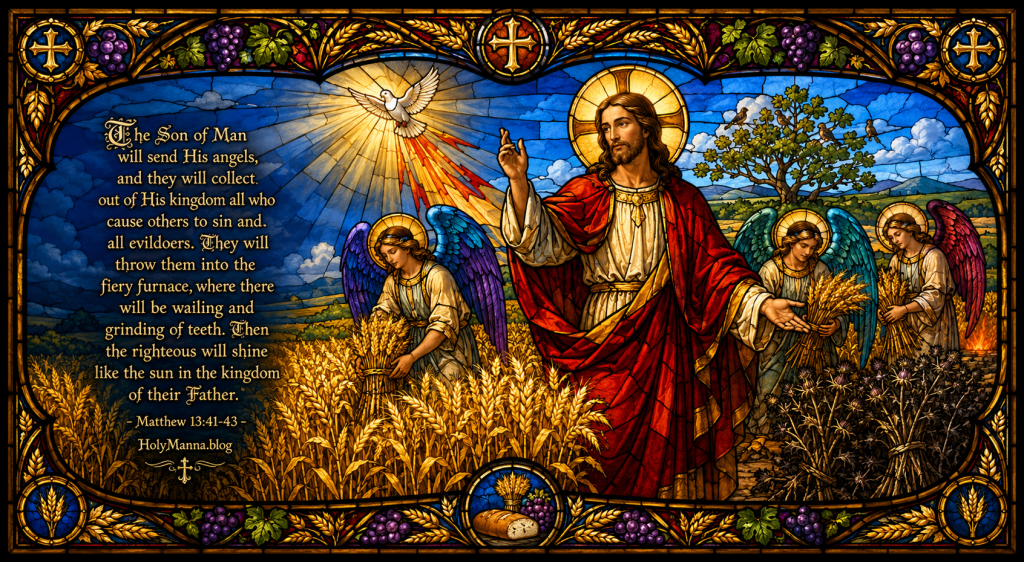
I will announce what has lain hidden from the foundation [of the world].”The Explanation of the Parable of the Weeds. 36 Then, dismissing the crowds, he went into the house. His disciples approached him and said, “Explain to us the parable of the weeds in the field.” 37 He said in reply, “He who sows good seed is the Son of Man, 38 the field is the world, the good seed the children of the kingdom. The weeds are the children of the evil one, 39 and the enemy who sows them is the devil. The harvest is the end of the age, and the harvesters are angels. 40 Just as weeds are collected and burned [up] with fire, so will it be at the end of the age. 41 The Son of Man will send his angels, and they will collect out of his kingdom all who cause others to sin and all evildoers. 42 They will throw them into the fiery furnace, where there will be wailing and grinding of teeth. 43 Then the righteous will shine like the sun in the kingdom of their Father. Whoever has ears ought to hear.
Detailed Exegesis
Verse 24: “The kingdom of heaven may be likened to a man who sowed good seed in his field.” The kingdom begins with a deliberate act of goodness. Everything God plants is good; evil will enter the story only as an intrusion.
Verse 25: “While everyone was asleep his enemy came and sowed weeds all through the wheat, and then went off.” Evil works in darkness and by imitation. The enemy sows nothing original, only a counterfeit of the wheat, and vigilance matters because sabotage happens while people sleep.
Verse 26: “When the crop grew and bore fruit, the weeds appeared as well.” Darnel is indistinguishable from wheat until fruit appears. Jesus teaches that authenticity is revealed by fruit, not by appearance.
Verse 27: “The slaves of the householder came to him and said, ‘Master, did you not sow good seed in your field? Where have the weeds come from?’” The servants voice humanity’s perennial protest: if God is good, why is there evil? The question itself is treated with dignity.
Verse 28: “He answered, ‘An enemy has done this.’ His slaves said to him, ‘Do you want us to go and pull them up?’” Evil comes from the enemy, not from God. The servants’ zeal to purge immediately feels righteous, yet it is about to be corrected.
Verse 29: “He replied, ‘No, if you pull up the weeds you might uproot the wheat along with them.’” The Master’s refusal protects the wheat. Human judgment cannot untangle roots it cannot see, and a premature purge would destroy the good.
Verse 30: “Let them grow together until harvest; then at harvest time I will say to the harvesters, ‘First collect the weeds and tie them in bundles for burning; but gather the wheat into my barn.’” Patience now, judgment later. Tolerance of evil is temporary and purposeful, and the separation, when it comes, will be exact.
Verse 31: “The kingdom of heaven is like a mustard seed that a person took and sowed in a field.” The kingdom’s beginnings are laughably small: one rabbi, twelve fishermen, one seed.
Verse 32: “It is the smallest of all the seeds, yet when full-grown it is the largest of plants. It becomes a large bush, and the ‘birds of the sky come and dwell in its branches.’” The birds nesting in branches echo the great tree of Daniel 4, an image of a kingdom sheltering all nations, fulfilling Psalm 86:9.
Verse 33: “The kingdom of heaven is like yeast that a woman took and mixed with three measures of wheat flour until the whole batch was leavened.” Three measures is roughly fifty pounds of flour, bread for a hundred people. Grace works hidden from sight, yet transforms the whole mass from within.
Verse 34: “All these things Jesus spoke to the crowds in parables. He spoke to them only in parables.” Parables both reveal and conceal, inviting the humble deeper while leaving the proud at the surface.
Verse 35: “I will open my mouth in parables, I will announce what has lain hidden from the foundation [of the world].” Matthew cites Psalm 78:2. In Jesus, secrets hidden since creation are finally spoken aloud.
Verse 36: “Then, dismissing the crowds, he went into the house. His disciples approached him and said, ‘Explain to us the parable of the weeds in the field.’” Understanding comes to those who follow Jesus inside and ask. Discipleship is the hermeneutic of the parables.
Verse 37: “He said in reply, ‘He who sows good seed is the Son of Man.’” Jesus identifies Himself as the sower, using the messianic title from Daniel 7.
Verse 38: “The field is the world, the good seed the children of the kingdom. The weeds are the children of the evil one.” The field is the world, though the Church has always seen here also an image of her own mixed condition until the end.
Verse 39: “The enemy who sows them is the devil. The harvest is the end of the age, and the harvesters are angels.” The devil is real and active, yet already defeated in the story’s structure; he can only imitate and wait.
Verse 40: “Just as weeds are collected and burned [up] with fire, so will it be at the end of the age.” Jesus affirms plainly that history has a terminus and evil has an expiration date.
Verse 41: “The Son of Man will send his angels, and they will collect out of his kingdom all who cause others to sin and all evildoers.” The judgment targets both scandal and sin. Nothing that wounds the little ones will survive the harvest.
Verse 42: “They will throw them into the fiery furnace, where there will be wailing and grinding of teeth.” Jesus, mercy incarnate, is also the most insistent preacher of hell in Scripture. The stakes of freedom are eternal.
Verse 43: “Then the righteous will shine like the sun in the kingdom of their Father. Whoever has ears ought to hear.” Echoing Daniel 12:3, Jesus promises transfiguration to the faithful. The final word of the parable is not fire but light.
Teachings
The Catechism reads this parable as a portrait of the Church herself. CCC 827 teaches: “In everyone, the weeds of sin will still be mixed with the good wheat of the Gospel until the end of time.” Scandal within the Church, painful as it is, does not falsify the Gospel; Jesus predicted it. Saint John Chrysostom, Doctor of the Church, drew a startling lesson from the Master’s restraint in his Homily 46 on Matthew, teaching that Christ forbade the uprooting to prevent violence, for “it is not right to put a heretic to death,” and because “of the very tares it is likely that many may change and become wheat.” Saint Augustine preached the same hope, telling his flock that many are at first weeds and later become wheat, and that if sinners “were not tolerated patiently, they would never reach the praiseworthy change in their life.” Augustine spoke from experience, since he had been darnel himself before grace made him a Doctor of the Church. Yet patience never cancels justice. CCC 1034 cites this very Gospel: Jesus solemnly proclaims that He “will send his angels, and they will gather . . . all evil doers, and throw them into the furnace of fire.” And CCC 546 reminds readers that parables demand a decision: “to gain the kingdom, one must give everything. Words are not enough; deeds are required.”
Reflection
The servants wanted to fix the field immediately, and honestly, most people share that instinct, especially online, where uprooting sinners has become a spectator sport. Jesus asks for something harder: the patience of the Master. Start with the field of your own heart, where wheat and weeds grow tangled together, and bring the weeds to Confession rather than pretending the field is clean. Then extend that patience outward. Choose one person you have quietly written off as a hopeless weed, a family member, a coworker, a public figure, and commit to praying for their conversion every day this week. Remember that the harvest belongs to the angels, not to you. Whom have you already condemned in your heart, forgetting that weeds can still become wheat? And where is God asking you to trust His timing instead of demanding an immediate purge?
Trusting the Master of the Harvest
Taken together, these readings tell a single story about the heart of God. The Book of Wisdom pulls back the curtain on His power and finds, astonishingly, leniency at its source. Psalm 86 teaches the only fitting response, the honest cry of a beggar to a God who is slow to anger and rich in mercy. Saint Paul goes further still, revealing that this merciful God does not wait at the far end of prayer but kneels within it, His own Spirit interceding with groanings too deep for words. And Jesus gathers everything into the field: good seed, sabotaged soil, servants itching to purge, and a Master whose patience is not indifference but strategy, because He is still hoping the weeds will change.
That hope has a name, and it is every person reading these words. Everyone has been darnel at some point, spared by a Master who refused to uproot too soon. The mustard seed and the yeast promise that His kingdom is growing even when it looks small, hidden, and outnumbered. The harvest promises that evil’s lease on the field will expire. Between now and then stretches the season of mercy, and mercy is meant to be spent.
So take these readings into the week ahead. Forgive someone from a position of strength. Pray Psalm 86 when words come easily, and lean on the Spirit when they do not. Refuse the temptation to appoint yourself a harvester. Go to Confession and let the Sower tend His field in you. The righteous, Jesus promises, “will shine like the sun in the kingdom of their Father.” Live now like someone destined for that light.
Engage With Us!
The conversation does not end here, and every reflection shared helps someone else grow in faith. Please share your thoughts in the comments below, whether these readings challenged you, comforted you, or raised new questions. Here are some questions to pray with this week:
- In Wisdom 12:13, 16-19, God’s mastery over all things makes Him lenient to all. Where in your life do you hold power over someone, and how might God be inviting you to exercise it with clemency instead of severity?
- Psalm 86:5-6, 9-10, 15-16 calls God good and forgiving, slow to anger, and abounding in mercy. Which of these attributes is hardest for you to believe applies to you personally, and why?
- In Romans 8:26-27, Saint Paul admits that no one knows how to pray as they ought. When has a season of wordless or struggling prayer turned out, in hindsight, to be the Spirit working within you?
- In Matthew 13:24-43, the Master forbids his servants from uprooting the weeds before the harvest. Whom have you been tempted to uproot from your life or condemn in your heart, and what would it look like to entrust that person to God’s patience instead?
- Across all of today’s readings, God reveals His almighty power through mercy and patience. How can you make your own strength, whatever form it takes, an instrument of that same mercy this week?
Faith is not a performance for the perfect; it is a field where God is patiently growing something beautiful in imperfect soil. Keep showing up, keep praying, keep forgiving, and do everything with the love and mercy Jesus taught us. The Master of the harvest is not finished with you yet.
Sacred Heart of Jesus, we trust in You!
Immaculate Heart of Mary, pray for us!
Saint Michael the Archangel, defend us in battle!
Follow us on YouTube, TikTok, Instagram and Facebook for more insights and reflections on living a faith-filled life.

 Holy Manna!
Leave a comment