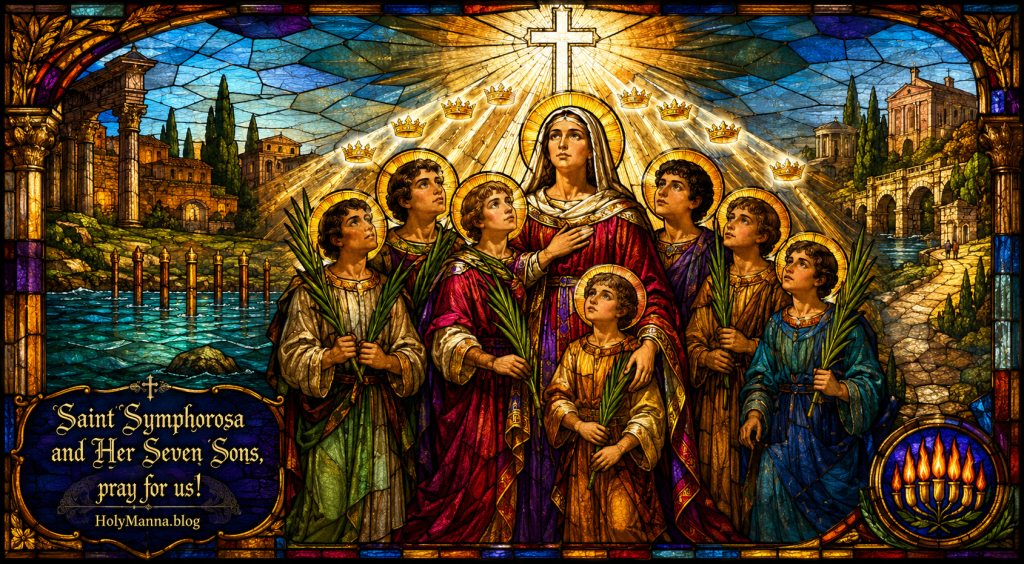
When a Widow’s Prayers Shook an Empire
Every July 18th, the Church remembers a family that Rome tried very hard to erase and completely failed to forget. Saint Symphorosa was a Christian widow living in the town of Tibur, known today as Tivoli, just outside Rome. Around the year 138, during the reign of Emperor Hadrian, she and her seven sons, Crescens, Julian, Nemesius, Primitivus, Justin, Stacteus, and Eugenius, were put to death for refusing to sacrifice to the Roman gods. Eight members of one family gave their lives within two days of each other rather than deny Jesus Christ, and the early Church treasured their memory so deeply that their tomb on the Via Tiburtina became one of the oldest confirmed martyr shrines near Rome.
Symphorosa and her sons hold a documented patronage: the Diocese of Tivoli honors them as its patron saints, and the city has venerated this family for nearly nineteen centuries. Their names appear in The Roman Martyrology on July 18th, where the Church’s official record states in part, “At Tivoli, the holy martyrs Symphorosa, widow of the martyr Getulius, and her seven sons… Symphorosa was first most cruelly tormented for the Faith and finally thrown into the river with a great stone tied to her neck.”
Why does the Church treasure a story this old and this painful? Because martyrdom is not a tragedy in the eyes of faith; it is a testimony. The Catechism teaches that “Martyrdom is the supreme witness given to the truth of the faith: it means bearing witness even unto death” (CCC 2473). Symphorosa’s witness is doubled, because she bore it not only in her own body but as a mother who had raised seven sons to love Christ more than life itself. In an age when many parents wonder whether faith can survive a hostile culture, this second century widow has something urgent to say.
A Household Built on the Blood of a Martyr
Everything known about Symphorosa’s life comes through an ancient account of her martyrdom, a text known as the Acts or Passio of Saint Symphorosa. It is important to be honest from the start: modern Catholic scholars, including the Bollandists who study the lives of the saints, have serious questions about how much of this account is documented history and how much is later devotional storytelling. The Church herself acknowledged this when the feast was removed from the General Roman Calendar in 1969, precisely because the details in the Acts could not be trusted as history, even though the martyrs themselves remain in The Roman Martyrology and their cult remains legitimate and ancient. So this post will do what the Church does: honor what is certain, and tell the rest as the tradition hands it down, clearly labeled.
According to the Acts, Symphorosa was a matron of Tibur, a Roman town famous for its waterfalls, its temples, and eventually for the magnificent country villa that Hadrian built there. She was the widow of Getulius, a man from Gabii in the Sabine country who had served as a tribune in the Roman army. The tradition holds that when Getulius was baptized a Christian, he resigned his military commission and retired to his estate near Tivoli, where his brother Amantius, also a tribune and also a Christian, joined him. Under Hadrian, both brothers were arrested and beheaded for the faith, and the tradition places their martyrdom at Gabii. The Church commemorates Saint Getulius separately on June 10th. Symphorosa, now a widow, buried her husband’s remains on the family estate with her own hands.
Stop and picture that household. A mother who had already given her husband to Christ was now raising seven boys alone, in a town where the emperor himself was building his pleasure palace, in an empire where the price of their faith had already been paid in family blood. She did not flee to obscurity or quietly blend in. The tradition presents her as a woman of constant prayer whose whole house was ordered toward God. This is exactly what The Catechism means when it calls the Christian family the domestic church, teaching that “the family home is rightly called ‘the domestic church,’ a community of grace and prayer, a school of human virtues and of Christian charity” (CCC 1666). Symphorosa’s home was a school of martyrs, and she was its teacher.
The Domestic Church That Troubled the Gods of Rome
There are no miracles attributed to Symphorosa during her lifetime; the sources record none, and none will be invented here. What the tradition records instead is something arguably more startling: her prayers were felt as an assault by the powers of paganism itself.
The Acts recount that when Hadrian completed his costly palace at Tibur and began to dedicate it with pagan sacrifices, seeking oracles from the idols, the demons who spoke through those idols gave him this answer: “The widow Symphorosa and her sons torment us daily by invoking their God. If she therefore, together with her sons, shall offer sacrifice, we promise to make good all that you ask.” This episode comes from the disputed Acts and cannot be verified as history. But notice what the early Christians who told this story believed: that the hidden prayer of one faithful widow and her children was more disruptive to the spiritual empire of idolatry than any army. The story is a dramatization of a truth the Church has always taught, that “Idolatry consists in divinizing what is not God” (CCC 2113), and that the simple, stubborn worship of the true God unmasks every false one.
Why should you remember Symphorosa and want to emulate her? Because her greatness was built almost entirely out of hidden, ordinary faithfulness. She was not a bishop, a theologian, or a public figure. She was a widowed mother who prayed daily with her children and refused to let grief or fear pull her family away from Christ. The Catechism teaches that parents “have the mission of teaching their children to pray and to discover their vocation as children of God” (CCC 2226), and that through the grace of the sacrament of marriage, parents receive the responsibility and privilege of being the first heralds of the faith to their children (CCC 2225). Symphorosa fulfilled that mission so completely that when the trial came, not one of her seven sons broke. That kind of fruit does not grow overnight. It grows from years of family prayer, from a mother who talked about her martyred husband not with bitterness but with holy pride, and from a home where Christ was the unquestioned center.
The Church has always seen in this family a living echo of the Scriptures. Catholic tradition explicitly connects Symphorosa with the heroic mother of 2 Maccabees 7, who watched her seven sons die under King Antiochus rather than violate God’s law, and who encouraged them with words like these: “I do not know how you came into being in my womb. It was not I who gave you life and breath, nor I who set in order the elements within each of you” (2 Maccabees 7:22). That mother trusted that the God who knits life together in the womb could restore it in the resurrection. Symphorosa, living on the other side of Easter, had even more reason to trust.
Seven Stakes Around the Temple of Hercules
What follows is the account of the martyrdom as the ancient Acts hand it down. The reader should know that scholars question the reliability of this text, and some believe it was modeled on the Passio of Saint Felicitas of Rome, another mother martyred with seven sons. The narrative cannot be verified as history in its details, and it is told here as the Church’s ancient tradition rather than as documented fact. What is not in doubt is the existence of the cult, the tomb, and the Church’s constant veneration of these martyrs.
According to the Acts, Hadrian ordered Symphorosa and her sons seized and at first tried courtesy, urging them to sacrifice to the idols. Symphorosa’s answer, as the Acts record it, invoked the memory of her husband: “My husband Getulius, together with his brother Amantius, when they were tribunes in thy service, suffered different punishments for the name of Christ, rather than consent to sacrifice to idols, and, like good athletes, they overcame thy demons.” She was telling the most powerful man on earth that her family had already counted this cost and found Christ worth it.
Hadrian then threatened her directly, saying that either she would sacrifice with her sons or be sacrificed herself. Her reply, in the words the Acts attribute to her, may be the most breathtaking sentence in the whole account: “And whence is this great good to me, that I should be deemed worthy along with my sons to be offered as an oblation to God?” Where the emperor saw a threat, she saw an honor. When he pressed further, she answered, “Thy gods cannot take me in sacrifice; but if I am burned for the name of Christ, my God, I shall rather consume thy demons.” These words come from the disputed Acts and cannot be independently verified, but they perfectly express the spirit the Church has always attributed to her.
The Acts then recount that Symphorosa was taken to the Temple of Hercules, subjected to various tortures, and finally thrown into the river Anio with a heavy stone fastened to her neck. Her brother Eugenius, a member of the town council of Tibur, recovered her body and buried her on the outskirts of the city. The next day, the emperor summoned her seven sons. When they too refused to sacrifice, he ordered seven stakes erected around the Temple of Hercules and had the brothers bound to them. The Acts describe each son receiving a different fatal wound: Crescens was pierced through the throat, Julian through the breast, Nemesius through the heart, Primitivus at the navel, Justin through the back, Stacteus at the side, and Eugenius, the youngest, was cleft in two. Their bodies were thrown together into a deep ditch, at a spot the pagan priests afterward mockingly named Ad septem Biothanatos, using a Greek term the pagans applied to Christians who suffered martyrdom. The Acts add that the persecution then ceased for a year and six months, during which the Christian community recovered the bodies and buried them with honor on the Via Tiburtina, eight or nine miles from Rome. Again, these dramatic details rest on a text whose reliability is questioned, and this story cannot be verified.
One discrepancy deserves honest mention. The Hieronymian Martyrology, compiled in the second half of the fifth century, commemorates Symphorosa and her sons on July 18th but gives entirely different names for the sons, while listing seven brother martyrs with the familiar names on June 27th. Scholars suggest the traditional names may have been borrowed from that other group. The Church flags this uncertainty rather than hiding it, and so does this post. What no serious scholar doubts is that a woman named Symphorosa and a group of martyrs connected with her were venerated at that tomb from Christian antiquity.
Whatever the precise details, the substance of the witness stands within the Church’s living memory, and it is the substance that matters. Jesus told His disciples, “And do not fear those who kill the body but cannot kill the soul; rather fear him who can destroy both soul and body in hell” (The Gospel of Matthew, Mt 10:28). Symphorosa and her sons took Him at His word.
A Tomb the Centuries Could Not Hide
There are no verified miracles attributed to Symphorosa and her sons after death; the sources record veneration rather than documented healings, and none will be fabricated here. Yet what history does record is remarkable in its own right, because it is written in stone.
For centuries, a spot on the Via Tiburtina about nine miles from Rome carried the popular name le sette fratte, understood as a corruption of words meaning the seven brothers. In the seventeenth century, the pioneering archaeologist Antonio Bosio discovered the ruins of a basilica at that very place. Both the ancient Acts and The Hieronymian Martyrology, two independent witnesses, point to this spot as the tomb of Symphorosa and her sons. In the nineteenth century, further excavations by the scholar Enrico Stevenson confirmed beyond reasonable doubt that the basilica had been built over their tomb. Think about what that means: the most dramatic parts of the story may be uncertain, but the grave is real, the basilica is real, and the veneration is as old as the Church in that region.
The story of the relics continues in Rome itself. In the year 752, Pope Stephen II had the remains transferred from the Via Tiburtina to the Church of Sant’Angelo in Pescheria, near the ancient fish market in the heart of Rome. There, in 1610, a sarcophagus was discovered bearing a Latin inscription recording that within it rested the bodies of the holy martyrs Symphorosa, her husband, and her sons, transferred by Pope Stephen. Curiously, the inscription names her husband Zoticus rather than Getulius, and at least one ancient manuscript of the Acts does the same; this naming discrepancy is noted honestly in Catholic scholarship and is flagged here as an unresolved puzzle rather than smoothed over.
The cultural impact of this family has been strongest in Tivoli, where they are honored as patrons of the diocese and where their feast has been kept on July 18th for centuries. Although the feast was removed from the universal General Roman Calendar in 1969 because the Acts were judged historically untrustworthy, the martyrs were never removed from The Roman Martyrology, and their veneration remains fully approved. This distinction is worth understanding, because it shows how carefully the Church handles history. She does not need embellished stories to honor her martyrs, and she is not afraid to admit when a beloved narrative has weak documentation.
Why does the Church keep records like this at all? The Catechism explains that “the Church has painstakingly collected the records of those who persevered to the end in witnessing to their faith. These are the acts of the Martyrs. They form the archives of truth written in letters of blood” (CCC 2474). And why do Catholics venerate martyrs’ tombs and relics in the first place? Because the Church has done so from her earliest days, as The Catechism shows by quoting the second century account of Saint Polycarp’s martyrdom: “We worship Christ as God’s Son; we love the martyrs as the Lord’s disciples and imitators, and rightly so because of their matchless devotion towards their king and master. May we also be their companions and fellow disciples!” (CCC 957). The basilica on the Via Tiburtina was an early chapter in that unbroken story.
Raising Saints in a Hostile World
It is tempting to file Symphorosa’s story under ancient history, something noble but remote. Resist that temptation, because her situation is closer to yours than it first appears. She lived as a serious Christian in a culture that found her faith strange at best and threatening at worst. She raised children in the shadow of an empire whose entertainment, politics, and religion all pulled in the opposite direction of the Gospel. She had suffered a devastating loss and could have used it as a reason to quietly compromise. Instead, she doubled down on prayer, on teaching her children, and on trusting God with the outcome.
Most Christians today will never face an emperor’s tribunal, but every Christian faces the daily choice between comfortable compromise and costly fidelity. The Catechism teaches that “Fortitude is the moral virtue that ensures firmness in difficulties and constancy in the pursuit of the good” and that it “enables one to conquer fear, even fear of death, and to face trials and persecutions” (CCC 1808). Fortitude is not a personality trait reserved for heroes; it is a virtue, which means it grows through practice, through small daily acts of courage long before any great trial arrives. Symphorosa’s sons did not become brave at the stakes. They became brave at the family dinner table, in years of watching their mother pray, in hearing the story of their father told as a victory rather than a defeat.
Consider some practical ways to weave her lessons into daily life. Make prayer a fixed, visible part of the home rather than a private afterthought, because children learn the faith first by breathing it. Speak of the faith positively and courageously in front of others, even when it would be easier to stay silent, because small confessions of Christ train the soul for larger ones. When suffering or loss enters life, bring it consciously to God as Symphorosa did, letting grief become an offering instead of a wound that festers. And take seriously the Church’s teaching that the family is a true domestic church in which “the father of the family, the mother, children, and all members of the family exercise the priesthood of the baptized in a privileged way” (CCC 1657), by prayer, by witness, and by love that is willing to sacrifice.
Now let Symphorosa’s questions become yours. If the practice of your faith suddenly carried a real social or professional cost, what in your daily life would already have prepared you to stand firm? What are you doing, concretely and consistently, to hand on the faith to the people God has entrusted to you? Where is God inviting you to see a hardship in your life not as a curse but as an offering you can place in His hands?
Engage With Us!
Saint Symphorosa’s story has been challenging hearts for almost nineteen hundred years, and now it is your turn to sit with it. Share your thoughts and reflections in the comments below; your experience of trying to live the faith courageously might be exactly the encouragement another reader needs today. Here are some questions to help you reflect and start the conversation.
- Symphorosa saw martyrdom not as a loss but as being “deemed worthy” to be offered to God. How does her attitude challenge the way you view the sacrifices your faith asks of you?
- Her seven sons stood firm because their home was a school of prayer and courage. What is one concrete habit you could begin this week to make your own home more of a domestic church?
- The Church honestly admits which parts of this story are uncertain while still honoring the martyrs. How does that honesty strengthen, rather than weaken, your confidence in the Church?
- Symphorosa carried the grief of losing her husband and turned it into deeper trust in God. Is there a grief or hardship in your life that God may be inviting you to offer back to Him?
- Fortitude grows through small daily acts of courage. Where in your ordinary week is God giving you a chance to practice being brave for Him?
Take heart from this mother and her sons. The same Holy Spirit who steadied them beside the Anio River lives in you through your baptism, and He is more than enough for whatever trials this week holds. Live your faith boldly, love the people around you generously, and do everything with the love and mercy that Jesus taught us. HolyManna.blog will be here tomorrow with another story of grace; until then, may Saint Symphorosa and her seven sons pray for us all.
Saint Symphorosa and Her Seven Sons, pray for us!
Follow us on YouTube, TikTok, Instagram and Facebook for more insights and reflections on living a faith-filled life.


Leave a Reply