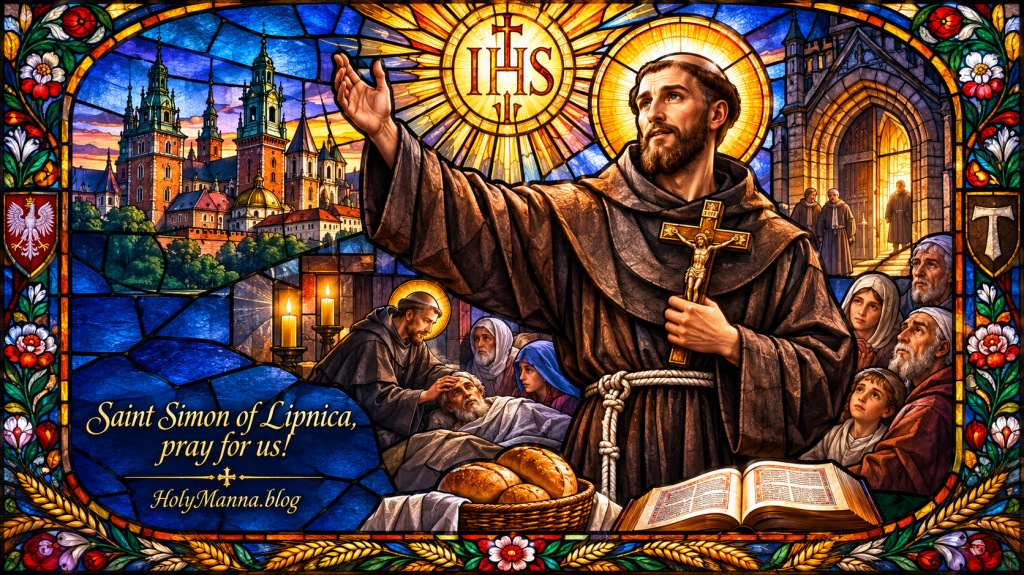
The Baker’s Son Who Ran Toward the Plague
Some saints are famous for what they built, and some for what they wrote. Saint Simon of Lipnica is remembered for something simpler and far harder: when everyone with sense was fleeing a dying city, he walked deeper into it. Simon was a fifteenth-century Polish Franciscan of the Observant reform, the branch of the Friars Minor that Poles affectionately called the Bernardines after their patron, Saint Bernardine of Siena. In his own lifetime he was the most sought-after preacher in Kraków, the first Friar Minor ever entrusted with the pulpit of Wawel Cathedral, the church of Poland’s kings. The old sources gave him a Latin title that says everything, predicator ferventissimus, the most fervent of preachers. Yet the moment that sealed his sanctity came not in a pulpit but in the plague-ridden streets of Kraków in the summer of 1482, where he comforted the sick, carried the sacraments to the dying, and finally caught the disease himself, dying on July 18, 1482, with his eyes fixed on a crucifix.
The Church waited a long time to crown him. Blessed Innocent XI confirmed his ancient and uninterrupted cult in 1685, and Pope Benedict XVI canonized him in Saint Peter’s Square on Trinity Sunday, June 3, 2007, after the recognition of a miraculous cure in Kraków in 1943. When the Church canonizes a saint, she does something precise: The Catechism teaches that by canonizing certain of the faithful, the Church recognizes the power of the Spirit of holiness within her and sustains the hope of believers by giving them models and intercessors (CCC 828). Simon holds real patronages to this day. He is honored as one of the patrons of the city of Kraków, a patron of students, and a patron of expectant mothers, especially women facing difficult pregnancies and deliveries. A preacher for the university crowd and a protector of mothers in danger: that is a combination worth getting to know.
A Baker’s Son with a Scholar’s Mind
Simon was born in Lipnica Murowana, a small walled town in southern Poland about sixty kilometers from Kraków, sometime between 1435 and 1440. The exact year is unknown, and honest Catholic sources simply give the range. His parents, Gregory and Anne, were people of modest means who nonetheless made two decisions that shaped everything. First, they raised their son in a home saturated with the Christian faith. Second, when they saw his unusual gift for learning, they sacrificed to send him away for a real education. A cherished local tradition in Lipnica holds that Gregory and Anne were bakers who had hoped Simon would take up the family trade, and that they let the ovens go to another heir so their son could go to the books. That detail comes from the town’s own memory of its saint rather than from contemporary documents, so it is best received as a beloved tradition; it cannot be verified. Another tender story from Lipnica says that as a boy Simon would speak with the saints depicted in the little wooden church of Saint Leonard, as naturally as a child speaks with friends. That story cannot be verified either, and it should be told as a story, but it captures how his neighbors remembered him: a boy for whom heaven was not far away.
In 1454 Simon enrolled in the faculty of liberal arts at the Kraków Academy, the great university known today as the Jagiellonian. He arrived at a providential hour. Just one year earlier, on September 8, 1453, the aged Italian friar Saint John of Capistrano had founded the first convent of the Franciscan Observance in Poland, dedicating it to the newly canonized Saint Bernardine of Siena in the Stradom quarter at the foot of Wawel hill. Capistrano preached in the market square of Kraków with such holiness and fire that the whole city was shaken, and a flood of gifted young men, many of them university students, asked for the habit of Saint Francis. Because their church bore Bernardine’s name, the people of Poland called these Observant friars the Bernardines, a name the province carries to this day.
Simon completed his degree, earning the title of bachelor in 1457. A young graduate of the Kraków Academy in that era had bright prospects; the paths of medicine, theology, and comfortable advancement lay open. The official Vatican biography prepared for his canonization frames his choice in the language of The Gospel of Matthew: fascinated by the Franciscan ideal, Simon chose to acquire the pearl of great price and set aside a promising and prosperous future. Our Lord had said, “the kingdom of heaven is like a merchant in search of fine pearls, who, on finding one pearl of great value, went and sold all that he had and bought it” (Mt 13:45-46). In 1457 Simon and ten fellow students knocked together at the door of the Stradom convent. He was formed in the novitiate by Brother Christopher of Varese, a friar renowned for both learning and holiness, made his religious vows in 1458, and was ordained a priest around the year 1460, with some Polish sources placing the ordination as late as 1462. What is certain is that by his mid-twenties, the baker’s son from Lipnica was a Franciscan priest.
The Most Fervent Preacher in Poland
Simon’s first assignment took him to Tarnów, where he served as Guardian, the superior of the friary. He then returned to Stradom in Kraków, and there his true vocation within the vocation caught fire. He gave himself to preaching without reserve. The sources describe a word that was clear, ardent, and wise, the fruit of long hours over Sacred Scripture and of a soul visibly united to God. His preaching model was Saint Bernardine of Siena, and like Bernardine and Capistrano before him, Simon made the Holy Name of Jesus the burning center of his message. He held the Name before sinners until they melted, and the old accounts say the conversions were innumerable. The town chronicle tradition of Lipnica preserved the memory that no sinner was so hardened as to leave his sermons without a resolution to change.
This devotion to the Holy Name was not a stylistic quirk. It was theology preached at white heat. The Catechism teaches that the name Jesus means that the very name of God is present in the person of his Son, and that it is the divine name that alone brings salvation (CCC 432). It teaches further that the name of Jesus is at the heart of all Christian prayer and that his name is the only one that contains the presence it signifies (CCC 435, CCC 2666). Saint Paul had written, “God has highly exalted him and bestowed on him the name which is above every name” (Phil 2:9). Simon spent his priesthood making fifteenth-century Poland kneel at that Name.
The Church of Kraków noticed. In 1463 Simon was appointed preacher at Wawel Cathedral, the royal church of Poland, the first member of the Friars Minor ever to hold that office. Imagine the scene: the son of small-town tradespeople, wearing a patched grey-brown habit and a cord, standing in the most prestigious pulpit in the kingdom, preaching to courtiers and canons with the same directness he used with market crowds. It was in this period that he earned the title predicator ferventissimus. Fervor, not eloquence for its own sake, was his signature.
His love for his Franciscan inspiration ran deep enough to cross a continent. In 1472 Simon and several Polish confreres traveled to L’Aquila in Italy for the solemn transfer of the body of Saint Bernardine of Siena to the new church built in the saint’s honor on May 17 of that year. He returned to Italy in 1478 for the General Chapter of the order in Pavia, and from there fulfilled two great desires of his heart: he prayed at the tombs of the Apostles Peter and Paul in Rome, and he continued on pilgrimage to the Holy Land itself. The Vatican biography records a detail from that journey that reveals the man. Knowing that pilgrims to the Holy Land risked capture, Simon memorized the entire Rule of Saint Francis before setting out, so that even if every book were taken from him, the Rule would remain before the eyes of his mind. The same biography notes that he traveled in a spirit of penance, with a hidden hope of shedding his blood for the salvation of souls if God should will it. God did not will a martyr’s death for Simon in the Holy Land. God was preparing something quieter and, in its own way, just as complete.
As for miracles during his lifetime, the honest record is striking in its restraint. The official sources attribute no spectacular wonders to the living Simon. His contemporaries pointed instead to the daily marvel of his preaching, the conversion of hardened sinners, which the Church has always counted among the greatest works of grace. His brothers also remembered the texture of his hidden life: severe with himself, tender with others, profoundly devoted to the Blessed Sacrament, to the Mother of God, and to the Holy Name. In an age that loved the sensational, Simon’s holiness was built of ordinary materials pushed to heroic intensity.
Six Days to Heaven
Simon was never martyred, and no Catholic source claims he was. His hardships were of a different kind, and the final one gave him to God. In July 1482 an epidemic erupted in Kraków and raged until January 6, 1483. The Vatican’s canonization biography and Pope Benedict XVI both call it the plague, while some Polish sources connected with Lipnica describe the epidemic as cholera; the discrepancy exists in the record and deserves to be named rather than smoothed over. Whatever the disease was, its effect was the same. The city became a place of terror. Those who could flee, fled.
The Bernardine friars of Stradom stayed. The Vatican biography records that they exhausted themselves caring for the sick like consoling angels, and that Simon regarded the outbreak not as a catastrophe to survive but as a favorable hour to exercise charity and to make the offering of his own life. He went everywhere. He comforted the frightened, brought food and help to the suffering, heard confessions, anointed the dying, and preached the consoling Word of God at bedsides where no one else would stand. Every step of it was voluntary. Every step of it was informed; a man of his intelligence knew exactly what repeated contact with the infected meant.
He was soon infected himself. The sources say he bore the pain of the disease with extraordinary patience, and near the end he made one last request that distills his whole soul: he asked to be buried beneath the threshold of the church, so that everyone entering would walk over him. The friar who had held the most famous pulpit in Poland wanted to end as a doorstep. On the sixth day of his illness, July 18, 1482, without fear and with his eyes fixed on the crucifix, Simon gave his soul back to God. He was in his mid-forties.
The Church does not call this martyrdom, which The Catechism defines as the supreme witness of bearing witness even unto death to the truth of the faith (CCC 2473). She calls it something that sits very close beside it: charity unto death. Our Lord himself set the measure when he said, “Greater love has no man than this, that a man lay down his life for his friends” (Jn 15:13), and he identified himself forever with the suffering when he taught, “I was sick and you visited me” (Mt 25:36). The Catechism teaches that the works of mercy are charitable actions by which we come to the aid of our neighbor in his bodily and spiritual necessities, and that instructing, consoling, and comforting are spiritual works of mercy just as visiting the sick is a corporal one (CCC 2447). It also teaches that Christ’s compassion toward the sick and his many healings are a resplendent sign that God has visited his people (CCC 1503). Simon performed the corporal and spiritual works of mercy simultaneously, in the same rooms, at the cost of his life. At the canonization Mass in 2007, Pope Benedict XVI drew out exactly this point, preaching that Simon, “filled with the mercy he drew from the Eucharist, did not hesitate to help the sick” who had been struck by the epidemic, contracting the disease that led to his death. The Eucharist was the engine; the plague ward was the road.
Three Hundred Seventy Graces and a Cure in Wartime
Simon’s brothers buried him, as the Church’s memory holds, in the crypt beneath the altar of the church of Saint Bernardine at Stradom, and the people of Kraków began coming almost at once. The friars kept records, and those records grew to more than 370 reported recoveries and graces attributed to Simon’s intercession in the years after his death, as the sanctuary of the saint in Lipnica recounts. These favors were recorded by the friars in good faith, but as individual events most of them cannot be verified today, and they are handed on here as the recorded testimony of that community rather than as adjudicated facts. One vivid practice appears in the old texts: the Bernardines of Stradom would visit the suffering carrying Simon’s cloak and belt, and accounts describe sick people healed upon touching these relics. Those accounts likewise come from devotional records and cannot be independently verified, and they are shared here as the tradition preserves them.
The devotion never died out, which matters enormously in the history of his cause. On February 24, 1685, Blessed Pope Innocent XI confirmed the immemorial cult of Simon of Lipnica, the act by which he is counted among the beatified. The old title attached to his memory in Franciscan history is a beautiful one, Salutis omnium sitibundus, which may be rendered as one who thirsted for the salvation of all. Efforts toward canonization were made as early as the eighteenth century, but the cause in its modern form was taken up by Pope Pius XII on June 25, 1948.
Then came the miracle that carried the cause home, and its timing is remarkable. In 1943, in the middle of the Nazi occupation of Poland, a Kraków pharmacist named Maria Piątek, originally from Lipnica itself, lay paralyzed and unable to speak after a cerebral attack. Her cure, attributed to the intercession of Blessed Simon, was the case examined by the Congregation for the Causes of Saints. The medical board gave its judgment in 2005, the theologians in 2006, and Pope Benedict XVI promulgated the decree recognizing the miracle on December 16, 2006, having already recognized Simon’s heroic virtues on December 19, 2005. On Trinity Sunday, June 3, 2007, in Saint Peter’s Square, Benedict XVI canonized Simon of Lipnica together with George Preca, Charles of Saint Andrew Houben, and Marie Eugenie of Jesus Milleret, presenting the Polish friar to the universal Church as a timely model of Gospel charity and entrusting to his protection all who suffer poverty, illness, loneliness, and injustice. This is the communion of saints in action: The Catechism teaches that the saints in heaven do not cease to intercede with the Father for us, and that their fraternal concern is a great help to our weakness (CCC 956), and that we venerate their memory not only for their example but so that the union of the whole Church in the Spirit may be strengthened (CCC 957).
The saint’s presence in Poland today is warm and concrete. His relics rest in the Bernardine church on Stradom Street in Kraków, in the shadow of Wawel, and the saint’s thumb is kept in his own chapel there. In April 2007, ahead of the canonization, his tomb was opened for the first time in half a century and 120 small capsules of relics were prepared for churches that venerate him; his cult is celebrated in more than one hundred places, in Poland and beyond. His birthplace, Lipnica Murowana, keeps his feast with particular joy. Pilgrims come to the sanctuary of Saint Simon, and on July 18th the faithful receive the little bread rolls of Saint Simon, a custom recalling the bread he once gave away to the poor of his hometown, a fitting emblem for a baker’s son who became bread for others. Since 1990 the annual church fair in Lipnica has even included a festival of religious song, with a figurine of the saint as its prize. In sacred art Simon is usually shown as a Franciscan giving bread to a poor man, or celebrating Mass surrounded by the dying, the two images his people could never forget.
What a 15th Century Friar Says to a 21st Century Heart
It would be easy to admire Simon from a safe distance, the way one admires a stained-glass window. It is more useful to let him ask questions. Simon’s life turns on a handful of decisions that have exact equivalents in modern life, and none of them required living in the fifteenth century.
He chose formation over comfort. A degree from the Kraków Academy was a ticket upward, and he traded it for a rough habit and a cord because he had encountered something worth everything. The Catechism teaches that all Christians in any state of life are called to the fullness of Christian life and to the perfection of charity (CCC 2013). Holiness was never meant to be a specialty for professionals. What is the pearl of great price in your life right now, and what are you still refusing to sell in order to buy it?
He put the Name of Jesus at the center. Simon’s whole public ministry was one long act of making people say, love, and trust that Name. The invocation of the holy name of Jesus is the simplest way of praying always, as The Catechism teaches (CCC 2668), a prayer possible in traffic, in a hospital waiting room, or at a kitchen sink at midnight. When your mind goes quiet, what name rises first?
He served when service was expensive. Anyone can be generous when generosity costs nothing. Simon called a plague a favorable hour, because it was finally possible to love at full price. Most people will never face an epidemic ward, but every family, parish, and workplace contains its own quietly contagious suffering: the relative with dementia whom no one visits, the coworker in grief whom everyone avoids, the friend whose illness has outlasted everyone’s patience. The works of mercy listed in The Catechism, feeding, sheltering, visiting, consoling, forgiving, and bearing wrongs patiently (CCC 2447), remain the family business of every baptized person. Who in your life is sick, lonely, or frightened, and what would it cost you to walk toward them this week instead of away?
He wanted to be a threshold. Simon’s request to be buried under the church doorway so that all could walk over him is the opposite of a personal brand. It is the logic of The Gospel of John: “He must increase, but I must decrease” (Jn 3:30). Where in your life are you still fighting to be the monument, when God is inviting you to be the doorway?
Engage With Us!
Saint Simon of Lipnica went from a baker’s oven to a royal pulpit to a plague ward, and every step was the same step: closer to Jesus and closer to the people Jesus loves. Share your thoughts and reflections in the comments below; this community grows when readers bring their own stories of faith to the table. Here are some questions to spark that conversation.
- Simon left a promising career after hearing one holy preacher. Who has God placed in your life whose example is quietly calling you higher, and how will you respond?
- Devotion to the Holy Name of Jesus transformed Simon’s listeners. What would change in your week if you began repeating the name of Jesus in the empty moments of your day?
- Simon called the plague a favorable hour for charity. What difficult circumstance in your life right now might actually be an invitation to heroic love?
- He asked to be buried under the threshold so others could walk over him. What act of hidden, unrecognized service could you offer this week that no one will ever applaud?
- Simon is a patron of students and of mothers in difficult pregnancies. Is there a student or an expectant mother you could pray for, by name, through his intercession today?
Sanctity did not require Simon to be anyone other than a baker’s son who said yes, completely, to the love of God. The same yes is available today, in an office, a classroom, a nursery, or a hospital corridor. Live this day with the love and mercy that Jesus taught us, and let Saint Simon of Lipnica show the way: preach with a life on fire, serve at full price, and be a threshold through which others walk toward Christ.
Saint Simon of Lipnica, pray for us!
Follow us on YouTube, TikTok, Instagram and Facebook for more insights and reflections on living a faith-filled life.


Leave a Reply