Saturday of the Fifteenth Week in Ordinary Time – Lectionary: 394
When the Powerful Plot and Heaven Answers Softly
Everyone has wondered, at least once, why God seems silent while the ruthless win. The readings for Saturday of the Fifteenth Week in Ordinary Time take that raw, honest question and refuse to look away from it. In the First Reading, the prophet Micah, a small-town contemporary of Isaiah in eighth-century Judah, pronounces a funeral dirge over wealthy land-grabbers who lie awake at night designing ways to seize the fields and houses of ordinary families. The Responsorial Psalm then hands the microphone to the victims, and Psalm 10 gives the poor the boldest prayer in the Psalter: Why, Lord, do you stand afar? And then the Gospel answers. The Pharisees plot to kill Jesus, the newest scheme of the powerful against the innocent, and Jesus responds in the strangest way imaginable. He withdraws, He heals everyone who follows Him, and He asks for silence. Matthew explains this hush with the longest Old Testament quotation in his entire Gospel, the Servant Song of Isaiah 42: “A bruised reed he will not break, a smoldering wick he will not quench, until he brings justice to victory.”
The central theme uniting these readings is this: the God who sees every scheme of the powerful answers the cry of the poor, not with noise, but with the gentle, unstoppable justice of His Chosen Servant. Divine justice is real, patient, and tender toward the broken. It moves quietly, and it always wins. These readings invite every reader to decide which side of that story they are living on today.
First Reading — Micah 2:1-5
The Sin Planned in Bed and the Judgment Planned in Heaven
Micah came from Moresheth, a farming village in the lowlands of Judah, and he prophesied during the reigns of Jotham, Ahaz, and Hezekiah, in the second half of the eighth century before Christ. Judah was enjoying an economic boom, and as so often happens, the boom enriched a small class of elites at the expense of small farmers. Wealthy men were absorbing family lands into vast estates, exactly the abuse Isaiah condemned when he cried woe to those who join house to house and field to field in Isaiah 5:8. In Israel, this was not merely an economic offense. Land was covenant inheritance, allotted by God to each tribe and family, protected by the Law in Leviticus 25 so that no Israelite family could be permanently dispossessed. To seize a man’s field was to rob him of his place in God’s promise. Micah, the villager, stood up in the capital and pronounced a funeral dirge over the powerful, and this reading anchors the day’s theme: God sees the schemes carried out against the weak.
Micah 2:1-5 – New American Bible (Revised Edition)
1 Ah! you plotters of iniquity,
who work out evil on your beds!
In the morning light you carry it out
for it lies within your power.
2 You covet fields, and seize them;
houses, and take them;
You cheat owners of their houses,
people of their inheritance.3 Therefore thus says the Lord:
Look, I am planning against this family an evil
from which you cannot free your necks;
Nor shall you walk with head held high,
for it will be an evil time.
4 On that day you shall be mocked,
and there will be bitter lament:
“Our ruin is complete,
our fields are divided among our captors,
The fields of my people are measured out,
and no one can get them back!”
5 Thus you shall have no one
in the assembly of the Lord
to allot to you a share of land.
Detailed Exegesis
Verse 1: “Ah! you plotters of iniquity, who work out evil on your beds! In the morning light you carry it out for it lies within your power.” The Hebrew opens with a “woe,” the cry mourners raised over the dead, so Micah is effectively conducting a funeral for men who are still alive. Their sin is premeditated. They do not stumble into evil; they design it at night and execute it at dawn. The chilling phrase is the last one: they do it because they can. Power without conscience becomes its own permission.
Verse 2: “You covet fields, and seize them; houses, and take them; You cheat owners of their houses, people of their inheritance.” The sin begins with coveting, the disordered desire condemned by the tenth commandment, and matures into theft, condemned by the seventh. Micah traces the anatomy of injustice: first the heart wants, then the hand takes. The word “inheritance” is the theological center, because these fields were portions of the Promised Land itself, echoes of the crime of Ahab against Naboth in 1 Kings 21.
Verse 3: “Therefore thus says the Lord: Look, I am planning against this family an evil from which you cannot free your necks; Nor shall you walk with head held high, for it will be an evil time.” Here is divine poetic justice. The same verb governs both parties: they plan evil on their beds, and the Lord is planning calamity against them. The image of the neck evokes a yoke, the yoke of the coming Assyrian conqueror, and men who strutted with heads held high will walk bent under it.
Verse 4: “On that day you shall be mocked, and there will be bitter lament: ‘Our ruin is complete, our fields are divided among our captors, The fields of my people are measured out, and no one can get them back!’” The punishment mirrors the crime with perfect symmetry. The men who measured out stolen fields will watch invaders measure out their own. Their taunt song becomes their own lament, and history confirmed it when Assyria ravaged Judah’s countryside in 701 BC.
Verse 5: “Thus you shall have no one in the assembly of the Lord to allot to you a share of land.” This is the deepest cut. When God restores His people and the land is allotted anew, the land-grabbers will have no representative and no portion. Those who stole inheritance forfeit inheritance. Exclusion from the assembly is exclusion from the covenant community itself, a sober Old Testament shadow of what the Church means by separating oneself from communion through grave sin.
Teachings
The Catechism addresses Micah’s diagnosis with striking precision. On the coveting that begins the whole disaster, CCC 2536 teaches: “The tenth commandment forbids greed and the desire to amass earthly goods without limit. It forbids avarice arising from a passion for riches and their attendant power.” On the seizure itself, CCC 2409 teaches that any form of unjustly taking and keeping the property of others is against the seventh commandment, even if it does not contradict the provisions of civil law. Micah’s oppressors were almost certainly operating within legal cover, using courts and creditors, and the Catechism refuses that excuse just as the prophet did.
The tradition of the Church goes further and names oppression of the poor among the gravest categories of sin. CCC 1867 teaches: “The catechetical tradition also recalls that there are ‘sins that cry to heaven’: the blood of Abel, the sin of the Sodomites, the cry of the people oppressed in Egypt, the cry of the foreigner, the widow, and the orphan, injustice to the wage earner.” And CCC 2443 states plainly: “God blesses those who come to the aid of the poor and rebukes those who turn away from them.” The Fathers of the Church preached this without flinching. Saint Ambrose and Saint John Chrysostom both taught that hoarding what the poor need is a form of robbery, a patristic consensus the Church has handed on in her social doctrine ever since. Micah is not a relic of ancient economics; he is a standing witness that God audits how His people acquire and use wealth.
Reflection
Micah aims his woe at people who would never call themselves villains. They were respectable, successful, and legally careful. That should make every honest reader pause. The prophet’s real target is the quiet arithmetic of advantage, the plans made when no one is watching, the moments when someone takes simply because taking lies within their power. Living this reading means examining the hidden ledger. It means asking whether any income, deal, or advantage in one’s life rests on someone else’s loss, and whether generosity or acquisition is the true engine of the heart. A concrete step: this week, reverse Micah’s pattern. Instead of lying awake calculating gain, spend those quiet nighttime minutes planning one deliberate act of restoration, such as a debt forgiven, an overdue payment made promptly, or a gift to a family losing ground. What do you plan when you have power and no one is watching? Is there anything in your possession, materially or relationally, that quietly belongs to someone else?
Responsorial Psalm — Psalm 10:1-4, 7-8, 12, 14
The Boldest Question the Poor Ever Prayed
Psalm 10 is the prayer Micah’s victims would have prayed. In the ancient Greek and Latin Bibles, Psalms 9 and 10 form a single psalm, originally woven together as one acrostic poem, which is why older Catholic Bibles number the Psalms differently from this point forward. Psalm 9 praises God’s justice; Psalm 10 dares to ask why that justice seems absent. The Church places this lament on the lips of the faithful today because Scripture itself authorizes the question. God is not offended when the oppressed ask where He is. He inspired the question, preserved it in His Word, and set it in His liturgy, and within the psalm itself He supplies the answer that prepares the heart for the Gospel: He does see, and He does take the matter in hand.
Psalm 10:1-4, 7-8, 12, 14 – New American Bible (Revised Edition)
1 Why, Lord, do you stand afar
and pay no heed in times of trouble?
2 Arrogant scoundrels pursue the poor;
they trap them by their cunning schemes.3 The wicked even boast of their greed;
these robbers curse and scorn the Lord.
4 In their insolence the wicked boast:
“God does not care; there is no God.”7 Their mouths are full of oaths, violence, and lies;
discord and evil are under their tongues.
8 They wait in ambush near towns;
their eyes watch for the helpless
to murder the innocent in secret.12 Rise up, Lord! God, lift up your hand!
Do not forget the poor!14 But you do see;
you take note of misery and sorrow;
you take the matter in hand.
To you the helpless can entrust their cause;
you are the defender of orphans.
Detailed Exegesis
Verse 1: “Why, Lord, do you stand afar and pay no heed in times of trouble?” The psalm opens with holy audacity. This is not doubt but wounded faith, the cry of someone who believes so firmly in God’s justice that its apparent delay is agony. The Church has never sanitized this verse, because honest lament is itself an act of trust.
Verse 2: “Arrogant scoundrels pursue the poor; they trap them by their cunning schemes.” The vocabulary matches Micah exactly: schemes, cunning, the strong hunting the weak. The wicked man here is a predator, and the poor are his prey.
Verse 3: “The wicked even boast of their greed; these robbers curse and scorn the Lord.” Sin has become shameless. What Micah’s landowners did quietly at night, the psalm’s wicked man now brags about in daylight. Greed celebrated openly is a culture in an advanced stage of decay, and the boast itself is called a curse against God.
Verse 4: “In their insolence the wicked boast: ‘God does not care; there is no God.’” This is what the tradition calls practical atheism. The wicked man may never deny God with his lips, but he denies God with his life, wagering everything on the assumption that heaven is not watching. The entire psalm is a refutation of that wager.
Verse 7: “Their mouths are full of oaths, violence, and lies; discord and evil are under their tongues.” Saint Paul quotes this very verse in Romans 3:14 to prove that all humanity stands in need of redemption. The corrupt heart overflows first through the mouth: false oaths in court, lies in contracts, words as weapons.
Verse 8: “They wait in ambush near towns; their eyes watch for the helpless to murder the innocent in secret.” The imagery intensifies from fraud to bloodshed. Whether the murder is literal or the slow economic killing of a family, the psalmist insists that predation on the helpless is violence in God’s eyes.
Verse 12: “Rise up, Lord! God, lift up your hand! Do not forget the poor!” The lament turns to petition. The psalmist does not take vengeance into his own hands; he lifts the case to the divine court. This is the biblical posture of the oppressed: bold appeal rather than bitter retaliation.
Verse 14: “But you do see; you take note of misery and sorrow; you take the matter in hand. To you the helpless can entrust their cause; you are the defender of orphans.” Here the psalm answers its own opening question. The distance of verse 1 was appearance, not reality. God sees, notes, and acts, and the helpless can literally hand their case over to Him. The title “defender of orphans” presents God as the legal guardian of those with no one else to plead for them.
Teachings
The Catechism teaches that this kind of raw, humble prayer is precisely where a real relationship with God begins. CCC 2559 states: “‘Prayer is the raising of one’s mind and heart to God or the requesting of good things from God.’ But when we pray, do we speak from the height of our pride and will, or ‘out of the depths’ of a humble and contrite heart?” The psalmist prays from the depths, and the Church holds his prayer up as a model. On the mystery of God’s apparent delay, CCC 305 calls the faithful to filial abandonment to providence, trusting the Father who knows every need. And on God’s special bond with the poor, CCC 2443 reminds believers that “God blesses those who come to the aid of the poor and rebukes those who turn away from them.”
The Fathers loved the Psalter’s honesty. Saint Augustine, in his Expositions on the Psalms, treats Psalms 9 and 10 as a single meditation on the humility of the poor and the pride of the wicked, teaching that the “poor” of the psalm are ultimately all who recognize their total dependence on God. That patristic insight widens the psalm’s reach: whoever comes to God empty-handed, materially or spiritually, prays this psalm truthfully. The one prayer God cannot answer is the prayer of the man in verse 4 who never prays at all.
Reflection
Every believer eventually stands inside verse 1, staring at some injustice and asking why God seems far away. This psalm gives permission to say so out loud, and then it teaches the next move: keep talking to God until complaint matures into trust. Living this psalm means refusing both false options, the despair that says God does not care and the cynicism that stops praying. A concrete practice: take one injustice that currently burns, whether personal or in the news, and pray this psalm over it slowly, ending deliberately at verse 14, entrusting the cause to the defender of orphans. Then ask a harder question, because the psalm cuts both ways. The wicked man lives as if God is not watching. Where in your daily life do you quietly operate as a practical atheist, behaving as though God does not see? And what cause are you still gripping tightly that God is waiting for you to entrust to Him?
Holy Gospel — Matthew 12:14-21
The Servant Who Wins Without Shouting
The scene opens at a murderous turning point. Jesus has just healed a man with a withered hand on the Sabbath, and the Pharisees respond to mercy with a death plot, becoming the living heirs of Micah’s schemers and Psalm 10’s ambushers. What Jesus does next defines His entire mission. He does not summon legions, denounce them in the streets, or flee the country. He withdraws, keeps healing everyone who comes, and asks for silence. Saint Matthew, writing for an audience steeped in the Scriptures, explains this quiet strategy with the longest Old Testament quotation in his whole Gospel, the first Servant Song of Isaiah 42:1-4. The evangelist wants his readers to see that the gentleness of Jesus is not weakness or retreat. It is the exact fulfillment of prophecy, the signature of the Messiah, and God’s own answer to the question the psalmist asked this morning.
Matthew 12:14-21 – New American Bible (Revised Edition)
14 But the Pharisees went out and took counsel against him to put him to death.
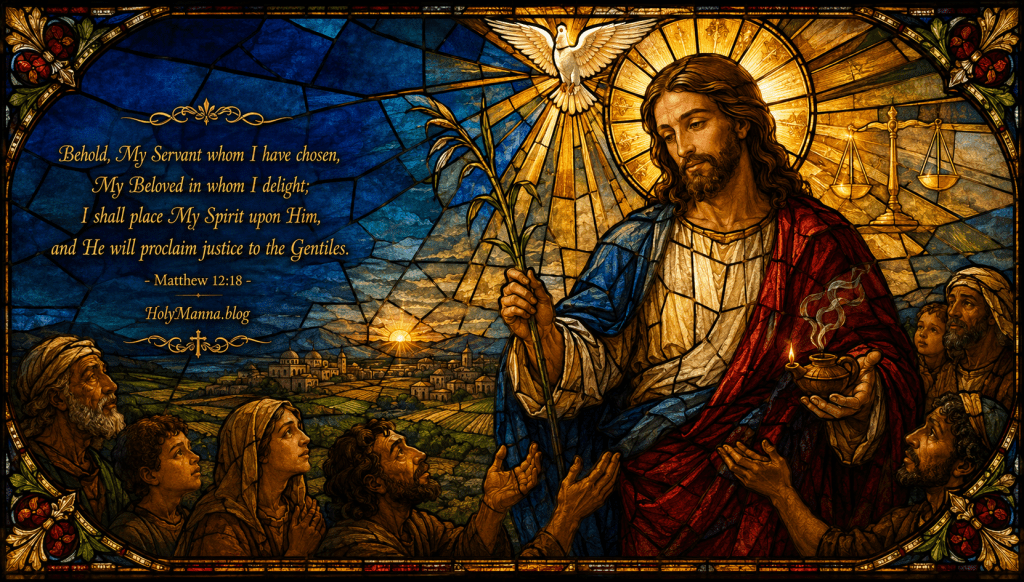
The Chosen Servant. 15 When Jesus realized this, he withdrew from that place. Many [people] followed him, and he cured them all, 16 but he warned them not to make him known. 17 This was to fulfill what had been spoken through Isaiah the prophet:
18 “Behold, my servant whom I have chosen,
my beloved in whom I delight;
I shall place my spirit upon him,
and he will proclaim justice to the Gentiles.
19 He will not contend or cry out,
nor will anyone hear his voice in the streets.
20 A bruised reed he will not break,
a smoldering wick he will not quench,
until he brings justice to victory.
21 And in his name the Gentiles will hope.”
Detailed Exegesis
Verse 14: “But the Pharisees went out and took counsel against him to put him to death.” The irony is devastating. On the Sabbath, the day of life and rest, the guardians of the Law plot a killing. Like the plotters of Micah 2:1, they scheme deliberately, and the shadow of the Cross falls across the Gospel from this verse forward.
Verse 15: “When Jesus realized this, he withdrew from that place. Many [people] followed him, and he cured them all.” Jesus withdraws not from fear but from obedience to the Father’s timetable; His hour has not yet come. And notice what withdrawal looks like: He cures them all. No one who came to Him was turned away. The plot against His life does not shrink His mercy by a single healing.
Verse 16: “but he warned them not to make him known.” This command of silence, which scholars call the messianic secret, protects the crowds from misunderstanding Him as a political conqueror. Jesus refuses the publicity that would define His messiahship on the world’s terms rather than the Father’s.
Verse 17: “This was to fulfill what had been spoken through Isaiah the prophet:” Matthew’s fulfillment formula appears again, insisting that nothing here is improvisation. Seven centuries earlier, God described exactly this kind of Messiah.
Verse 18: “Behold, my servant whom I have chosen, my beloved in whom I delight; I shall place my spirit upon him, and he will proclaim justice to the Gentiles.” The verse echoes the Father’s own voice at the Baptism and the Transfiguration and quietly unveils the Trinity: the Father who chooses, the beloved Son, the Spirit who rests upon Him. And the mission explodes beyond Israel’s borders, for this Servant brings justice to the Gentiles, to everyone.
Verse 19: “He will not contend or cry out, nor will anyone hear his voice in the streets.” The Messiah will not campaign like a demagogue or brawl like a revolutionary. His withdrawal in verse 15 is this verse in action. Divine justice advances without the noise the world associates with power.
Verse 20: “A bruised reed he will not break, a smoldering wick he will not quench, until he brings justice to victory.” Here is the most tender verse in the day’s liturgy. A bruised reed is one snap from useless; a smoldering wick is one breath from dark. The Servant handles both with such care that neither is lost. The traditional interpretation of the Church is that Christ will not crush those who are weak in faith or love but will strengthen and rekindle them by His own gentleness. And the sentence ends in iron: until he brings justice to victory. Gentleness is the method; victory is the guarantee.
Verse 21: “And in his name the Gentiles will hope.” The passage closes with the holy Name as the anchor of hope for all nations, a promise every baptized reader outside Israel is living proof of at this very moment.
Teachings
The Catechism teaches that these Servant Songs are the key to the Messiah’s identity. CCC 713 states: “The Messiah’s characteristics are revealed above all in the ‘Servant songs.’ These songs proclaim the meaning of Jesus’ Passion and show how he will pour out the Holy Spirit to give life to the many: not as an outsider, but by embracing our ‘form as a slave.’ Taking our death upon himself, he can communicate to us his own Spirit of life.” The gentleness of the Servant, in other words, points straight to the Cross, where the One who would not break the bruised was Himself bruised for our offenses.
Saint John Chrysostom preached on this very passage in his Homily 40 on Matthew, gathered by Saint Thomas Aquinas in the Catena Aurea, and marveled at the restraint hidden in verse 20: “He shall not break a bruised reed, shows that it was as easy for Him to break them all, as to break a reed, and that a bruised reed. And, He shall not quench a smoking flax, shows that their rage was fired, and that the power of Christ was strong to quench such rage with all readiness; hence in this is shown the great mercy of Christ.” Christ’s meekness, Chrysostom insists, is omnipotence choosing mercy. Saint Hilary of Poitiers, in the same Catena, reads the bruised reed as the wounded Gentile world itself, not broken but “reserved for salvation.” On the closing verse, CCC 2668 teaches that the invocation of the holy Name of Jesus is the simplest way of praying always, which means verse 21 is not only a prophecy about the nations but an invitation to every reader: hope has a Name, and it can be whispered anywhere.
Reflection
Most people, if honest, feel like the bruised reed some days and the smoldering wick on others: faith bent by suffering, a prayer life down to embers. This Gospel is the definitive answer to the fear that God is disappointed with the barely burning. He is not in the business of snuffing anyone out. He cups His hands around the flame. Living this reading has two movements. First, receive the gentleness: bring the most bruised part of life to Christ in prayer or, better still, in the Sacrament of Reconciliation, trusting that He heals all who follow Him. Second, imitate it: identify one person this week whose faith or spirit is flickering, a lapsed friend, a discouraged coworker, a family member barely holding on, and be deliberately gentle rather than corrective, patient rather than loud. Justice wins through such quiet mercy. Where in your life are you a smoldering wick that needs to stop hiding from the One who will not quench you? And who is the bruised reed God has placed within your reach this week?
The Quiet Hands That Hold the Whole Story
Step back and watch the day’s readings become a single story. In the morning darkness of Judah, powerful men lie on their beds designing the ruin of the weak, and Micah pronounces their funeral in advance. In the psalm, the victims of every such scheme in every age lift the boldest question in the Psalter, asking why the Lord stands afar, and the psalm itself answers: He sees, He takes note, He takes the matter in hand. And then, in Galilee, the reader watches Him take it in hand. The newest cabal of the powerful plots murder against innocence itself, and God’s response walks quietly out of town, healing every sick person who follows, guarding every bruised reed, shielding every smoldering wick, moving with unbreakable patience toward a victory won not by shouting in the streets but by dying outside the city walls and rising on the third day.
This is how God’s justice works. It is never absent, only unhurried. It is never harsh with the broken, only relentless against evil. And it invites every reader into both of its mercies: to be healed as the bruised, and to be converted from any quiet scheming of one’s own. The call to action is simple and demanding. Stop measuring God’s care by His volume. Bring the flickering, bent, exhausted places of the soul to Jesus this week, especially in Confession and the Eucharist, where the gentle Servant still cures all who come to Him. Then go be His gentleness to someone else. The nations were promised they would hope in His Name. Say that Name today, slowly and often, and let hope do what hope does: refuse to go out.
Engage With Us!
The conversation should not end here, so readers are warmly invited to share their reflections, questions, and experiences in the comments below. Every story of a bruised reed strengthened or a smoldering wick rekindled encourages the whole community.
- In Micah 2:1-5, the plotters sin deliberately, planning evil at night and carrying it out by day simply because it lies within their power. Where in your own life do you hold power over someone, at work, at home, or financially, and how is God asking you to use it justly?
- In Psalm 10:1-4, 7-8, 12, and 14, the psalmist moves from asking why God stands afar to declaring that God sees and defends the helpless. What injustice or sorrow do you need to stop carrying alone and formally entrust to the defender of orphans this week?
- In Matthew 12:14-21, Jesus responds to a death plot by withdrawing, healing everyone, and fulfilling the prophecy of the gentle Servant. When have you experienced Christ treating you as a bruised reed He refused to break, and who needs that same gentleness from you now?
- Taken together, these readings reveal a God whose justice is both tender toward the broken and certain in its victory. What would change in your daily decisions if you truly believed that God sees everything and that His quiet justice always wins?
Faith is not lived in grand gestures alone but in the daily choice to trust the God who sees, to pray honestly from the depths, and to handle every fragile soul the way the Servant handles a smoldering wick. May every reader go into this day resolved to do all things with the love and mercy Jesus taught us, gentle with the bruised, honest before the God who sees, and full of hope in His holy Name.
Sacred Heart of Jesus, we trust in You!
Immaculate Heart of Mary, pray for us!
Saint Michael the Archangel, defend us in battle!
Follow us on YouTube, TikTok, Instagram and Facebook for more insights and reflections on living a faith-filled life.


Leave a Reply