When a Courtroom Became a Doorway to Heaven
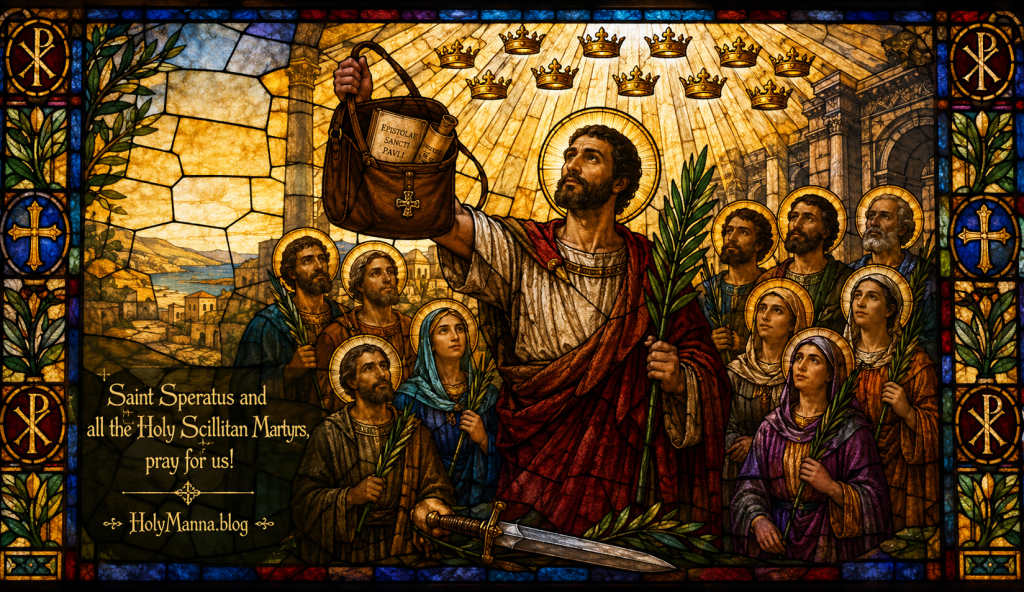
On July 17, in the year 180, twelve ordinary people from a small North African town stood in a judgment hall in Carthage and did something that still echoes across eighteen centuries. They said no. They said it politely, calmly, and without a trace of hatred for the man who held their lives in his hands. And because a court clerk wrote down what they said, word for word, these twelve became the first Christians of Africa whose names history remembers, and their trial transcript became the oldest dated document of the entire Latin-speaking Church.
Their names deserve to be spoken in full: Speratus, Nartzalus, Cittinus, Veturius, Felix, Aquilinus, Laetantius, Januaria, Generosa, Vestia, Donata, and Secunda. Seven men and five women. They are known together as the Scillitan Martyrs, after their hometown of Scillium, and the Church celebrates them each year on July 17, the anniversary of the day they were beheaded and, as they themselves insisted, the day they were born into heaven.
The Church has always treasured records like theirs. The Catechism teaches that “the Church has painstakingly collected the records of those who persevered to the end in witnessing to their faith. These are the acts of the Martyrs. They form the archives of truth written in letters of blood” (CCC 2474). The Acts of the Scillitan Martyrs sits at the very front of those archives. If you have ever wondered what the faith of the earliest Christians actually sounded like, not in a stained-glass retelling but in their own recorded words, this is the place to listen.
A Town History Almost Forgot
Here is a humbling truth about these twelve saints: the world remembers almost nothing about them except the hour of their greatest testimony. No birth records survive. No family histories survive. Even their hometown is a mystery. Scillium, sometimes spelled Scilium or Scili, was a small town somewhere in Roman North Africa, in the region the sources variously place in Numidia or in the province of Africa Proconsularis, within modern Tunisia or nearby. Some have speculated that it stood near the modern town of Kasserine, but that identification has never been proven, and honest scholarship admits that the location remains unresolved.
What the sources do reveal is quietly beautiful. Two of the twelve, Nartzalus and Cittinus, bore Punic names, the old language of Carthage; the other ten bore Latin names. This tells the reader that the group was a cross-section of ordinary provincial Africa, a blend of native and Roman stock, most likely people of modest means. They were not bishops or nobles or famous teachers. They were laypeople from a town so small the map has lost it.
Nothing is recorded about how the Gospel first reached Scillium or how these twelve came to believe. By 180, Christianity had been quietly spreading through North Africa for some time, yet these martyrs are the first documented evidence of its presence there. In a very real sense, the Church in Africa steps onto the stage of history already on trial for its faith. Whoever first evangelized that region did their work so quietly that history missed it, and the first fruit anyone ever saw was heroic fidelity. That anonymous sowing and glorious harvest is itself a lesson. Speratus emerges from the transcript as the group’s spokesman, clearly a man formed deeply in Scripture, since his answers echo Saint Paul almost line by line. His formation happened in hiddenness, the way most real formation does.
Quiet Lives, Honest Taxes, and a Satchel Full of Scripture
Before looking at how these twelve died, it is worth looking hard at how they lived, because the transcript preserves their own description of their daily lives, and it is a portrait every Christian should sit with.
When the proconsul Saturninus opened the hearing by offering them the emperor’s pardon if they would “return to a sound mind,” Speratus answered: “We have never done ill, we have not lent ourselves to wrong, we have never spoken ill, but when ill-treated we have given thanks; because we pay heed to our Emperor.” A moment later he added that he had never stolen, and that on any purchase he paid the tax, because he acknowledged “my Lord, the King of kings and Emperor of all nations.”
Notice what the first recorded African Christians chose to say in their own defense. They did not boast of visions or wonders. They pointed to honesty in business, gentleness under insult, gratitude in suffering, and scrupulous payment of taxes. Their lives matched the instruction of Saint Paul in Romans 13 and the words of the Lord Himself in The Gospel of Matthew, where Jesus says, “Render therefore to Caesar the things that are Caesar’s, and to God the things that are God’s” (Mt 22:21). The Catechism echoes this same balance: submission to legitimate authority, and obedience to God before all (CCC 2242). Donata, one of the five women, compressed that entire theology into a single sentence when her turn came: “Honour to Caesar as Caesar: but fear to God.” She gave the emperor everything he was owed and not one ounce of worship more.
The sources record no miracles worked by these saints during their lives, and it would be dishonest to invent any. What the record preserves instead may be more useful to the average reader than a miracle story. It preserves proof that ordinary, unspectacular holiness, the kind woven from honesty, patience, and prayer, can become heroic the moment it is tested. The Catechism teaches that “the witness of a Christian life and good works done in a supernatural spirit have great power to draw men to the faith and to God” (CCC 2044 citing the tradition of the apostolate). The Scillitan twelve lived that witness in obscurity for years before a single word of it was written down.
Then comes the detail that has made this trial famous among lovers of the Bible. At one point Saturninus gestured toward the case Speratus was carrying and asked what was in it. Speratus answered: “Books and letters of Paul, a just man.” That satchel is the first recorded mention of the Christian Scriptures in the Latin-speaking world. Scholars note that the Acts of the Scillitan Martyrs is the earliest document to reference a Latin Bible. A farmer or tradesman from a forgotten town walked into a Roman courtroom carrying the word of God on his shoulder, and he would not walk out without it. The Catechism urges every believer toward that same attachment: “The Church forcefully and specifically exhorts all the Christian faithful… to learn the surpassing knowledge of Jesus Christ, by frequent reading of the divine Scriptures”, adding with Saint Jerome that “ignorance of the Scriptures is ignorance of Christ” (CCC 133). Speratus knew Christ because he carried Christ’s word, literally, everywhere he went.
Thirty Days to Change Their Minds
The persecution that caught the Scillitan twelve was the last flare of the storms under the emperor Marcus Aurelius, the same wave of hostility that had claimed the martyrs of Lyons in Gaul a few years earlier. Tertullian, the great Carthaginian writer of the next generation, names Vigellius Saturninus as the first Roman official to put Christians to death in Africa. These twelve were his victims, arrested in Scillium and brought to Carthage for trial. The transcript names six of them standing in the judgment hall, Speratus, Nartzalus, Cittinus, Donata, Secunda, and Vestia, while the final sentence names all twelve; the most common explanation is that the other six had been examined earlier and all were condemned together. Readers may therefore find some older sources speaking of six Scillitan martyrs and others of twelve; both are describing the same event through the same document.
What makes this martyrdom so striking is its restraint. There was no torture. There was no rage. Saturninus comes across in the transcript as a man genuinely trying to save their lives, and the martyrs come across as people genuinely at peace. He told them: “We too are religious, and our religion is simple, and we swear by the genius of our lord the Emperor, and pray for his welfare, as ye also ought to do.” Speratus offered to explain instead “the mystery of simplicity,” and when finally pressed to swear by the emperor’s genius, his protecting spirit, he gave the answer that has become the signature of this feast: “I recognize not the empire of this world; but rather do I serve that God whom no man hath seen, nor with these eyes can see.”
That sentence is Scripture praying out loud. Saint Paul writes in 1 Timothy 6:16 of the God “who alone has immortality and dwells in unapproachable light, whom no man has ever seen or can see.” Speratus was not improvising a philosophy; he was quoting the letters in his satchel back to the empire. And the issue at stake was precisely the one The Catechism identifies at the heart of the First Commandment: “Idolatry consists in divinizing what is not God” (CCC 2113). Swearing by the genius of Caesar was a small gesture, a pinch of formality, and every person in that room knew it would have cost the twelve nothing externally and everything internally.
Each of the others then answered in turn, and the transcript preserves their voices like a litany. Cittinus said: “We have none other to fear, save only our Lord God, who is in heaven.” Vestia said simply: “I am a Christian.” Secunda said: “What I am, that I wish to be.” Asked whether he persisted, Speratus answered: “I am a Christian,” and all assented with him. Saturninus, still reluctant, offered them a remand of thirty days to think it over. They declined it on the spot. Speratus spoke for them all: “In a matter so straightforward there is no considering.”
So the sentence was read: “Whereas Speratus, Nartzalus, Cittinus, Donata, Vestia, Secunda and the rest have confessed that they live according to the Christian rite, and since after opportunity offered them of returning to the custom of the Romans they have obstinately persisted, it is determined that they be put to the sword.” Speratus answered: “We give thanks to God.” And Nartzalus spoke a sentence that ought to be framed above every Christian’s door: “Today we are martyrs in heaven; thanks be to God.”
The herald read all twelve names. The twelve answered together: “Thanks be to God.” They were led out and beheaded. The transcript closes with the acclamation of the Church that copied and treasured it: “And so they all together were crowned with martyrdom; and they reign with the Father and the Son and the Holy Ghost, for ever and ever. Amen.”
The Catechism gives the exact name for what happened that day: “Martyrdom is the supreme witness given to the truth of the faith: it means bearing witness even unto death. The martyr bears witness to Christ who died and rose, to whom he is united by charity” (CCC 2473). Twelve people bore that witness before lunch on an ordinary Tuesday of the Roman calendar, and the empire that killed them is gone, while the Church they died for still reads their words.
A Basilica, a Bishop’s Sermons, and Relics Carried Across the Sea
The Church of Carthage never forgot them. Their feast on July 17 was inscribed in the primitive calendar of Carthage, one of the oldest liturgical calendars in existence, and a basilica was raised in the city and dedicated to them. Honesty requires saying plainly that the sources record no specific miracle stories attached to their relics or intercession; no accounts of healings or wonders at their shrine have come down to us, and none will be invented here. Their glory after death took a different and, in its way, more astonishing form: they became the founding memory of one of the most brilliant Churches in Christian history.
Within a generation, Carthage produced Tertullian, the first great theologian to write in Latin, who looked at deaths like theirs and wrote the line the whole Church still repeats: “The blood of martyrs is the seed of Christians” (CCC 852, citing Tertullian’s Apologeticus). Within a century, Carthage gave the Church Saint Cyprian, bishop and martyr. Within three centuries, Roman Africa gave the Church Saint Augustine, arguably the most influential theologian the West has ever known. And Augustine himself stood in Carthage on July 17 and preached on the Scillitan Martyrs’ feast, not once but at least three times. In one of those sermons he told the congregation: “The holy martyrs, witnesses of God, preferred to live by dying, in order not to die by living; in order not to deny life by fearing death, they despised life by loving life.” He reminded his hearers that when the Church celebrates the solemnities of the martyrs, she sets before them examples to be imitated. The greatest doctor of the Latin Church preached the memory of these twelve laypeople from a forgotten town; that is a legacy grander than any single miracle account.
A later tradition extends their story across the sea. Agobard, archbishop of Lyon in the early ninth century, stated that the relics of Speratus, together with relics of Saint Cyprian, were translated from Carthage to Lyon at the order of the emperor Charlemagne, as North Africa passed out of Christian hands. It is a moving tradition, the first martyr of Africa finding refuge in the city of the martyrs of Gaul who had died only a few years before him. This account rests on Agobard’s testimony and later tradition, and it cannot be independently verified.
The final chapter of their afterlife is almost providential. The original Latin text of their Acts was lost for centuries, surviving only in Greek translations, until 1890, when the scholar J. Armitage Robinson discovered the Latin original in a ninth-century manuscript in the British Museum. After more than a thousand years of silence, the exact words of the first African martyrs were heard again in their own tongue. The Church venerates such continuity because, as The Catechism teaches of the communion of saints, “our communion with the saints joins us to Christ, from whom as from its fountain and head issues all grace” (CCC 957). The Scillitan Martyrs are not museum pieces; they are living members of the Body of Christ who intercede for the Church they helped to plant.
What Would Be Found in Your Satchel?
The Scillitan Martyrs are unusually easy to imitate, precisely because there is so little about them that is unusual. They performed no recorded wonders. They held no office. They wrote no books. Everything the Church knows about them fits on two pages, and every line of those two pages is available to any believer today.
Start with the satchel. Speratus carried the Scriptures and the letters of Saint Paul with him into a Roman courtroom. Most readers of this post carry a phone that contains the entire Bible and rarely open it. When was the last time you carried the word of God with you on purpose, and let it shape how you answered the hardest question of your day? A practical resolution flows straight from this feast: keep the Scriptures physically close for one week, a pocket Gospel, a Bible app opened before social media, five minutes of The Letters of Paul before bed, and let the word travel where you travel.
Consider next their defense. When their lives were on the line, the only evidence they offered was the quality of their ordinary conduct: no wrongdoing, no evil speech, gratitude under mistreatment, honest payment of every debt and tax. If you were accused of being a Christian, would your weekday behavior, your business dealings, and your tax returns be usable as evidence? Holiness for most people will never mean a courtroom; it will mean the checkout line, the group chat, the expense report, and the way irritation is answered. The Scillitan twelve show that this hidden integrity is not the small stuff of faith; it is the training ground of martyrs.
Consider, too, Donata’s balance. She honored Caesar as Caesar and reserved fear for God alone. Modern life constantly asks for small pinches of incense: compromises of conscience at work, silence when the faith is mocked, little idolatries of money, status, comfort, and approval. What is the “genius of the emperor” in your life, the small, socially convenient act of worship that everyone around you insists costs nothing? The Church teaches that the citizen is “obliged in conscience not to follow the directives of civil authorities when they are contrary to the demands of the moral order” (CCC 2242), and that quiet obligation begins in tiny refusals long before it ever reaches anything dramatic.
Finally, learn their gratitude. Sentenced to death, they answered, “Thanks be to God.” These are the very words the faithful say at the end of every Mass. Can you say “Thanks be to God” over the sentence your life has handed you this month, the diagnosis, the layoff, the loneliness, the unanswered prayer? Gratitude in suffering was the Scillitan signature, and it was possible because they believed, with Nartzalus, that heaven was not a distant hope but the very next thing.
Engage With Us!
The story of Saint Speratus and his eleven companions belongs to the whole family of faith, and every reader is warmly invited to share thoughts, reflections, and experiences in the comments below. Their conversation with Rome lasted only a few minutes; the conversation about their witness has lasted eighteen centuries, and it continues here.
- Speratus carried the Scriptures with him everywhere, even to his trial. What one concrete habit could help you keep God’s word physically and spiritually closer this week?
- The martyrs’ only defense was the honesty and gentleness of their ordinary lives. Which everyday behavior of yours most needs to become “usable evidence” that you belong to Christ?
- Donata honored Caesar as Caesar but reserved fear for God alone. Where in your life are you being asked to offer a small pinch of incense to something that is not God?
- Offered thirty days to reconsider, the twelve answered that in so straightforward a matter there is no considering. Is there a decision of faith you have been postponing that is actually already clear?
- The martyrs answered their death sentence with “Thanks be to God,” the same words spoken at the end of every Mass. How might you carry that dismissal out of church and into your hardest circumstance this week?
The Scillitan Martyrs prove that no life is too small, too hidden, or too ordinary to become a masterpiece of grace. The reader who pays honest taxes, forgives sharp words, keeps the Scriptures close, and refuses the little idols of the age is walking the exact road that led twelve townspeople from a forgotten village straight into the calendar of the saints. Live this day, and every day, with the love and mercy that Jesus taught, and let every answer you give, in courtrooms large and small, end the way theirs did: Thanks be to God.
Saint Speratus and all the Holy Scillitan Martyrs, pray for us!
Follow us on YouTube, TikTok, Instagram and Facebook for more insights and reflections on living a faith-filled life.


Leave a Reply