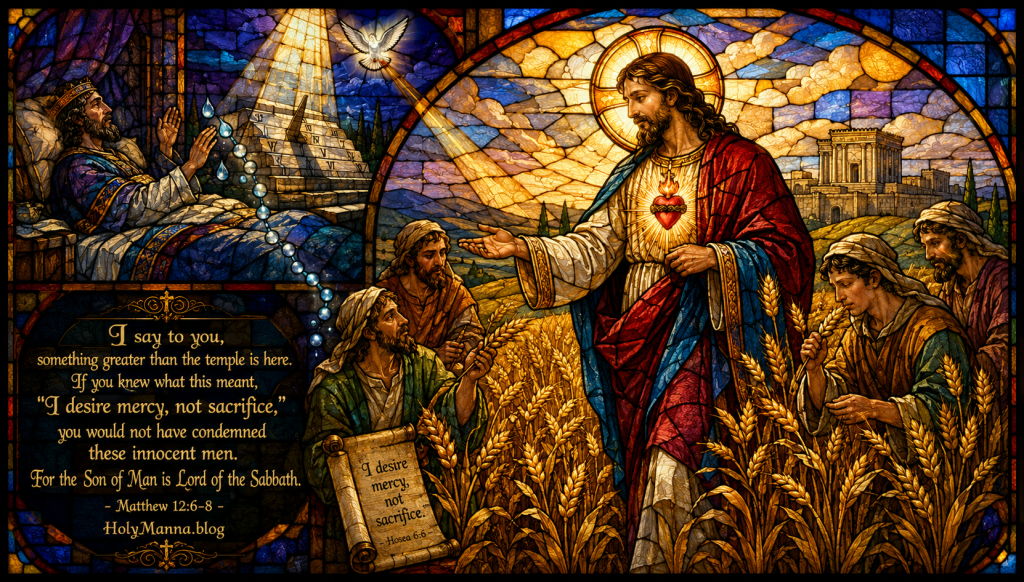
Friday of the Fifteenth Week in Ordinary Time – Lectionary: 393
The Mercy That Bends Toward Us
There is a moment in nearly every life when the news arrives that changes everything, a diagnosis, a loss, a door slammed shut. Today’s readings for Friday of the Fifteenth Week in Ordinary Time meet that moment head on. A dying king turns his face to the wall and weeps, and heaven answers. A healed man sings his way out of the pit. Hungry disciples pluck grain on the sabbath, and the Lord of the sabbath defends them against men who knew the rules but had forgotten the heart behind them. The central theme uniting these readings is that God’s mercy bends toward human need, and that authentic religion must do the same. In the ancient Near East, kings measured their worth in armies and monuments, yet Scripture shows the God of Israel measuring something else entirely: prayers and tears. Hezekiah lived during the terrifying advance of the Assyrian empire around 701 BC, when Jerusalem’s survival hung by a thread, and it was precisely then that God said, “I have heard your prayer; I have seen your tears” (Isaiah 38:5). Seven centuries later, Jesus stood in a grainfield and quoted the prophet Hosea to religious experts: “I desire mercy, not sacrifice” (Matthew 12:7). The Catechism of the Catholic Church teaches that “outward sacrifice, to be genuine, must be the expression of spiritual sacrifice” (CCC 2100). Today the Church invites every reader to bring real tears, real hunger, and real need before a God whose deepest desire is mercy. What might change if God’s mercy were trusted that completely?
First Reading — Isaiah 38:1-6, 21-22, 7-8
The King Who Wept at the Wall
Hezekiah was one of the rare bright lights among the kings of Judah. Reigning from roughly 715 to 686 BC, he purified the Temple, tore down the idolatrous high places, and even shattered the bronze serpent of Moses because the people had begun worshiping it (2 Kings 18:4). Then, at the height of the Assyrian crisis, with Sennacherib’s war machine devouring the region, the king himself was struck down with a mortal illness. This reading, which parallels 2 Kings 20:1-11, shows what a man of genuine faith does when the bottom falls out. It is worth noting that the lectionary presents the verses in the order the New American Bible, Revised Edition arranges them, placing verses 21 and 22 before verses 7 and 8 to match the narrative flow of the parallel account in 2 Kings 20:7-8. The reading fits today’s central theme perfectly, because it reveals a God who is moved, truly moved, by human tears.
Isaiah 38:1-6, 21-22, 7-8 – New American Bible (Revised Edition)
Sickness and Recovery of Hezekiah. 1 In those days, when Hezekiah was mortally ill, the prophet Isaiah, son of Amoz, came and said to him: “Thus says the Lord: Put your house in order, for you are about to die; you shall not recover.” 2 Hezekiah turned his face to the wall and prayed to the Lord:
3 “Ah, Lord, remember how faithfully and wholeheartedly I conducted myself in your presence, doing what was good in your sight!” And Hezekiah wept bitterly.
4 Then the word of the Lord came to Isaiah: 5 Go, tell Hezekiah: Thus says the Lord, the God of your father David: I have heard your prayer; I have seen your tears. Now I will add fifteen years to your life. 6 I will rescue you and this city from the hand of the king of Assyria; I will be a shield to this city.
21 Then Isaiah said, “Bring a poultice of figs and apply it to the boil for his recovery.” 22 Hezekiah asked, “What is the sign that I shall go up to the house of the Lord?”
7 This will be the sign for you from the Lord that the Lord will carry out the word he has spoken: 8 See, I will make the shadow cast by the sun on the stairway to the terrace of Ahaz go back the ten steps it has advanced. So the sun came back the ten steps it had advanced.
Detailed Exegesis
Verse 1: “In those days, when Hezekiah was mortally ill, the prophet Isaiah, son of Amoz, came and said to him: ‘Thus says the Lord: Put your house in order, for you are about to die; you shall not recover.’” The prophet delivers a sentence of death with no softening. Under the Old Covenant, putting one’s house in order meant settling succession and estate, and for a king without an heir at that moment, it also meant the possible collapse of the Davidic line. God speaks honestly to Hezekiah, and honesty about death is itself a severe mercy.
Verse 2: “Hezekiah turned his face to the wall and prayed to the Lord.” The dying king does not summon physicians or counselors first. He turns away from every human comfort and toward God alone. Many commentators note that turning toward the wall likely meant turning toward the Temple, the place of God’s presence, an instinct the Church still honors when the faithful orient their hearts toward the tabernacle.
Verse 3: “Ah, Lord, remember how faithfully and wholeheartedly I conducted myself in your presence, doing what was good in your sight!” Hezekiah appeals not to merit as a bargaining chip but to relationship. He has walked with God, and he asks God to remember that walk. The verse ends with the detail that pierces the heart: “And Hezekiah wept bitterly.” The Catechism teaches that “the man of the Old Testament lives his sickness in the presence of God” (CCC 1502), and that is exactly what unfolds here, lament poured out before the Master of life and death.
Verse 4: “Then the word of the Lord came to Isaiah.” The parallel account in 2 Kings 20:4 reveals that Isaiah had not even left the middle courtyard of the palace before God sent him back. Heaven’s answer came faster than the prophet’s footsteps.
Verse 5: “Go, tell Hezekiah: Thus says the Lord, the God of your father David: I have heard your prayer; I have seen your tears. Now I will add fifteen years to your life.” God identifies himself through the covenant with David, reminding Hezekiah that the promises made in 2 Samuel 7 still stand. Notice what moved God: not the king’s building projects or reforms, but his prayer and his tears. God counts tears.
Verse 6: “I will rescue you and this city from the hand of the king of Assyria; I will be a shield to this city.” The healing of the man and the salvation of the city are bound together. God’s mercy toward one person overflows into mercy for a whole people, a pattern fulfilled supremely in Christ.
Verse 21: “Then Isaiah said, ‘Bring a poultice of figs and apply it to the boil for his recovery.’” God works through ordinary medicine. Grace does not bypass nature; it heals through it. The Church has always blessed the work of physicians for this reason, and the Catechism affirms that “life and physical health are precious gifts entrusted to us by God” (CCC 2288).
Verse 22: “Hezekiah asked, ‘What is the sign that I shall go up to the house of the Lord?’” The king’s first thought upon hearing of his recovery is worship. He does not ask when he can return to his throne but when he can return to the Temple.
Verse 7: “This will be the sign for you from the Lord that the Lord will carry out the word he has spoken.” God graciously stoops to human weakness and offers confirmation, just as he did for Gideon and for Ahaz before him.
Verse 8: “See, I will make the shadow cast by the sun on the stairway to the terrace of Ahaz go back the ten steps it has advanced. So the sun came back the ten steps it had advanced.” The stairway of Ahaz functioned as a kind of sundial. The shadow’s advance is the most relentless image of time and death that the ancient world knew, and God reverses it. The Lord of history can turn back the very shadow of death, a foreshadowing of the empty tomb.
Teachings
The Church Fathers loved this passage because it teaches the power of humble, tearful prayer. St. Jerome, writing in his Letter 38, lists Hezekiah among the great examples of trials that bear fruit, noting that his “tears and prayers obtain for him a respite of fifteen years.” St. Cyril of Jerusalem, catechizing converts in the 4th century, pointed to this scene as proof of the might of repentance, teaching that the king’s “repentance won the repeal” of “the sentence God had passed on him” (Catechetical Lectures). The Catechism gathers this whole tradition into a single luminous sentence: “The man of the Old Testament lives his sickness in the presence of God. It is before God that he laments his illness, and it is of God, Master of life and death, that he implores healing” (CCC 1502). It likewise teaches regarding petition that “when we share in God’s saving love, we understand that every need can become the object of petition” (CCC 2633). Historically, this healing also preserved the Davidic line through which the Messiah would come, since Hezekiah’s son Manasseh was born during those added years, a sobering reminder that God’s gifts of time carry weighty responsibility, for Manasseh became one of Judah’s worst kings before his own late repentance (2 Chronicles 33:12-13).
Reflection
Hezekiah’s story gives permission to pray with raw honesty. Concrete steps for living this reading include praying tonight with the actual fears that usually stay hidden, naming them aloud before the tabernacle or a crucifix; asking a priest about the Anointing of the Sick for anyone facing serious illness, since the Church continues Christ’s healing ministry through this sacrament; and thanking God specifically for medicine, doctors, and treatments, recognizing them as instruments of grace like the poultice of figs. Time itself is the hidden gift of this passage, fifteen years granted to a weeping man. When was the last time tears were part of prayer rather than something hidden from God? If God added fifteen years to life starting today, what would actually change tomorrow morning? Is worship the first response to good news, as it was for Hezekiah, or an afterthought?
Responsorial Psalm — Isaiah 38:10-12, 16-17
The Song of a Man Given Back His Life
Today’s responsorial is not drawn from the Book of Psalms at all. It is the Canticle of Hezekiah, the thanksgiving hymn the healed king composed after his recovery, and the Church treasures it enough to pray it in the Liturgy of the Hours. This is poetry written from inside the experience of nearly dying, and its honesty is startling. Under the Old Covenant there was not yet the full, confident hope of heaven that Christ would later reveal, for as St. Paul writes, Christ Jesus “destroyed death and brought life and immortality to light through the gospel” (2 Timothy 1:10). Hezekiah stood at the edge of Sheol, the shadowy realm of the dead, without that light, which makes his rescue and his gratitude all the more piercing. The canticle fits the day’s theme because it shows what mercy looks like from the receiving end.
Isaiah 38:10-12, 16-17 – New American Bible (Revised Edition)
10 In the noontime of life I said,
I must depart!
To the gates of Sheol I have been consigned
for the rest of my years.
11 I said, I shall see the Lord no more
in the land of the living.
Nor look on any mortals
among those who dwell in the world.
12 My dwelling, like a shepherd’s tent,
is struck down and borne away from me;
You have folded up my life, like a weaver
who severs me from the last thread.
From morning to night you make an end of me;16 Those live whom the Lord protects;
yours is the life of my spirit.
You have given me health and restored my life!
17 Peace in place of bitterness!
You have preserved my life
from the pit of destruction;
Behind your back
you cast all my sins.
Detailed Exegesis
Verse 10: “In the noontime of life I said, I must depart! To the gates of Sheol I have been consigned for the rest of my years.” Noontime means midlife, the height of strength. Hezekiah was likely in his late thirties, and the injustice of dying young saturates the line. Sheol in Hebrew thought was not hell as later revelation would define it but the gray abode of all the dead, and its gates swing only one way.
Verse 11: “I said, I shall see the Lord no more in the land of the living. Nor look on any mortals among those who dwell in the world.” The king’s deepest grief is not lost power but lost communion, first with God in Temple worship, then with other human beings. This ordering of loves, God first and neighbor second, echoes the two great commandments.
Verse 12: “My dwelling, like a shepherd’s tent, is struck down and borne away from me; You have folded up my life, like a weaver who severs me from the last thread. From morning to night you make an end of me.” Two images of fragility follow each other. A shepherd’s tent stands for a night and vanishes by morning, and a weaver finishing a cloth cuts it from the loom with one decisive stroke. St. Paul would later use the same tent imagery for the mortal body, writing that “if our earthly dwelling, a tent, should be destroyed, we have a building from God” (2 Corinthians 5:1).
Verse 16: “Those live whom the Lord protects; yours is the life of my spirit. You have given me health and restored my life!” The turn from lament to praise is total. Hezekiah confesses that life is not self-generated but held in existence moment by moment by God, an insight the Church affirms in teaching that God “at every moment upholds and sustains” creation “in being” (CCC 301).
Verse 17: “Peace in place of bitterness! You have preserved my life from the pit of destruction; Behind your back you cast all my sins.” Here the canticle reaches its theological summit. Healing of body and forgiveness of sin arrive together, and the image is unforgettable: God throws sins behind his back where he will never look at them again. This anticipates the Gospel, where Jesus consistently joins healing and forgiveness, as when he tells the paralytic that his sins are forgiven before telling him to walk (Matthew 9:2-6).
Teachings
The Church reads this canticle as a school of gratitude and a prophecy of resurrection hope. The Catechism teaches that illness can become a road to God: “Illness can lead to anguish, self-absorption, sometimes even despair and revolt against God. It can also make a person more mature, helping him discern in his life what is not essential so that he can turn toward that which is” (CCC 1501). Hezekiah models exactly that maturing. His image of sins cast behind God’s back belongs to a family of Old Testament mercy images the Fathers loved to gather together, alongside Micah’s promise that God “will cast into the depths of the sea all our sins” (Micah 7:19) and the psalmist’s cry, “As far as the east is from the west, so far has he removed our sins from us” (Psalm 103:12). The Church sees these promises fulfilled in the Sacrament of Reconciliation, where, as the Catechism teaches, “those who approach the sacrament of Penance obtain pardon from God’s mercy for the offense committed against him” (CCC 1422). What Hezekiah glimpsed in poetry, every Catholic can receive in a confessional this weekend.
Reflection
This canticle invites readers to do something countercultural: rehearse mortality honestly, then rehearse gratitude just as honestly. Concrete steps include writing a personal verse 16, a single sentence naming one specific way God has restored or protected life this year; going to Confession soon and consciously picturing verse 17 during absolution, sins cast behind God’s back forever; and praying this canticle at the bedside of someone who is ill, since Scripture gives words when personal words fail. Which line of Hezekiah’s song sounds most like the current season of life, the lament of verses 10 through 12 or the praise of verses 16 and 17? Is there a bitterness that God is waiting to turn into peace? What would it mean to actually believe that confessed sins are behind God’s back, never to be brought up again?
Holy Gospel — Matthew 12:1-8
The Lord of the Sabbath Walks Through the Wheat
The scene could not be more ordinary: a footpath through a grainfield, hungry travelers, ripening wheat. Jewish law explicitly permitted what the disciples did, for Deuteronomy 23:26 allows anyone passing through a neighbor’s field to pluck grain by hand, forbidding only the sickle. The controversy was the calendar, not the crop. It was the sabbath, and in the developing oral tradition of the Pharisees, plucking counted as reaping, one of the categories of forbidden sabbath work. Matthew places this clash immediately after Jesus’ tender invitation, “Come to me, all you who labor and are burdened, and I will give you rest” (Matthew 11:28), a placement that is no accident. The one who gives true rest is about to reveal himself as Lord of the day of rest. This Gospel carries the day’s theme to its summit, because Jesus does not merely defend mercy; he identifies himself as its source.
Matthew 12:1-8 – New American Bible (Revised Edition)
Picking Grain on the Sabbath. 1 At that time Jesus was going through a field of grain on the sabbath. His disciples were hungry and began to pick the heads of grain and eat them. 2 When the Pharisees saw this, they said to him, “See, your disciples are doing what is unlawful to do on the sabbath.” 3 He said to them, “Have you not read what David did when he and his companions were hungry, 4 how he went into the house of God and ate the bread of offering, which neither he nor his companions but only the priests could lawfully eat? 5 Or have you not read in the law that on the sabbath the priests serving in the temple violate the sabbath and are innocent? 6 I say to you, something greater than the temple is here. 7 If you knew what this meant, ‘I desire mercy, not sacrifice,’ you would not have condemned these innocent men. 8 For the Son of Man is Lord of the sabbath.”
Detailed Exegesis
Verse 1: “At that time Jesus was going through a field of grain on the sabbath. His disciples were hungry and began to pick the heads of grain and eat them.” Matthew notes the hunger deliberately. This is not casual snacking but genuine need, and the whole passage turns on whether human need matters to God. It does, as Hezekiah’s tears already proved.
Verse 2: “When the Pharisees saw this, they said to him, ‘See, your disciples are doing what is unlawful to do on the sabbath.’” The Pharisees address Jesus rather than the disciples, holding the teacher responsible for his students. Their concern for the sabbath was not wicked in itself, for the sabbath was a gift of the covenant, but they had buried the gift under human regulations. St. John Chrysostom observes in his Homily 39 on Matthew that here the Pharisees merely find fault, yet when Jesus later heals a withered hand they become furious enough to plot his destruction, revealing that hardened hearts grow angriest precisely when mercy is displayed.
Verse 3: “He said to them, ‘Have you not read what David did when he and his companions were hungry.’” The question stings, because reading Scripture was the Pharisees’ specialty. Jesus points them to 1 Samuel 21:2-7, where the fleeing David comes to the sanctuary at Nob.
Verse 4: “How he went into the house of God and ate the bread of offering, which neither he nor his companions but only the priests could lawfully eat?” The bread of the Presence, twelve loaves set weekly before the Lord (Leviticus 24:5-9), was reserved to priests, yet the priest Ahimelech gave it to David’s hungry men. Scripture itself records the precedent without condemnation: human need can outrank ritual restriction. The Fathers also saw in this bread a quiet foreshadowing of the Eucharist, the true Bread of the Presence given to the hungry.
Verse 5: “Or have you not read in the law that on the sabbath the priests serving in the temple violate the sabbath and are innocent?” The second precedent comes from the Torah itself. Numbers 28:9-10 commands sacrifices on the sabbath, meaning priests must slaughter, carry, and burn, all technically work, yet they are guiltless because Temple service outranks sabbath rest.
Verse 6: “I say to you, something greater than the temple is here.” For any first-century Jew, this claim was thunderous. Nothing on earth was greater than the Temple, God’s dwelling among his people, yet Jesus claims that title for himself. The Catechism teaches that only the divine identity of Jesus can justify such absolute claims, citing this very verse alongside his statements about being greater than Jonah and Solomon (CCC 590). If priests serving the Temple are innocent of sabbath violation, how much more are disciples serving the incarnate God.
Verse 7: “If you knew what this meant, ‘I desire mercy, not sacrifice,’ you would not have condemned these innocent men.” Jesus quotes Hosea 6:6 for the second time in this Gospel, having already cited it at the call of Matthew (Matthew 9:13). Repetition in Scripture signals emphasis. God does not reject sacrifice, which he himself commanded, but sacrifice without mercy is a body without a soul, and the Catechism echoes the prophets in teaching that “outward sacrifice, to be genuine, must be the expression of spiritual sacrifice” (CCC 2100).
Verse 8: “For the Son of Man is Lord of the sabbath.” The title Son of Man evokes the exalted figure of Daniel 7:13-14 who receives everlasting dominion. Since God himself instituted the sabbath at creation (Genesis 2:3), only God can be its Lord. The verse is nothing less than a claim to divinity, sealing the argument of verse 6.
Teachings
St. John Chrysostom teaches that Christ handled the sabbath with deliberate pastoral wisdom, never dismissing it arbitrarily. In his Homily 39 on Matthew, the golden-mouthed preacher explains that Jesus “never breaks it without a cause, but giving reasonable excuses,” so that he might bring the old law to its fulfillment without startling his hearers. The Catechism summarizes the Church’s understanding beautifully: “The Gospel reports many incidents when Jesus was accused of violating the sabbath law. But Jesus never fails to respect the holiness of this day” (CCC 2173), and the same paragraph teaches that Christ declares the sabbath a day “for doing good rather than harm, for saving life rather than killing” (CCC 2173). This teaching flows directly into the Christian Sunday, for the Church transfers the sabbath’s meaning to the Lord’s Day, teaching that “Sunday is expressly recommended as the primordial holy day of obligation” (CCC 2177). History offers a sobering footnote: Matthew records that after the next sabbath healing, the Pharisees “went out and took counsel against him to put him to death” (Matthew 12:14), proving that legalism unchecked by mercy ends by attacking Mercy himself.
Reflection
This Gospel asks a piercing question of every practicing Catholic: has the faith become rules without a heart, or a heart formed by the rules? Concrete steps for living it out include examining Sunday habits honestly, asking whether the Lord’s Day includes both worship and works of mercy, perhaps visiting someone lonely or sick after Mass; catching the inner Pharisee in the act, noticing the next time a judgment forms about how someone else prays, dresses, or parents, and offering a silent prayer for that person instead; and memorizing Hosea 6:6 this week, letting “I desire mercy, not sacrifice” become the lens for one difficult relationship. Where has rule-keeping quietly replaced love in daily spiritual life? Who nearby is hungry, in body or in spirit, while others debate technicalities? What would change if Jesus were truly received as Lord of every day, not only Sunday?
The God Who Hears, Heals, and Sets Free
Today’s readings tell one continuous story about the heart of God. A dying king turned his face to the wall, and the God of the universe stopped everything to say, “I have heard your prayer; I have seen your tears” (Isaiah 38:5). That same king rose from his sickbed singing that God had cast all his sins behind his back, trading peace for bitterness. And seven centuries later, God walked through a wheatfield in human flesh and told the religious experts of his day that the whole system of Temple, sabbath, and sacrifice had always been pointing to one thing: “I desire mercy, not sacrifice” (Matthew 12:7). The shadow on the stairway of Ahaz moved backward, and the world learned that death does not get the last word. The disciples ate their fill on the sabbath, and the world learned that human need is not an inconvenience to God but the very place where he loves to show his power. The lesson lands close to home. Prayers offered through tears are not weakness; they are the prayers heaven answers fastest. Sins sincerely confessed are not filed away for future reference; they are thrown behind God’s back forever. And religious practice, from Sunday Mass to daily devotions, is not a scorecard but a love story, kept alive by the mercy at its center. This week, let Hezekiah teach honest prayer, let his canticle teach loud gratitude, and let the Lord of the sabbath teach mercy toward the next person who fails to meet expectations. The God who counts tears is counting on his people to love the same way. Come back tomorrow, and keep walking this road of daily bread together at HolyManna.blog.
Engage With Us!
The comments below are open, and every reflection shared there becomes bread for someone else’s journey, so please share what stirred the heart in today’s readings.
- In Isaiah 38:1-6, 21-22, 7-8, Hezekiah prays with tears and total honesty when facing death. What fear or need has been held back from prayer, and what would it look like to bring it before God this week with Hezekiah’s honesty?
- In Isaiah 38:10-12, 16-17, the healed king sings that God has cast all his sins behind his back. Is there a forgiven sin still being carried as if God had not forgotten it, and how might the Sacrament of Reconciliation bring the peace of verse 17?
- In Matthew 12:1-8, Jesus declares that God desires mercy, not sacrifice. Where in daily life, at home, at work, or even at the parish, has rule-keeping or judgment quietly crowded out mercy toward a real person in need?
- Taking all of today’s readings together, how does knowing that God hears prayers, sees tears, and desires mercy above all change the way this coming week should be lived?
Living a life of faith is not about performing perfectly for a distant judge; it is about walking daily with the God who counts tears, turns back shadows, and feeds the hungry. Go into this day determined to do everything, every task, every conversation, every small sacrifice, with the love and mercy Jesus taught us.
Sacred Heart of Jesus, we trust in You!
Immaculate Heart of Mary, pray for us!
Saint Michael the Archangel, defend us in battle!
Follow us on YouTube, TikTok, Instagram and Facebook for more insights and reflections on living a faith-filled life.


Leave a Reply