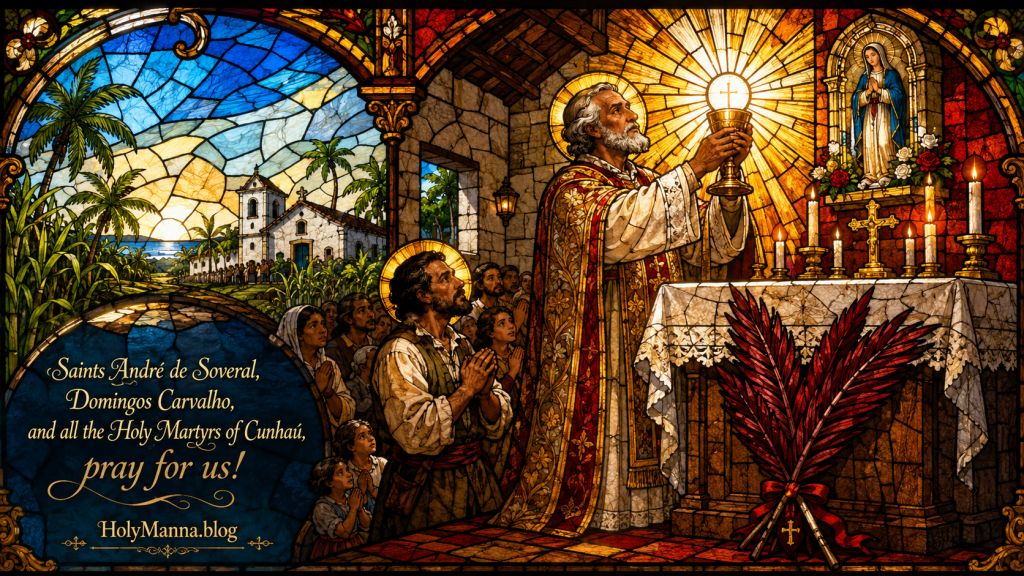
Blood on the Altar
Every so often, the story of a saint begins not in a palace or a monastery but in a place so ordinary that it could be anyone’s parish. On July 16th, the Church remembers Saints André de Soveral, Domingos Carvalho, and their companions, the Martyrs of Cunhaú, a priest and a congregation of farmers and sugar mill workers in colonial Brazil who went to Sunday Mass in 1645 and never walked out of the chapel. They were not theologians or bishops or famous preachers. They were a country pastor and his people, gathered around the altar as they did every week, when soldiers burst through the doors at the most sacred moment of the liturgy and cut them down.
These martyrs hold a singular place in the history of the Americas. Together with the martyrs of Uruaçu, who died a few months later in the same wave of persecution, they are honored as the Protomartyrs of Brazil, the first canonized martyrs of the largest Catholic nation on earth. Saint John Paul II beatified the group of thirty on March 5, 2000, in the very first beatification of the Great Jubilee, and Pope Francis canonized them in Saint Peter’s Square on October 15, 2017. When the Church raises someone to the altars in this way, she is doing something quite specific. The Catechism teaches that by canonizing certain of the faithful, the Church solemnly proclaims that they practiced heroic virtue and lived in fidelity to God’s grace, and she recognizes them as sources of renewal, holding them up as models and intercessors, as CCC 828 explains.
What makes the Martyrs of Cunhaú so striking is where they died. They did not die in a prison or on a battlefield or in a public square. They died at Mass, gathered around the Eucharist, which the Church calls the source and summit of the Christian life, as CCC 1324 teaches. Their witness is inseparable from the altar itself. That is why Brazilian Catholics have long invoked them as examples of Eucharistic devotion, remembering them especially at Eucharistic Congresses and on the feast of Corpus Christi. Their story asks each generation a question that never grows old. What is the Mass actually worth to you?
A Missionary Forged in the New World
Father André de Soveral was a son of Brazil itself. He was born around the year 1572 in the Captaincy of São Vicente, in the region of present-day São Vicente near the port of Santos, one of the oldest Portuguese settlements in the New World. Sources give his birth year only approximately, which is common for the colonial period, so the Church says he was born about 1572 rather than asserting a precise date. Little is recorded of his family background, and honest devotion does not invent what history did not preserve. What is documented is what he chose to do with his life.
On August 6, 1593, at the age of twenty-one, André entered the Society of Jesus, the great missionary order founded by Saint Ignatius of Loyola, and made his novitiate at the Jesuit college in Bahia. His formation was exactly what one would expect of a Jesuit destined for the missions. He studied Latin and moral theology, and, crucially, he learned the language of the indigenous peoples of the coast. This was not an academic exercise. The Jesuits of colonial Brazil understood that the Gospel had to be preached to people in words they could understand, and André prepared himself accordingly. He was sent to the college at Olinda in Pernambuco, which served as a catechetical center for the indigenous peoples of the whole region.
In 1606 his real missionary life began. He was sent into Rio Grande do Norte, in the far northeast of Brazil, to catechize the Potiguar people. Here it is worth pausing over a genuine wrinkle in the historical record, because faithfulness to the truth demands it. Some sources record that after about a year in the missions André left the Society of Jesus and became a diocesan priest, and the official Vatican decree of his cause lists him as a diocesan priest. Other sources, including Jesuit ones, continue to describe him as a Jesuit missionary. What all sources agree on is his Jesuit formation and his missionary heart. By 1614 he was the parish priest of Cunhaú, a settlement near Natal built around a sugar mill, where he would shepherd farmers, mill workers, and their families for some three decades.
Think about that for a moment. Thirty years in one rural parish. Thirty years of baptisms, confessions, weddings, funerals, and Sunday Masses in a frontier chapel far from any center of power. When his hour came, Father André was not a newcomer among strangers. He was an old pastor among his own people, and he would die exactly as he had lived, at the altar, surrounded by them.
Three Decades of Hidden Faithfulness
There is a temptation, when telling the story of a martyr, to rush toward the dramatic ending. But the Church has always understood that martyrdom is not a moment of sudden heroism disconnected from everything that came before. It is the final flowering of a whole life of grace. The Catechism teaches in CCC 2473 that martyrdom is “the supreme witness given to the truth of the faith”, the witness of one who bears testimony even unto death. The key word is supreme. It is the summit of a mountain the martyr has been climbing all along.
Father André’s climb was made of decades of ordinary pastoral work. The sources do not record any miracles worked by him during his lifetime, and the Church does not invent wonders where none are documented. His documented greatness lies elsewhere, in something arguably harder than a single miraculous moment. He learned a difficult indigenous language so that he could teach the faith. He left the security of the coastal colleges for the missions. He remained at his post in Cunhaú through years when the political ground was shifting dangerously beneath his feet.
And it was shifting. In 1630 the Dutch West India Company invaded northeastern Brazil, seizing Pernambuco and, by 1633, the Natal region itself. The Dutch administration was Calvinist, and its hostility toward the Catholic faith of the Portuguese colonists and indigenous converts hardened over time into open persecution. Many priests fled or were expelled. Some priests deliberately moved into the region precisely to sustain the persecuted faithful. Father André stayed with his flock. When Portuguese colonists rose up in 1645 to throw off Dutch rule in the conflict remembered as the Restoration War, Catholics in Rio Grande do Norte became targets of reprisal.
This is where the layman Domingos Carvalho enters the story, and honesty requires saying plainly how little is known about him. He was a layman of the Cunhaú community, one of the roughly sixty-nine faithful in the chapel that Sunday. Of all the laypeople slaughtered at Cunhaú, his is the only name that history preserved. No verified biographical details, occupations, or sayings of his survive. And yet the Church canonized him by name. There is something profoundly moving in that. Domingos Carvalho stands at the altar of history as the representative of every anonymous believer who ever died for Christ, every mother and field hand and child whose name is written not in any archive but in the Book of Life. Saint Paul reminds the Corinthians that God chose what is weak in the world to shame the strong, as 1 Corinthians 1:27 teaches, and the Communion of Saints, as CCC 957 explains, binds us to these witnesses whether or not we know their stories.
The Massacre at the Chapel of Our Lady
On Sunday morning, July 16, 1645, about sixty-nine people gathered for Mass in the chapel at Cunhaú, a small church under a Marian title connected to Candlemas; sources name it variously as Our Lady of the Candles, Our Lady of the Purification, or Our Lady of the Presentation, related titles for the same feast of the Lord’s presentation in the Temple. They were mostly farmers and workers from the sugar mill, together with their families. Father André de Soveral, now an old man of about seventy-three, presided.
A German officer in Dutch service named Jacó Rabe had arrived with a pretext. He announced that he carried provisions to communicate from the Supreme Council of the Dutch administration in Recife, and that the community should gather for Mass, after which the orders would be read. It was a trap. The accounts agree that the attack came at the most sacred moment of the liturgy, around the consecration; some say immediately after the consecration, others at the elevation of the Host, and the small variations among early accounts are honestly acknowledged rather than smoothed over. At that moment, soldiers and their armed allies from the Tapuia and Potiguar tribes, who had sided with the Dutch, rushed into the chapel, blocked the exits, and fell upon the defenseless congregation with blades.
The faithful were massacred where they knelt. The accounts record that they died professing their faith and asking pardon for their sins. Father André, seeing death coming for his people and for himself, did the most priestly thing imaginable. He began praying the prayers of the dying, the Church’s ancient commendation of departing souls, accompanying his flock across the threshold even as the swords fell. He was killed with them at the altar where he had offered the Holy Sacrifice for thirty years. The bodies were looted, and only five of the faithful were taken away alive as hostages to the Dutch fort. Of all who died that morning, only two names could later be established with certainty, the pastor André de Soveral and the layman Domingos Carvalho, and these two were therefore the ones formally canonized from Cunhaú, standing in for all the rest.
The persecution did not end there. Terrified Catholics from the Natal area fled to improvised refuges, but on October 3, 1645, they were captured along with their pastor, Father Ambrósio Francisco Ferro, and brought to the banks of the Uruaçu river, where Dutch soldiers and some two hundred indigenous allies, led by the fervently Calvinist convert Antônio Paraoupaba, tortured and mutilated them to death. Among them was the layman Mateus Moreira, whose death gave Brazil one of the most extraordinary dying declarations in the history of martyrdom. As Saint John Paul II recounted in his beatification homily, Mateus had his heart torn out through his back while still alive, and yet found the strength to proclaim his faith in the Eucharist, crying out, “Praised be the Blessed Sacrament.”
Here the words of Our Lord, which the same holy pope applied to these martyrs, ring out across the centuries. “Do not fear those who kill the body but cannot kill the soul”, Jesus says in The Gospel of Matthew, in Mt 10:28. The Church teaches in CCC 1258 that those who suffer death for the sake of the faith are configured to Christ in his own death, so fully that martyrdom has always been understood as a baptism of blood. The people of Cunhaú and Uruaçu, priests, laymen, women, the elderly, and children, entered eternal life through that crimson door.
The Seed That Grew Into a Nation’s Faith
Tertullian wrote in his Apologeticus, at the end of the second century, that “the blood of Christians is seed.” Few places prove that ancient observation like Rio Grande do Norte. The Dutch occupation of Brazil collapsed within a decade of the massacres, and the Catholic faith the persecutors had tried to exterminate took even deeper root in the soil watered by the martyrs’ blood. Jesus himself gave the Church this pattern when he said, in The Gospel of John, in Jn 12:24, that “unless a grain of wheat falls into the earth and dies, it remains alone; but if it dies, it bears much fruit.”
The formal recognition of the martyrs took centuries, which is itself a lesson in the Church’s patience and rigor. The cause opened in Natal on June 6, 1989. The diocesan investigation ran until 1994, the documentation was validated in Rome, and in 1998 the theologians of the Congregation for the Causes of Saints approved the cause. Saint John Paul II confirmed that the thirty had been killed in odium fidei, in hatred of the faith, and beatified them in Saint Peter’s Square on March 5, 2000, as the very first beatification of the Jubilee Year. In his homily, the pope called them “the first fruits of the missionary work, the protomartyrs of Brazil”, brothers and sisters whose blood made their homeland fertile for generations of new Christians.
On March 23, 2017, Pope Francis approved their canonization. Here again a small discrepancy in the sources deserves honest mention. Some accounts say the decree recognized a miracle obtained through the martyrs’ intercession, while the greater weight of sources, including the postulator’s office, records that the Holy Father waived the miracle ordinarily required, as the Church may do for martyrs, whose supreme witness is itself the proof of grace. On October 15, 2017, in Saint Peter’s Square, Pope Francis canonized Saints André de Soveral, Ambrósio Francisco Ferro, Mateus Moreira, and their twenty-seven companions, among them Domingos Carvalho, inscribing the Protomartyrs of Brazil in the catalogue of saints.
No individual healing miracles attributed to these saints after death are formally documented in the process, precisely because the miracle requirement was waived, and it would be dishonest to invent any. Their impact after death is of a different and arguably grander kind. Devotion to the Protomartyrs spread through all of Rio Grande do Norte and far beyond, and the faithful invoke them especially at Eucharistic Congresses and on Corpus Christi, since they have always been held up as examples of Eucharistic devotion, loyalty to the Church, and missionary commitment. Pilgrims visit the sites of the two massacres. At Cunhaú, in the present-day town of Canguaretama, the faithful venerate the place of the July massacre, and at São Gonçalo do Amarante, near the Uruaçu site, a chapel and a monument honor the martyrs. The whole group is commemorated liturgically on October 3rd, the date of the Uruaçu massacre, which is observed as a holiday in Rio Grande do Norte, while July 16th marks the anniversary of Cunhaú itself, the day the first blood of Brazil’s protomartyrs was shed. In a nation of more than a hundred million Catholics, the first names in the book of its saints belong to a country pastor and his congregation.
Lessons From a Congregation That Stayed
It would be easy to file this story away as a tragedy from a distant century, but the saints are never merely historical figures. The Communion of Saints, as CCC 957 teaches, joins the faithful on earth to the saints in heaven in one exchange of spiritual goods, and their example is given to be imitated, not merely admired.
The first lesson of Cunhaú is about the Mass. Those sixty-nine people were not doing anything extraordinary on the morning they became martyrs. They were doing the most ordinary thing a Catholic can do. They went to Sunday Mass. And because they were faithful in that ordinary thing, they were found at the altar when Christ called them to the supreme witness. The Catechism teaches in CCC 2181 that the Sunday Eucharist is the foundation and confirmation of all Christian practice, which is why the faithful are obliged to participate on days of obligation. The martyrs of Cunhaú did not know that particular Sunday would cost them everything. They simply never treated Sunday as optional. When was the last time you approached Sunday Mass as if it were worth your life?
The second lesson belongs to Father André. He spent three decades in one obscure parish, learning languages, catechizing, staying put while the world grew dangerous. His martyrdom lasted minutes; his faithfulness lasted a lifetime. Most believers will never be asked for the first, but every believer is asked for the second. Perseverance in the small, hidden duties of one’s state in life is the ordinary road to holiness, and daily fidelity in little things is the training ground for fidelity in great ones, as Our Lord teaches in The Gospel of Luke, in Lk 16:10, that whoever is faithful in very little is faithful also in much. What is the small, unglamorous post where God is asking you to remain faithful right now?
The third lesson belongs to Domingos Carvalho and the nameless dead. The world measures significance by fame, but heaven does not. Sixty-seven people died at Cunhaú whose names no one on earth remembers, and the Church solemnly teaches that anonymity before men means nothing before God. A hidden life of faith, ending in an unrecorded death, can be worth a canonization. For anyone who has ever felt invisible, unimportant, or forgotten, the layman of Cunhaú is proof that God sees, God remembers, and God crowns. Do you believe that your hidden faithfulness matters to God as much as anyone’s public achievements?
Practically, the martyrs suggest a rule of life within reach of anyone. Guard Sunday Mass as non-negotiable, arriving as if the consecration were the center of the week, because it is. Spend a few minutes after receiving Communion echoing Mateus Moreira’s dying prayer of praise to the Blessed Sacrament. Persevere quietly in one’s vocation, whether that means a marriage, a parish ministry, a difficult job, or the care of children and the elderly, trusting that decades of hidden fidelity are seen by God. And when the culture makes faith costly, in mockery, exclusion, or worse, remember that the Church was planted in Brazil, and everywhere else, by people who decided that Christ was worth more than safety.
Engage With Us!
The story of Saints André de Soveral, Domingos Carvalho, and the Martyrs of Cunhaú belongs to the whole Church, and that includes every reader of this post. Share your thoughts and reflections in the comments below; someone else’s faith may be strengthened by what the Lord has placed on your heart. To guide the conversation, here are some questions for prayerful reflection.
- The martyrs of Cunhaú were killed at the moment of the consecration. How would your experience of Mass change if you truly believed that Christ becomes present on the altar at that moment?
- Father André served one rural parish for about thirty years before his martyrdom. Where in your life is God asking for long, hidden faithfulness rather than dramatic gestures?
- Domingos Carvalho is the only layman of Cunhaú whose name survives, standing in for sixty-seven forgotten companions. How does his story change the way you think about the value of an ordinary, unnoticed Christian life?
- Mateus Moreira died crying out in praise of the Blessed Sacrament. What would it look like for praise of the Eucharist to become the deepest reflex of your heart?
- The blood of these martyrs became the seed of Brazil’s faith. What sacrifice is God inviting you to make so that faith can grow in your family, your parish, or your community?
The Martyrs of Cunhaú were not ready for that Sunday because they expected soldiers. They were ready because they loved the Mass, loved their pastor, and loved their Lord, week after ordinary week, until the ordinary opened into eternity. Let their witness stir up courage for the week ahead. Go to Mass as if it matters, because it does. Remain faithful in the hidden places, because God is watching there. And in every trial, great or small, do everything with the love and mercy that Jesus taught us, for the One who was worth dying for at Cunhaú is just as worthy of every moment of our living.
Saints André de Soveral, Domingos Carvalho, and all the Holy Martyrs of Cunhaú, pray for us!
Follow us on YouTube, TikTok, Instagram and Facebook for more insights and reflections on living a faith-filled life.

 Holy Manna!
Leave a comment