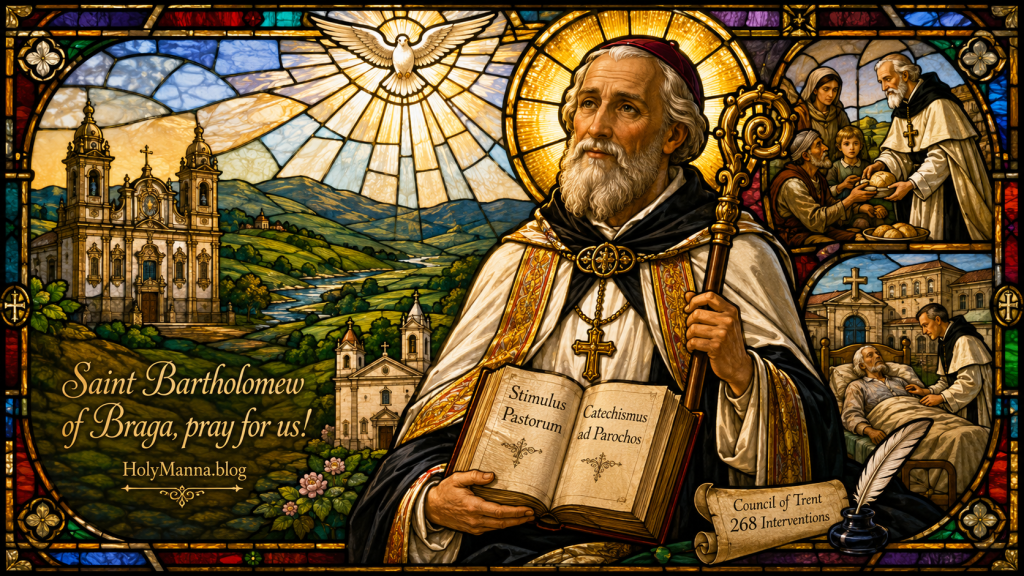
A Friar Who Never Wanted the Miter
Some saints charge into history like lightning. Others have to be dragged into it under obedience, protesting the whole way, and those are often the ones who change everything. Saint Bartholomew of Braga belongs firmly to the second kind. Born Bartolomeu Fernandes in Portugal in 1514, this quiet Dominican friar wanted nothing more than a classroom, a library, and a cell. Instead, God handed him one of the largest archdioceses in Europe at the precise moment the Church was bleeding from the wounds of the Protestant Reformation and desperate for shepherds who actually shepherded.
He answered that call so completely that he became one of the most influential voices at the Council of Trent, the great reforming council of the sixteenth century, where he offered 268 interventions and helped shape the decrees that renewed the Catholic priesthood and episcopacy for centuries. He wrote one of the first great vernacular catechisms so that ordinary Portuguese families could learn the faith in their own language. He personally mentored a young cardinal named Charles Borromeo, who would go on to become one of the most beloved reforming saints in Church history. He fed the starving during famine, nursed the sick during plague, built hospitals and hospices, and then, when the work was done, resigned his see and went home to die as a simple friar.
The Church venerates him as a patron of the Archdiocese of Braga, the flock he served with such total devotion. His feast is celebrated on July 16th, the day he entered eternal life in 1590. Pope Francis canonized him in 2019, calling him “a great evangelizer and pastor of his people.” What makes his story so compelling for the present moment is this: he lived through an age of scandal, confusion, and institutional failure inside the Church, and his response was not despair, not departure, but holiness. The Catechism teaches that “the Church is holy, though having sinners in her midst, because she herself has no other life but the life of grace” (CCC 827), and Bartholomew staked his entire life on that truth.
The Boy Baptized Among the Martyrs
Bartholomew was born on May 3, 1514, to Domingos Fernandes and Maria Correia, a family of humble means. Here the sources offer a small discrepancy worth naming honestly: the older Catholic Encyclopedia places his birth at Verdela, near Lisbon, while the Dominican Order and the Vatican records of his canonization say Lisbon itself. Either way, he was a son of the Lisbon area, born to parents with no wealth, no title, and no connections, which makes his later refusals of honor all the more believable. He never forgot where he came from.
Hours after his birth, his parents carried him to the parish church of Our Lady of the Martyrs, Nossa Senhora dos Mártires, to be baptized. That detail matters more than it first appears. When Bartholomew later entered religious life, he took the name Bartolomeu dos Mártires, Bartholomew of the Martyrs, out of veneration for the church of his baptism. He was never martyred; his name is a lifelong act of gratitude for the sacrament that made him a child of God. There is something beautifully Catholic in that. The Catechism teaches that “Baptism seals the Christian with the indelible spiritual mark (character) of his belonging to Christ” (CCC 1272), and Bartholomew wore his baptism in his very name for seventy-six years.
At thirteen years old, on November 11, 1527, he entered the Order of Preachers, the Dominicans, and made his profession on November 20, 1529. What followed was not drama but decades of hidden faithfulness. He completed his studies, taught philosophy at the Dominican convent in Lisbon, and then spent roughly twenty years teaching theology in various houses of his order. In 1551 he received the Master’s degree at the provincial chapter of Salamanca. While teaching at the famous monastery of Batalha, he was summoned to Évora by the Infante Dom Luis to direct the religious education of his son, Dom Antonio, who was preparing for the ecclesiastical state, and Bartholomew gave two years to that work.
This is the part of his life that should encourage anyone who feels ordinary. For more than thirty years, Bartholomew’s vocation looked like lesson plans, lectures, and the daily rhythm of Dominican prayer. There was no stage, no crowd, no crisis. Yet God was forging in that hiddenness exactly the man the Church would need. How much of your own faithfulness happens where no one sees it, and do you believe God is using it?
Obedience, Trent, and the Friendship That Shaped Two Saints
In 1558, everything changed against his will. Queen Catherine of Portugal wanted a new archbishop for Braga, the primatial see of Portugal, and her first choice was the celebrated Dominican Luis of Granada. Luis, who happened to be Bartholomew’s provincial superior, urged the queen to choose Bartholomew instead. Bartholomew refused. He wanted no part of it. Only when Luis of Granada commanded him under religious obedience did he accept, and in 1559 he was consecrated archbishop, his appointment confirmed by Pope Paul IV in the bull Gratiae divinae praemium. The Catechism reminds every believer that the episcopacy is a service, not a prize, teaching that bishops are appointed “to feed the Church by the word and grace of God” (CCC 886, quoting Lumen Gentium 11). Bartholomew understood the weight of that before he ever wore the miter, which is precisely why he tried to run from it.
Once consecrated, he held nothing back. When the Council of Trent resumed in 1561, Bartholomew traveled to Italy and took part in its final and most consequential sessions. The council Fathers came to esteem him for two things at once, his theological learning and the evident holiness of his life, and that combination gave him enormous influence, especially on the decrees reforming the life of the clergy. He made 268 interventions at the council. He argued relentlessly that bishops must live in their dioceses, preach constantly, and pour themselves out for souls at a time when many sees were treated as sources of income by absentee nobles. In an address at the council, he declared, “The blood of souls abandoned by their pastors cries out to heaven for vengeance.” Those are not the words of a timid man.
A story from those years has become the most famous episode of his life. Pope Pius IV introduced Bartholomew to the young Cardinal Charles Borromeo, the pope’s own nephew, and suggested that the reform of the cardinals might begin with Charles. According to the account preserved in the Catholic Encyclopedia, Bartholomew replied that if the princes of the Church had all been like Cardinal Borromeo, he would have proposed them as models for the reform of the rest of the clergy. A sharper version of this exchange circulates widely, in which Bartholomew is said to have declared that the most illustrious cardinals stood in need of a most illustrious reform. That punchier wording is a traditional account, told and retold across the centuries, and its exact phrasing cannot be verified against a primary source, so it is presented here as tradition rather than as an established verbatim quotation.
What is well documented is the friendship that followed. Charles Borromeo, wrestling with whether to abandon his position and retire to a monastery, opened his heart to Bartholomew in a private interview. Bartholomew praised the desire but told him plainly that it was God’s will for him to remain at his post and serve the Church from within. Charles obeyed, stayed, and became the great reforming Archbishop of Milan and one of the most consequential saints of the Catholic Reformation. Borromeo later wrote to Bartholomew in 1565, “Your figure is continually before my eyes. I have taken you as an example, your life under every virtuous and laudable aspect.” One saint forming another; that is how God renews His Church.
Bartholomew also gave Borromeo a copy of a work he had been compiling during the council for his own spiritual direction, a collection of passages from Scripture and the Church Fathers on the office of a bishop. At Borromeo’s insistence it was published in Rome in 1564 as the Stimulus Pastorum, a charge to pastors. In it Bartholomew asks, “Who is the Bishop if not the sun of his diocese, a man on fire, completely dedicated to conquering souls for Christ, who preaches so very often with the Word and always by example?” Remarkably, this book still speaks; a new English translation was published in 2022, and bishops read it to this day.
The Shepherd Who Smelled Like His Sheep
Bartholomew returned to Braga in February 1564 and immediately began doing at home what he had legislated at Trent. In 1566 he convened a major provincial synod, the fourth provincial council of Braga, whose decrees restored ecclesiastical discipline and lifted the moral and spiritual life of both clergy and people. He implemented the Tridentine reforms with a thoroughness that made Braga a model for the Catholic world, promoting the formation of clergy in the spirit of the council’s call for seminaries, insisting that priests actually teach, and preaching tirelessly himself.
His archdiocese was enormous, stretching across the rugged Minho region of northern Portugal, and Bartholomew refused to govern it from a palace. He undertook exhausting pastoral visitations, traveling into remote mountain villages to confirm children, correct abuses, and catechize the poor with his own voice. He believed that the faith belonged to everyone, not just the learned, and in 1562 he published his Catechismo ou Doutrina christiana, a catechism written in Portuguese so that ordinary families and parish priests could teach the faith clearly. The Church has always treasured this work of handing on the faith; the Catechism itself describes catechesis as “an education in the faith of children, young people and adults which includes especially the teaching of Christian doctrine imparted, generally speaking, in an organic and systematic way, with a view to initiating the hearers into the fullness of Christian life” (CCC 5, quoting Saint John Paul II). Bartholomew was doing precisely that four centuries before those words were written.
Then came the suffering years. A great famine struck the region, followed by a visitation of the plague, and it was in those horrors that the depth of Bartholomew’s charity was revealed. He gave away what he had, organized relief for the starving, and remained with his people when he could have fled. He founded a series of hospitals and hospices in and around Braga, institutions of mercy that served the sick and the poor. In him the words of the Lord found flesh: “whoever wishes to be great among you shall be your servant” (The Gospel of Matthew, Mt 20:26). The standard historical sources record no wonder-working miracles performed by Bartholomew during his lifetime, and honesty requires saying so plainly. His contemporaries did not remember him for marvels. They remembered him for something rarer, a bishop who was actually holy. In an age when holiness in high office was scarce, that itself struck people as a kind of miracle of grace.
Hardships Without Martyrdom
Bartholomew was not a martyr, and no account of his life should ever suggest otherwise; his name, as noted earlier, comes from the church of his baptism. But his life was not without heavy crosses. The first was the office itself. He genuinely did not want to be an archbishop, and he carried the burden of souls with a seriousness that bordered on dread. Those who knew his thought said he marveled that anyone would even desire such an office, given the heavy responsibility for souls it entailed.
The second cross was the work of reform itself. Anyone who has ever tried to change an institution knows the resistance Bartholomew faced. Entrenched clergy did not welcome a reformer who demanded residency, preaching, and moral seriousness. At Trent he did not hesitate to oppose powerful men, including on one occasion taking a position against the Archbishop of Toledo, Bartolomé Carranza, in a disputed matter. Speaking uncomfortable truth to the powerful, even within the Church, cost him comfort and won him enemies, yet he never wavered and never grew bitter. The famine and the plague were crosses of another kind, seasons in which he watched his people suffer and die while he worked himself to exhaustion serving them.
Finally there was the long cross of perseverance. He begged repeatedly to be allowed to resign, not from laziness but from a sincere conviction that his work was done and his soul needed silence. Pope Gregory XIII finally granted permission on February 20, 1582, and Bartholomew withdrew to the Dominican convent at Viana do Castelo, a convent he himself had founded. There he lived his final eight years in prayer, solitude, and teaching, a friar again at last. He died peacefully of natural causes on July 16, 1590. He was not martyred; he was spent, poured out drop by drop over decades, which is its own kind of total offering. The Catechism teaches that “the way of perfection passes by way of the Cross” (CCC 2015), and Bartholomew’s cross was the slow, unglamorous one of duty faithfully carried.
Four Centuries to the Altars
The people of Portugal did not wait for Rome to tell them what they had witnessed. Devotion to the holy archbishop began at his death and never faded, centered on his tomb at Viana do Castelo, which remains a place of veneration and pilgrimage in northern Portugal to this day. His memory became part of the spiritual identity of Braga itself, the ancient primatial see of Portugal, where he is honored as a patron of the archdiocese.
The formal path to the altars was extraordinarily long. The first process opened in 1631 under Archbishop Rodrigo da Cunha. The cause was formally introduced under Pope Benedict XIV on September 11, 1754, and Pope Gregory XVI declared him Venerable on May 23, 1845, recognizing that he had lived the Christian virtues to a heroic degree. Then the cause slept for another century and a half.
For his beatification, the Church required a verified miracle obtained through his intercession, and one came. A healing was investigated in Portugal and validated in Rome on March 12, 1999. In December 2000 the medical board of the Congregation for the Causes of Saints determined that the healing had no medical or scientific explanation, the theologians confirmed in 2001 that it came through Bartholomew’s intercession, and on July 7, 2001 Pope John Paul II formally declared it a genuine miracle. This is the one miracle attributed to him after death that the Church has formally verified, and it opened the door that had been closed for centuries. On November 4, 2001, Saint John Paul II beatified Bartholomew in Saint Peter’s Square, and heaven seemed to smile at the calendar, because November 4th is the feast day of Saint Charles Borromeo, the friend and spiritual son whom Bartholomew had once counseled to stay at his post.
The final chapter came within living memory. On July 5, 2019, Pope Francis approved his equipollent canonization, a solemn papal act that extends a blessed’s liturgical veneration to the universal Church on the strength of centuries of continuous devotion, waiving the requirement of a second miracle. With that decree, the reluctant archbishop of Braga was inscribed among the saints, and Pope Francis honored him as “a great evangelizer and pastor of his people.” The Church teaches that “by canonizing some of the faithful, i.e., by solemnly proclaiming that they practiced heroic virtue and lived in fidelity to God’s grace, the Church recognizes the power of the Spirit of holiness within her and sustains the hope of believers by proposing the saints to them as models and intercessors” (CCC 828). Four hundred and twenty-nine years after his death, Bartholomew became exactly that for the whole world.
What a Sixteenth-Century Reformer Says to You
It would be easy to file Bartholomew away as a bishop’s saint, relevant only to men in miters. That would be a mistake. His life speaks with startling directness to anyone trying to follow Christ in a confusing age, and especially to anyone tempted to despair over failures within the Church.
Start with his obedience. Bartholomew did not want the job God gave him. He accepted it only under obedience, and then he did it with his whole heart. Most people spend enormous energy resenting the duties they did not choose, the difficult family situation, the unglamorous job, the responsibility nobody else will carry. Bartholomew shows a different way: the duty you did not choose may be the exact instrument of your sanctification. The Catechism teaches that “all Christians in any state or walk of life are called to the fullness of Christian life and to the perfection of charity” (CCC 2013, quoting Lumen Gentium 40). Holiness is not somewhere else. It is inside the vocation already sitting in front of you. What responsibility in your life right now have you been treating as an obstacle to holiness rather than the path to it?
Consider next his approach to reform. Bartholomew lived in an era of genuine corruption in the Church, and he named it fearlessly, yet he never let scandal become an excuse to walk away or to grow cynical. He reformed by becoming holy himself, by preaching, catechizing, serving the poor, and forming one young man, Charles Borromeo, who would multiply his influence a hundredfold. When you are tempted to fix everyone else, remember that Bartholomew’s revolution began with a private collection of spiritual readings he compiled to correct his own heart. When something in the Church or in your family frustrates you, is your first move criticism, or conversion?
Finally, look at his charity. Doctrine and mercy were never rivals in his life. The same man who argued theology at Trent built hospitals during the plague and walked mountain trails to catechize peasants. Practical steps flow naturally from his example. A person could commit to learning the faith seriously this year, perhaps by reading a section of the Catechism each week, in honor of the great catechist. A person could take on one hidden act of service for the sick or the poor each month, in honor of the founder of hospices. A person could pray by name for their bishop and their pastor every day, in honor of the man who knew better than almost anyone how heavy that office is. Who is one person God has placed in your care, and what would it look like to serve them the way Bartholomew served Braga?
Engage With Us!
Saint Bartholomew of Braga waited more than four hundred years for the Church to declare what his people always knew, which is a good reminder that heaven keeps perfect records even when history forgets. Now it is your turn to sit with his story. Share your thoughts and reflections in the comments below; this community grows every time someone speaks honestly about their walk with Christ, and your experience may be exactly what another reader needs today.
Here are some questions to pray with this week:
- Bartholomew accepted the archbishopric only under obedience and then gave it everything he had. Where in your life is God asking you to stop resisting a responsibility and start embracing it as your path to holiness?
- He responded to corruption in the Church with personal holiness rather than cynicism. How do you respond when leaders in the Church, or in your own life, fail?
- His catechism put the faith into the hands of ordinary families. How intentionally are you learning your faith, and who could you help teach?
- He counseled Saint Charles Borromeo to stay at his post when Charles wanted to retreat. Has God ever used a friend to redirect you, and are you the kind of friend who could do that for someone else?
- After decades of labor, Bartholomew ended his life in silence and prayer. What does his hunger for solitude with God reveal about what your own soul might be missing?
However this story lands in your heart, do not let it stay on the page. The same Holy Spirit who took a poor boy from Lisbon and made him a light for the whole Church is at work in you through your own baptism. Live your faith boldly this week, carry your duties with joy, serve someone who cannot repay you, and do everything with the love and mercy that Jesus taught us.
Saint Bartholomew of Braga, pray for us!
Follow us on YouTube, TikTok, Instagram and Facebook for more insights and reflections on living a faith-filled life.


Leave a Reply