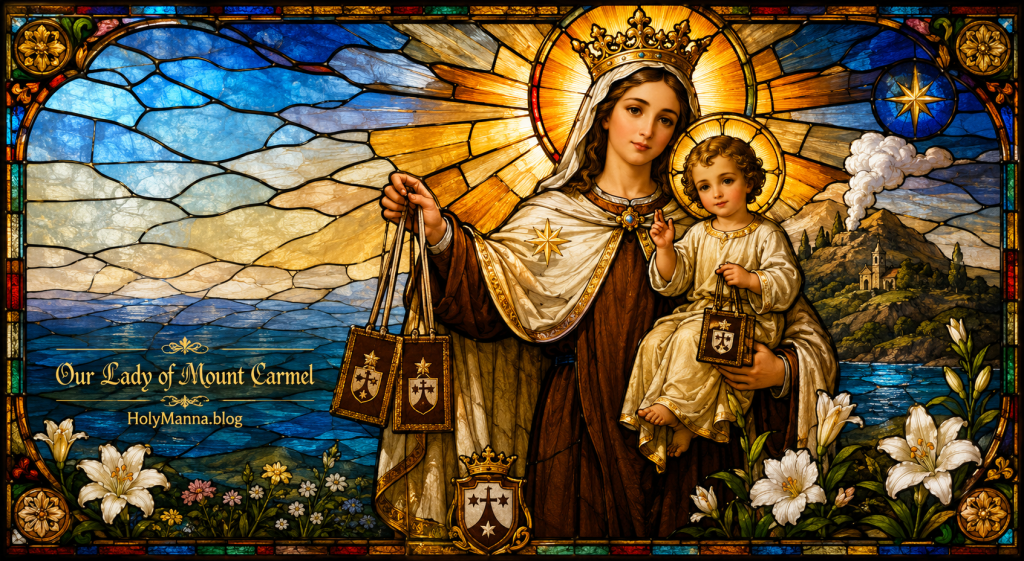
Clothed in Her Mantle
Every July 16th, the Church pauses to honor the Blessed Virgin Mary under one of her oldest and most beloved titles, Our Lady of Mount Carmel. On the General Roman Calendar the day is an Optional Memorial, though within the Carmelite family it is kept as a Solemnity, the principal celebration of the entire order, and parishes named for Our Lady of Mount Carmel celebrate it as their patronal solemnity as well. Whatever the formal rank, for millions of Catholics around the world this day feels like a family feast, because it celebrates something wonderfully personal: the maternal protection of Mary, expressed through one of the most familiar sacramentals in Catholic life, the brown scapular.
Unlike Lourdes, Fátima, or Guadalupe, this Marian title is not born from a single famous apparition. It is born from a place, and not just any place. Mount Carmel is the mountain of the prophet Elijah, the ridge overlooking the Mediterranean where the great prophet confronted the prophets of Baal and called Israel back to the one true God, as recounted in 1 Kings 18. Centuries before the first Hail Mary was ever prayed, Scripture already sang of this mountain’s loveliness. The prophet Isaiah promised that the desert would one day bloom with “the beauty of Carmel” (Isaiah 35:2). Christian tradition heard in that verse a whisper of Mary herself, the flowering of God’s grace in a barren world.
This celebration matters because it gathers so many threads of Catholic life into one day: the contemplative prayer of hermits, the boldness of a prophet, the tenderness of a Mother, the wisdom of three Doctors of the Church, and a small rectangle of brown wool that generations of ordinary Catholics have worn under their shirts as a quiet pledge of belonging to Jesus through Mary. It is a day about being clothed, interiorly and exteriorly, in the life of grace. The Catechism of the Catholic Church teaches that “the Church’s devotion to the Blessed Virgin is intrinsic to Christian worship” (CCC 971), and few devotions show that truth more concretely than the devotion of Carmel. The scapular is not jewelry and it is not a lucky charm. It is a sign of a relationship, and relationships change lives.
From Elijah’s Ridge to the Chapels of Europe
The story begins on the mountain itself. Sometime in the late 12th century, in the years of the Crusades, a group of Latin hermits settled on the slopes of Mount Carmel near the spring associated with Elijah. They wanted what Elijah wanted: to stand in the presence of the living God. In the midst of their cells they built a small chapel, and they dedicated it to the Blessed Virgin Mary. With the chivalric instincts of their age, they thought of her as the Lady of the place, and themselves as her brothers. In time they became known as the Brothers of the Blessed Virgin Mary of Mount Carmel. Between roughly 1206 and 1214, St. Albert of Jerusalem, the Latin patriarch, gave them a brief and beautiful rule of life centered on continual prayer, silence, work, and meditation on the law of the Lord day and night. Pope Honorius III gave the way of life papal approval in 1226, and Pope Innocent IV confirmed and adapted the rule in 1247 as the hermits, pressed by the dangers of Saracen conquest, migrated westward into Europe.
Europe did not exactly roll out a welcome mat. The Carmelites were a new and unusual form of religious life, hermits without a famous founder, and they struggled for acceptance alongside the established Benedictines, Cistercians, and the new mendicant orders. Their very name, Brothers of the Blessed Virgin Mary, was challenged. Tradition and historical record agree that the order’s early survival felt, to the friars themselves, like Mary’s personal doing.
The liturgical celebration grew out of that gratitude. The feast of Our Lady of Mount Carmel was probably first celebrated in England in the later part of the 14th century, as an act of thanksgiving to Mary for protecting the order through its difficult early years, quite possibly following the public vindication of the order’s Marian name at Cambridge in 1374. Some older devotional sources give 1332 as the year the feast was instituted within the order; the dating is disputed, and the later 14th century English origin is the better documented account. The date was originally July 17th, then moved to July 16th on the European mainland to avoid the feast of St. Alexis. The lovely hymn Flos Carmeli, the Flower of Carmel, first appears as the sequence for this Mass. Pope Sixtus V approved the feast in 1587, it was declared the patronal feast of the order after Cardinal Robert Bellarmine examined the Carmelite traditions in 1609, and Pope Benedict XIII extended it to the universal Church in 1726. From a chapel on a ridge in the Holy Land to every altar in the world; that is quite a journey for a family of hermits who only wanted to pray.
The Tradition of Saint Simon Stock and the Brown Scapular
Here the story reaches its most famous moment, and honesty requires care. According to a cherished Carmelite tradition, in the year 1251 the Blessed Virgin Mary appeared to St. Simon Stock, an English Carmelite who is believed to have served as prior general of the order during its anxious transition to European life. Tradition recounts that Mary held the Christ Child and extended the brown scapular, the apron-like garment of the Carmelite habit, with a promise preserved in a 14th century narrative: “whosoever dies clothed in this shall never suffer eternal fire” (traditional account of the scapular vision).
What is the Church’s judgment on this event? The Holy See has never issued a formal pronouncement affirming the historicity of the vision itself. It remains a tradition, and the faithful should know its documentary history plainly. The earliest written accounts appear roughly a century after the event they describe. The precise date of July 16th, 1251 derives from a letter attributed to Simon’s secretary, published in 1642, which historians since the early 20th century have judged to be a forgery. Even the original feast of July 16th had no specific connection to the scapular; that association grew gradually over the centuries. None of this is scandalous, and none of it is hidden by the Church. As a private revelation, the vision would in any case be non-binding on the faithful, for the Catechism teaches of private revelations that “they do not belong, however, to the deposit of faith” (CCC 67).
What the Church has approved, warmly and repeatedly for over seven centuries, is the devotion itself. The brown scapular is an approved sacramental, with its own Rite of Blessing of and Enrollment in the Scapular confirmed by the Congregation for Divine Worship. Pope after pope has commended it, worn it, and preached it. A related tradition, the so-called Sabbatine privilege concerning Mary’s aid on the Saturday after death, rests on a papal bull attributed to John XXII that scholars consider inauthentic; a decree of 1613 restricted how it could be preached, and today’s Carmelites do not promote it, encouraging instead confident trust in Mary’s intercession for the faithful departed, especially those who wore her scapular devoutly.
One more thread deserves mention. At Fátima, an apparition fully approved by the Church in 1930, the three shepherd children reported that in the final vision of October 13th, 1917, Our Lady appeared under several aspects, among them Our Lady of Mount Carmel holding the scapular. Sr. Lúcia later explained, in her personal testimony, that Our Lady desires all the faithful to wear it. Heaven, it seems, has a long memory for Carmel.
Mother, Advocate, and Sign: The Theology Beneath the Wool
Strip away the wool and the processions, and what remains is doctrine, solid and beautiful. Devotion to Our Lady of Mount Carmel rests on the Church’s constant teaching about Mary’s spiritual motherhood. The Catechism, quoting St. Augustine, calls Mary “clearly the mother of the members of Christ” (CCC 963), because by her charity she cooperated in the birth of believers into the Church. Her motherhood in the order of grace did not end at the Cross or the Assumption; it continues until the eternal fulfillment of all the elect, which is why the Church invokes her as “Advocate, Helper, Benefactress, and Mediatrix” (CCC 969), titles that take nothing away from Christ the one Mediator but rather flow from the superabundance of his merits (CCC 970).
The Second Vatican Council devoted the entire eighth chapter of Lumen Gentium to Mary’s place in the mystery of Christ and the Church, and St. Paul VI’s Marialis Cultus insisted that authentic Marian devotion must be biblical, liturgical, and ordered to Christ. St. John Paul II deepened the same vision in Redemptoris Mater, and he gave the Church its richest modern teaching on this particular devotion in his Message to the Carmelite Family of March 25th, 2001, written for the 750th anniversary of the scapular tradition. There the Pope taught that “the Scapular is essentially a ‘habit’”, a garment in the deepest sense; those who receive it are associated with the family of Carmel and commit themselves to a permanent orientation of Christian living, woven of prayer, the sacraments, and the works of mercy. He recalled, citing Pius XII’s 1950 letter Neminem profecto latet, that the truest form of the devotion is consecration to the Immaculate Heart of Mary, and he offered his own moving witness that he had worn the scapular of Carmel over his heart since long before his papacy.
The theology of the scapular as a sacramental matters enormously here. The Catechism teaches that sacramentals are sacred signs instituted by the Church that prepare the faithful to receive grace and dispose them to cooperate with it (CCC 1667). They sanctify the ordinary occasions of life (CCC 1668), but they are not sacraments, and “sacramentals do not confer the grace of the Holy Spirit” in the way the sacraments do (CCC 1670). The scapular saves no one by magic; treating any object as automatically effective would fall into the superstition the Church explicitly warns against (CCC 2111). What the scapular does is enroll a believer in a school of prayer whose headmistress is the Mother of God, the perfect model of prayer, of whom the Catechism says “we can pray with and to her” (CCC 2679). Carmel’s whole genius is contemplative intimacy with God, and Mary is its living pattern.
Enrollment, Confraternity, and the Holy Places of Carmel
So how does a person actually live this devotion? The traditional path begins with enrollment. A priest or authorized minister invests the faithful in the brown scapular using the approved rite, and from that moment the small cloth version, or the approved scapular medal, is worn as a continual sign of belonging to Mary and, through her, to Christ. The Carmelite orders have long fostered the Confraternity of the Brown Scapular, which spiritually associates lay wearers with the prayers and good works of the whole Carmelite family. The conditions of the devotion have always pointed beyond the object itself: wear the sign faithfully, live chastely according to one’s state in life, and pray daily, with many devotees taking up the Rosary or the Little Office of the Blessed Virgin Mary. The wool is the reminder; the life is the devotion.
Pilgrimage keeps this devotion rooted in real soil. On Mount Carmel itself, above the modern city of Haifa, stands the Stella Maris Monastery of the Discalced Carmelite friars, built over a grotto associated with the prophet Elijah, where the order returned to its birthplace after centuries of exile. In Kent, England, Aylesford Priory, known simply as The Friars, was a home of the medieval English Carmelites and, according to tradition, of St. Simon Stock himself; restored to the order in the 20th century, it now welcomes pilgrims and houses the relic of St. Simon’s skull, returned from Bordeaux where he died. In Naples, the Basilica of Santa Maria del Carmine Maggiore shelters the ancient icon lovingly called the Madonna Bruna, the Brown Madonna, a magnet for centuries of southern Italian devotion. And in Chile, the National Votive Shrine of Maipú rises on the field where, in 1818, the fathers of Chilean independence entrusted their cause to Our Lady of Mount Carmel and vowed a temple in her honor. Each of these places tells the same story in a different accent: the Lady of the place has become the Lady of every place.
Pilgrims come to these shrines for the same reasons the first hermits climbed the mountain, silence, conversion, and the sense of being personally awaited by a Mother. Confession lines at Carmelite shrines on July 16th are famously long, and that is exactly the point. The scapular is an invitation to grace, and grace does its deepest work in the sacraments.
Boats, Bell Towers, and Brass Bands: Carmel Around the World
Few Marian titles have sunk deeper roots into popular culture. In Chile, Our Lady of Mount Carmel was adopted in the 19th century as patroness of the nation; she is honored as the Queen of Chile, her image is carried in massive national celebrations, and the shrine of Maipú stands as the country’s votive thanksgiving for independence. Across the Spanish-speaking world she is the beloved Virgen del Carmen, patroness of sailors and fishermen, and by royal decree of 1901 the patroness of the Spanish Navy. On July 16th, coastal towns throughout Spain and Latin America carry her image out onto the water in flower-covered boats, whole flotillas escorting the Star of the Sea across the harbors she guards.
Italy celebrates with characteristic exuberance. In Naples, the festa of the Madonna del Carmine culminates in the spectacular symbolic burning of the basilica’s bell tower in fireworks, a tradition of thanksgiving centuries old. Italian immigrants carried the feast across the Atlantic, and it took glorious root in New York City. The feast of Our Lady of Mount Carmel in East Harlem has been celebrated since the 1880s, and its church was honored with a canonically crowned image of the Madonna; in Williamsburg, Brooklyn, the annual feast is famous for the Dancing of the Giglio, in which more than 100 men carry a towering decorated spire and a full brass band through the streets on their shoulders. In the Philippines, in India, in Africa, wherever Carmelites and Spanish or Italian missionaries planted the Gospel, July 16th blossoms into processions, novenas, and family celebrations.
The cultural impact runs deeper than festivity. Carmel gave the Church three Doctors: St. Teresa of Ávila, St. John of the Cross, and St. Thérèse of Lisieux, whose writings on prayer have formed countless souls far beyond Catholic boundaries. It gave martyrs like St. Teresa Benedicta of the Cross, Edith Stein, and Bl. Titus Brandsma, witnesses against the darkest ideologies of the 20th century. A devotion capable of producing both a street festival with fireworks and the Dark Night of the Soul is a devotion that has baptized the whole human personality, body and spirit together. That is Catholicism at its most itself.
Living Under the Mantle Today
What does all this mean for you, on an ordinary Wednesday in July, with emails waiting and traffic ahead? Start with St. John Paul II’s word: habit. The scapular is essentially a habit, and so is holiness. Holiness is not a mood or a burst of enthusiasm after a good retreat; it is a permanent orientation of life, renewed in small choices every single day. Mary’s greatness was exactly this. At the Annunciation she answered, “Be it done to me according to thy word” (Luke 1:38), and she kept answering it in thirty hidden years of cooking, cleaning, praying, and loving. Her only recorded instruction to the Church is the one she gave the servants at Cana: “Whatsoever he shall say to you, do ye” (John 2:5). Carmel simply takes her at her word.
Consider a few concrete steps. If you have never been enrolled in the brown scapular, ask a priest; the rite takes minutes and the grace lasts a lifetime. If you already wear it, let it interrupt you: each time you feel the wool or the medal, breathe a short prayer, a Hail Mary, or simply the name of Jesus. Claim 10 minutes of real silence each day, phone in another room, and sit with the Lord the way the hermits sat on the mountain; contemplative prayer is not a luxury for monks but the birthright of the baptized. Take up some practice of mercy that costs you something, since the same papal message that praised the scapular tied it firmly to the spiritual and corporal works of mercy. And when life turns dry and confusing, remember the prophet on Carmel, who watched the empty sky until his servant finally saw “a little cloud arose out of the sea like a man’s foot” (1 Kings 18:44), the small beginning of the drenching rain. Tradition has long seen in that little cloud a figure of Mary, the small, quiet answer to a long drought. Your perseverance in prayer is watching for that cloud.
When Jesus, dying, said to the beloved disciple, “Behold thy mother” (John 19:27), the Church has always heard those words addressed to every disciple. The scapular is simply that verse in wearable form. St. Teresa of Ávila, Carmel’s great reformer, left a bookmark prayer that could be the motto of everyone under Mary’s mantle: “Let nothing disturb you… God alone suffices” (Bookmark of St. Teresa). Wear that truth. Live inside it. That is what it means to be clothed in Carmel.
Engage With Us!
The story of Our Lady of Mount Carmel belongs to the whole family of God, which includes you, so share your thoughts and reflections in the comments below. Have you worn the brown scapular, visited a Carmelite shrine, or grown up with a Virgen del Carmen procession in your town? Your experiences encourage everyone who reads them. Take a few of these questions to prayer today:
- What would change in your daily routine if devotion to Mary became a habit, a permanent orientation, rather than an occasional prayer?
- Where in your life are you watching an empty sky like Elijah, and how might Mary be the small cloud announcing God’s coming rain?
- The scapular is a sign, not a charm. Are there places where your faith has drifted toward superstition rather than trust, and what would purify it?
- Which Carmelite saint, Teresa of Ávila, John of the Cross, or Thérèse of Lisieux, is God inviting you to read this year?
- What is one concrete work of mercy you can complete before the end of this week as a gift to Jesus through Mary?
May the Blessed Virgin of Mount Carmel wrap every reader in her mantle, lead each heart up the mountain of prayer, and keep the whole HolyManna family close to her Son. Grow together in faith under the guidance of our Blessed Mother, and may her promise of protection accompany every step of the journey home.
Our Lady of Mount Carmel, pray for us!
Follow us on YouTube, TikTok, Instagram and Facebook for more insights and reflections on living a faith-filled life.


Leave a Reply