Thursday of the Fifteenth Week in Ordinary Time – Lectionary: 392
When the Soul Runs Out of Strength
There is a particular kind of tiredness that sleep cannot fix. It settles somewhere beneath the shoulders, in the place where worry lives, and no vacation, no scrolling, no productivity hack ever quite reaches it. Today’s readings speak directly to that exhaustion, and they do so with breathtaking honesty. The prophet Isaiah gives voice to a people who have labored and strained like a woman in childbirth, only to produce nothing but wind. The psalmist prays from the dust of a ruined city, clinging to the memory of God’s mercy. And then Jesus steps into the middle of all that weariness and says the words that have drawn burdened hearts to Him for two thousand years: “Come to me, all you who labor and are burdened, and I will give you rest.”
The central theme uniting these readings is rest and resurrection for those who cannot carry the weight alone. Isaiah’s community, likely praying under the shadow of exile, discovered that salvation could not be self-manufactured; it had to be received. The psalmist, writing what tradition counts among the seven Penitential Psalms, learned that the Lord hears “the plea of the lowly” precisely when human strength has failed. And in the Gospel, Christ reveals that the answer to human exhaustion is not a technique but a Person, His own meek and humble Heart. The readings trace a single arc, from the anguished longing of the night watches, through the confident hope of the exile, to the open arms of the Savior. For anyone running on empty this Thursday in Ordinary Time, the Church could hardly have chosen a more consoling word.
First Reading — Isaiah 26:7-9, 12, 16-19
Giving Birth to Wind, Waking to Light
This passage comes from the section of Isaiah that scholars often call the Isaiah Apocalypse, spanning chapters 24 through 27, a sweeping cycle of songs about judgment, ruin, and the astonishing hope that God will bring life out of death itself. Chapter 26 is a song of trust sung by the community of Judah, almost certainly reflecting the crushing experience of exile or foreign domination. The people have been disciplined, humbled, and emptied of every illusion of self-sufficiency. What makes this text extraordinary is where it lands: verse 19 stands with Daniel 12:2 and Ezekiel 37 as one of the clearest Old Testament affirmations of bodily resurrection. Centuries before the empty tomb, God was already teaching His people that the grave would not have the last word. The reading fits today’s central theme perfectly, because it is the testimony of a people who tried to save themselves, failed completely, and discovered that God gives what human labor never could.
Isaiah 26:7-9, 12, 16-19 – New American Bible (Revised Edition)
7 The way of the just is smooth;
the path of the just you make level.
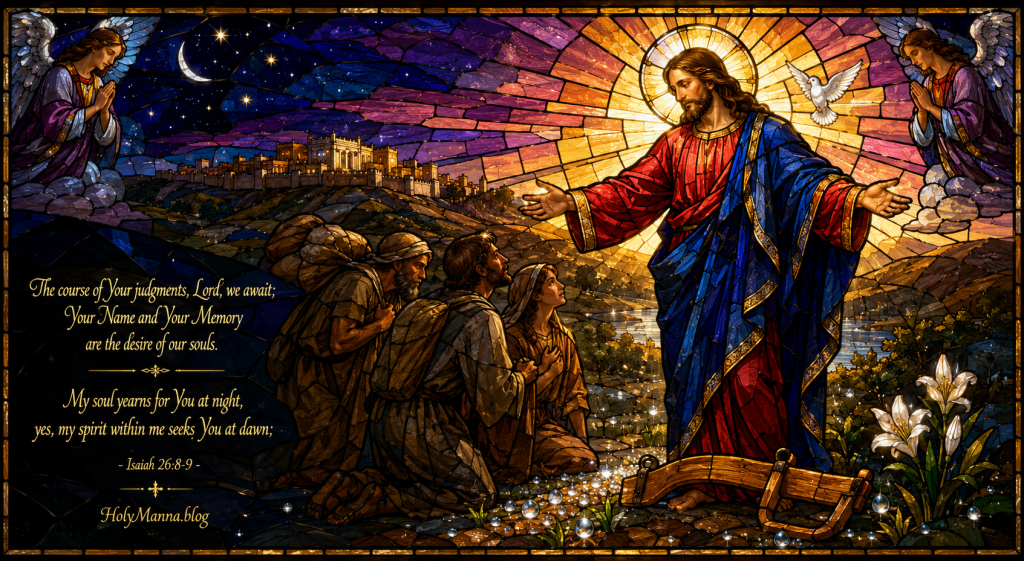
8 The course of your judgments, Lord, we await;
your name and your memory are the desire of our souls.
9 My soul yearns for you at night,
yes, my spirit within me seeks you at dawn;
When your judgment comes upon the earth,
the world’s inhabitants learn justice.12 Lord, you will decree peace for us,
for you have accomplished all we have done.16 Lord, oppressed by your punishment,
we cried out in anguish under your discipline.
17 As a woman about to give birth
writhes and cries out in pain,
so were we before you, Lord.
18 We conceived and writhed in pain,
giving birth only to wind;
Salvation we have not achieved for the earth,
no inhabitants for the world were born.
19 But your dead shall live, their corpses shall rise!
Awake and sing, you who lie in the dust!
For your dew is a dew of light,
and you cause the land of shades to give birth.
Detailed Exegesis
Verse 7: “The way of the just is smooth; the path of the just you make level.”
The song opens with quiet confidence. The path of the righteous is not smooth because life is easy, but because God Himself levels it. The Hebrew wisdom tradition consistently teaches that walking in God’s ways brings an interior steadiness the wicked never know. The verse establishes from the outset that everything good in the just person’s journey is God’s doing.
Verse 8: “The course of your judgments, Lord, we await; your name and your memory are the desire of our souls.”
Waiting is the posture of Israel at prayer. The people do not demand; they await. And what they desire is not merely rescue but God Himself, His name and His memory. This is the language of love, not transaction. The soul that has been stripped of everything discovers that God was the true desire underneath every lesser longing all along.
Verse 9: “My soul yearns for you at night, yes, my spirit within me seeks you at dawn; When your judgment comes upon the earth, the world’s inhabitants learn justice.”
The yearning here spans the whole night, from dusk to dawn, the hours when anxiety keeps a person staring at the ceiling. The prophet transforms sleeplessness into vigil. The second half of the verse adds that God’s judgments are not merely punitive; they are pedagogical. When God acts in history, the world learns what justice actually is.
Verse 12: “Lord, you will decree peace for us, for you have accomplished all we have done.”
This is one of the most theologically loaded lines in the passage. Whatever good Israel has done, God accomplished it. Grace precedes, accompanies, and completes every human work. The peace the people hope for is decreed by God, not negotiated by them. Saint Paul will later say the same thing about salvation itself in Ephesians 2:8-9.
Verse 16: “Lord, oppressed by your punishment, we cried out in anguish under your discipline.”
The community does not pretend its suffering came from nowhere. It names the exile as discipline, the painful correction of a Father who refuses to abandon His children to their sins. Crying out in anguish is itself an act of faith, because the cry is directed to the very God whose discipline they feel.
Verse 17: “As a woman about to give birth writhes and cries out in pain, so were we before you, Lord.”
The birth-pang image is among the most vivid in the prophets. Labor pain is suffering oriented toward life; it promises that something new is coming. Israel dares to hope that its anguish is not meaningless agony but the travail that precedes birth.
Verse 18: “We conceived and writhed in pain, giving birth only to wind; Salvation we have not achieved for the earth, no inhabitants for the world were born.”
And then the devastating admission. All that labor produced nothing. Wind. This is the honest bottom of the passage: human effort, even religious effort, cannot manufacture salvation. Every self-improvement project, every attempt to earn one’s way back to God, ends in this verse. The confession is not despair; it is the clearing of the ground so that grace can build.
Verse 19: “But your dead shall live, their corpses shall rise! Awake and sing, you who lie in the dust! For your dew is a dew of light, and you cause the land of shades to give birth.”
The word “But” changes everything. Where human labor gave birth to wind, God causes the very land of the dead to give birth. The dead will live. Corpses will rise. Those lying in the dust are commanded not merely to wake but to sing. The “dew of light” is a stunning image found nowhere else in Scripture: as morning dew quietly renews the parched earth, so God’s life will quietly, irresistibly renew the dead. The Church reads this verse as prophecy fulfilled in the Resurrection of Jesus Christ and awaiting its completion in the resurrection of the body confessed in the Creed.
Teachings
The Catechism of the Catholic Church teaches that this doctrine unfolded gradually across salvation history. CCC 992 states, “God revealed the resurrection of the dead to his people progressively.” Isaiah 26:19 is a landmark in that progression, a shaft of light centuries before Easter morning. CCC 993 adds that the Pharisees and many of the Lord’s contemporaries held this hope, and that Jesus taught it firmly, while CCC 1002 draws the truth into the present tense for the baptized, teaching that Christ will raise believers on the last day and that, in a real sense, they have already risen with Him through Baptism.
The passage also teaches the theological virtue of hope. CCC 1817 defines it: “Hope is the theological virtue by which we desire the kingdom of heaven and eternal life as our happiness, placing our trust in Christ’s promises and relying not on our own strength, but on the help of the grace of the Holy Spirit.” Notice how precisely that definition matches Isaiah’s movement: the people stop relying on their own strength, which gave birth to wind, and rest their trust entirely on God’s promise. Pope Benedict XVI captured the transforming power of this virtue in his encyclical Spe Salvi, writing that “the one who has hope lives differently.” A person who genuinely believes verse 19 cannot look at a cemetery, a diagnosis, or a dying world the same way again.
Reflection
Everyone has a verse 18 season, a stretch of life spent laboring furiously and producing wind. Maybe it is a career that was supposed to bring fulfillment, a relationship carried alone, or a private campaign of self-improvement that never quite delivers. This reading gives permission to name that failure honestly before God, because the confession of verse 18 is the doorway to the promise of verse 19.
A concrete step for today: take the anxiety that keeps you up at night and consciously turn it into Isaiah’s vigil. Instead of scrolling at midnight, pray one line: “My soul yearns for you at night.” Let the sleeplessness become seeking. Another step: visit the grave of a loved one, or simply call their name in prayer, and speak verse 19 over them as an act of faith in the resurrection.
Where in your life have you been giving birth to wind, laboring for something only God can accomplish? Do you truly believe that the dead shall live, and how would your daily choices change if that belief moved from your head to your heart?
Responsorial Psalm — Psalm 102:13-21
Written for a People Not Yet Born
Psalm 102 carries an ancient superscription identifying it as the prayer of one afflicted, faint and pouring out anguish before the Lord, and Church tradition has long counted it as the fifth of the seven Penitential Psalms, prayed for centuries in seasons of repentance and sorrow. The verses the Church selects today form the psalm’s great turning point. In the earlier verses, the psalmist describes himself as withered grass, a lonely bird on a rooftop, a man whose days vanish like smoke. Then, at verse 13, he lifts his eyes. The setting is almost certainly the Babylonian exile: Jerusalem lies in ruins, and the faithful love even her rubble, her stones and her dust. Yet precisely from the rubble, the psalmist declares that the Lord is enthroned forever and that the appointed time of mercy has come. This psalm belongs to today’s theme because it shows what the lowly do when they cannot rebuild their own lives: they appeal to the God who rebuilds, and He does not scorn their prayer.
Psalm 102:13-21 – New American Bible (Revised Edition)
13 But you, Lord, are enthroned forever;
your renown is for all generations.
14 You will again show mercy to Zion;
now is the time for pity;
the appointed time has come.
15 Its stones are dear to your servants;
its dust moves them to pity.
16 The nations shall fear your name, Lord,
all the kings of the earth, your glory,
17 Once the Lord has rebuilt Zion
and appeared in glory,
18 Heeding the plea of the lowly,
not scorning their prayer.
19 Let this be written for the next generation,
for a people not yet born,
that they may praise the Lord:
20 “The Lord looked down from the holy heights,
viewed the earth from heaven,
21 To attend to the groaning of the prisoners,
to release those doomed to die.”
Detailed Exegesis
Verse 13: “But you, Lord, are enthroned forever; your renown is for all generations.”
Like Isaiah’s “But your dead shall live,” this verse pivots on a single word. But. The psalmist’s days vanish like smoke; the Lord is enthroned forever. Prayer becomes possible again the moment the sufferer stops staring at his own collapse and looks up at the throne that never falls.
Verse 14: “You will again show mercy to Zion; now is the time for pity; the appointed time has come.”
The psalmist does not merely hope for mercy someday; he announces that the appointed time has arrived. This is the boldness of biblical prayer, which takes God’s promises and respectfully presents them back to Him. The Church hears in this verse the fullness of time in which God sent His Son.
Verse 15: “Its stones are dear to your servants; its dust moves them to pity.”
Only real love cherishes rubble. The exiles love Jerusalem not for her glory but in her ruin. There is a lesson here about loving the Church, one’s family, and one’s own soul even in seasons of visible wreckage, because God’s servants never write off what God intends to rebuild.
Verse 16: “The nations shall fear your name, Lord, all the kings of the earth, your glory.”
The restoration of Zion is never a private affair. When God rebuilds His people, the nations notice. The psalmist glimpses what the prophets saw more fully: Israel’s redemption is meant to draw the whole world to the true God.
Verse 17: “Once the Lord has rebuilt Zion and appeared in glory.”
Rebuilding and glory arrive together. For the Christian reader, this verse points beyond the second Temple to the true rebuilding: Christ, who spoke of the temple of His Body destroyed and raised in three days, as recounted in The Gospel of John, chapter 2.
Verse 18: “Heeding the plea of the lowly, not scorning their prayer.”
This is the heart of today’s psalm and the reason the Church pairs it with the Gospel. The God enthroned forever, feared by kings, bends down to the lowly and does not scorn their prayer. No throne in human history has ever worked that way. His does.
Verse 19: “Let this be written for the next generation, for a people not yet born, that they may praise the Lord.”
The psalmist consciously writes for readers he will never meet. Every Catholic praying this psalm today is that people not yet born. Across roughly two and a half millennia, the message arrives intact: God heard the lowly then, and He hears them now.
Verse 20: “The Lord looked down from the holy heights, viewed the earth from heaven.”
God’s transcendence never means distance. The One who dwells in holy heights looks down deliberately, attentively, like a father leaning over a crib. The Incarnation will reveal just how far down that look was willing to go.
Verse 21: “To attend to the groaning of the prisoners, to release those doomed to die.”
The psalm ends today on liberation. God attends to groaning prisoners and releases those doomed to die. The exiles heard their own hope in these words; the Church hears the mission of Christ, who announced liberty to captives, and who descended even to the dead to release those the world had doomed.
Teachings
The Catechism describes exactly the spiritual posture this psalm embodies. CCC 716 speaks of the People of the poor, those who, “humble and meek, rely solely on their God’s mysterious plans”, awaiting justice not from men but from the Messiah. The exiles of Psalm 102 are charter members of that people, and every Christian who prays from a place of ruin joins them. The Catechism also teaches in CCC 2559 that “humility is the foundation of prayer.” The psalmist proves the point: his prayer gains power precisely where his pride has died, in the dust of a broken city.
Saint Augustine, who prayed and preached the Psalms constantly and whose Expositions on the Psalms remains one of the treasures of the Church, taught that in the Psalter Christ prays in His members and His members pray in Him. That principle transforms this psalm: when the lowly Christian groans, Christ groans in him; when Christ was heard, the Christian was heard in Him. The Letter to the Hebrews confirms this christological reading, quoting the later verses of this very psalm, in Hebrews 1:10-12, and applying them directly to the Son through whom the heavens were founded. A prayer composed by an anonymous, afflicted exile became, under the Holy Spirit, a prayer about Jesus Christ. That is how seriously God took the plea of one lowly soul.
Reflection
Modern life trains people to hide ruin. Social media rewards the highlight reel, and even prayer can become a performance of having it together. Psalm 102 teaches the opposite discipline: bring the rubble. Show God the stones and the dust.
A concrete practice for this week: identify one ruined place in your life, a broken friendship, a neglected prayer life, a habit you have failed to conquer, and pray verse 14 over it aloud: “Now is the time for pity; the appointed time has come.” Then take one small rebuilding action, a text message, ten minutes of silence, a confession scheduled. Another practice: do something today for a future generation that will never know your name, exactly as the psalmist did in verse 19. Teach a child a prayer. Write down your testimony. Plant something.
What ruin in your life have you stopped bringing to God because you assumed it was beyond rebuilding? If this psalm was written for a people not yet born, what are you writing, saying, or doing today for the generation that will come after you?
Holy Gospel — Matthew 11:28-30
The Only Time Jesus Describes His Own Heart
These three verses arrive at a striking moment in The Gospel of Matthew. Jesus has just pronounced woes over the unrepentant towns of Chorazin, Bethsaida, and Capernaum, and then turned to His Father in a prayer of praise, thanking Him for revealing the mysteries of the Kingdom not to the wise and learned but to the childlike. Then, without pause, He turns to the crowd, and to every burdened soul in every century since, with an invitation. The “yoke” was a familiar image in Jewish teaching; the wisdom tradition, as in Sirach 51:26, invited disciples to submit their necks to the yoke of Wisdom, and rabbis spoke of the yoke of the Law. But the scribes and Pharisees, as Jesus says later in Matthew 23:4, tied up heavy burdens and laid them on people’s shoulders without lifting a finger to move them. Into that religious exhaustion, and into every modern exhaustion, Jesus speaks as Wisdom in person, offering not a lighter version of the rules but Himself. This is the only passage in all four Gospels where Jesus describes His own Heart, and the Church’s entire devotion to the Sacred Heart flows from it. It gathers today’s theme into a single embrace: the God who raises the dead and hears the lowly now opens His arms and says, come.
Matthew 11:28-30 – New American Bible (Revised Edition)
The Gentle Mastery of Christ. 28 “Come to me, all you who labor and are burdened, and I will give you rest. 29 Take my yoke upon you and learn from me, for I am meek and humble of heart; and you will find rest for yourselves. 30 For my yoke is easy, and my burden light.”
Detailed Exegesis
Verse 28: “Come to me, all you who labor and are burdened, and I will give you rest.”
Three things demand attention. First, the direction: come to me, not to a program, a philosophy, or a set of techniques. Christianity is a Person before it is anything else. Second, the audience: all who labor and are burdened, with no exceptions, no prerequisites, no entrance exam. The word for labor suggests toiling to the point of exhaustion. Third, the promise: I will give you rest. Rest is given, not earned, which is precisely what Isaiah’s exhausted laborers discovered when their striving gave birth only to wind. The rest Jesus offers is not the absence of work but the presence of God, the interior stillness of a soul reconciled to its Maker.
Verse 29: “Take my yoke upon you and learn from me, for I am meek and humble of heart; and you will find rest for yourselves.”
Remarkably, Jesus does not remove the yoke; He replaces it. Discipleship still involves weight, obedience, and effort, but the yoke is now His, shared with Him, fashioned by the carpenter who knows exactly how a yoke should fit. To take His yoke is to learn from Him, and the word for learning is the root of the word disciple. Then comes the revelation without parallel: meek and humble of heart. Almighty God, through whom all things were made, describes His inmost Heart with the two qualities the world respects least. Meekness is not weakness; it is strength under perfect control. Humility is not self-hatred; it is living in the truth. The rest promised here echoes the invitation of God to Israel in Jeremiah 6:16 to walk the good way and find rest for their souls.
Verse 30: “For my yoke is easy, and my burden light.”
The Greek word rendered easy carries the sense of well-fitting and kind. His yoke does not chafe because it was made for the one who wears it. The paradox resolves once a person realizes what the alternative actually weighs. Sin promises freedom and delivers slavery; the commandments look like burdens and turn out to be wings. Everyone carries some yoke, whether ambition, anxiety, addiction, or the exhausting project of self-justification. Jesus simply asks which yoke a person would rather wear, and He is the only master who climbs into the harness alongside His servant.
Teachings
Saint John Chrysostom preached on this very passage in his Homily 38 on Matthew, and his words remain as fresh as the day he spoke them. Addressing the fear these verses might stir, he taught, “Be not afraid, says He, hearing of a yoke, for it is easy: fear not, because I said, a burden, for it is light.” Chrysostom then turned the whole question around, observing that Christ said come, you that labor and are heavy laden, precisely because “sin too has labor, and a burden that is heavy and hard to bear.” In other words, the choice is never between a burden and no burden; it is between the crushing weight of sin and the well-fitted yoke of grace. He added that for the soul that is prepared and in earnest, all becomes easy and light.
The Catechism presents this Gospel as the pattern of Christian holiness. CCC 459 teaches, “The Word became flesh to be our model of holiness,” and cites this very verse, “Take my yoke upon you, and learn from me,” as Christ’s own summons to imitation. And Saint Augustine, in the opening lines of his Confessions, gave the Church the sentence that explains why this invitation never stops working: “You have made us for yourself, O Lord, and our heart is restless until it rests in you.” Every generation rediscovers that restlessness under new names, burnout, anxiety, languishing, and every generation finds the same answer waiting in these three verses. The Litany of the Sacred Heart enshrines the lesson permanently, invoking Jesus, meek and humble of heart, and asking Him to make our hearts like His.
Reflection
The hardest word in this Gospel is the first one. Come. Not achieve, not fix yourself first, not clean up and then approach. Come as you are, burdens and all. For many people between twenty and forty-five, exhaustion has become an identity, worn almost like a badge. Jesus offers a different identity: not the one who carries everything, but the one who is carried.
A concrete step for today: make a literal list of your burdens, name them one by one, and then bring the list before the Blessed Sacrament or a crucifix and read it aloud to Jesus, ending each item with the words, I give this to you. Another step: memorize verse 28 this week and pray it every time stress spikes, at the red light, before the meeting, in the checkout line. Let it become the heartbeat of your day. Finally, imitate the Heart you are learning from: choose one deliberate act of meekness today, absorbing an irritation without retaliation, and one act of humility, letting someone else take the credit.
What yoke are you currently wearing that Jesus never asked you to carry? When Jesus says learn from me, what is one specific way you could study His meekness and humility this week?
The God Who Climbs Into the Harness
Step back and watch how these readings move. Isaiah’s people labor through the night and give birth to wind, then hear the impossible promise that their dead shall live and that the dust itself will sing. The psalmist prays from the rubble of Jerusalem and discovers that the Lord enthroned forever bends low to hear the plea of the lowly, releasing prisoners doomed to die. And then Jesus of Nazareth stands before the crowds and gathers every one of those promises into His own person: “Come to me, all you who labor and are burdened, and I will give you rest.”
The story the Church tells today is simple and staggering. Salvation is not achieved; it is received. Rest is not earned; it is given. Resurrection is not a metaphor; it is a promise sealed on Easter morning by the same Lord whose dew is a dew of light. The exhausted world keeps offering new techniques for carrying the unbearable, but the Gospel offers something no technique can match: a God who climbs into the harness beside His creature and pulls.
So here is the invitation for this ordinary Thursday in Ordinary Time. Stop giving birth to wind. Bring the rubble, the stones and the dust of whatever lies in ruins, and hand it to the One who rebuilds Zion. Take the list of burdens that keeps you awake at night and trade it for a yoke that actually fits, fashioned by the carpenter of Nazareth, meek and humble of heart. The dead shall live. The lowly are heard. The weary find rest. That is not wishful thinking; that is the Catholic faith, written long ago for a people not yet born, which means it was written for you. Awake, and sing.
Engage With Us!
The conversation does not end with the final paragraph; it begins there. Share your reflections in the comments below, because your experience of these readings may be exactly the encouragement another reader needs today. To help you pray with the Scriptures, here are some questions to carry into your day:
- In Isaiah 26:7-9, 12, 16-19, the people confess that their labor gave birth only to wind before God promised that the dead shall live. Where have you been striving in your own strength, and what would it look like to hand that struggle over to the God who raises the dust?
- In Psalm 102:13-21, the psalmist writes for a people not yet born, confident that God heeds the plea of the lowly. What is one thing you can say, write, or do today that will pass the faith on to a generation you may never meet?
- In Matthew 11:28-30, Jesus describes His own Heart as meek and humble and invites the burdened to take His yoke. Which burden are you carrying right now that Jesus is asking you to exchange for His well-fitted yoke?
- Taken together, the readings proclaim rest and resurrection for those who cannot carry the weight alone. How is God inviting you to stop performing strength and start receiving grace this week?
Living a life of faith does not mean pretending the burdens are not real. It means knowing whose shoulders they ultimately rest on. Walk gently today, love generously, and do everything with the love and mercy Jesus taught us, for His yoke is easy, and His burden is light.
Sacred Heart of Jesus, we trust in You!
Immaculate Heart of Mary, pray for us!
Saint Michael the Archangel, defend us in battle!
Follow us on YouTube, TikTok, Instagram and Facebook for more insights and reflections on living a faith-filled life.

 Holy Manna!
Leave a comment