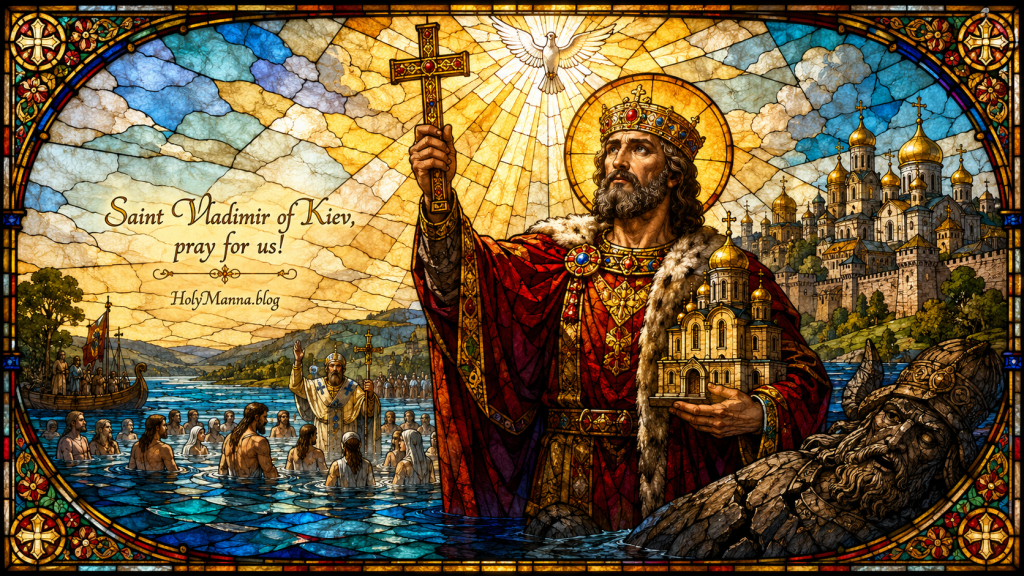
The Red Sun of Kiev
Some saints seem born for heaven. Their stories read like a straight road, from a devout childhood to a holy death, and the reader marvels at a life that never seems to have wandered far from God. Saint Vladimir of Kiev is not one of those saints. His story begins in blood, ambition, idolatry, and lust, and it ends with an old prince who had given away nearly everything he owned to the poor, dying on the very day the Church now celebrates as his feast, July 15th. Between those two points stands one of the most consequential conversions in the history of Christianity.
Vladimir, who lived from roughly 956 to 1015, was the Grand Prince of Kiev and the first Christian ruler of Kievan Rus’, the great medieval realm from which the peoples of Ukraine, Russia, and Belarus trace their spiritual ancestry. When he accepted baptism in the year 988 and led his people to the waters of the Dnieper River, he set in motion what history calls the Baptism of Rus’, the entry of an entire civilization into the life of Christ. For this reason the Byzantine tradition honors him with the extraordinary title of Equal to the Apostles, and both the Catholic Church and the Eastern Orthodox Church venerate him as a saint. His feast falls on July 15th, the anniversary of his death.
It matters enormously that Vladimir was baptized in 988, before the tragic division between East and West. Pope Saint John Paul II, writing his apostolic letter Euntes in Mundum for the millennium of the Baptism of Rus’ in 1988, rejoiced that the people of Kiev, following in the footsteps of Princess Olga and Prince Vladimir, were “grafted on to Christ through the Sacrament of Baptism.” Vladimir belongs to the undivided Church, which makes him a saint whom Catholics and Orthodox alike can claim, honor, and imitate. The Catechism reminds the faithful that by canonizing some of the faithful, “the Church recognizes the power of the Spirit of holiness within her” (CCC 828), and few lives display that power more dramatically than the life of a man who built pagan temples in his youth and built the first great churches of Rus’ in his maturity.
His story asks a question of every reader before a single detail is told. If God could reach a man like Vladimir, is there anyone alive whom God cannot reach?
Born of Conquest, Raised in the Shadow of a Holy Grandmother
Vladimir was born around the year 956, though the sources vary between 956 and 958, in the world of Kievan Rus’, a rough federation of Slavic and Norse peoples ruled from Kiev along the great river roads between Scandinavia and Constantinople. He was the son of Sviatoslav, the fierce pagan Grand Prince of Kiev, and Malusha, a woman of Sviatoslav’s household rather than a princely wife. That irregular birth would shadow Vladimir’s early standing among his half brothers. His uncle Dobrynya became his tutor and closest adviser, and while still a boy Vladimir was given the northern city of Novgorod to rule.
Yet there was another figure in his childhood, and she is the quiet key to everything that followed. His grandmother was Saint Olga of Kiev, one of the first Christians of the ruling house of Rus’. Olga had traveled to Constantinople, had been baptized, and had tried with all her considerable will to convert her son Sviatoslav. She failed. Sviatoslav lived and died a pagan and raised his sons as pagans. But grace is patient, and the Church has always understood that the prayers of one generation can bear fruit in another. Olga did not live to see her grandson baptized, yet the tradition of Rus’ has always credited her intercession with preparing the soil of his soul.
When Sviatoslav died in 972, his sons turned on one another. Vladimir’s brother Yaropolk killed their brother Oleg and seized power, and Vladimir fled across the sea to Scandinavia. He returned with an army of Varangian warriors, and what followed was ruthless even by the standards of the age. He captured the city of Polotsk and killed its prince. He took Ragnilda, the bride promised to his brother, as his own wife. He besieged Kiev, and Yaropolk was slain after surrendering. By the year 980 Vladimir was the sole ruler of Rus’, master of a realm stretching from the Baltic Sea to the steppes of Ukraine.
The young conqueror was also a devout pagan. He raised temples and idols to the gods of the Slavs, above all the thunder god Perun, and he threw himself into the appetites of a pagan king. The old sources disagree on the exact count of his wives, some saying five and others as many as seven, along with many concubines, and this discrepancy is worth naming honestly rather than smoothing over. The sources also record that pagan rites in Kiev during these years may have involved human sacrifice, and that a Christian named Fyodor and his son Ioann were killed by a mob in 983, remembered afterward as the first martyrs of Rus’. The accounts tell us that Vladimir brooded over that killing for a long time. Something had begun to work on him.
An old story, preserved in the Russian Primary Chronicle, tells that Vladimir resolved to examine the great religions of the world. Envoys came to him from the Muslims, from the Jews, from the Latin Christians of Germany, and from the Greek Christians of Constantinople, and he then sent his own emissaries out to see each faith in practice. The Chronicle records his blunt rejection of a religion that forbade wine with the words “Drinking is the joy of the Rus’.” But when his envoys returned from the Divine Liturgy in the great church of Hagia Sophia in Constantinople, they reported in awe, “We knew not whether we were in Heaven or on Earth.” It must be said plainly that this beloved story comes from a chronicle compiled more than a century after the events it describes, and modern scholarship regards it as tradition rather than verified history; it cannot be verified. Yet even as tradition it captures a profound truth the Church still teaches, that the beauty of the sacred liturgy is itself a doorway to God, for in the earthly liturgy the faithful share “a foretaste of that heavenly liturgy which is celebrated in the holy city of Jerusalem” (CCC 1090).
The documented turning point came in 988. Vladimir besieged and captured the Byzantine city of Kherson in Crimea, and then sent word to Emperor Basil II in Constantinople asking to marry the emperor’s sister, Anna. The emperor’s reply, as the tradition records it, drew the line that would change history: “It is not proper for Christians to marry pagans.” If Vladimir would be baptized, the marriage could take place. Vladimir answered that he had already examined the Christian faith and was ready. Anna sailed to Kherson with clergy in her retinue, and there Vladimir was baptized, taking the Christian name Basil. A story attached to the baptism tells that Vladimir had been struck blind before Anna’s arrival and recovered his sight the moment he was baptized, a vivid image of the man who had been spiritually blind all his life finally learning to see. This story cannot be verified.
The Prince Who Fed the Poor from His Own Table
Here is the astonishing part, the part that separates Vladimir from every cynical reading of his conversion. A skeptic could say, and some have said, that Vladimir was baptized for a bride and an alliance. The politics were real. But what no political calculation can explain is what happened afterward. From the moment of his baptism, Vladimir changed, visibly, completely, and permanently, and the transformation was so thorough that even the sober historical sources struggle to describe it without wonder.
He put away his wives and concubines and lived faithfully with Anna alone. He freed his slaves. The man who had killed his own brother now hesitated to execute even criminals, troubled by whether a sinner like himself was worthy to sit in judgment over another. He ordered the idols of Kiev torn down, and the great statue of Perun that he himself had erected was dragged through the city and thrown into the Dnieper. In the spring of 988 he called the people of Kiev to the river, and there, at the waters where the Khreshchatyk stream meets the Dnieper, the people were baptized in a scene the Eastern Slavs have never forgotten. The Primary Chronicle records the prince’s prayer as he watched his people rise from the waters, asking God to “grant them, O Lord, to know Thee as the true God.”
What Vladimir understood, perhaps better than many lifelong believers, is what the Church teaches about baptism itself, that it “not only purifies from all sins, but also makes the neophyte ‘a new creature’” (CCC 1265). He took the new creature seriously. He invited missionary priests into his lands, and they brought with them the Scriptures and the liturgy in the Slavonic language, the precious inheritance of Saints Cyril and Methodius, so that the people of Rus’ could worship God in words they understood. He built churches across the land, most famously the Church of the Tithes in Kiev, so named because Vladimir dedicated a tenth of his own princely income to support it, introducing the biblical practice of tithing to his realm. He founded schools so that the children of Rus’ could be formed in the new faith. He expanded courts of justice and reformed the laws along Christian lines.
Above all, he became a father to the poor. The sources record that he fulfilled the commands of Christ with the fervor of a young convert, especially the commands concerning the sick, the hungry, and the destitute. He gave alms constantly and lavishly. The traditions of Rus’ tell of wagons of bread, meat, and drink sent through the streets of Kiev for those too weak to come to the prince’s gates, and of the poor fed at his own table. Whether every detail of those accounts is history or affectionate memory, the pattern they describe is exactly what the Catechism calls the works of mercy, “charitable actions by which we come to the aid of our neighbor” (CCC 2447), and the historical record is unambiguous that aid to the poor became a mark of his reign. His people gave him a name that survived in folk ballads for a thousand years, Krasno Solnyshko, the Fair Sun.
No formally investigated miracles are attributed to Vladimir during his lifetime, and honesty requires saying so rather than inventing wonders. The healing of his blindness at baptism is a tradition that cannot be verified. But the Church has never needed spectacular signs to recognize sanctity, because the greatest miracle in Vladimir’s story is the one that is historically certain: the total conversion of his life. Butler’s Lives of the Saints preserves the memory of his ongoing repentance, noting that when he fell, “he at once sought to make up for it by penitence and almsgiving.” That is not the portrait of a man who was baptized for politics. That is the portrait of a penitent.
Wars Without, Rebellion Within, and a Deathbed Without Possessions
Vladimir was never granted a peaceful old age, and his final years were marked by the particular grief that wounds a father most deeply. The sons of his pagan marriages, raised in the years before his conversion, brought him war instead of comfort. Rebellions stirred among them as they maneuvered for the succession, and in 1014 his son Yaroslav, ruling in Novgorod, refused the customary tribute to Kiev, an open act of defiance. The old prince, though ill, gathered his forces to march north and confront his own child.
He never arrived. Vladimir fell gravely ill on the way and died at Berestova, near Kiev, on July 15th in the year 1015. He was not martyred, and no honest account may claim otherwise; he died of illness, an old man worn down by a hard life and a harder final decade. Yet the tradition of Rus’ preserves a detail about his death that says everything about how he had spent his last twenty seven years. It is said that when he died, he possessed almost nothing of his own, because he had given everything away to the poor. That account is a tradition and cannot be verified, but it is fully consistent with everything the historical record does establish about his charity.
There is also a sorrowful crown upon his fatherhood. Two of his sons by Anna, Boris and Gleb, refused to shed their brothers’ blood in the succession struggle that followed his death, choosing to die rather than to fight, and they became the first canonized saints of Rus’. The father who had once waded to power through his brothers’ blood raised sons who would rather die than repeat his sin. Grace had not only converted Vladimir; it had changed what his family handed down.
His hardships were not the arena or the executioner’s sword, but they were real, and they are the hardships many readers know intimately. He carried the memory of terrible sins. He endured betrayal by his own children. He watched the old paganism resist the Gospel in the northern cities, where conversion came slowly and with difficulty. He persevered anyway, doing penance, giving alms, and building the Church until the day he died. The Catechism teaches that conversion “is an uninterrupted task for the whole Church” (CCC 1428), and Vladimir lived that truth to his final breath.
A Millennium of Fruit from One Baptism
Vladimir’s veneration began early. Within a few generations the Church of Kiev honored him as the Baptizer of Rus’ and as Equal to the Apostles, the title given to those whose evangelizing work is compared to that of the Twelve, and his feast was fixed on July 15th, where it remains in the Byzantine calendars of both the Orthodox Church and the Eastern Catholic Churches in communion with Rome. Tradition holds that his relics were recovered in Kiev in the seventeenth century and venerated there, with his memory anchored above all at the Kiev Caves and the churches of the city he baptized. Specific accounts of healings at his relics are sparse in the reliable sources, and it is more truthful to say plainly that his enduring miracle is not a catalogue of individual wonders but the sheer scale of what flowed from his baptism, a thousand years of Christian faith among the Eastern Slavs, with its martyrs, monasteries, missionaries, and saints beyond counting.
The cultural and national impact of this one man’s conversion is almost impossible to overstate. Saint Volodymyr’s Cathedral in Kyiv bears his name, as did the original university of Kiev. Statues of him stand in London and Toronto, raised by Ukrainian communities in 1988 to mark the thousandth anniversary of the Baptism of Rus’. He is honored as a founding figure in Ukraine, Russia, and Belarus alike, and pilgrims still come to the Dnieper, to the monument of Saint Vladimir overlooking the river where his people were baptized.
The Catholic Church marked that millennium with particular love. In 1988 Pope Saint John Paul II issued the apostolic letter Euntes in Mundum, giving thanks to the Holy Trinity for the Baptism of Kievan Rus’ and pointing to a truth of great ecumenical weight, that when Vladimir was baptized in 988 the Church of East and West was still one. The pope wrote of both the Catholic and Orthodox Churches looking with hope, in that millennium year, to “all the spiritual sons and daughters of Saint Vladimir.” Vladimir thus stands today as a bridge saint, a father shared by divided children, and the Church’s prayer for the unity of Christians, grounded in the Lord’s own petition in The Gospel of John that all may be one, finds in him a common ancestor. The Catechism teaches that through the communion of saints “a perennial link of charity exists between the faithful” (CCC 1475), those in heaven and those still on pilgrimage, and Vladimir’s intercession belongs to the whole Church.
The Saint for Everyone Who Thinks It Is Too Late
Vladimir’s life delivers one message with overwhelming force: no one is too far gone. Not the person with a violent past, not the person enslaved to lust, not the person who has spent decades building altars to false gods, whether those gods are carved of wood or made of money, pleasure, power, and self. Vladimir had done nearly everything a soul can do to run from God, and God pursued him anyway, patiently, across decades, through a grandmother’s prayers, a martyr’s blood, an emperor’s refusal, and the beauty of the liturgy. Scripture promises exactly this in Ezekiel 36:26, where God declares, “A new heart I will give you, and a new spirit I will put within you.” Vladimir is the proof that God keeps that promise even for warlords.
His story also corrects a common misunderstanding about conversion. Baptism was not the end of Vladimir’s journey but the beginning of a long, daily labor of repentance, almsgiving, and rebuilding. The Catechism calls this the second conversion, the lifelong turning of the baptized heart back toward God, and Vladimir models what it looks like in practice: when he fell, he got up, did penance, and gave to the poor. Where in life has the conviction quietly settled in that it is too late to change? Vladimir was past thirty, powerful, and thoroughly compromised when grace found him, and he became Equal to the Apostles.
There are practical ways to walk in his footsteps this week. Pray for the conversion of someone who seems unreachable, and refuse to give up on them, because Saint Olga never gave up on her family. Go to Confession, especially after a long absence, and experience the same washing that changed Vladimir at Kherson. Give alms in a way that actually costs something, since Vladimir did not donate leftovers; he fed the poor from his own table. Recover a sense of awe at the Mass, arriving early, lingering after, remembering that envoys once mistook the liturgy for heaven itself. And pray for the unity of Christians, asking Saint Vladimir, father of both Catholic and Orthodox children, to intercede for the healing of the Church’s wounds. Which of these could begin today rather than someday?
Engage With Us!
The conversation continues in the comments below, and every thought, question, and story of conversion is welcome there. Saint Vladimir’s life touches something in nearly everyone, whether it is the weight of an old sin, the long wait for a loved one’s conversion, or the quiet call to begin again, and hearing how his story lands in real lives is a gift to this whole community. These questions can help start the reflection.
- Vladimir’s conversion began with the prayers of his grandmother, Saint Olga, who died without seeing its fruit. Who in life needs that kind of patient, persevering prayer, and what would it take to commit to it?
- The envoys were converted by the beauty of the liturgy before any argument persuaded them. When has beauty, in worship, art, or creation, drawn the heart closer to God?
- After baptism, Vladimir made restitution with his whole life, freeing slaves, feeding the poor, and doing penance. What would a genuinely changed life look like after the next Confession?
- Vladimir is honored by both Catholics and Orthodox as a common father in faith. What is one concrete way to pray or work for the unity of Christians this month?
- If God could transform a man like Vladimir into a saint, what long-held excuse for delaying conversion deserves to be thrown into the river along with the old idols?
Saint Vladimir of Kiev stands as living proof that the mercy of God is deeper than any past and stronger than any sin. The same grace that reached a pagan warlord on the shores of Crimea reaches into every heart that opens to it, today, right now, without exception. Take courage from the Red Sun of Kiev, begin again without fear, and go out into this week determined to do everything, the small things and the great ones, with the love and mercy that Jesus taught us. Saint Vladimir of Kiev, Equal to the Apostles, pray for us.
Saint Vladimir of Kiev, pray for us!
Follow us on YouTube, TikTok, Instagram and Facebook for more insights and reflections on living a faith-filled life.


Leave a Reply