Memorial of Saint Bonaventure, Bishop and Doctor of the Church – Lectionary: 391
When the Smartest Man in the Room Knelt Down
There is a story worth sitting with today. Saint Bonaventure, whose memorial the Church celebrates on July 15th, was one of the most brilliant minds Europe ever produced, a master at the University of Paris, a cardinal, and a Doctor of the Church. Yet according to a tradition handed down among the Franciscans, when asked about the source of his learning, Bonaventure pointed to the crucifix. Whatever the historical details of that tradition, his writings confirm the heart of it: the Seraphic Doctor insisted that God is not conquered by cleverness but received in humble love.
Today’s readings tell that same story on the grandest possible scale. In Isaiah 10, the mightiest empire on earth struts across the nations, boasting that its own power and wisdom won its victories, and God calls it nothing more than a rod in His hand, an ax that has forgotten the woodsman. In Psalm 94, the powerful crush the widow, the alien, and the orphan, sneering that God does not see, and the psalmist answers with devastating logic: the One who formed the eye sees everything. Then in Matthew 11, Jesus lifts His eyes to heaven and praises the Father for hiding the mysteries of the Kingdom from the wise and learned and revealing them to the childlike.
One thread runs through it all. God alone is Lord of history and of the heart. Pride, whether imperial, social, or intellectual, blinds a person to the truth. Humility opens the eyes. The readings ask a question that has not aged a day in twenty-seven centuries: is God the Lord of your life, or merely a tool in your plans?
First Reading — Isaiah 10:5-7, 13-16
The Ax That Forgot the Woodsman
To feel the shock of this oracle, picture the world Isaiah lived in. It is the late eighth century before Christ, and Assyria is the superpower of the age, a war machine headquartered in Nineveh that has already devoured the Northern Kingdom of Israel in 722 BC and deported its people. Judah trembles next in line. Assyrian kings carved boasts into stone celebrating cities burned and populations dragged away in chains. Into this terror, Isaiah speaks a word almost too bold to believe: this monster is not outside God’s plan. God is using Assyria to chastise His own unfaithful people. Yet the instrument has grown arrogant, claiming the glory for itself, and so the instrument itself will be judged. The passage fits today’s theme perfectly, because it is the story of pride meeting the living God.
Isaiah 10:5-7, 13-16 – New American Bible (Revised Edition)
Judgment on Assyria
5 Ah! Assyria, the rod of my wrath,
the staff I wield in anger.
6 Against an impious nation I send him,
and against a people under my wrath I order him
To seize plunder, carry off loot,
and to trample them like the mud of the street.
7 But this is not what he intends,
nor does he have this in mind;
Rather, it is in his heart to destroy,
to make an end of not a few nations.13 For he says:
“By my own power I have done it,
and by my wisdom, for I am shrewd.
I have moved the boundaries of peoples,
their treasures I have pillaged,
and, like a mighty one, I have brought down the enthroned.
14 My hand has seized, like a nest,
the wealth of nations.
As one takes eggs left alone,
so I took in all the earth;
No one fluttered a wing,
or opened a mouth, or chirped!”
15 Will the ax boast against the one who hews with it?
Will the saw exalt itself above the one who wields it?
As if a rod could sway the one who lifts it,
or a staff could lift the one who is not wood!
16 Therefore the Lord, the Lord of hosts,
will send leanness among his fat ones,
And under his glory there will be a kindling
like the kindling of fire.
Detailed Exegesis
Verse 5: “Ah! Assyria, the rod of my wrath, the staff I wield in anger.” The oracle opens with a cry of woe. God names Assyria as His own rod, an instrument of discipline like the staff a shepherd uses to correct a straying flock. The theology here is staggering: even a pagan empire that does not know God still serves His purposes. Nothing in history, not even the violence of nations, escapes His sovereign hand.
Verse 6: “Against an impious nation I send him, and against a people under my wrath I order him to seize plunder, carry off loot, and to trample them like the mud of the street.” The “impious nation” is, painfully, God’s own covenant people, who had turned to idolatry and injustice. God permits chastisement not out of cruelty but as a father disciplines a child, always aiming at conversion and return.
Verse 7: “But this is not what he intends, nor does he have this in mind; rather, it is in his heart to destroy, to make an end of not a few nations.” Here is the moral hinge of the passage. God intends measured correction; Assyria intends annihilation. The empire remains fully responsible for its own cruel choices. God’s providence and human freedom operate together, and the sin belongs entirely to the sinner.
Verse 13: “By my own power I have done it, and by my wisdom, for I am shrewd. I have moved the boundaries of peoples, their treasures I have pillaged, and, like a mighty one, I have brought down the enthroned.” The Assyrian king speaks, and every sentence begins with himself. My power, my wisdom, my hand. This is the anatomy of pride: taking credit for what was never one’s own.
Verse 14: “My hand has seized, like a nest, the wealth of nations. As one takes eggs left alone, so I took in all the earth; no one fluttered a wing, or opened a mouth, or chirped!” The image is chillingly casual. Conquering the world was as easy as robbing an unguarded nest. The boast drips with contempt for the conquered, and heaven hears every word.
Verse 15: “Will the ax boast against the one who hews with it? Will the saw exalt itself above the one who wields it? As if a rod could sway the one who lifts it, or a staff could lift the one who is not wood!” This is one of the great one-liners of the Old Testament. A tool claiming credit for the carpenter’s work is absurd, and that absurdity is precisely what pride looks like from heaven’s vantage point. Every talent, every victory, every breath is borrowed.
Verse 16: “Therefore the Lord, the Lord of hosts, will send leanness among his fat ones, and under his glory there will be a kindling like the kindling of fire.” Judgment falls. The fattened warriors will waste away, and the empire’s pomp will burn like dry brush. History confirmed the oracle: Nineveh fell in 612 BC, and Assyria vanished so completely that later travelers walked over its buried ruins without knowing it.
Teachings
The Catechism addresses exactly this way of speaking about God’s action in history. It teaches, “And so we see the Holy Spirit, the principal author of Sacred Scripture, often attributing actions to God without mentioning any secondary causes. This is not a ‘primitive mode of speech’, but a profound way of recalling God’s primacy and absolute Lordship over history and the world, and so of educating his people to trust in him. The prayer of the Psalms is the great school of this trust” (CCC 304). Assyria was a real empire making real choices, yet Scripture insists God remained Lord over all of it, so that His people would learn to trust Him even in catastrophe.
On the sin at the heart of the passage, the Catechism teaches that vices “can be classified according to the virtues they oppose, or also be linked to the capital sins which Christian experience has distinguished, following St. John Cassian and St. Gregory the Great. They are called ‘capital’ because they engender other sins, other vices. They are pride, avarice, envy, wrath, lust, gluttony, and sloth or acedia” (CCC 1866). Pride heads the list because it engendered every other Assyrian sin, from plunder to slaughter. Tradition has long seen in pride the original wound, the creature’s refusal to depend on the Creator.
Reflection
The ax and the woodsman is not just geopolitics; it is a mirror. Every achievement in a person’s life, the degree, the promotion, the healthy body, the sharp mind, is a tool held in a greater Hand. Forgetting that is the quiet beginning of Assyria’s sin. A concrete practice for today: before going to sleep, name three things accomplished during the day and deliberately thank God for the strength, intelligence, and opportunities that made each one possible. Gratitude is the antidote that keeps the ax honest about the woodsman. Another step: when tempted to take full credit for a success at work or at home, pause and silently pray the words of the Psalmist, giving glory back to God. Where in life has success been claimed as “my power and my wisdom”? What would change if every talent were treated as borrowed rather than owned?
Responsorial Psalm — Psalm 94:5-10, 14-15
The One Who Formed the Eye Sees Everything
Psalm 94 rises from a wounded community. Somewhere in Israel’s history, and the pattern repeated often, the powerful learned to work the system, crushing precisely the people the Law of Moses commanded them to protect: the widow, the orphan, and the resident alien. Worse than the oppression itself was its theology. The oppressors told themselves, “The Lord does not see” (Psalm 94:7). Practical atheism, the belief that God exists but does not notice, is the permission slip for every injustice. The psalmist dismantles that lie with an argument so simple a child can follow it and so sharp a philosopher cannot escape it. The psalm answers Isaiah’s oracle like a choir answering a cantor: the God who judges empires also defends the smallest person those empires trample, which is exactly the theme uniting today’s readings.
Psalm 94:5-10, 14-15 – New American Bible (Revised Edition)
5 They crush your people, Lord,
torment your very own.
6 They kill the widow and alien;
the orphan they murder.
7 They say, “The Lord does not see;
the God of Jacob takes no notice.”8 Understand, you stupid people!
You fools, when will you be wise?
9 Does the one who shaped the ear not hear?
The one who formed the eye not see?
10 Does the one who guides nations not rebuke?
The one who teaches man not have knowledge?14 For the Lord will not forsake his people,
nor abandon his inheritance.
15 Judgment shall again be just,
and all the upright of heart will follow it.
Detailed Exegesis
Verse 5: “They crush your people, Lord, torment your very own.” The psalmist begins by telling God what God already sees, which is itself an act of faith. The victims are not anonymous; they are “your very own,” God’s inheritance and treasured possession. Injustice against them is an offense against Him personally.
Verse 6: “They kill the widow and alien; the orphan they murder.” These three groups form a fixed trio in the Torah, the people with no husband, no family, and no homeland to defend them. Exodus 22 explicitly warns that God hears their cry. Attacking the defenseless is the surest way to summon the Defender.
Verse 7: “They say, ‘The Lord does not see; the God of Jacob takes no notice.’” Here is the creed of the wicked. Few oppressors deny God outright; they simply assume He is not paying attention. It is the same self-deception as Assyria’s boast, pride dressed in different clothes.
Verse 8: “Understand, you stupid people! You fools, when will you be wise?” The psalmist turns and addresses the oppressors directly, and the language is deliberately blunt. In biblical wisdom literature, the “fool” is not the person with a low IQ but the person who lives as if God were irrelevant. It is a moral category, not an intellectual one.
Verse 9: “Does the one who shaped the ear not hear? The one who formed the eye not see?” This is the argument from creation, and it lands like a hammer. The Craftsman who designed hearing cannot be deaf; the Artist who invented sight cannot be blind. Every human eye is a testimony that God sees.
Verse 10: “Does the one who guides nations not rebuke? The one who teaches man not have knowledge?” The logic widens from the senses to history itself. The God who steers the destinies of nations, as Isaiah just proclaimed about Assyria, is certainly capable of correcting individual evildoers. He who is the source of all human knowledge is not lacking knowledge Himself.
Verse 14: “For the Lord will not forsake his people, nor abandon his inheritance.” After the confrontation comes the consolation. Whatever the delay, whatever the darkness, God does not walk away from His own. This verse has steadied believers through exile, persecution, and every personal season when heaven seemed silent.
Verse 15: “Judgment shall again be just, and all the upright of heart will follow it.” The psalm ends in confident hope. Justice is not a lost cause; it is a delayed verdict. When God’s judgment arrives, the upright will recognize it and walk gladly in its light.
Teachings
The Catechism defines the virtue these oppressors abandoned: “Justice is the moral virtue that consists in the constant and firm will to give their due to God and neighbor. Justice toward God is called the ‘virtue of religion.’ Justice toward men disposes one to respect the rights of each and to establish in human relationships the harmony that promotes equity with regard to persons and to the common good” (CCC 1807). The wicked of Psalm 94 fail justice in both directions at once, robbing their neighbor of protection and robbing God of the trust and reverence He is owed.
The Catechism also points to this very kind of prayer as a school of the soul, teaching that “the prayer of the Psalms is the great school of this trust” (CCC 304). Psalm 94 models something modern believers often forget: it is permitted, even holy, to bring outrage over injustice directly to God, so long as the prayer ends where this psalm ends, in trust that He will act.
Reflection
This psalm asks two uncomfortable questions at once. The first: is there any corner of life quietly governed by the assumption that “the Lord does not see”? The browser history, the tax return, the way a difficult coworker gets spoken about, the small cruelties nobody witnesses. The One who formed the eye sees. The second question turns outward: who are the widow, the orphan, and the alien within reach today? A concrete step: identify one vulnerable person in the parish, the neighborhood, or the extended family, someone recently bereaved, newly arrived, or simply alone, and do one tangible thing for them this week, a meal, a visit, a phone call. Another step: when injustice in the news stirs anger, channel it the way the psalmist does, into honest prayer that names the evil and then hands the verdict to God. Anger prayed becomes intercession; anger merely scrolled becomes despair. When judgment shall again be just, will this life be found among the upright of heart who follow it?
Holy Gospel — Matthew 11:25-27
The Secret God Tells to Little Ones
The setting of this prayer makes it astonishing. Jesus has just finished rebuking Chorazin, Bethsaida, and Capernaum, the towns that watched His miracles with their own eyes and shrugged. By every human measure, this is the low point of the Galilean ministry, a moment of rejection and apparent failure. And precisely here, Jesus erupts not in discouragement but in praise. The educated elite have missed Him, and fishermen, tax collectors, and village women have found Him, and Jesus calls this the Father’s gracious will. On the memorial of Saint Bonaventure, a Doctor of the Church who wore his brilliance like a beggar wears borrowed clothes, this Gospel lands with particular force. It completes today’s theme: the God who topples proud empires and sees every hidden injustice reveals His deepest secret, Himself, to the childlike.
Matthew 11:25-27 – New American Bible (Revised Edition)
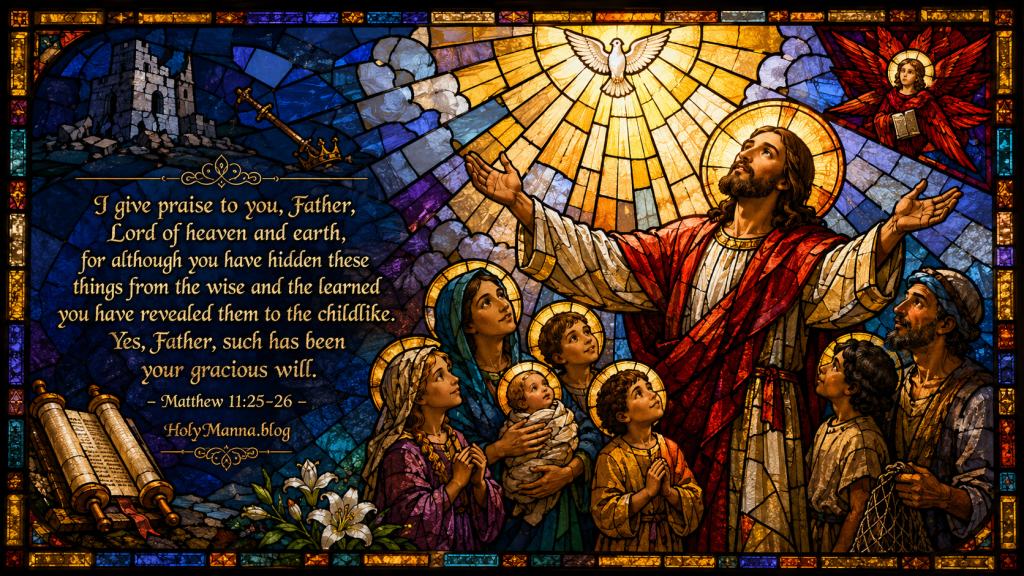
The Praise of the Father. 25 At that time Jesus said in reply, “I give praise to you, Father, Lord of heaven and earth, for although you have hidden these things from the wise and the learned you have revealed them to the childlike. 26 Yes, Father, such has been your gracious will. 27 All things have been handed over to me by my Father. No one knows the Son except the Father, and no one knows the Father except the Son and anyone to whom the Son wishes to reveal him.
Detailed Exegesis
Verse 25: “At that time Jesus said in reply, ‘I give praise to you, Father, Lord of heaven and earth, for although you have hidden these things from the wise and the learned you have revealed them to the childlike.’” Jesus addresses God with the tender word “Father” and the cosmic title “Lord of heaven and earth” in the same breath, intimacy and sovereignty joined. The “wise and learned” are not condemned for education itself. Saint Gregory the Great, as recorded in Saint Thomas Aquinas’s Catena Aurea, explains: “He says not ‘to the foolish,’ but to babes, showing that He condemns pride, not understanding.” Saint Augustine, in the same collection, asks the decisive question: “for who are babes but the humble?” God does not hide from intelligence; He hides from arrogance, because a heart full of itself has no room left for revelation.
Verse 26: “Yes, Father, such has been your gracious will.” One short sentence, and the entire interior life of Jesus is visible in it. He does not merely accept the Father’s way of working; He delights in it. The Catechism treasures this verse, teaching that “his exclamation, ‘Yes, Father!’ expresses the depth of his heart, his adherence to the Father’s ‘good pleasure,’ echoing his mother’s Fiat at the time of his conception and prefiguring what he will say to the Father in his agony. The whole prayer of Jesus is contained in this loving adherence of his human heart to the mystery of the will of the Father” (CCC 2603). Mary’s Fiat at Nazareth, this “Yes, Father” in Galilee, and Gethsemane’s surrender are one single melody played three times.
Verse 27: “All things have been handed over to me by my Father. No one knows the Son except the Father, and no one knows the Father except the Son and anyone to whom the Son wishes to reveal him.” Scholars have called this verse a thunderbolt because it sounds like Saint John’s Gospel dropped into Saint Matthew’s. Jesus claims a mutual, exclusive, total knowledge with the Father that no prophet ever claimed and no creature could claim. Only God knows God like this. And then comes the breathtaking turn: this closed circle of divine knowing opens outward, “and anyone to whom the Son wishes to reveal him.” Knowing the Father is not an achievement; it is a gift Christ chooses to give. Every catechism class, every conversion, every quiet moment of prayer where God suddenly feels real is verse 27 happening again.
Teachings
No saint embodies this Gospel like today’s saint. Bonaventure of Bagnoregio, born around 1217, became Minister General of the Franciscans, a cardinal, and the Seraphic Doctor, one of the towering intellects of the medieval university. Yet at the summit of his masterpiece, Itinerarium Mentis in Deum, the Journey of the Mind into God, he tells the reader that the final step toward God cannot be climbed by intellect at all: “But if you wish to know how these things come about, ask grace not instruction, desire not understanding, the groaning of prayer not diligent reading, the Spouse not the teacher, God not man, darkness not clarity, not light but the fire that totally inflames and carries us into God by ecstatic unctions and burning affections.” Pope Benedict XVI held these words up to the whole Church in his General Audience catechesis on Bonaventure in March 2010, urging that they be made to sink to the depths of the heart. A genius wrote that, and a genius meant it: the childlike of Matthew 11 are not the uneducated but the surrendered.
The Catechism draws the same lesson for every believer’s prayer life: “But when we pray, do we speak from the height of our pride and will, or ‘out of the depths’ of a humble and contrite heart? He who humbles himself will be exalted; humility is the foundation of prayer. Only when we humbly acknowledge that ‘we do not know how to pray as we ought,’ are we ready to receive freely the gift of prayer. ‘Man is a beggar before God’” (CCC 2559). That last line comes from Saint Augustine, and it could serve as the caption for today’s entire liturgy.
Reflection
Becoming childlike is not becoming childish. It means approaching God the way a small child approaches a good father: with total trust, no pretense, and open hands. A concrete practice: begin prayer today with thirty seconds of silence and the honest admission, “Lord, without You, nothing here works.” That single act of intellectual poverty opens more doors than an hour of impressive words. Another step, borrowed straight from Saint Bonaventure: before studying Scripture or any spiritual book this week, ask for grace before information, praying briefly for a burning heart rather than merely a full head. And a third: notice the “little ones” through whom God may already be speaking, the elderly parishioner whose simple faith puts sophistication to shame, the child whose bedtime question about heaven cuts deeper than a theology lecture. Does prayer flow from the height of pride and will, or out of the depths of a humble heart? What is one credential, achievement, or self-image that needs to be set down at the door before entering God’s presence? To whom might the Son be waiting to reveal the Father through an ordinary act of humble witness this week?
The Fire That Carries Us Into God
Step back and watch the whole day come together like a triptych. On the left panel stands Assyria, the ax boasting against the woodsman, all muscle and menace, already dust. In the center, the psalmist stands among widows and orphans, pointing at the sky and insisting that the One who formed the eye sees everything, and that the Lord will not forsake His people. And on the right panel, Jesus lifts His face to heaven amid rejection and praises the Father, because the secret hidden from the impressive has been handed to the little.
It is one continuous revelation. The God who is Lord of empires is the same God who counts the tears of a widow, and He is the same Father whom Jesus reveals to anyone humble enough to receive Him. Pride, in every form the readings display, imperial arrogance, comfortable injustice, intellectual self-sufficiency, ends the same way: leanness, fire, and a locked door. Humility ends another way entirely: revelation, belonging, and a Father’s embrace.
Saint Bonaventure, whose feast crowns this day, spent his life proving that the two great loves, love of truth and love of God, are not rivals. His counsel remains the perfect response to these readings: seek the fire, not merely the light. Let study become prayer, let achievement become gratitude, and let every success point back to the Hand that made it possible.
So here is the invitation as the day unfolds. Find five quiet minutes. Set down the phone, the résumé, and the running list of worries. Approach the Father the way His Son taught, childlike, empty-handed, and expectant. The mysteries of the Kingdom are still being revealed, and they are still being given to the little ones. Through the intercession of Saint Bonaventure, may every reader be counted among them.
Engage With Us!
The conversation does not end when the post does. Share reflections, questions, and stories in the comments below; someone else’s journey may be strengthened by reading them, and every voice makes this community of faith richer.
Here are some questions to pray with today:
- In Isaiah 10:5-7, 13-16, Assyria boasts, “By my own power I have done it, and by my wisdom.” What accomplishment in life is most tempting to claim as purely one’s own, and what would it look like to hand the credit back to God this week?
- In Psalm 94:5-10, 14-15, the wicked say, “The Lord does not see.” Where does that quiet assumption operate in daily life, and who is one vulnerable person, a widow, an orphan, a stranger, whom God may be asking to be seen and served right now?
- In Matthew 11:25-27, Jesus praises the Father for revealing the Kingdom to the childlike. What credential or self-image most gets in the way of childlike trust, and what is one concrete way to pray “out of the depths” of humility this week?
- Taking all the readings together with the witness of Saint Bonaventure, who asked for “grace not instruction, desire not understanding,” what is one area of life where God is being treated as a tool rather than as Lord, and what single step of surrender could change that today?
Keep walking the road of faith with courage and joy. Live this day humbly, love generously, and do everything with the love and mercy Jesus taught, trusting that the Father who sees in secret never forsakes His own.
Sacred Heart of Jesus, we trust in You!
Immaculate Heart of Mary, pray for us!
Saint Michael the Archangel, defend us in battle!
Follow us on YouTube, TikTok, Instagram and Facebook for more insights and reflections on living a faith-filled life.


Leave a Reply