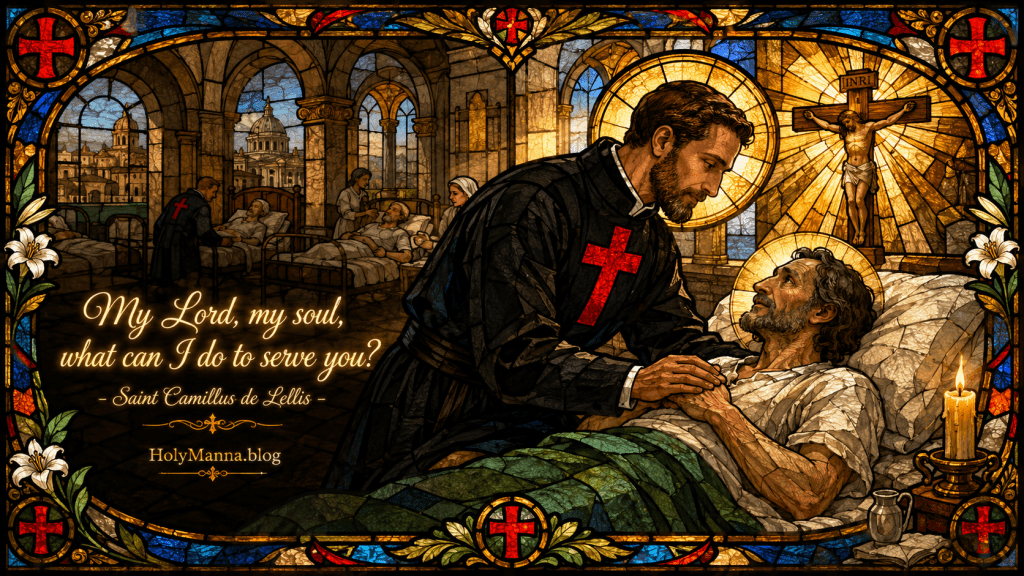
From Gambler to Giant of Charity
Every so often the Church holds up a saint whose life reads less like a quiet holy card and more like a second chance nobody saw coming. Saint Camillus de Lellis is exactly that kind of saint. He was a towering former soldier and a compulsive gambler who lost almost everything before God reached into the wreckage of his life and made him one of the most tender servants of the sick the world has ever known. The Church honors his memory on July 14th, the day he died in Rome in the year 1614, and she venerates him as the patron saint of the sick, of hospitals and hospital workers, and of nurses and nursing associations. His intercession is also sought by those struggling against the grip of gambling, a vice he knew from the inside.
What makes Camillus unforgettable is the sheer distance he traveled. He went from a hospital servant dismissed for playing cards to the founder of a religious order that reinvented how the dying were cared for across Europe. He is the man who fixed a large red cross to the habits of his followers, a sign of charity that would echo, centuries later, across battlefields, ambulances, and hospital wards everywhere. He is often called the Giant of Charity, and not only because tradition remembers him as a man of unusual height and strength. His greatness was measured in the way he could bend his enormous frame down to wash a dying stranger and see, in that broken body, the face of Jesus Christ.
His story matters because it insists on something the Gospel promises and the world keeps forgetting, that no past is too ruined for grace to redeem. The Catechism of the Catholic Church teaches that interior conversion is a radical reorientation of the whole person, a turning of the heart back toward God with everything one has, described in CCC 1431 as “a radical reorientation of our whole life, a return, a conversion to God with all our heart.” Camillus lived that definition in the flesh. His life is an invitation to believe that the same God who lifted a penniless gambler off the floor is not finished with anyone.
From the Dice Table to the Threshold of Grace
Camillus de Lellis was born on May 25th of 1550 in the small town of Bucchianico, in the Abruzzo region of what was then the Kingdom of Naples. His mother, Camilla Compellio de Laureto, was nearly sixty years old when she gave birth to him, and she died while he was still a boy, somewhere around the age of twelve or thirteen. His father, Giovanni, was a military officer who had served in both the Neapolitan and French armies and was seldom at home. The result was a childhood of neglect. Camillus grew up with his father’s fierce temper and very little guidance, and by his early teens he was already following the drum from one military campaign to the next.
As a young man he became a soldier, fighting in the service of Venice and others against the Turks until his regiment was disbanded around the year 1574. Two shadows followed him through those years. The first was a stubborn ulcer that opened on his leg, an affliction that first drove him to seek treatment at the San Giacomo hospital in Rome and that would torment him for the rest of his life. The second was gambling. Camillus was a compulsive gambler, and by the bitter winter of 1574, when he was twenty-four years old, he had gambled away everything he owned, his savings, his weapons, and the very shirt off his back. He was reduced to begging and to hard labor.
It was in this destitution that grace found him. Taking laboring work at a Capuchin friary, he was struck one day by the words of a friar. Tradition recounts that a Capuchin spoke to him plainly about the vanity of everything except the salvation of the soul, telling him in effect that God is everything and the rest is nothing. On February 2nd of 1575, the feast of the Presentation of the Lord, Camillus experienced the turning point that changed the course of his life. This account of the friar’s exact words comes down through the traditions of his order and cannot be verified word for word, yet the fact of his profound conversion at San Giovanni Rotondo in early 1575 is well attested.
His conversion did not instantly heal his wound or smooth his path. Twice he sought to enter the Capuchins, and twice he was sent away because the coarse religious habit irritated the sore on his leg and it would not close. Here the Church would later see the hand of Providence, for God had a different work in mind. Camillus returned to the hospital of San Giacomo, and there, among the suffering, his true vocation slowly took shape. He was horrified by what he saw, patients left in filth, the dying handled roughly, souls slipping away without a priest. In Rome he met the great Saint Philip Neri, who became his confessor and spiritual guide. At the age of thirty-two, with almost no formal schooling, Camillus began to study Latin alongside boys, preparing for the priesthood so that he might serve the sick in both body and soul. The Church honors exactly this kind of stubborn, unglamorous pursuit of holiness, teaching in CCC 2013 that “all Christians in any state or walk of life are called to the fullness of Christian life and to the perfection of charity.”
Building a House of Mercy for the Dying
Camillus was ordained a priest in 1584, on the feast of Pentecost, by a remarkable figure, Bishop Thomas Goldwell of St. Asaph, the last surviving Catholic bishop of the old hierarchy of England and Wales, then living in exile in Rome. From that moment the former soldier turned his considerable energy to a single campaign, the loving care of the sick. Around this time he gathered a small band of like-minded companions who bound themselves to serve the suffering. Pope Sixtus V gave the young community formal recognition as a congregation in 1586, entrusting to them the church of Santa Maria Maddalena in Rome, which the Camillians hold to this day. In 1591 Pope Gregory XIV raised the congregation to the full status of a religious order, and the members professed solemn vows that December. It is worth noting here that a few popular accounts mistakenly credit this act to Pope Gregory XV, but Gregory XV did not reign until 1621, seven years after Camillus had died, so the correct pope is Gregory XIV. Pope Clement VIII confirmed the order in 1592.
What set these men apart was a fourth vow, added to the usual three of poverty, chastity, and obedience. They vowed to serve the sick, including the plague-stricken, even at the risk of their own lives. This was not poetic exaggeration. Camillus taught his followers to treat every patient as if he were Christ himself, and he lived it with an intensity that startled witnesses. From the records gathered for his canonization, one observer described watching Camillus kneel beside a man whose mouth was consumed by a foul and stinking cancer, drawing close breath to breath, whispering words of tenderness, and calling the dying man “my Lord, my soul, what can I do to serve you?” as though he were serving Jesus in person. As he trained his brothers at the bedside, he would urge them on with the cry that became the heartbeat of his whole mission, “More heart in those hands, brothers, more heart!”
This vision was rooted deep in the Gospel. Christ identifies himself so completely with the suffering that he says in The Gospel of Matthew, “I was sick and you visited me,” and then, in Matthew 25:40, “as you did it to one of the least of these my brethren, you did it to me.” The Catechism gathers this into the corporal works of mercy, teaching in CCC 2447 that these are “charitable actions by which we come to the aid of our neighbor in his spiritual and bodily necessities,” and it names visiting the sick among them. Camillus understood that to touch the sick was to touch the Lord, because Christ himself, as CCC 1503 teaches, showed a compassion toward the sick that was “a resplendent sign that ‘God has visited his people.’”
The practical genius of Camillus matched his tenderness. He wrote down concrete guidelines for the proper care of the sick, insisting on cleanliness, fresh air, good food, and the dignity of every patient, and for this he is regarded as a forerunner of modern nursing. His experience as a soldier led him to send his brothers onto the battlefield to tend the wounded, an effort remembered as one of the earliest organized field medical services. When plague swept through, his men went where others fled, and two of his companions who died nursing the sick aboard a quarantined fleet off Naples were honored as the first martyrs of charity of the order. When famine and flood struck Rome, Camillus and his brothers labored to feed the hungry and to carry patients to safety as the Tiber overflowed its banks.
There is also a story the Camillians treasure from the field. During a battlefield fire near Nagykanizsa in the year 1601, as the brothers tended the wounded, the tent holding all their supplies burned to the ground, and it is said that everything was destroyed except a single red cross from the habit of one of the ministers, which survived untouched. The community received this as a sign of God’s favor upon their red cross of charity. This story is part of the order’s own tradition and cannot be historically verified, so it is best received as a treasured account rather than as documented fact.
A Wound That Never Healed and a Love That Never Quit
It is important to say plainly that Saint Camillus de Lellis was not a martyr. He did not die by the sword or on the executioner’s block, and there is no honest way to dress his death in a martyr’s crown. His holiness was forged instead in a long, grinding endurance that lasted decades, a slow martyrdom of the body offered day after day for love of the suffering.
The ulcer on his leg, which had twice barred him from the Capuchins, never healed. It plagued him for roughly forty-six years, joined in time by other ailments, so that his life became, in the words of the old accounts, one of nearly uninterrupted suffering. Yet he refused to let anyone wait on him. When he could barely stand, he would drag himself from his own sickbed to visit patients who were worse off than he was. Here the Catechism gives the key to reading such a life. It teaches in CCC 1505 that Christ “makes their miseries his own” and that by his passion he has given a new meaning to suffering, so that “it can henceforth configure us to him and unite us with his redemptive Passion.” Camillus did not waste his pain. He carried it, and he offered it, and it made him gentle.
He faced hardships beyond his body, too. Reforming the care of the sick meant confronting entrenched neglect, indifferent hospital staff, and administrators who resented change. His work advanced against real opposition and no small amount of exhaustion. Through it all his resolve held. In 1607, wanting more time at the bedside and less at his desk, he resigned as Superior General of the order, though he continued to serve as its Vicar General and to spread its houses across Italy and beyond, reaching as far as Hungary. His care for the dying was tied to a spiritual conviction the Church still holds dear, expressed in CCC 1014, which reminds the faithful to prepare for the hour of death and even preserves the ancient plea, “From a sudden and unforeseen death, deliver us, O Lord.” His brothers came to be called the Fathers of a Good Death precisely because they labored so that no one would die alone, unclean, or without the sacraments.
In 1613 Camillus took part in a general chapter of his order and then set out, despite his failing health, to inspect the hospitals of his communities throughout Italy. On that journey he fell ill for the last time. He died in Rome on July 14th of 1614, at the age of sixty-four, reportedly while making a final appeal to the brothers gathered at his side. He met death not as an enemy conquered but as a friend long prepared for, the same death he had helped so many strangers to face with dignity and hope.
A Heart That Would Not Rest, Even in Death
If Camillus spent his life running toward the sick, his intercession did not stop when his heart fell still. During his lifetime he was already credited by the people of Rome with extraordinary help in times of plague and famine, and the sources report that he was popularly believed to possess the gifts of healing and of prophecy. For a time the grateful city called him the Saint of Rome. These reports of miraculous gifts come down as widely held belief rather than as tidy documented cases, and the Church presents them with the honest phrasing that it is said he had such gifts.
After his death, popular devotion surged, and the faithful attributed healings and favors to his intercession. The Church does not canonize on the strength of affection alone. His cause required the careful examination of his heroic virtues and the rigorous verification of miracles worked through his intercession, a process that unfolded over many decades. In the end, Pope Benedict XIV beatified Camillus in 1742 and canonized him in 1746, placing him among the saints of the universal Church.
Rome soon adorned him with titles that recognized his life’s work. In 1886 Pope Leo XIII proclaimed him patron of the sick and of all hospitals, and in 1930 Pope Pius XI named him, together with Saint John of God, co-patron of nurses and of nursing associations. In these declarations the Church was doing something the Gospel itself commands, for as CCC 1509 teaches, “‘Heal the sick!’ The Church has received this charge from the Lord and strives to carry it out.” Camillus gave that charge a human face.
His relics rest in the church of Santa Maria Maddalena in Rome. Among the treasures venerated there is his heart, preserved as an incorrupt relic, which has traveled far beyond Italy so that the sick might venerate it, including more than one visit to the Philippines, where crowds of patients and caregivers have come to pray before it. Also displayed at the church is the crucifix bound up with one of the most beloved traditions of his life. The story is told that in a moment of discouragement, when the burden of his work felt crushing, the figure of Christ on the cross spoke to Camillus and asked, “Why are you afraid? Do you not realize that this is not your work but mine?” Those words became a kind of motto for Camillus and for the caregivers who have followed him. It is a tender and powerful tradition, and the crucifix is genuinely venerated, yet the spoken words themselves cannot be historically verified, so the story is best held as a cherished tradition rather than as established fact.
There is also a quiet tradition that his mother, before his birth, dreamed she would bear a son who would wear a red cross on his chest and lead others marked with the same cross. Whether or not that dream can ever be confirmed, and it cannot, the red cross of Camillus did indeed go out into all the world. It first marked the black habits of his order as a sign of charity to the sick, centuries before the modern Red Cross movement adopted a similar emblem, and it endures today on the habits of the Camillians, who continue their founder’s mission in roughly forty countries, running hospitals, caring for the dying, and answering disasters wherever they strike. From a gambler’s ruin, God raised a river of mercy that still flows.
Putting More Heart Into Your Own Hands
The life of Saint Camillus refuses to let anyone off the hook with the excuse that their past is too dark or their habits too deeply grooved. Here was a man who wasted his youth on the dice table, who was thrown out of a hospital for his temper and his gambling, and who carried an open, aching wound in his leg for nearly half a century. God did not wait for him to become impressive. God met him in the wreckage and made him a saint. The Catechism teaches in CCC 1989 that the grace of the Holy Spirit brings about justification and turns the heart toward God, and Camillus is living proof that this grace works on real, messy, half-ruined lives. What in your own history have you written off as beyond redemption, and what might change if you handed it to the God who specializes in second chances?
His great lesson is that holiness is not abstract. It has hands, and those hands do concrete things. Camillus taught his brothers to see Christ in the sick and to serve them with what he called maternal tenderness, and the Church affirms that a neighbor’s body is not a nuisance to be managed but a gift to be honored, teaching in CCC 2288 that “life and physical health are precious gifts entrusted to us by God.” You do not need a red cross on your chest to live this. You need only to notice the suffering person already within your reach, the aging parent, the sick friend, the lonely neighbor, the coworker quietly falling apart, and to bring them, in the words that Camillus loved, more heart.
Camillus also shows that suffering, when united to Christ, becomes a strange kind of fruitfulness. He did not pretend his wound was pleasant, and he did not waste energy demanding that God remove it. He offered it and kept serving through it. If you are carrying a burden that will not lift, whether an illness, a weakness, a grief, or a temptation you fight every single day, his example points you toward the meaning the Catechism describes in CCC 1505, that suffering borne with Christ can configure you to him. Where is God asking you to keep serving, not once the pain is gone, but right in the middle of it?
Finally, there is the crucifix and its haunting question, whether or not the words were literally spoken, that this is not your work but Christ’s. So much anxiety in the life of faith comes from carrying alone what was never yours to carry. Camillus laid down the crushing weight of thinking it all depended on him, and in that surrender he found the freedom to love without burning out. What would it feel like to hand your heaviest responsibility back to the One whose work it truly is?
Engage With Us!
Share your thoughts and reflections in the comments below, because the witness of Saint Camillus is meant to be lived out in ordinary lives like yours, and your story may be exactly the encouragement another reader needs today. Take a few quiet minutes with the following questions, and let the Giant of Charity accompany you as you pray through them.
- When you look at the sick, the suffering, or the difficult people already in your daily life, how might it change your actions to truly believe you are serving Christ himself in them?
- Saint Camillus turned his gambling and his failures into the very ground of his conversion. What weakness or past mistake might God be waiting to transform into your mission?
- He carried an unhealed wound for nearly fifty years and never let it stop him. What pain are you carrying, and what would it look like to keep serving God faithfully in the middle of it?
- If Christ asked you today, “Why are you afraid, do you not realize that this is not your work but mine,” what burden would you finally be willing to hand back to him?
- In what one concrete way, this very week, could you put “more heart in your hands” for someone who is sick, lonely, or forgotten?
May the life of Saint Camillus de Lellis stir you to go and do likewise, seeing the face of Jesus in every wounded person you meet and serving them without counting the cost. Go out and love the sick, the poor, and the difficult with the same mercy that Christ first poured out on you, remembering that the smallest act of tenderness offered in his name is never wasted. Do everything, as the Lord taught, with love, and let your hands become his hands for a world aching to be healed.
Saint Camillus de Lellis, pray for us!
Follow us on YouTube, TikTok, Instagram and Facebook for more insights and reflections on living a faith-filled life.


Leave a Reply