Memorial of Saint Kateri Tekakwitha, Virgin – Lectionary: 390
Where Trembling Meets Trust
Some mornings the news feels like two armies marching straight toward the front door, and the temptation is to measure the threat instead of measuring God. That is exactly the corner King Ahaz found himself backed into on this day’s first page of Scripture, and the readings for the Memorial of Saint Kateri Tekakwitha refuse to leave anyone stranded there.
The central theme of the day is disarmingly simple. Firm faith is the only stronghold that actually holds. In Isaiah 7, a terrified king is handed a single command dressed as a promise: trust the Lord, and you will stand; refuse, and you will fall. Psalm 48 then answers that summons from the far side of the crisis, singing about a city that enemies could not shake because God Himself lived inside its walls. And in The Gospel of Matthew, Jesus grieves over towns that saw His power up close yet never let it change their hearts, which is faith’s saddest possible failure.
There is a beautiful thread running underneath all of it. The Hebrew of Isaiah plays on one root that means both “to believe” and “to be made firm,” so that believing and standing are two forms of the same act. Saint Kateri Tekakwitha, born in 1656 and canonized as the first Native American saint in 2012, lived that root word out loud, holding fast to Christ through persecution and exile. Her feast is the perfect frame for readings that ask one question of every heart. Will trust win, or will fear?
First Reading — Isaiah 7:1-9
A King at the Edge of Panic
To feel the weight of this passage, picture the political map of the eighth century before Christ. Assyria was swallowing kingdoms whole, and the smaller nations were scrambling to form a coalition against it. When Judah’s King Ahaz refused to join, his northern neighbors decided to remove him by force. Aram, centered in Damascus under King Rezin, joined with the northern kingdom of Israel, called Ephraim here, under Pekah son of Remaliah. Their plan was to march on Jerusalem, depose the descendant of David, and install a puppet ruler. Into that fear the prophet Isaiah walks with a word that fits the day’s central theme like a key in a lock. Security is not found in armies or alliances. It is found in believing God.
Isaiah 7:1-9 – New American Bible (Revised Edition)
Crisis in Judah. 1 In the days of Ahaz, king of Judah, son of Jotham, son of Uzziah, Rezin, king of Aram, and Pekah, king of Israel, son of Remaliah, went up to attack Jerusalem, but they were not able to conquer it. 2 When word came to the house of David that Aram had allied itself with Ephraim, the heart of the king and heart of the people trembled, as the trees of the forest tremble in the wind.
3 Then the Lord said to Isaiah: Go out to meet Ahaz, you and your son Shear-jashub, at the end of the conduit of the upper pool, on the highway to the fuller’s field, 4 and say to him: Take care you remain calm and do not fear; do not let your courage fail before these two stumps of smoldering brands, the blazing anger of Rezin and the Arameans and of the son of Remaliah— 5 because Aram, with Ephraim and the son of Remaliah, has planned evil against you. They say, 6 “Let us go up against Judah, tear it apart, make it our own by force, and appoint the son of Tabeel king there.”
7 Thus says the Lord God:
It shall not stand, it shall not be!
8 The head of Aram is Damascus,
and the head of Damascus is Rezin;
9 The head of Ephraim is Samaria,
and the head of Samaria is the son of Remaliah.
Within sixty-five years,
Ephraim shall be crushed, no longer a nation.
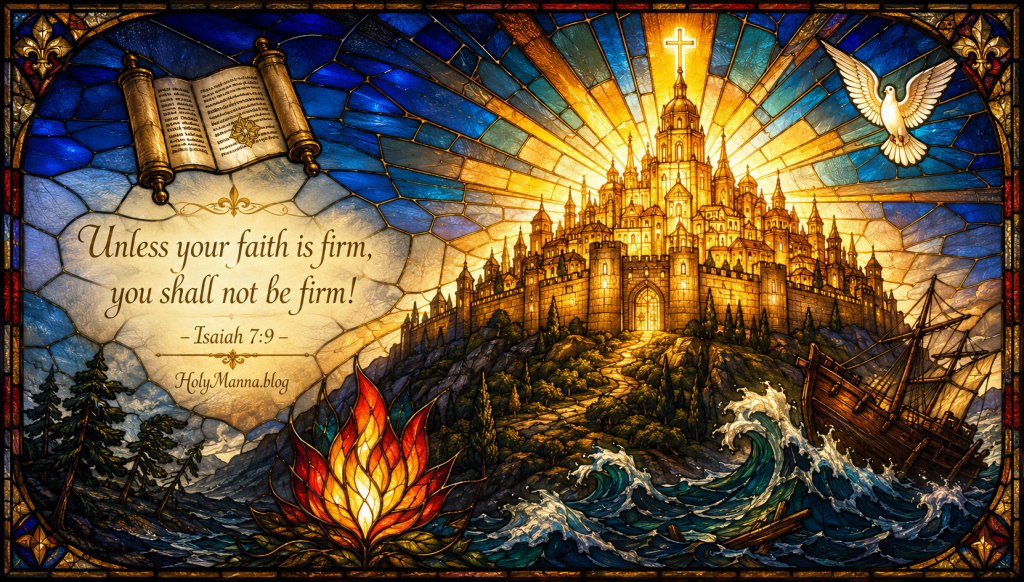
Unless your faith is firm,
you shall not be firm!
Detailed Exegesis
“1 In the days of Ahaz, king of Judah, son of Jotham, son of Uzziah, Rezin, king of Aram, and Pekah, king of Israel, son of Remaliah, went up to attack Jerusalem, but they were not able to conquer it.”
The verse names the players and quietly spoils the ending. The attack fails. Before Ahaz ever hears a word of counsel, the reader already knows the coalition cannot take the city, which means the real drama is never military. It is interior. The question is not whether Jerusalem will survive, but whether its king will believe.
“2 When word came to the house of David that Aram had allied itself with Ephraim, the heart of the king and heart of the people trembled, as the trees of the forest tremble in the wind.”
The phrase “the house of David” is deliberate, because God had promised David an enduring throne. Ahaz forgets that promise and trembles instead. The image of a whole forest shaking in a gale is one of Scripture’s most honest pictures of panic, a fear that spreads from one leader to an entire people.
“3 Then the Lord said to Isaiah: Go out to meet Ahaz, you and your son Shear-jashub, at the end of the conduit of the upper pool, on the highway to the fuller’s field,”
God sends the prophet with company. The son’s name, Shear-jashub, means “a remnant shall return,” so the boy is a walking promise of hope even before Isaiah opens his mouth. The location matters too, since this same water conduit reappears later in Isaiah 36 when Assyria threatens the city, tying Ahaz’s choice to consequences that outlast his reign.
“4 and say to him: Take care you remain calm and do not fear; do not let your courage fail before these two stumps of smoldering brands, the blazing anger of Rezin and the Arameans and of the son of Remaliah,”
The command “remain calm and do not fear” is the heartbeat of the passage. God reduces the two dreaded kings to “two stumps of smoldering brands,” burnt-out logs giving off more smoke than fire. What looks like a wildfire from ground level is nearly ash from heaven’s vantage point.
“5 because Aram, with Ephraim and the son of Remaliah, has planned evil against you. They say,”
God does not deny the danger or pretend the plot is imaginary. He acknowledges the evil intention fully. Faith is never asked to close its eyes to reality; it is asked to weigh reality against the greater reality of God.
“6 ‘Let us go up against Judah, tear it apart, make it our own by force, and appoint the son of Tabeel king there.’”
Here is the enemies’ actual plan, and it aims straight at the Davidic line by proposing a foreign puppet, the son of Tabeel. The plot is not merely political. It attacks the promise God made to David, which is why the Lord Himself steps in to answer it.
“7 Thus says the Lord God: It shall not stand, it shall not be!”
With four short words God overturns the whole conspiracy. The phrase “it shall not stand” is a courtroom verdict against the coalition, and it sets up the closing pun, because standing is precisely what Ahaz himself is being invited to do through faith.
“8 The head of Aram is Damascus, and the head of Damascus is Rezin; Within sixty-five years, Ephraim shall be crushed, no longer a nation.”
God draws a boundary line. Rezin will never be more than the head of Damascus, a mere man over a mere city, never the master of Judah’s destiny. The prophecy that Ephraim will vanish within sixty-five years came true when the northern kingdom was scattered by Assyria, a reminder that God’s word about history proves reliable.
“9 The head of Ephraim is Samaria, and the head of Samaria is the son of Remaliah. Unless your faith is firm, you shall not be firm!”
Everything funnels into this final line. In Hebrew the two verbs share one root, so the sentence could be heard as “unless you are firm in faith, you will not be firmed.” Belief and stability are the same reality seen from two sides. The choice set before Ahaz is the choice set before every reader on this day.
Teachings
The Church has treasured this final verse for centuries. The Greek translation of the Old Testament rendered it as an invitation to knowledge, which is why Pope Francis, in his encyclical Lumen Fidei, opens his second chapter with it and explains the Hebrew wordplay directly. He writes that the Hebrew prophet tells the king, “If you will not believe, you shall not be established,” and that this rests on “a play on words, based on two forms of the verb ‘amān.” Saint Augustine leaned on the same verse throughout his life, preaching in his Sermon 43 on the words “Unless you believe, you shall not understand,” and coining from it his famous counsel to believe first so that understanding may follow.
The Catechism gathers this into a single teaching on perseverance. CCC 162 warns that faith can be lost and must be guarded: “Faith is an entirely free gift that God makes to man. We can lose this priceless gift… To live, grow, and persevere in the faith until the end we must nourish it with the word of God; we must beg the Lord to increase our faith.” Ahaz stands at the exact hinge the Catechism describes, holding a gift he can either nourish or squander.
Reflection
Ahaz’s crisis is not as far away as it looks. Everyone meets a moment when the alliances lined up against them feel bigger than the promise God has made. The invitation of this reading is to name the fear honestly, as God did, and then to weigh it against the God who calls two menacing kings “smoldering stumps.” A concrete step is to identify the one situation that has your heart trembling like trees in the wind, and to bring it to prayer with the deliberate act of trust that Ahaz withheld. Another is to feed your faith the way CCC 162 prescribes, with a steady diet of Scripture, rather than a steady diet of the news that frightens you.
Where in your life are you tempted to measure the threat instead of measuring God? What would change today if you truly believed that being firm in faith is the same thing as being made firm?
Responsorial Psalm — Psalm 48:2-9
A City That Cannot Be Shaken
If Isaiah shows the crisis, this psalm shows the aftermath from the winner’s side. Psalm 48 is one of the Songs of Zion, hymns sung by pilgrims who climbed toward Jerusalem and marveled that the living God had chosen to dwell among them. The psalm celebrates a moment when hostile kings assembled against the city and were routed, not by superior weapons, but by the sheer presence of God in their midst. Set beside Isaiah, it becomes the answer to the summons Ahaz nearly refused. This is what it looks like when a people believes and is therefore made firm.
Psalm 48:2-9 – New American Bible (Revised Edition)
2 Great is the Lord and highly praised
in the city of our God:
His holy mountain,
3 fairest of heights,
the joy of all the earth,
Mount Zion, the heights of Zaphon,
the city of the great king.4 God is in its citadel,
renowned as a stronghold.
5 See! The kings assembled,
together they advanced.
6 When they looked they were astounded;
terrified, they were put to flight!
7 Trembling seized them there,
anguish, like a woman’s labor,
8 As when the east wind wrecks
the ships of Tarshish!9 What we had heard we have now seen
in the city of the Lord of hosts,
In the city of our God,
which God establishes forever.
Selah
Detailed Exegesis
“2 Great is the Lord and highly praised in the city of our God: His holy mountain,”
The psalm begins not with the city’s strength but with the Lord’s greatness, keeping first things first. Jerusalem matters only because God is praised there. The security celebrated in the verses to come is borrowed security, on loan from the One who lives inside the walls.
“3 fairest of heights, the joy of all the earth, Mount Zion, the heights of Zaphon, the city of the great king.”
The phrase “the heights of Zaphon” borrows a Canaanite image of the mountain where the gods were thought to dwell, and boldly reassigns it to Mount Zion. The point is polemical and joyful at once. True kingship over heaven and earth belongs to the Lord alone, and His dwelling is “the joy of all the earth,” not merely of one nation.
“4 God is in its citadel, renowned as a stronghold.”
Here is the theological center of the psalm and its link to Isaiah. The word “stronghold” describes not the walls but God Himself within them. A fortress is only as strong as its defender, and this defender cannot be breached, which is exactly the confidence Ahaz was invited to have.
“5 See! The kings assembled, together they advanced.”
The psalm shifts to a scene of attack, kings massing for a coordinated advance. The verse deliberately echoes the kind of coalition Ahaz feared, so that the reader watches the very nightmare of the first reading march up to the gates of the city.
“6 When they looked they were astounded; terrified, they were put to flight!”
The turn is sudden and total. The attackers only have to look, and their nerve collapses. They came to inspire terror and instead they carry it away, put to flight by something they can see but cannot overpower.
“7 Trembling seized them there, anguish, like a woman’s labor,”
The trembling that gripped Ahaz’s heart in Isaiah 7 now seizes the enemies instead, a striking reversal. The image of labor pains conveys a fear that cannot be controlled or postponed once it begins, the panic of those who suddenly realize whom they are fighting.
“8 As when the east wind wrecks the ships of Tarshish!”
The ships of Tarshish were the largest ocean-going vessels of the ancient world, symbols of human power and wealth. The east wind shatters them effortlessly. So too the mightiest human coalition splinters before God, and the biggest thing people can build proves fragile in His presence.
“9 What we had heard we have now seen in the city of the Lord of hosts, In the city of our God, which God establishes forever. Selah”
This is the hinge of the whole psalm and the deep tie to the day. The worshipers had heard the promises passed down about God’s protection, and now they have seen those promises with their own eyes. The city is one “which God establishes forever,” using the very language of firmness that Isaiah pressed on Ahaz. The word “Selah” marks a pause, an invitation to let the truth settle into silence.
Teachings
The Church has never read Zion as merely a set of ancient walls. The Catechism carries the image forward to the Church herself. CCC 757 teaches that “The Church, further, which is called ‘that Jerusalem which is above’ and ‘our mother’, is described as the spotless spouse of the spotless lamb,” and CCC 756 recalls that the temple “is compared in the liturgy to the Holy City, the New Jerusalem.” The stronghold of Psalm 48 becomes a portrait of the community of believers in whom God dwells, a city whose foundation is the presence of Christ.
There is a pastoral wisdom in verse 9 that Saint Augustine loved to preach, the movement from hearing to seeing. Faith begins by trusting a promise received from others, and then, over a lifetime, it ripens into a personal experience of the God who keeps that promise. The psalm gives words to that maturing. The believer stops living on secondhand report and begins to say, with the pilgrims, what was once heard is now seen.
Reflection
Most people carry a stack of things they have heard about God, doctrines learned in childhood, promises read in Scripture, testimonies borrowed from others. This psalm invites the reader to let those heard things become seen things, by noticing the concrete places where God has already proven Himself a stronghold. A simple practice is to keep a short record of answered prayers and quiet rescues, so that “what we had heard” slowly becomes “we have now seen.” Another is to make the word “Selah” a habit, pausing after prayer long enough to let God’s faithfulness sink below the surface of a busy mind.
What promises about God have you heard your whole life but not yet seen with the eyes of experience? Where has the Lord already proven Himself a stronghold that you have been too busy to notice?
Holy Gospel — Matthew 11:20-24
The Sorrow of Wasted Wonder
After celebrating a city that believed, the liturgy turns to towns that would not. Chorazin, Bethsaida, and Capernaum sat along the northern shore of the Sea of Galilee, and they were the towns where Jesus performed most of His mighty deeds. They had a front-row seat to the very power that Psalm 48 praises, healings, exorcisms, the kingdom breaking in, and still they did not repent. Jesus contrasts them with Tyre and Sidon, Gentile Phoenician cities long associated with idolatry, and with Sodom, the ancient byword for wickedness. The message fits the day’s theme from the shadow side. To see God’s power and refuse to believe is the gravest failure of faith, because it is the failure that had the most reason to succeed.
Matthew 11:20-24 – New American Bible (Revised Edition)
Reproaches to Unrepentant Towns. 20 Then he began to reproach the towns where most of his mighty deeds had been done, since they had not repented. 21 “Woe to you, Chorazin! Woe to you, Bethsaida! For if the mighty deeds done in your midst had been done in Tyre and Sidon, they would long ago have repented in sackcloth and ashes. 22 But I tell you, it will be more tolerable for Tyre and Sidon on the day of judgment than for you. 23 And as for you, Capernaum:
‘Will you be exalted to heaven?
You will go down to the netherworld.’For if the mighty deeds done in your midst had been done in Sodom, it would have remained until this day. 24 But I tell you, it will be more tolerable for the land of Sodom on the day of judgment than for you.”
Detailed Exegesis
“20 Then he began to reproach the towns where most of his mighty deeds had been done, since they had not repented.”
The verse names the offense precisely. It is not that the towns rejected an argument, but that they failed to repent after witnessing grace. In the words of Saint Jerome in the Catena Aurea, Jesus upbraids them “because after He had such mighty works and wonders in them they had not done penitence.” The tragedy is proportion. The more grace given, the more unbelief costs.
“21 ‘Woe to you, Chorazin! Woe to you, Bethsaida! For if the mighty deeds done in your midst had been done in Tyre and Sidon, they would long ago have repented in sackcloth and ashes.’”
The word “woe” is not a curse so much as a lament, the grief of a Savior over the lost. Saint John Chrysostom observes that Jesus deliberately names Bethsaida, the hometown of several apostles, “That you should not say that they were by nature evil.” The people were not doomed by birthplace or temperament. They had every advantage and simply would not turn. Sackcloth and ashes were the ancient signs of repentance, which Saint Gregory the Great explained as the pricking of conscience and the reminder of what we become in death.
“22 ‘But I tell you, it will be more tolerable for Tyre and Sidon on the day of judgment than for you.’”
Jesus introduces the sober principle of graded responsibility. Judgment is not one-size-fits-all. Those who received more light will be measured against that light. The pagan cities that never saw His miracles will fare better than the Galilean towns that saw them and shrugged.
“23 ‘And as for you, Capernaum: “Will you be exalted to heaven? You will go down to the netherworld.” For if the mighty deeds done in your midst had been done in Sodom, it would have remained until this day.’”
Capernaum receives the sharpest word because it received the most, serving as the base of much of Jesus’ ministry. The language about being exalted to heaven and cast down echoes the prophets’ oracle against Babylon’s pride. To be near to Christ and unmoved is more perilous than being far from Him and ignorant, for even Sodom, Jesus says, would have repented at what Capernaum saw.
“24 ‘But I tell you, it will be more tolerable for the land of Sodom on the day of judgment than for you.’”
The Gospel closes on the day of judgment, drawing the whole passage toward eternity. The comparison to Sodom is meant to shake the comfortable. Nearness to grace is a gift that becomes a summons, and the summons carries weight. Grace received is grace for which an account will be given.
Teachings
This Gospel sits at the heart of the Church’s teaching on judgment. The Catechism cites this very passage when it teaches in CCC 678 that “Following in the steps of the prophets and John the Baptist, Jesus announced the judgment of the Last Day in his preaching… Then will the culpable unbelief that counted the offer of God’s grace as nothing be condemned.” The towns of Galilee are the Catechism’s own example of that culpable unbelief, grace offered and counted as nothing.
Yet the same Catechism refuses to let the passage end in fear alone, because the true target of Jesus’ reproach is the heart, not the ritual. CCC 1430 teaches that “Jesus’ call to conversion and penance, like that of the prophets before him, does not aim first at outward works, ‘sackcloth and ashes,’ fasting and mortification, but at the conversion of the heart, interior conversion.” The very phrase Jesus uses is the phrase the Catechism gently reinterprets. He is not asking merely for a change of clothing but for a change of heart. And CCC 1428 insists this call is ongoing: “Christ’s call to conversion continues to resound in the lives of Christians.” The woe over Galilee is finally an invitation, still open, to repent while the door stands ajar.
Reflection
The frightening thing about this Gospel is how ordinary the sin is. The people of Capernaum did nothing dramatic. They simply witnessed grace and remained unchanged, which is a temptation for anyone raised close to the faith. Familiarity can quietly dull wonder until the sacraments feel routine and the Gospel feels like background noise. A concrete step is to name one place where God has clearly acted in your life and ask honestly whether you have let it change how you live, or merely admired it and moved on. Another is to return to the sacrament of Confession, which the Church calls the sacrament of conversion, and to treat it as the interior turning of the heart that CCC 1430 describes rather than a checklist.
Have you allowed the mighty deeds God has already done in your life to actually change you, or only to impress you? If Jesus were to name your town, would He praise its repentance or grieve its comfort?
Standing Firm on the Only Ground That Holds
Three readings, one quiet verb. Believe, and you will stand. Ahaz was handed that promise while two armies loomed, and the whole future of the house of David hung on whether he would trust the God who called his enemies smoldering stumps. Psalm 48 then let the world glimpse what trust makes possible, a city that its attackers could only look at before fleeing in terror, because the real fortress was never the wall but the God who lived behind it. And in Galilee, Jesus wept over towns that had every reason to believe and would not, showing that the saddest fall of all is to see grace up close and count it as nothing.
The day’s saint quietly proves the point. Saint Kateri Tekakwitha held her faith through ridicule, pressure, and exile, and she was made firm precisely because she believed. Her life is Isaiah 7:9 in flesh and blood, a young woman who chose Christ as her only stronghold and never looked back.
Readers are invited to take the same road today, to name whatever is making the heart tremble like trees in the wind and to hand it, deliberately, to the Lord who establishes His city forever. Faith is not a feeling that arrives on its own. It is a decision, renewed each morning, to be firm because God is firm. May every heart that hears these readings choose to believe and, in believing, to stand on the only ground that has never once given way, the faithfulness of God Himself.
Engage With Us!
Please share your reflections in the comments below, because a curious friend’s honest question often lights the way for another reader walking the same road. These readings press on the tender places of trust and repentance, and no one is meant to walk that path in silence.
Take a few moments with these questions, one for each reading and one for the whole message together:
- In Isaiah 7:1-9, God tells Ahaz that being firm in faith and being made firm are the same reality. What is the one fear you most need to weigh against God rather than against your circumstances?
- In Psalm 48:2-9, the worshipers move from what they had heard to what they had now seen. Where has God already proven Himself your stronghold, even in a way you overlooked?
- In Matthew 11:20-24, Jesus grieves over towns that saw His power and stayed unchanged. Which mighty deed of God in your life have you admired without letting it convert your heart?
- Bringing all three together, they teach that firm faith is the only stronghold that holds. What would your day look like tomorrow if you truly believed that trusting God and standing secure are one and the same?
Faith grows in the living, not merely in the pondering. Carry these readings into ordinary hours, into the difficult conversation and the tired evening, and let every choice be shaped by the love and mercy Jesus taught. A life built on that trust is a city that no east wind can wreck, established by God, and standing firm forever.
Sacred Heart of Jesus, we trust in You!
Immaculate Heart of Mary, pray for us!
Saint Michael the Archangel, defend us in battle!
Follow us on YouTube, TikTok, Instagram and Facebook for more insights and reflections on living a faith-filled life.

 Holy Manna!
Leave a comment