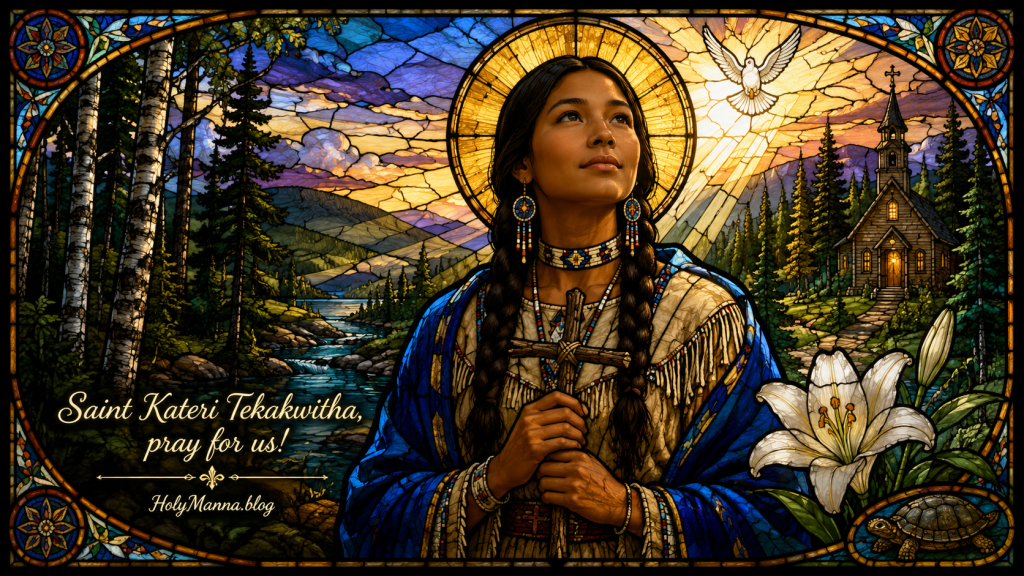
The Lily of the Mohawks
Some saints are remembered for the great books they wrote or the monasteries they founded. Saint Kateri Tekakwitha is remembered for something quieter and, in its own way, more astonishing. She is remembered for becoming radiantly holy in a place where almost nothing supported her faith, and for loving Jesus with her whole heart while remaining fully and beautifully a daughter of her own people. Celebrated in the United States on July 14th, she holds a singular place in the story of the Church in North America, because she is the first Native American ever to be raised to the altars as a saint.
She is known across the world as the Lily of the Mohawks, a title that captures both her purity and her tender fragility. Born of a Mohawk father and a Christian Algonquin mother, orphaned as a small child, half-blind and scarred by smallpox, she found in the Gospel a love that no earthly hardship could take from her. The Church honors her today as a patroness of ecology and the environment, of Native and Indigenous peoples, and of those who live in exile, and countless believers also turn to her as a friend of orphans and of everyone who has ever been mocked for their faith.
When the Church places a saint like Kateri before the faithful, she does so for a reason. The Catechism teaches that in canonizing the saints the Church proposes them to believers “as models and intercessors” (CCC 828). Kateri is exactly that, a model of quiet fidelity and a powerful intercessor whose prayers, as the Church has formally recognized, still reach into hospital rooms in our own century. Her story sets before every reader a simple question. If she could become a saint with so little, what excuse remains for those who have been given so much?
From Smallpox and Silence to the Waters of Baptism
Kateri Tekakwitha was born in 1656 in the Mohawk village of Ossernenon, near what is today Auriesville, New York. Sources differ slightly on the exact village of her birth, with some older accounts placing it at a nearby settlement, and that small discrepancy is worth noting honestly rather than smoothing over. Her father was a Mohawk chief of the Turtle clan, a man firmly attached to the traditions of his people. Her mother, named Kahenta in several accounts, was an Algonquin woman who had been baptized and raised among French Catholics near Trois-Rivières before she was captured in a raid and taken as the chief’s wife. From her mother, though Kateri would lose her far too soon, she received something that would shape her entire life, which was a first sense of the living God.
That loss came when Kateri was only about four years old. A smallpox epidemic swept through the village and killed her father, her mother, and her baby brother. Kateri alone survived, but the disease left her face deeply scarred and her eyesight badly weakened, so that bright sunlight pained her and she often had to feel her way carefully as she walked. Her Mohawk name is usually connected to this condition, and it has been translated in more than one way, sometimes as she who bumps into things and sometimes as she who puts things in order. Both renderings appear in reputable sources, and the honest truth is that the precise meaning remains uncertain.
Orphaned, the little girl was taken in by her aunts and by an uncle who had become a chief and who was openly hostile to Christianity. She grew into a skilled and diligent young woman who worked the fields of corn, beans, and squash and became known for fine beadwork and needlework. Yet even as a girl she showed an unusual reserve and a deep aversion to the marriage plans her relatives kept pressing upon her.
In 1667, when Kateri was around eleven, three Jesuit missionaries, Fathers Frémin, Bruyas, and Pierron, lodged for a few days in her uncle’s longhouse while traveling with a Mohawk delegation. These were most likely the first Christian missionaries she had ever encountered, and their words and their manner of life left a deep impression on her heart. She did not ask for baptism then, because the moment was not yet ripe and the danger was real, but a seed had been planted that would take years to flower.
Later, a Jesuit named Father Jacques de Lamberville came to take charge of the mission near her village. Kateri opened her heart to him and told him of her longing to be baptized. He instructed her patiently in the faith, and on Easter of 1676, at about twenty years of age, she was baptized and given the name Catherine, rendered Kateri in the Mohawk tongue, in honor of Saint Catherine of Siena. The Catechism calls Baptism “the gateway to life in the Spirit” (CCC 1213), and for Kateri that gateway opened onto a path she would follow to the end without ever turning back.
A Hidden Life of Prayer Among the Longhouses
It should be said plainly, in fairness to the historical record, that no miracles are documented from Kateri’s own lifetime. She did not heal the sick or still storms while she walked the earth. What made her extraordinary was something less spectacular and far more demanding, which was a life of heroic virtue lived out in ordinary and often hostile surroundings. The Church has always taught that this, too, is true greatness. The Catechism reminds every believer that “all Christians in any state or walk of life are called to the fullness of Christian life and to the perfection of charity” (CCC 2013).
Kateri lived that call with a purity of purpose that startled those around her. Long before she fully understood that a consecrated life for women even existed, she resolved never to marry, but to belong to Christ alone. When her relatives pressed a suitor upon her, she refused, and they punished her with heavier work and with contempt. She held firm. In this she embodied what the Church honors in those who renounce marriage for the sake of the Kingdom, a path the Catechism describes as clinging to the Lord “with greater freedom of heart, body, and spirit” (CCC 922).
Once she reached the Christian mission where she would spend her final years, her days revolved entirely around the Eucharist. She was known to arrive at the chapel before dawn, ahead of even the priests, and to remain there until the doors were locked at night. The Catechism calls the Eucharist “the source and summit of the Christian life” (CCC 1324), and Kateri’s life was arranged around that summit as naturally as a flower turns toward the sun. She practiced severe fasting and penance, offering her sufferings for the conversion of her people, living out in her own body the truth that “there is no holiness without renunciation and spiritual battle” (CCC 2015).
Some of her penances were extreme by any measure, and the Church, in raising her to the altars, honors the love that inspired them without proposing every detail as a model to imitate. What every reader can imitate is the heart beneath them, a heart that wished only to know and to do what pleased God.
Stones, Scorn, and a Two Hundred Mile Flight to Freedom
Kateri’s conversion did not bring her peace with those around her. It brought persecution. Because she refused to work on Sundays, she was often denied food on those days. Children were encouraged to taunt her and to throw stones at her. Rumors spread that her chastity and her devotion were forms of sorcery. According to accounts of her life, she was even threatened with torture and with death. Through all of it she remained gentle and unshaken, answering cruelty with patience.
The situation grew dangerous enough that Father de Lamberville counseled her to flee. In 1677, with the help of a few Christian companions, Kateri slipped away and undertook a journey of roughly two hundred miles north through the wilderness to the mission of Saint Francis Xavier at Sault Saint-Louis, near Montreal, a settlement of Native Christians where she could at last live her faith in peace. It was an act of quiet courage, a young woman with weak eyes and a frail body walking away from the only home she had ever known in order to keep her soul.
At the mission she flourished under the guidance of an older Iroquois woman named Anastasie, who had once been a friend of her mother. She made her First Communion at Christmas of 1677, was received into the Confraternity of the Holy Family, and, in the last year or so of her life, made a formal vow of perpetual virginity, giving herself to Christ as her only spouse.
Here something must be said clearly, so that no false impression is left. Saint Kateri Tekakwitha was not a martyr. She did not die by violence for the faith, and it would dishonor both her and the truth to pretend otherwise. The Catechism reserves the word martyrdom for “the supreme witness given to the truth of the faith” by those who bear it even unto death (CCC 2473). Kateri’s witness was of a different kind, no less total for being bloodless. Her health, never strong since her childhood illness, declined steadily, worsened by her austerities. Some accounts attribute her final illness to tuberculosis, while others simply describe a body worn down by penance and hardship. She died on April 17th, 1680, during Holy Week, at only about twenty-four years of age. Those at her bedside recorded that her last words were “Jesos Konoronkwa,” which means “Jesus, I love you.” She took up her cross to the very end, faithful to the One who taught that whoever loses his life for his sake will find it (cf. Matthew 10:39).
The Vanishing Scars and a Boy Called Back from Death
What happened next belongs to the earliest memory of the Church in New France, and it is best told the way her contemporaries told it. Father Pierre Cholenec, one of the Jesuits who knew her and who wrote her life in 1696, recorded that within about fifteen minutes of her death the smallpox scars that had marked Kateri’s face since childhood faded away, and her face became smooth and shone with a striking beauty. Father Claude Chauchetière, who had also known her and who painted the oldest portrait of her, gave a similar testimony. Those who loved her saw in this the first sign of her holiness, a hint that the disfigurement of earth had given way to the beauty of heaven. This account comes from her earliest biographers, who were eyewitnesses to her life, yet it belongs to the realm of pious testimony and tradition rather than to the kind of medically examined miracle the modern Church requires for canonization, and that distinction deserves to be stated plainly.
Almost at once her grave at the mission became a place of prayer, and both Native Christians and French settlers began to report favors and healings obtained through her intercession. Her reputation spread quickly. Within a few years a bishop of Quebec was calling her the Geneviève of Canada, and later writers named her the Protectress of Canada. More than three hundred books in some twenty languages have since been written about her, and her relics are venerated to this day at the shrine in Kahnawake, near Montreal, while pilgrims also gather at Auriesville and at the national shrine in Fonda, New York, near the place of her baptism.
The long road to her canonization stretched across generations. She was declared Venerable by Pope Pius XII in 1943 and beatified by Pope Saint John Paul II in 1980. The miracle that finally opened the way to sainthood came in more recent times. In 2006, a five-year-old boy in Washington State named Jake Finkbonner, who is himself part Native American, cut his lip during a basketball game and contracted a ferocious flesh-eating bacterial infection. The disease raced across his face, doctors were unable to halt it, and his family was told to prepare for his death and had already begun to speak of last rites. Their parish priest urged them to pray for the intercession of Blessed Kateri, and a religious sister brought a relic of Kateri to the boy’s bedside and prayed over him. The next day the infection stopped its advance, without medical explanation. After careful investigation, the Vatican recognized the healing as miraculous, and on October 21st, 2012, Pope Benedict XVI canonized her in Saint Peter’s Square, making Kateri Tekakwitha the first Native American saint.
In his homily that day, the Holy Father spoke words that have since become almost inseparable from her memory. He marveled at “the action of grace in her life in spite of the absence of external help,” and he declared that “in her, faith and culture enrich each other.” He then entrusted to her the renewal of the faith among the first nations and throughout North America. Her impact on Native Catholic life has been profound, and the annual Tekakwitha Conference continues to gather Indigenous Catholics from across the continent in her name.
Holiness Where You Stand, Beauty Beneath the Scars
It would be easy to read Kateri’s life from a comfortable distance and to admire her the way one admires a far-off mountain. The truer response is to let her challenge every easy excuse. So many people imagine that holiness would be possible if only their circumstances were different, if they had more support, better health, a friendlier environment, or less opposition. Kateri had almost none of those things. She had a scarred face, failing eyes, the loss of her whole family, an uncle who despised her faith, and neighbors who threw stones. And she became a saint anyway, because holiness does not depend on ideal conditions. It depends on love.
Her life also speaks tenderly to anyone who has ever felt disfigured, in body or in spirit, by suffering they never chose. Kateri carried her scars all the way to the grave, and only then did they vanish. There is a quiet promise hidden in that for every reader. The wounds you carry now are not the final word about you. Where in your own life have you assumed that God cannot begin to work until your circumstances finally improve?
Practically, her example can be woven into an ordinary week in simple ways. It might mean making the Mass and the Eucharist the true center around which the days are arranged, rather than an afterthought squeezed in when convenient. It might mean choosing purity and integrity when the surrounding culture mocks them, exactly as it mocked Kateri. It might mean bearing an unkind word or an old wound with patience, offering it quietly to God for someone else’s sake. And it might mean loving the created world, the rivers and woods Kateri loved to walk in, as a gift placed in human hands to be guarded, for the Catechism teaches that respect for the integrity of creation is part of the moral life (CCC 2415).
Above all, Kateri teaches that a person can be wholly faithful to Christ without ever ceasing to be fully themselves. She did not have to stop being Mohawk in order to belong entirely to Jesus. What part of your own story, your background, your gifts, or even your wounds, might God be inviting you to offer to Him rather than to hide?
Engage With Us!
The story of Saint Kateri Tekakwitha is not meant to stay on the page. It is meant to become part of your own conversation with God, and part of a conversation with one another. Please share your thoughts and reflections in the comments below, so that this community can grow together in faith. To help you begin, here are a few questions worth carrying into prayer this week.
- Kateri became holy with almost no external support. What is one excuse, tied to your circumstances, that you may need to surrender to God?
- Kateri carried her scars to the grave before they vanished. What wound in your life might God want to redeem rather than simply erase right now?
- The Eucharist was the center of Kateri’s every day. What would need to change for the Mass to become the true center of your week?
- Kateri remained fully herself while belonging wholly to Christ. What gift from your own background or culture can you offer back to God?
- Kateri answered cruelty with patience. Who in your life is difficult to love, and how might her example shape your response this week?
Wherever you find yourself today, scarred or weary or unsure, remember that Kateri stood in a far harder place and still let the light of Christ shine through her. Go out and do the same. Let every ordinary task, every hidden sacrifice, and every encounter be filled with the same love and mercy that Jesus taught us, and trust that the God who made the Lily of the Mohawks bloom in the wilderness can do the very same in you.
Saint Kateri Tekakwitha, pray for us!
Follow us on YouTube, TikTok, Instagram and Facebook for more insights and reflections on living a faith-filled life.

 Holy Manna!
Leave a comment