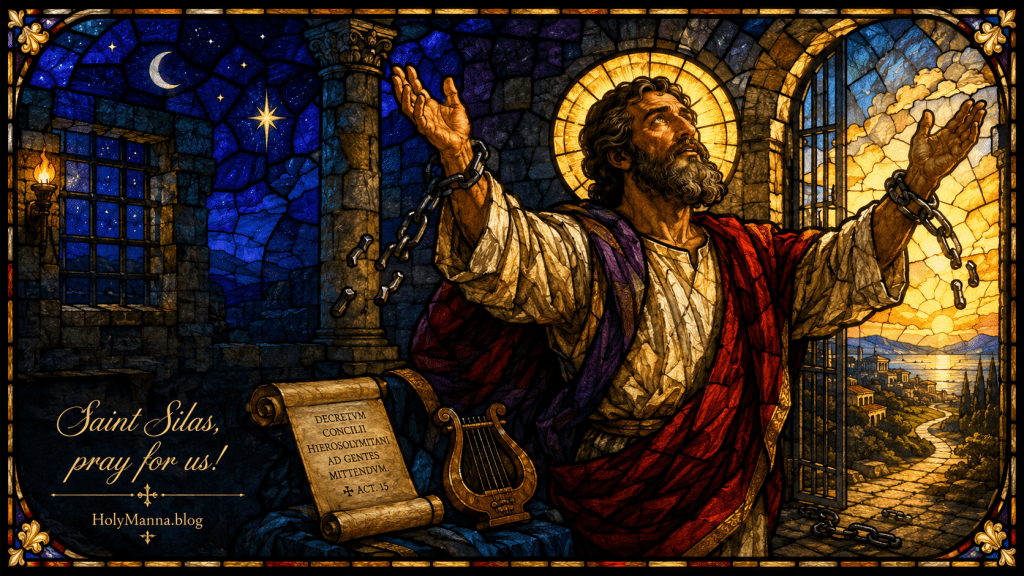
A Quiet Giant of the Apostolic Age
Some saints enter the story of the Church with trumpets and crowds, and others enter quietly, carrying a letter in one hand and a song in the other. Saint Silas belongs to that second kind. He is not the loudest name in the New Testament, yet he stands beside two of the greatest figures the Church has ever known, Saint Paul and Saint Peter, and both of them trusted him completely. In The Acts of the Apostles he appears as a respected leader of the mother Church in Jerusalem, a prophet, a Roman citizen, and the man Paul chose to walk with him into unknown cities and very real danger. In the letters that the faithful still hear proclaimed at Mass, he is remembered as a co-worker and a faithful brother.
Silas matters because his whole life quietly preached a truth that the Catechism teaches with great clarity, that the Church is one because of her source and her soul (CCC 813). He served the unity of the early Christian family, carrying peace between Jewish believers and Gentile believers, holding the mission together when it would have been easier to compete or to quit. The Roman calendar honors him on July 13th, and though the record of his life is brief, the character revealed in that record is luminous. He is worth remembering, and he is worth imitating.
A Trusted Voice From the Church of Jerusalem
Honesty is the first duty of anyone who loves the saints, and honesty requires admitting that Scripture and the earliest sources tell almost nothing about the childhood of Silas. His birthplace, his parents, and the story of his youth have not come down through history, and this account will not invent what the sources do not provide. What can be said with confidence is that he was a Jew, and by every indication a Jew closely bound to Jerusalem, since he first appears as one of the leading men of the Church in that holy city.
His very name is a small puzzle worth pausing over. In The Acts of the Apostles he is always called Silas, while in the letters of Paul and in The First Letter of Peter he is called Silvanus. Pope Benedict XVI, teaching on this quiet companion of Paul, explained that Silas is a Greek form of a Jewish name and that the Latin Silvanus derives from it. The New Catholic Encyclopedia concludes that the two names belonged to the same man, whether because he carried two names as Paul also carried the name Saul, or because one form is simply the translation of the other. A few scholars still discuss which spelling is the original, so it is fair to say that the naming question is not entirely settled, even while the Church has long treated Silas and Silvanus as one and the same person.
Silas held Roman citizenship, a detail that becomes important later in his story (Acts 16:37). More importantly, he had already grown into a mature and trusted disciple by the time he steps onto the page, so trusted that the apostles themselves relied on him. The exact moment of his conversion is not recorded anywhere reliable, and no honest account can supply a scene that history did not preserve.
What Silas is most known for begins at a hinge point in Christian history. After the Council of Jerusalem settled the burning question of whether Gentile converts had to keep the whole Law of Moses, the apostles needed trustworthy men to carry that decision to the anxious churches. They chose Silas. Scripture describes him and his companion as “leading men among the brethren,” and it records that the two of them were prophets who strengthened the community, saying that “Judas and Silas, who were themselves prophets, encouraged and strengthened the brethren with many words” (Acts 15:32). From that first mission of encouragement, Silas would go on to become the traveling companion of the Apostle to the Gentiles.
Prophet, Peacemaker, and Fearless Missionary
The Council of Jerusalem had settled a storm that could have split the young Church in two, and Silas was sent as a living bridge between Jewish Christians and Gentile Christians. Benedict XVI observed that Silas was considered capable of a kind of mediation between Jerusalem and Antioch, serving the unity of the Church across differences of origin and custom. That gift for holding people together is exactly what the Catechism means when it teaches that the whole Church is apostolic and that all her members share in the mission handed on from the apostles (CCC 863).
When Paul and Barnabas parted ways at the start of the second missionary journey, Paul chose Silas to go with him (Acts 15:40). Together they strengthened the churches of Syria and Cilicia and pressed on into Macedonia, carrying the Gospel into Europe for the first time. Their most unforgettable adventure unfolded in the city of Philippi. There a slave girl possessed by a spirit of divination followed the missionaries through the streets, crying out about them day after day. Scripture preserves her strange announcement, “These men are servants of the Most High God, who proclaim to you the way of salvation” (Acts 16:17). When Paul finally turned and commanded the spirit to leave her in the name of Jesus Christ, the girl was freed, and her furious owners, who had profited from her fortune-telling, dragged Paul and Silas before the magistrates.
The two were stripped, beaten with rods, and thrown into the inner cell with their feet fastened in stocks. What happened next is one of the most beautiful scenes in the New Testament, and it is the reason many readers first fall in love with Silas. Bleeding and chained in the dark, the two missionaries did not despair. Scripture records that “about midnight Paul and Silas were praying and singing hymns to God, and the prisoners were listening to them” (Acts 16:25). Their praise in that cell is a perfect picture of what the Catechism calls the prayer of praise, teaching that “Praise is the form of prayer which recognizes most immediately that God is God” (CCC 2639). Then heaven answered. Scripture continues that “suddenly there was a great earthquake, so that the foundations of the prison were shaken” (Acts 16:26), and every door flew open and every chain fell loose.
Here the compassion of Silas and Paul shines even brighter than the miracle. The terrified jailer, certain his prisoners had fled and that his own life was forfeit, drew his sword to end it. Paul stopped him, and the whole household was saved that night, the jailer crying out, “Men, what must I do to be saved?” and receiving the answer, “Believe in the Lord Jesus, and you will be saved, you and your household” (Acts 16:30 to 31). The men who could have escaped chose instead to stay and to rescue a soul. That is the heart of a true missionary, and it is why the Catechism speaks of the missionary mandate that flows from the love of Christ himself (CCC 849).
From Philippi the mission carried on to Thessalonica and Berea, and Silas remained a co-worker at the very center of Paul’s labors. He is named alongside Paul and Timothy in the greeting of the letters to the Thessalonians, and Paul recalled their shared preaching in the words, “the Son of God, Jesus Christ, whom we preached among you, Silvanus and Timothy and I” (2 Corinthians 1:19). Reflecting on this partnership, Benedict XVI drew out a lesson the whole Church still needs, teaching that “Silvanus serves Paul and he serves Peter, because the Church is one and the missionary proclamation is one.” Silas matters because he shows that holiness often looks like faithful teamwork, and that the Gospel advances not through soloists but through servants who labor together in the one apostolic mission of the Church (CCC 857).
Beaten, Chained, and Still Singing
The hardships Silas endured were neither few nor light. At Philippi he was publicly humiliated, beaten with rods, and imprisoned without trial, a violation of his rights as a Roman citizen. Even in that injustice he modeled a quiet dignity, for when the magistrates tried to release him and Paul in secret, the two insisted on lawful redress, Paul reminding the officials, “They have beaten us publicly, uncondemned, men who are Roman citizens, and have thrown us into prison” (Acts 16:37). Standing up for justice was itself a witness, since it protected the fledgling community they would soon leave behind.
The persecution did not end at Philippi. In Thessalonica the preaching of Silas and Paul stirred violent opposition, and a mob dragged some of the believers before the city authorities. When the missionaries slipped away to Berea, the agitators followed them there as well. Paul went ahead toward Athens while Silas stayed behind in Berea with Timothy to strengthen the new converts, later rejoining Paul in Corinth. Through all of it, Silas displayed the virtue the Catechism calls fortitude, teaching that “Fortitude is the moral virtue that ensures firmness in difficulties” (CCC 1808). He kept preaching when preaching was dangerous, and he kept trusting when trusting was costly.
It is important to speak plainly about how Silas died, because online accounts sometimes rush past the uncertainty. The New Testament records no martyrdom for Silas. After his time in Corinth, the inspired narrative simply falls silent about him. Later tradition holds that he became the first bishop of Corinth and that he died in Macedonia, and a smaller strand of tradition says that he died there as a martyr. That martyrdom, however, cannot be verified, and the oldest and most careful Catholic reference works speak only of his death in Macedonia without describing a violent end. This account will not turn an unverified tradition into a certainty. What can be said honestly is that Silas suffered greatly for Christ during his life, that he poured himself out for the Gospel to the very end of his recorded ministry, and that the Church does not number him among the martyrs with historical certainty, even as it honors the very real crosses he carried.
What the Church Remembers, and What Tradition Adds
The story of Silas after his death is a study in honesty. There is no famous catalog of miracles worked at his tomb in the way there is for many later saints, and it would be a disservice to invent one. The Church’s memory of Silas rests less on dramatic wonders and more on the enduring honor of his name in Scripture, in the liturgy, and in the living communion of the saints. That communion is itself a treasure, for the Catechism teaches that the saints in heaven do not forget the faithful on earth but intercede for them constantly (CCC 956), and that those who have gone before contemplate God, praise him, and constantly care for those they have left behind (CCC 2683).
Tradition and geography still keep his memory warm. A monastery dedicated to Saint Silas the Apostle stands today in the Kavala region of Macedonia in northern Greece, close to the ancient sites of Philippi and Neapolis where he once preached and once sang in chains. Pilgrims who walk that region walk the very ground where the Gospel first entered Europe through the labors of Paul and Silas. Tradition also remembers Silas as the first bishop of Corinth, though the New Catholic Encyclopedia is careful to present that claim as tradition rather than documented fact.
One further account belongs here, told plainly for what it is. The private revelations of the mystic Anne Catherine Emmerich describe Silas as a hidden disciple who had once traveled in the company of Jesus. Such private revelations are not part of the deposit of faith, the Church does not require anyone to believe them, and this particular claim cannot be verified from any historical source. It is offered here only as a devotional story, not as established history, and it cannot be verified.
Even the dates of his life carry a measure of mystery. Some references place his death remarkably early, while others suggest he lived on into the later first century, perhaps ministering with Saint Peter, since Peter names him as the faithful brother through whom his first letter was written, saying, “By Silvanus, a faithful brother as I regard him, I have written briefly to you” (1 Peter 5:12). Those sources genuinely conflict, and the honest conclusion is that the exact year of his death is unknown. His true and lasting impact is not measured in relics or shrines but in the letters he helped to carry and compose, letters that the Church still proclaims, and in the example of a man who served the one mission of Christ with his whole heart. The Church remembers him each year on July 13th in the Roman calendar, while the Eastern churches keep his memory on July 30th and again on January 4th among the company of the earliest disciples.
Learning to Sing in Your Own Midnight
Everyone eventually meets a midnight. There are seasons when the doors slam shut, when the chains feel real, and when the future looks as dark as the inside of a Philippian jail. The witness of Silas speaks straight into those seasons, because he did not wait for the earthquake before he began to sing. He praised God in the dark, and only afterward did the walls shake. When the doors of your own life seem to lock from the outside, what song is your heart able to sing before anything changes?
Silas also models a rarer kind of greatness, the greatness of the faithful companion. He was content to be the co-worker rather than the star, the man who carried the letter, strengthened the frightened, and held the mission together. In a culture that prizes being the main character, his life offers a quiet correction, reminding the faithful that the Body of Christ is built up by hidden service as much as by public brilliance. The Catechism teaches that every believer shares in the apostolate of the whole Church and evangelizes above all by the witness of a Christian life (CCC 905). Where is God asking you to be a faithful supporter of someone else’s mission rather than the center of your own?
His care for the unity of the Church is a third lesson for today. Silas carried peace between believers who could easily have splintered apart, and he served a proclamation that was one because the Church is one. In a world of factions, and even in a Church where Christians can grow suspicious of one another, the example of Silas invites the reader to become a bridge rather than a wall. Practical love here can be simple and daily, choosing to encourage rather than to criticize, to reconcile rather than to nurse a grudge, and to build up the parish rather than to complain about it. Is there a relationship or a community where you are being called to be a peacemaker this week?
Finally, Silas teaches a resilience rooted in praise. His courage did not come from ignoring his pain but from lifting his voice to God in the middle of it. A believer can imitate him in very concrete ways, by beginning the hardest days with a word of praise, by choosing to give thanks before the answer arrives, and by staying present to the people God places nearby, even the ones who feel like jailers. The jailer of Philippi found salvation because two beaten men chose compassion over escape. Small choices like that still open prison doors today.
Engage With Us!
Readers are warmly invited to share their own reflections in the comments below, because the communion of saints grows richer when believers encourage one another with their stories, their questions, and their hope. The life of Silas is short in the record but wide in its lessons, and there is room here for many voices to explore it together.
To help that reflection along, here are a few questions to carry into prayer this week.
- When you face your own midnight of fear or difficulty, what would it look like for you to praise God before your circumstances change?
- Who is the Paul in your life, the person whose mission God may be asking you to support faithfully and humbly?
- Where is the Holy Spirit inviting you to be a bridge of unity rather than a source of division in your family, your friendships, or your parish?
- When have you been tempted to escape a hard situation, and how might staying present in love open a door for someone else?
- What is one concrete act of encouragement you can offer someone this week, in imitation of a man the Scriptures themselves call a faithful brother?
May the quiet courage of Saint Silas inspire every reader to keep singing in the dark, to serve the one mission of Christ with humble and generous love, and to treat everyone they meet, even the difficult and the fearful, with the same mercy that Jesus poured out for the world. Go now and do everything in love, for that love is the surest song the world still longs to hear.
Saint Silas, pray for us!
Follow us on YouTube, TikTok, Instagram and Facebook for more insights and reflections on living a faith-filled life.


Leave a Reply