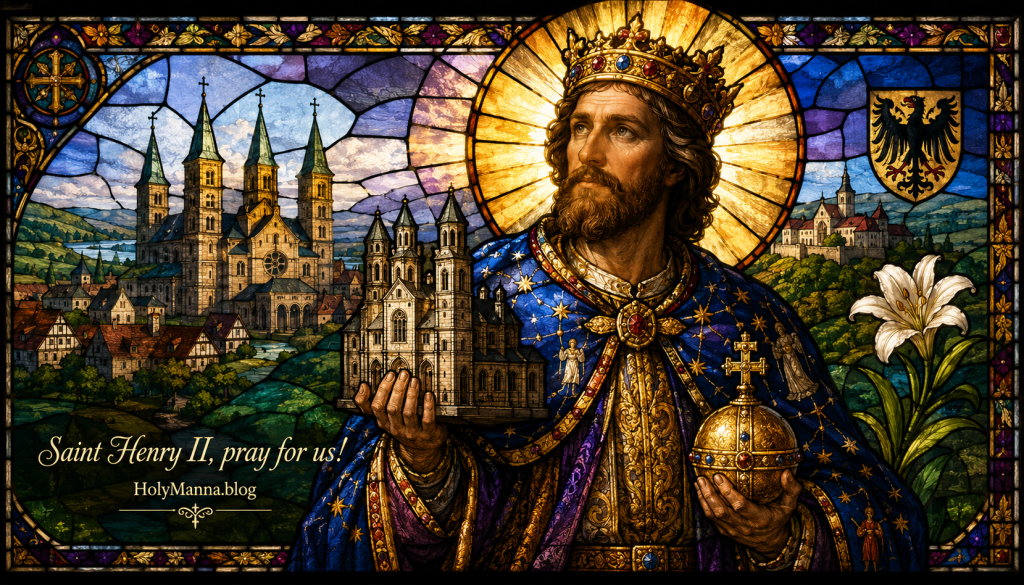
The Emperor Who Ruled on His Knees
Every so often the Church lifts up a saint whose life quietly dismantles an excuse that a great many people carry around in their hearts, the excuse that holiness is meant for monks and mystics and hidden souls, and not for those who live in the noise and pressure of the world. Saint Henry II is exactly that kind of saint. He was a king, an emperor, a soldier, a builder of churches, and a shrewd politician, and he is the only Holy Roman Emperor whom the Church has ever raised to the altars. Where so many rulers of his age treated power as a private treasure to be spent on themselves, Henry treated a throne as a trust to be spent on God and on the people placed in his care.
The Church has always understood that saints like Henry are given to the faithful for a reason. When the Church canonizes someone, she is doing more than praising a life that is over. As the Catechism teaches in CCC 828, she proposes the holy ones to believers as “models and intercessors,” examples to be imitated and friends who pray for the pilgrim Church from within the peace of heaven. Henry stands in that company as a model for everyone who governs, everyone entrusted with wealth or authority, and everyone who has ever wondered whether an ordinary station in life can become the road to sanctity. The answer the Church gives through him is the same answer she gives in CCC 2013, that “all Christians in any state or walk of life are called to the fullness of Christian life and to the perfection of charity.”
Because his holiness bore visible fruit, the faithful have long claimed Henry as a patron in many needs. He is honored as the patron of Benedictine oblates, of the childless and of those who carry the sorrow of infertility, of those who have been turned away by religious orders, of the disabled and physically challenged, of dukes and of those who rule, and of the city and diocese of Bamberg in Germany, where his body still rests, as well as of Basel in Switzerland.
A Boy Raised in the Shadow of the Sanctuary
Henry was born into the Ottonian dynasty of Saxon kings and emperors around the year 972 or 973, and the sources are not in perfect agreement on the exact year, with some placing his birth in 972 and others in 973. He was the son of Henry the Quarrelsome, Duke of Bavaria, and of Gisela of Burgundy, which means that royal blood ran through both sides of his family. Yet what shaped him far more deeply than his lineage was the profoundly Christian atmosphere in which he was raised. He received his early education from the canons at Hildesheim and was later formed by Saint Wolfgang, the holy Bishop of Regensburg, who is himself venerated as a saint. In his youth Henry was even thought to be destined for the priesthood, and so from his earliest years he came to know the life of the Church from the inside, learning to love prayer, Scripture, and the sacraments before he ever learned to command an army.
His was not a childhood free of hardship. His father’s conflict with the emperor Otto II led to the duke’s exile and the loss of his title, and young Henry was sent away for his schooling during those unsettled years. In the providence of God, that season of family disgrace placed him under the care of saints and scholars, so that the very trials of his household became the soil in which his faith took root. When his father died in 995, Henry succeeded him as Duke of Bavaria. Around the year 999 he married Cunigunde of Luxembourg, a woman of deep piety who would one day be canonized in her own right.
Henry’s marriage carries a tender and much loved tradition that deserves to be told with honesty. It is documented fact that Henry and Cunigunde had no children. From this childlessness grew the cherished belief that the two had bound themselves by a mutual vow of perpetual chastity, living as brother and sister for the love of God. This belief is a tradition treasured across the centuries, and it is worth noting that some historians dispute it, since the image of a perfectly chaste imperial marriage developed most strongly only after Cunigunde was canonized in the year 1200. What is beyond dispute, and what the Church holds up for admiration, is that Henry never repudiated his wife despite their lack of an heir, a decision that ran against the common practice of powerful men in his time. His fidelity was itself a witness, an honoring of the covenant of marriage that the Catechism calls a bond of faithful and total love in CCC 1646. Whether the couple lived in continence for the Kingdom, as the tradition holds, or simply in a marriage God chose to leave without children, their union has always been remembered as holy.
A Throne Turned Toward Heaven
Henry mattered to his age, and he matters to readers still, because he proved that a person can hold enormous power without being ruined by it. In 1002 his cousin Otto III died suddenly and without an heir, and Henry, after a struggle for the loyalty of the nobles, was crowned King of Germany. Two years later he added the crown of Italy at Pavia. Finally, on February 14, 1014, Pope Benedict VIII crowned him Holy Roman Emperor in Rome. From that height of worldly glory Henry did something rare. He bent it toward God.
He governed as a servant, not as a tyrant, and in doing so he lived out the very heart of the Catechism, which teaches in CCC 2235 that “those who exercise authority should do so as a service,” echoing the words of the Lord that “whoever would be great among you must be your servant” (Matthew 20:26). Henry appointed devout and capable bishops, founded new dioceses, and threw the full weight of the empire behind the reform of the Church. He worked to root out simony, the buying and selling of holy offices, and he promoted the discipline of celibacy among the clergy. In all of this he became one of the most important lay champions of the great Cluniac reform, taking counsel from Saint Odilo, the abbot of Cluny, whose renewal of Benedictine life was reshaping the whole Church of the West.
His charity was famous and, to some of his relatives, scandalous. He gave so freely to churches, monasteries, and the poor that his own kinsmen complained he was being reckless with the family fortune. Henry seems to have understood something that the wealthy of every age are tempted to forget, that possessions are held in stewardship and not in absolute ownership. The Lord’s warning rang in his conscience, that “much will be required of the person entrusted with much” (Luke 12:48), and the Church honors such open handed love toward the needy as a duty of justice and mercy, teaching in CCC 2447 that almsgiving stands among the chief works of mercy by which the disciple shares his goods with the poor.
Alongside the documented record of his rule, the faithful have long cherished a number of pious stories about Henry’s inner life. One tradition tells that his old teacher Saint Wolfgang appeared to him in a dream and showed him the words “After six.” Henry supposedly took the message first as a warning that he had six days to live, then six months, and at last six years, and so he spent that time in prayer and generous almsgiving, preparing his soul for death. Another beloved story recounts that on his first night in Rome, praying in the basilica of Saint Mary Major, Henry beheld a heavenly Mass in which the Christ Child himself was the celebrant, assisted by Saints Lawrence and Vincent, while countless saints filled the church and angels sang in the choir. There is likewise a tradition that Henry, moved by love for the monastic life, once wished to lay down his crown and enter a monastery, and that a wise abbot persuaded him that his true vocation was to sanctify the world by ruling it well, which is why he is remembered ever after as a Benedictine oblate. These are pious stories handed down through later accounts of his life, and they cannot be verified from the historical record.
The Weight of the Crown and the Wounds He Carried
It would be a mistake to imagine Henry’s life as a smooth procession of triumphs. The empire he inherited was fractured and quarrelsome, and holding it together cost him constant labor and no small suffering. He was repeatedly drawn into war on his eastern frontier, most notably in long and grinding campaigns against Boleslaw the Brave of Poland, which ended only with the negotiated Peace of Bautzen. He was forced to march into Italy more than once to restore order and to defend the papacy, and he had to confront rebellion and disloyalty even among his own relatives and among bishops who resented his reforms. The dispute with Archbishop Aribo of Mainz over an appeal to Rome touched the very unity of the Church, and Henry stood firmly on the side of Rome and of reform against the danger of a national church cutting itself off from the See of Peter.
He also carried physical suffering. Henry endured chronic and painful illness through much of his life, a bodily cross that never left him and that finally brought about his death. He bore it, the sources tell us, without abandoning his duties or his prayer. There is a moving account of his humility in the midst of these strains, that Henry once cast himself at the feet of Herbert, the Bishop of Cologne, to beg pardon for having treated him coldly during a misunderstanding. A ruler who could kneel to ask forgiveness of a subject had learned the lesson of the Gospel deeply.
Honesty requires a clear word here. Saint Henry II was not a martyr. He did not die by violence for the faith, and no authentic account claims that he did. He died in his own palace at Grona, near Göttingen, on July 13, 1024, worn down by long illness, at peace and surrounded by the works of mercy he had spent his life building. His holiness is the holiness of endurance rather than of bloodshed, the sanctity of a man who carried the ordinary and extraordinary burdens of a demanding life and offered every one of them to God. The Church has always taught that this hidden, faithful perseverance is itself a path to the fullness of charity, exactly as CCC 2013 affirms.
A Tomb That Still Draws Pilgrims
Henry’s story did not end at his death, for the veneration of his memory only deepened as the years passed. His body was laid to rest in the great cathedral of Bamberg, the diocese he had founded and the church he had built, and there his wife Cunigunde was buried beside him after her own holy death, so that the two who had ruled together now await the resurrection together. Their shared tomb, carved by the master sculptor Tilman Riemenschneider in the early sixteenth century, is counted among the supreme achievements of late Gothic art, and its marble panels depict scenes from the couple’s lives, including the wonders that tradition attached to them.
The faithful soon began to attribute miracles to Henry’s intercession, and it was on the strength of such reports, gathered in a petition led by Bishop Egilbert of Bamberg, that Pope Eugene III canonized him. The standard date given for this canonization is the year 1146, and a reader will occasionally find the year given slightly differently in some references, though 1146 is the year affirmed by the major Catholic and scholarly sources. His holy wife Cunigunde was canonized in 1200 by Pope Innocent III, making them the only imperial couple ever raised to the altars.
Among the stories of divine protection remembered by later devotion is an account that Henry, outnumbered in battle, invoked the holy martyrs, and that they appeared with heavenly aid to scatter his enemies and win the day, a wonder tied to the banner that Bamberg long preserved among his relics. Another tradition holds that Henry was miraculously cured during his illness through the intercession of Saint Benedict, a scene the faithful later carved into his very tomb. These accounts come to readers as pious stories from the devotion of the Middle Ages, and they cannot be verified from the historical record, yet they express a truth the Church does hold with certainty, that the saints in glory continue to pray for those still on the way, for as the Catechism teaches in CCC 956, the intercession of the saints is a real and unceasing help to the pilgrim Church.
Henry’s cult spread well beyond Bamberg. Portions of his relics were carried to Basel in Switzerland, where he became the second patron of the cathedral after the Virgin Mary herself, and the anniversary of his death on July 13th became a central civic and religious celebration in that city. To this day pilgrims climb the hills of Bamberg to pray at the tomb of the holy emperor and empress, and the old town has been recognized as a UNESCO World Heritage Site, a lasting monument to a ruler who poured his wealth into the beauty of God’s house. Even his famous embroidered Star Mantle survives, treasured as the oldest cope of its kind in Europe, a woven image of a Christian cosmos crowned by Christ, fit emblem for a man who tried to place the whole of his realm under the reign of God.
Ruling the Small Kingdom of Your Own Day
The life of Saint Henry II presses a searching question upon anyone who reads it. Henry held real power, real wealth, and real status, the very things most people spend their lives chasing, and he refused to let those things possess him. Where in your own life has power, even small power over a family, a team, or a household, tempted you to be served rather than to serve? The Gospel that shaped Henry insists that greatness is measured downward, in humble service, and not upward, in dominance, and the Catechism makes that same standard the measure of all authority in CCC 2235.
You do not need a throne to imitate this saint. Every person governs some small kingdom, whether it is a home, a job, a classroom, a friendship, or simply the ordering of one’s own heart. Henry teaches that the way to holiness runs straight through the duties already in front of you, done with love and offered to God. His extravagant generosity, which even his relatives thought excessive, invites a hard look at your own relationship with money and comfort. If your generosity toward the poor and toward the Church were weighed today, would anyone accuse you of giving too much, or would the scales fall the other way? The Lord asked what it profits a person “to gain the whole world and forfeit his life” (Matthew 16:26), and Henry answered that question with the whole of his reign, choosing the glory of God over the glory of self.
There is comfort in Henry as well, and not only challenge. He endured chronic illness, family betrayal, exhausting wars, and the loneliness of leadership, and he sanctified all of it by perseverance and prayer rather than by escaping it. If your own life feels heavy with burdens you did not choose, Henry stands beside you as a friend who understands. He shows that faithfulness in hardship is not a lesser holiness but a very great one. The prophet Micah reduced the whole of a righteous life to a single sentence, that the Lord asks a person “only to do justice and to love goodness, and to walk humbly with your God” (Micah 6:8), and Henry did precisely that from a palace, proving it can be done from anywhere.
Engage With Us!
The story of Saint Henry II is meant to be more than admired from a distance, and this community grows richer when readers share what the Lord is stirring in their hearts. Please leave your thoughts and reflections in the comments below, and let this holy emperor become a companion on your own road to God. To help you begin, consider praying over these questions this week.
- What is the small kingdom God has entrusted to you right now, and are you ruling it as one who serves or as one who wishes to be served?
- Saint Henry gave so generously that others called it reckless, so what is one concrete act of generosity toward the poor or the Church that God may be inviting you to make?
- Which of your present burdens, whether an illness, a strained relationship, or a heavy responsibility, could you begin to offer to God today as Henry offered his?
- Henry remained faithful to his marriage and his duties even when they brought no earthly reward, so where is God calling you to quiet, hidden faithfulness that no one else may ever notice?
- If you asked Saint Henry to intercede for you tonight, what is the one grace you would most want to receive from God through his prayers?
May the example of Saint Henry II give you courage to seek first the Kingdom of God in the very place where you already stand, trusting the promise that “all these things will be given you besides” (Matthew 6:33). Whatever authority, work, or love has been placed in your hands, carry it as he did, with justice, with humility, and above all with the mercy that Jesus taught us, so that everything you do, small or great, becomes an offering poured out for the glory of God and the good of the people He has given you to love.
Saint Henry II, pray for us!
Follow us on YouTube, TikTok, Instagram and Facebook for more insights and reflections on living a faith-filled life.


Leave a Reply