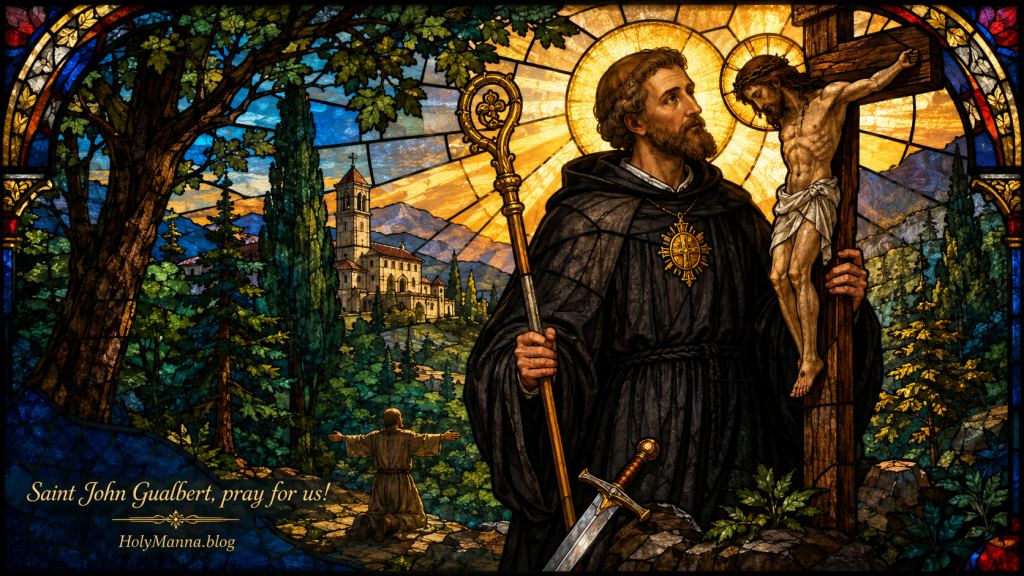
The Merciful Knight Who Laid Down His Sword
Every so often the Church hands the faithful a saint whose entire life turns on a single decision, a saint whose holiness can be traced back to one trembling moment when everything could have gone the other way. Saint John Gualbert is exactly that kind of saint. Born into the proud world of medieval Florence, he began as a pleasure-loving young nobleman with a sword on his hip and revenge in his heart, and he ended his days as a gentle abbot, a fearless reformer, and one of the most beloved monastic founders of medieval Italy. Between those two lives stood a cross, a pair of outstretched arms, and a choice to forgive.
John Gualbert, known in his native Italian as San Giovanni Gualberto, is remembered above all as the founder of the Vallombrosan Order, a reforming branch of the great Benedictine family that took root in a shady Tuscan valley and spread across Italy. The Church honors him as the patron of forest workers, foresters, park rangers, and parks, a patronage that flows directly from the way his monks cared for the wild land around their monastery by planting trees where others would have laid out ordinary gardens. His feast is kept on July 12th, the day of his death, and his story has drawn admirers for nearly a thousand years, from popes who traveled to meet him to artists who later painted the great turning point of his conversion. To walk through his life is to watch grace overtake a proud heart, and it is a reminder that the same grace still stands ready for every heart that will receive it.
One Good Friday in a Narrow Florentine Lane
John was born in Florence into the noble Visdomini family. The sources genuinely disagree on the year of his birth, giving dates that range from around 985 to around 999, and honesty requires that this be acknowledged rather than smoothed over. Some accounts even place his birth at the family castle of Poggio Petroio outside the city. What the sources agree upon is his station in life. He was the son of a proud Florentine house, raised in the faith and given a good education, yet as a young man his heart was captured by the vanities of his world. He gave himself to worldly amusements and to the profession of arms, the life expected of a young nobleman whose family prized honor and power above holiness.
Then tragedy struck. John’s brother, named Hugh, was murdered, and according to the harsh custom of the age it became John’s duty to avenge that death with blood. He hunted the killer, and the moment of reckoning came, providentially, on Good Friday. As the Catholic Encyclopedia records the scene, one of his relatives having been murdered, it became his duty to avenge the deceased, and he met the murderer in a narrow lane and was about to slay him. There was no escape for the defenseless man. Yet in that instant the killer threw himself to the ground and stretched out his arms in the shape of a cross, begging for his life for the sake of the Passion of Christ, who had died on that very day.
John’s sword hung in the air. Everything in his upbringing, his honor, and his grief demanded the blow. Everything in the day itself, Good Friday, the day of the Lord’s own dying prayer for his executioners, demanded mercy. Grace won. According to the traditional accounts preserved in Butler’s Lives of the Saints, John said to his enemy, “I cannot refuse what you ask in Christ’s name. I grant you your life, and I give you my friendship. Pray that God may forgive me my sin.” In that sentence a knight of Florence became a disciple of the Crucified.
The pious tradition, handed down in the early Lives of the saint, adds a tender detail. On his way home John entered the nearby Benedictine church of San Miniato al Monte to pray, and as he knelt, the figure of Christ on the crucifix bowed its head toward him, as though heaven itself were ratifying the pardon he had given. This detail comes from the traditional accounts of his life and cannot be independently verified, yet it has been treasured by the faithful for centuries because it captures a real truth: when a person forgives an enemy for love of Christ, the crucified Lord is honored and pleased.
John’s act was nothing less than the Gospel lived at sword point. The Lord had commanded, “But I say to you, Love your enemies and pray for those who persecute you” (Matthew 5:44), and had cried from the Cross itself, “Father, forgive them; for they know not what they do” (Luke 23:34). Saint Paul had warned that vengeance does not belong to us, teaching that God says, “Vengeance is mine, I will repay, says the Lord” (Romans 12:19). The Catechism of the Catholic Church draws these threads together and shows how high a summit John had climbed in a single moment, for “Christian prayer extends to the forgiveness of enemies, transfiguring the disciple by configuring him to his Master” (CCC 2844). John had been configured to his Master in a Florentine alley, and the change was permanent. That very week he cut off his hair, put on a borrowed habit, and asked to become a monk at San Miniato. His father hastened to stop him, but on hearing his son’s resolve and reasons, he relented and gave his blessing, counseling him only to do good. This interior turning, from a heart bent on revenge to a heart bent on God, is precisely the conversion the Church calls every sinner to embrace (CCC 1431).
The Shady Valley and a Life Poured Out for Reform
The peace of the cloister did not make John comfortable. The eleventh-century Church he entered was wounded by a grave corruption, and he could not close his eyes to it. His own abbot, Oberto, and the Bishop of Florence, Pietro Mezzabarba, stood accused of simony, and their guilt was discovered. Simony is a sin many Catholics today have never heard named, yet it poisoned the medieval Church at its roots. The Catechism defines it plainly: “Simony is defined as the buying or selling of spiritual things” (CCC 2121). To purchase a bishopric or to sell the grace of God as if it were merchandise is to treat what belongs to God as one’s own property, and John found it unbearable. Unwilling to compromise with such corruption, he left San Miniato to seek a purer and stricter life.
For a time he lived among the hermit-monks at Camaldoli, but his heart was drawn to community life rather than solitary hermitage. So he made his way to a wild, wooded valley some twenty miles from Florence, a place whose Latin name, Vallis umbrosa, means shady valley, and there he founded the monastery that would give its name to his whole order: Vallombrosa. The chronology of these early years has long been disputed by scholars, and honesty requires the admission that the dates do not perfectly agree. The learned Mabillon placed the foundation a little before 1038, the church was consecrated by Blessed Rotho, Bishop of Paderborn, in 1038, and the site was donated in 1039 by Itta, the abbess of the neighboring monastery of Sant’Ellero. Some accounts give an earlier date of around 1036. What is certain is that from this hidden valley a great work of reform began.
John adopted the venerable Rule of Saint Benedict but added to it a severe austerity and a penitential spirit all his own. Silence was strict, poverty was fierce, and he refused to allow his monasteries to be built in a costly or showy manner, judging that grand buildings did not befit men vowed to poverty. To free his choir monks to become pure contemplatives, devoted to prayer, he established the system of lay-brothers, called conversi, who cared for the community’s secular work. This was one of the first examples of such an arrangement in monastic history, and other orders would soon imitate it. Yet John’s austerity was never cold. He was famous for his tenderness toward the poor and the sick, attaching hospices to his houses so that no poor person who came to the door would be sent away empty.
His holiness became widely known, and the greatest men of the age sought him out. Pope Leo IX traveled to Vallombrosa to see the humble monk. Popes Stephen IX and Alexander II held him in the highest regard, and Pope Gregory VII, the towering reformer of that century, praised him for the pureness and meekness of his faith. In his humility, John never wished to be ordained to the priesthood, content to serve God and his brothers as a monk. Here is a man who fought the corruption of high office precisely by refusing to grasp at office himself, an eloquent rebuke to the ambition that had wounded the Church.
There was one more feature of Vallombrosa that would shape John’s memory forever. The valley was wild and unkempt when the monks arrived, and John wanted the grounds to reflect the order and beauty of their prayer. Instead of a conventional garden, he had his monks plant trees, firs and pines for the most part, cultivating the forest as part of their ordinary labor. In doing so he lived out a truth the Church still teaches, that creation is good and that human beings are called to respect the integrity of the world God has made rather than to plunder it (CCC 2415). The Psalmist sings, “The righteous flourish like the palm tree, and grow like a cedar in Lebanon” (Psalm 92:12), and in the monks of Vallombrosa, planting their cedars and pines for the glory of God, that verse took living root. It is from this humble labor among the trees that the Church came to name him the patron of foresters, forest workers, park rangers, and parks.
Two miracle stories from his lifetime have been handed down in the traditional Lives of the saint, and they deserve to be told as the treasured stories they are. According to one account, during a time of famine John went to the nearly empty storeroom of the monastery, and at his prayer the provisions multiplied so abundantly that he was able to feed all his houses and every poor person who came seeking help. According to another, upon finding a certain monastery grown too rich and comfortable, he prayed that a stream flowing past it would swell into a torrent and overturn the building, and it did so at once. These stories come from the traditional accounts of his life and cannot be independently verified, yet the faithful have loved them because each carries a lesson John’s whole life proclaimed, that God provides for the poor and that holiness is worth more than riches.
Fire, Slander, and a Peaceful Passing at Passignano
A life spent attacking corruption does not win a man peace, and John’s reform made powerful enemies. The party that profited from simony and clerical abuse struck back at Vallombrosa and its founder. In one of the bitterest episodes, enemies of the saint came to his monastery of San Salvi near Florence, plundered it, set it on fire, and treated the monks with contempt, beating and wounding them. When word reached John of what his sons had suffered, his response revealed how completely his heart had been remade. Far from calling for vengeance, the man who had once hunted his brother’s killer rejoiced. As Butler’s Lives of the Saints records his words, “Now you are true monks. Would that I myself had had the honor of being with you when the soldiers came, that I might have had a share in the glory of your crowns.” The knight who once thirsted for blood now envied his brothers the glory of suffering for Christ.
The struggle against simony produced one of the most dramatic documented episodes of the entire reform, and John’s monks stood at its center. To expose the guilt of the simoniac Bishop Pietro Mezzabarba of Florence, one of John’s followers, Saint Peter Igneus, underwent a public ordeal by fire in 1068, walking through the flames unharmed as a sign of the truth. The bishop’s corruption was thereby confirmed before the whole city, and the reputation of Vallombrosa soared. Through such trials John never wavered in his conviction that the Church must be purified of the buying and selling of holy things.
It must be stated plainly, because it is the truth of his life, that Saint John Gualbert was not a martyr. He did not die by the sword or in prison for the faith, and no source claims that he did. His hardships were of another kind, the long and grinding labor of reform, the slander and violence of powerful enemies, and the daily austerity he embraced for the love of God. After a life of penance and prayer, he received the last sacraments most devoutly and died a peaceful death at the abbey of San Michele Arcangelo at Passignano, near Florence, on July 12, 1073. The sources differ on his exact age at death, giving figures that range from around seventy-four to nearly ninety, a reflection of the same uncertainty that surrounds his birth year. He had lived long, fought hard, and finished well.
A Tomb of Wonders and a Legacy Among the Trees
Death did not silence John Gualbert; it amplified him. Almost at once, miracles were reported at his tomb, and the faithful began to venerate him as a saint. The Church did not act hastily. Pope Celestine III ordered that juridical information be gathered concerning John’s virtues and the miracles attributed to him, and only after this careful examination did he canonize John Gualbert in 1193, on the twenty-fourth of October, one hundred and twenty years after the saint’s death. In this the Church did what she always does with her holy ones, for by canonizing some of the faithful, solemnly declaring that they practiced heroic virtue and lived in fidelity to grace, she proposes them to the faithful “as models and intercessors” (CCC 828). John Gualbert was now given to the whole Church as both a pattern to imitate and a friend to invoke. His feast, long kept locally, was added to the General Roman Calendar in 1595 so that the universal Church might honor him each July 12th.
John is buried at Passignano, where his relics are venerated to this day, and the abbey remains a place of quiet pilgrimage for those who wish to pray near the founder of the Vallombrosans. The great motherhouse at Vallombrosa, high on the wooded slopes above Florence, still stands as a monastery and draws visitors who come as much for the towering forest the monks planted and tended for centuries as for the sanctuary itself. The order John founded spread with remarkable speed after his death. A papal Bull of Urban II in 1090 already lists fifteen monasteries besides the motherhouse, and by the time of Pope Innocent III the Vallombrosan houses numbered more than sixty. Though the order is small today, its witness endures.
John’s influence reached far beyond the cloister and even beyond the Church of his own age. In the twentieth century, Pope Pius XII named him the patron of the Italian forest rangers in 1951, a fitting honor for the monk who first taught his brothers to sanctify their labor among the trees. His memory has also inspired the wider world of art and letters, for the unforgettable scene of his conversion, the merciful knight sparing his enemy in the name of the crucified Christ, became the subject of a celebrated painting by the artist Burne-Jones titled “The Merciful Knight,” and the same story was woven into the novel “John Inglesant.” In these ways the mercy John showed in a Florentine alley continues to preach across the centuries, in stone and paint and word, wherever people are tempted to answer injury with injury.
When Mercy Costs You Something
The temptation, when reading a life like this one, is to admire the saint from a safe distance and then to change nothing. Saint John Gualbert will not allow that. His holiness did not begin in a monastery or on a mountaintop; it began in a narrow lane, with a weapon in his hand and every human reason to strike. The lesson of his life reaches you exactly where you are most tempted to nurse a grudge, to keep score, to insist on your right to be angry. You are probably not carrying a sword, but you may be carrying a resentment against a family member, a coworker, a former friend, or someone who genuinely wronged you, and that resentment may feel as justified as John’s did on Good Friday.
Here is where the saint speaks. Forgiveness is not the pretense that no wound was inflicted, and it is not weakness; it is the hardest and highest act of a Christian, a sharing in the very mercy of the Cross. The Lord set no limit to it, commanding his followers to forgive “seventy times seven” (Matthew 18:22), and the Church teaches that this kind of forgiveness transfigures the one who offers it, configuring him to Christ himself (CCC 2844). John shows that such forgiveness is possible, that it can be given even to the person who has hurt you most, and that when it is given, it does not diminish you but transforms you into a saint. Is there someone in your life whom you have refused to forgive, and might this be the day Christ is asking you to lay down your sword?
John’s life offers more than a lesson in forgiveness. It offers a lesson in courage against corruption and in tender care for the poor and for creation. He refused to look away from what was wrong in the Church he loved, yet he fought it not with bitterness but with holiness, reform, and prayer. He fed the hungry, he housed the sick, and he taught his monks to cultivate the forest as an act of reverence toward the God who made it. You can weave these same virtues into an ordinary week. You can forgive one person you have been avoiding. You can refuse to participate in some small dishonesty at work or at home. You can show mercy to someone poorer than yourself, and you can care for the little corner of God’s creation entrusted to you. When you look honestly at your own life, where is God inviting you to trade the pursuit of your own honor for the pursuit of his mercy? The merciful knight of Florence proves that a single act of grace, embraced in a single hard moment, can set an entire life on the road to holiness.
Engage With Us!
The Church treasures Saint John Gualbert because his story is not only his; it is an invitation held out to you. Please share your thoughts and reflections in the comments below, and let his witness spark an honest conversation about mercy, courage, and conversion. Take a few quiet minutes with the questions that follow, and let the Holy Spirit press them gently into your heart.
- Who is the person you find hardest to forgive right now, and what would it look like to hand that grievance over to Christ, as John did in the lane at Florence?
- John’s conversion began with a single decision on a single day; what one decision could you make today that would set your own life more firmly on the path to holiness?
- Where do you see corruption, dishonesty, or compromise in the world around you, and how might you resist it with holiness and prayer rather than with bitterness?
- John taught his monks to care reverently for the forest as part of their love for God; how might you honor the Creator this week in the way you care for creation and for the poor?
- In what area of your life are you clinging to your own honor or your own rights, and what would change if you sought God’s mercy there instead?
Go out, then, and live as Saint John Gualbert learned to live, ready to forgive even when it costs you everything, ready to defend what is holy without losing your gentleness, and ready to pour out compassion on the poor and the wounded. Do everything, every hard forgiveness and every small mercy, with the love and the mercy that Jesus taught us from the Cross, and trust that the same grace which turned a knight’s sword into a monk’s prayer is more than able to make a saint of you as well.
Saint John Gualbert, pray for us!
Follow us on YouTube, TikTok, Instagram and Facebook for more insights and reflections on living a faith-filled life.


Leave a Reply