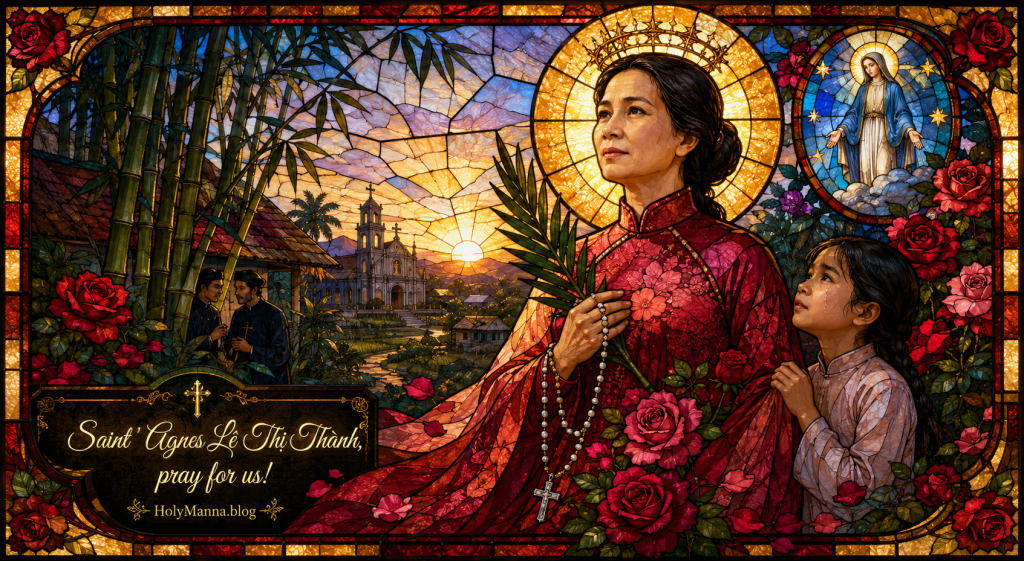
The Mother Who Wore a Robe of Roses
When the Church remembers the great company of the Vietnamese Martyrs, it names one hundred and seventeen witnesses who gave their lives for Christ during centuries of persecution. Bishops and priests are counted there, catechists and seminarians, soldiers and village chiefs. Standing among all of them is a single laywoman, and her name is Agnes Lê Thị Thành. She was not a religious sister. She held no office in the Church. She was a wife and a mother of six who kept a home, raised her children in the faith, and quietly opened her door to priests who had nowhere safe to go. That ordinary life, lived with extraordinary courage, is exactly why she matters so much to believers today.
Saint Agnes Lê Thị Thành was born in 1781 and died a prisoner for Christ in 1841. She was beatified by Pope Pius X on May 2, 1909, and canonized by Pope Saint John Paul II on June 19, 1988, together with her one hundred and sixteen companions. Because of her tender care for her children’s faith, and because she gave her life while defending the priests who brought the sacraments to her people, she is honored and invoked as a patroness of Vietnamese Catholic mothers. Mothers’ associations in Vietnam keep her July feast as their own patronal celebration, asking her to help them love, protect, and form their families.
Her witness speaks directly to a truth the Church holds dear. The Catechism of the Catholic Church teaches that “Martyrdom is the supreme witness given to the truth of the faith: it means bearing witness even unto death. The martyr bears witness to Christ who died and rose, to whom he is united by charity” (CCC 2473). Agnes never preached from a pulpit or wrote a treatise. She simply refused to let go of Jesus, even when letting go would have saved her life. Her story is a reminder that holiness is not reserved for the cloister or the sanctuary. It can be lived at a kitchen table, in a garden, and inside a prison cell.
A Devout Daughter and a Faithful Wife
Agnes was born in 1781 in the village of Bái Điền, in the Yên Định district of Thanh Hóa province, in what is now northern Vietnam. Her family was both comfortable and deeply Catholic, and she was raised in the practice of the faith from her earliest years. Her childhood, however, was marked by a painful family rupture. Because her mother had not borne a son to continue the family line, her father took a second wife. Rather than remain in a divided household, her mother took young Agnes, then about twelve years old, and her younger sister Thuộc, and settled in the hamlet of Đông, in the Phúc Nhạc commune of Ninh Bình province. There the family began again, and there Agnes grew into a young woman known for her piety.
At the age of seventeen she married a Catholic man named Nguyễn Văn Nhất. Theirs was a quiet and devout home, and God blessed them with six children, two sons and four daughters. Following a local custom by which parents were addressed by the name of their firstborn son, Agnes came to be known throughout her community as Bà Đê, or “Mrs. Đê.” That homely nickname tells its own story. She was, first and most visibly, a mother, wrapped up in the daily labor of raising children in a hostile world.
It is worth pausing here, because it would be easy to overlook what a hidden heroism this ordinary life required. Agnes and her husband took the religious formation of their children with complete seriousness, teaching them to pray and to hold fast to Christ in a land where holding fast to Christ could cost everything. The Church sees such families as something far greater than a private arrangement. The Catechism calls the believing family the Ecclesia domestica, and it insists that “in a world often alien and even hostile to faith, believing families are of primary importance as centers of living, radiant faith” (CCC 1656). Agnes lived that teaching before it was ever written down for her. Her home was a small church, and she was its faithful guardian.
There is no dramatic conversion story to tell about Agnes, because she never left the faith to begin with. What deepened in her was not belief but courage. As the persecution around her grew more violent, her devotion did not shrink back. It expanded, until it reached out to shelter the very men the government most wanted to destroy.
Shelter in the Shadow of Persecution
To understand why Agnes is a saint, a reader must understand the world she lived in. From the seventeenth through the nineteenth centuries, the Catholic Church in Vietnam endured wave after wave of ferocious persecution. Emperors such as Minh Mạng and Thiệu Trị regarded Christianity as a foreign threat to the social order, and they moved to crush it. Christians were branded on the face with characters marking them as followers of a false religion. Families were torn apart, villages were destroyed, and both clergy and laity were subjected to exile, forced labor, torture, and death. The Vatican has recognized that the sufferings endured in these persecutions rank among the most brutal in the entire history of Christian martyrdom. Hundreds of thousands are believed to have died for the faith.
In the middle of that terror, priests could not move openly. They celebrated the sacraments in secret, slipping from village to village, depending entirely on the courage of ordinary Catholics who were willing to hide them. Agnes Lê Thị Thành was exactly such a Catholic. For years she gave shelter to the local clergy and to foreign missionaries, concealing them in her own home, providing them safe places to rest, and helping them travel in disguise so that the faithful could still receive the Eucharist and confession. Every priest she hid was a mortal risk to her whole family. She hid them anyway.
It is important to be honest about what the historical record does and does not contain. There are no accounts of Agnes working miracles during her lifetime, and this reflection will not invent any. Her greatness was not written in wonders. It was written in a steady, unglamorous fidelity that put her own life on the line, again and again, so that Christ could reach her neighbors through His priests. In this she becomes a model that any believer can actually follow, because she was not extraordinary in her gifts. She was extraordinary only in her love. Scripture gives us the measure of that love in the words of the Lord Himself: “Greater love has no man than this, that a man lay down his life for his friends” (John 15:13). Agnes would live those words to the letter.
The reason to remember her, and to imitate her, is precisely that her heroism grew out of her vocation rather than around it. She did not abandon her family to serve the Church. She served the Church through her family, by making her domestic life a fortress of hospitality and faith. The Catechism reminds every Christian parent that “through the grace of the sacrament of marriage, parents receive the responsibility and privilege of evangelizing their children” (CCC 2225). Agnes did not treat that responsibility as a private matter that stopped at her own front gate. She let it overflow into a courage that protected the whole Body of Christ around her.
Red Roses of Courage
On the morning of Easter Sunday, April 14, 1841, betrayal arrived at the very moment the Church was celebrating the Resurrection. A man named Đễ, an assistant to one of the priests, secretly reported the clergy’s whereabouts to Governor Trịnh Quang Khanh in exchange for a reward. To escape the raid that followed, the head of the parish council, a man named Cơ, arranged for Agnes to hide the French missionary Father Jean-Paul Galy Carles, known to the Vietnamese as Father Lý, in a dry ditch behind a bamboo grove in her garden. Soldiers searched the property, discovered the priest, and arrested Agnes for harboring him. Along with Mr. Cơ and eight others, she was locked into a heavy wooden cangue and forced to march to the prison at Nam Định. The weight of that yoke was so great that she collapsed again and again along the road.
What followed was a sustained campaign to break her. Governor Trịnh Quang Khanh first tried sweet promises, urging her to save herself by renouncing her faith. When enticement failed, he turned to torture. She was beaten savagely, especially on the legs, until her body was covered in wounds. According to the accounts of her martyrdom, the soldiers bound her legs and placed venomous snakes inside her clothing, hoping that sheer terror would accomplish what beatings had not. Those same accounts relate that she stayed perfectly still in prayer, calling on God and the Blessed Virgin, and that the snakes left her unharmed. This dramatic episode of preservation comes to us through the received tradition of her martyrdom as it has been handed down; it is presented here as those accounts relate it.
Through all of it, Agnes would not bend. When her husband was allowed to see her in prison, he was horrified by the blood and bruises where she had been beaten. She reassured him that through the grace of Our Lady she was able to bear the pain. Her most famous words, however, were spoken to her own child. When her youngest daughter was permitted to visit and burst into tears at the sight of her mother’s blood-stained clothing, Agnes comforted her instead of the other way around. As her words are commonly translated from the Vietnamese, she said, “Do not cry. These are my red roses of courage. I am suffering for the name of Jesus. Why are you crying?” In that single sentence, a tortured mother turned her wounds into a lesson in hope for the daughter she would soon leave behind. Because these sayings reach us through translation, the exact wording varies slightly across sources, though the substance is consistently attested.
Here the reader must understand something precise about the nature of Agnes’s martyrdom, because the truth is more moving than any embellishment. She was not beheaded on an execution ground as many of her companions were. Worn down by torture, starvation, the filth of the prison, and the dysentery she contracted there, her body finally gave way. She died in her cell on July 12, 1841, during the reign of Emperor Thiệu Trị. Following the custom of the time, the guards burned her toe to certify that she was dead. She was a martyr in the fullest sense the Church recognizes, for she died from sufferings deliberately inflicted upon her in hatred of the faith, sufferings she could have escaped at any moment by denying Christ. The Catechism honors exactly this kind of witness when it says that the Church has “painstakingly collected the records of those who persevered to the end in witnessing to their faith. These are the acts of the Martyrs. They form the archives of truth written in letters of blood” (CCC 2474). Agnes wrote her name into that archive, not with a single sword stroke, but with months of patient, bleeding endurance.
Her Roses Still Bloom
After her death, Agnes was buried at the execution ground where the bodies of the condemned were laid. About six months later, the faithful returned in secret, exhumed her remains, and reburied her with honor at the church in Phúc Nhạc, close to the community she had served. The reverent care taken with her body reflects a conviction that runs deep in Catholic devotion, for the Church has always cherished the earthly remains of those who died for Christ as precious relics of His victory in them.
It should be stated plainly and honestly that the sources available do not record a specific, individually documented posthumous miracle worked through her intercession alone. What the record does show is something arguably more powerful than a single wonder. It shows a devotion that has never faded. In the reflection of the Church, her death was not an ending but a seed. The ancient words repeated in the Catechism capture it exactly: “the blood of martyrs is the seed of Christians” (CCC 852). From the blood of Agnes and her companions, the Church in Vietnam did not wither but grew, until today it counts millions of believers.
Her influence is especially vivid among mothers. Across Vietnam and among Vietnamese Catholics scattered throughout the world, she is loved and invoked as a patroness of Christian mothers. Thousands gather for her feast to ask her help in raising their children in the faith, in guiding them with prayer and gentle counsel rather than harshness, and in keeping their homes anchored in Christ. Parishes and a retreat center bear her name, including a church community in Louisiana and a pilgrimage and retreat center in Texas, so that her memory continues to shape the prayer of the living.
The greatest sign of her impact, however, was written in Rome. When Pope Saint John Paul II canonized the Vietnamese Martyrs on June 19, 1988, he raised this one hidden mother to the altars alongside bishops and missionaries, declaring to the whole world that her ordinary, hidden, self-giving life was in fact a masterpiece of grace. In doing so the Church did what she always does with her saints, holding them up not as distant celebrities but as companions and helpers. Canonization proposes such holy men and women to the faithful as models to imitate and as intercessors to whom they can turn (CCC 828). The roses Agnes spoke of in her prison cell still bloom, every time a mother asks for her prayers and finds the courage to keep the faith.
The Ordinary Road to Extraordinary Holiness
It would be a mistake to read the life of Saint Agnes Lê Thị Thành as something safely locked in the past, in a distant country under a cruel emperor. Her deepest lesson is startlingly present. She teaches that sanctity is built out of the raw material of an ordinary life, faithfully surrendered to God. She was a wife, a mother, a homemaker, and a neighbor, and she became a saint not by escaping those roles but by pouring Christ into them. The reader who feels that holiness belongs only to priests and nuns should sit with her example for a long while.
Her first great virtue was courageous hospitality. Agnes opened her home to those in danger, knowing exactly what it might cost her. Few believers today will be asked to hide a hunted priest, yet every believer is asked to make room for Christ in the people around them, especially the vulnerable, the frightened, and the ones the world would rather ignore. Where in your own life is Jesus asking you to open a door you would prefer to keep shut?
Her second virtue was maternal faithfulness. She formed her children in the faith with such devotion that she is now the patroness of mothers who do the same. In a culture that often treats the handing on of faith as optional, her life insists that the family is the first and most important school of the love of God. What is one concrete way you could make your own home more of a domestic church this week, whether through shared prayer, honest conversation about faith, or simple acts of mercy?
Her third virtue was endurance. Agnes was not delivered from her suffering by a dramatic rescue. She was given, instead, the strength to bear it to the end, day after painful day, until it was finished. Most crosses in an ordinary life are like that, long and quiet rather than sudden and heroic. Her example, and the words of Saint Paul, offer a pattern to imitate: “I have fought the good fight, I have finished the race, I have kept the faith” (2 Timothy 4:7). When your own faithfulness feels less like a battle and more like a slow endurance, where might you find the grace to keep going?
Practically, the saint invites a few simple resolutions. A believer might choose one act of hospitality this week toward someone in genuine need, offering not merely convenience but a real share in one’s time or home. A parent might begin a small, steady rhythm of prayer with their children, trusting that these humble seeds are of primary importance. And anyone carrying a long, wearying trial might turn to Agnes directly, asking this mother who called her wounds red roses to obtain the courage to keep loving Christ without counting the cost.
Engage With Us!
Please share your thoughts and reflections in the comments below. The witness of Saint Agnes Lê Thị Thành is meant to be talked about, prayed over, and lived out together, and your experiences may be exactly the encouragement another reader needs today. Take a few moments with the following questions, and let them lead you into deeper conversation with the Lord and with one another.
- Saint Agnes opened her home to those in danger for the sake of Christ. Who in your life is Jesus asking you to welcome, protect, or make room for right now?
- She formed her children in the faith so faithfully that she is now honored as a patroness of mothers. What is one specific step you could take to make your own home more of a domestic church?
- She endured a long, painful martyrdom rather than a swift one. What long and quiet cross are you carrying, and how might Saint Agnes’s perseverance strengthen you to keep the faith?
- She called her blood-stained clothes red roses of courage. Where in your own suffering might God be weaving something beautiful that you cannot yet see?
- She refused to renounce Christ even to save her life. Is there any area where you have been tempted to hide or soften your faith, and what would courageous witness look like there?
May the example of Saint Agnes Lê Thị Thành give you courage in your own hidden faithfulness, and may her prayers keep you close to the heart of Jesus. Go out and love the people God has placed in your life with the same mercy and tenderness that Christ has shown to you, holding nothing back, trusting that even your smallest act of faith can bloom, in His hands, into a rose of courage. Saint Agnes Lê Thị Thành, pray for us.
Saint Agnes Lê Thị Thành, pray for us!
Follow us on YouTube, TikTok, Instagram and Facebook for more insights and reflections on living a faith-filled life.


Leave a Reply