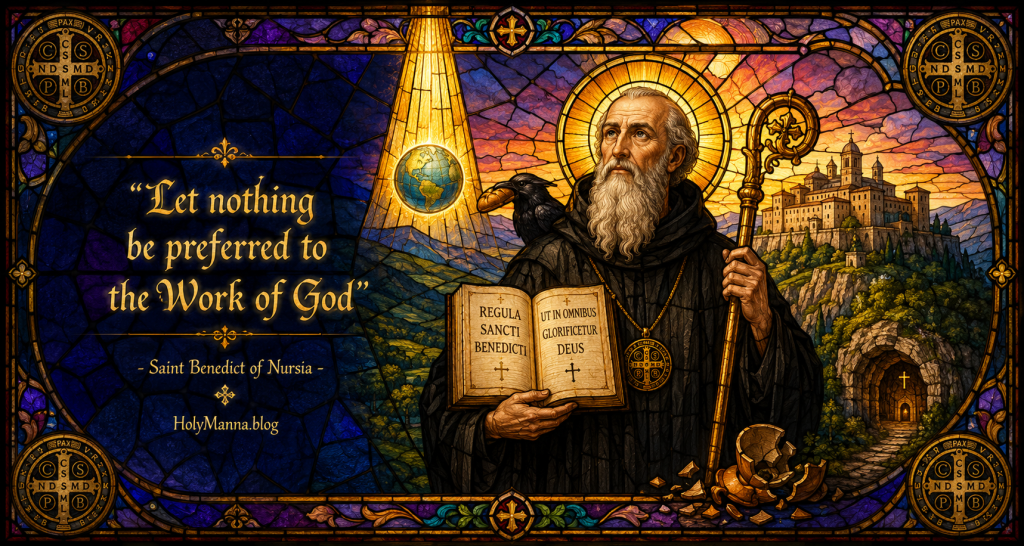
A Father for a Continent
Some saints blaze across history like comets. Saint Benedict of Nursia is not one of them. He never led an army, never sat on a throne, never preached to roaring crowds. He simply climbed a mountain, gathered a family of monks around him, and wrote a short book about how to pray, work, and live together in peace. And yet that quiet life, lived between roughly 480 and 547, did more to shape the soul of the Western world than nearly any other in Christian history. The Church honors him as the Father of Western Monasticism, and on October 24, 1964, Pope Saint Paul VI formally proclaimed him the Principal Patron of all Europe in the apostolic letter Pacis Nuntius, calling him a messenger of peace and a father of European civilization. He is also the traditional patron of monks and monastics, and he is invoked against poison, a patronage rooted in two real attempts on his life that will be told below.
His feast is celebrated on July 11 in the General Roman Calendar. For centuries it was kept on March 21, the traditional day of his death, but because that date always falls within Lent, the 1969 reform of the calendar moved the celebration to the summer, where the whole Church could feast him properly. The Church teaches that from her very beginning there were men and women who set out to follow Christ with greater liberty and to imitate him more closely by practicing the evangelical counsels, and that each of them lived a life consecrated to God in their own way (CCC 918). Benedict took that ancient impulse, which had flourished in the deserts of Egypt, and gave it a stable, humane, and enduring home in the West. Nearly everything known about his life comes from Book Two of The Dialogues of Pope Saint Gregory the Great, written around the year 593 from the testimony of four of Benedict’s own disciples. Gregory opens with a line that has defined the saint ever since, describing him as a man of venerable life, “blessed by grace, and blessed in name, for he was called Benedictus.”
Leaving Rome Behind
Benedict was born around the year 480 in Nursia, the mountain town in Umbria known today as Norcia, into a family Gregory describes as distinguished and free born. Later tradition supplies the names of his parents, but those names cannot be verified from the early sources, and honesty requires saying so plainly. What the early record does give is a sister, Saint Scholastica, who consecrated herself to God from her youth and whose story is woven into her brother’s until the very end. The popular claim that Benedict and Scholastica were twins is a later tradition; Gregory calls her simply his sister, and the twin detail cannot be verified.
As a young man Benedict was sent to Rome for the liberal studies expected of a boy from a good family. What he found there horrified him. The Rome of the late fifth century was a city of collapsing order and casual vice, the Western Empire having formally ended in 476, only a few years before his birth. Gregory says that Benedict, seeing many of his fellow students falling headlong into moral ruin, drew back his foot from the threshold of the world. He abandoned his studies, his inheritance, and his prospects, and Gregory describes the choice with one of the most striking phrases in all hagiography, saying that Benedict withdrew “knowingly ignorant and wisely unlearned.” He knew exactly what he was giving up, and he judged that his soul was worth more.
He went first to the village of Enfide, today called Affile, in the company of his childhood nurse, who loved him and would not leave him. There Gregory records the first miracle attributed to him. His nurse had borrowed an earthenware sieve for cleaning wheat, and it fell and broke in two pieces. Finding her weeping over it, the young Benedict took the pieces, gave himself to prayer, and rose to find the sieve whole. The grateful villagers hung it over the church door, where Gregory says it remained for decades. This story comes from The Dialogues on the testimony of Benedict’s disciples; like all the miracle accounts of his life, it is venerable tradition handed down by the Church rather than independently documented history.
The attention that little miracle brought was exactly what Benedict did not want. He slipped away alone into the wild valley of Subiaco, about forty miles from Rome, and found a cave in a cliff face, the place pilgrims still visit today as the Sacro Speco, the Holy Cave. There he lived as a hermit for about three years, unknown to the world, sustained by a monk named Romanus from a nearby monastery who lowered bread to him on a rope with a small bell attached. Gregory recounts that one Easter, God prompted a priest preparing his holiday meal to seek out a hidden servant of God who was hungry; the priest found Benedict, who had lost track of the calendar entirely, and told him it was the day of the Lord’s Resurrection. Shepherds later discovered the man in the cave, at first mistaking the figure clothed in skins for a wild animal, and through them his holiness became known throughout the region.
The Rule That Ordered the West
Fame found the hermit whether he wanted it or not. The monks of a nearby monastery at Vicovaro, having lost their abbot, begged Benedict to lead them. He warned them honestly that his way of life would not suit theirs, and he was right. His discipline proved unbearable to men who had grown comfortable, and they resolved to be rid of him by mixing poison into his wine. When the glass pitcher was brought to him at table, Benedict made the sign of the cross over it, and Gregory records that the pitcher shattered as if struck by a stone. Benedict rose calmly, told the monks to seek an abbot suited to their ways, and returned to his beloved solitude. The Church sees in such moments the truth she teaches about the sacramentals and the power of blessing, for the sign of the cross marks the Christian’s whole life and calls down God’s protection (CCC 1670, CCC 2157).
Solitude did not last. Disciples gathered, and Benedict organized them into twelve small monasteries of twelve monks each in the Subiaco valley, forming young men including two boys entrusted to him by Roman nobles, Maurus and Placid, both venerated as saints today. The Dialogues record wonders from these years that generations of Christians have loved. When the boy Placid fell into the lake while drawing water and was swept from shore, Benedict, knowing it in spirit from his cell, sent Maurus running; Maurus ran out upon the surface of the water itself, seized the boy by the hair, and only realized on dry land what he had done. When three of the mountaintop monasteries suffered for lack of water, Benedict spent the night in prayer on the heights, and a spring broke from the rock at the place he marked. When a poor laborer’s borrowed tool flew from its handle into the deep water, Benedict held the handle at the surface and the iron rose and rejoined it. Each of these accounts rests on Gregory’s testimony from Benedict’s disciples; they are told here as the Church has always told them, as tradition rather than verifiable record, and they paint a consistent portrait of a father whose prayer met the ordinary needs of ordinary people.
Around the year 529, after the jealousy of a local priest made peace at Subiaco impossible, Benedict took a small band of monks south to a high hill between Rome and Naples called Monte Cassino. What he found on the summit says everything about the age: a still active altar and sacred grove of Apollo, where the local country people offered pagan sacrifice a full century after the empire had become Christian in name. Benedict smashed the idol, overturned the altar, cut down the grove, and built in their place oratories dedicated to Saint Martin of Tours and Saint John the Baptist, preaching until the surrounding people embraced the faith. On that mountain he spent the rest of his life, and there he wrote the work for which the world remembers him, the Rule of Saint Benedict.
The Rule is a short book, roughly seventy three brief chapters, and its genius is its balance. It orders the monk’s day around the Divine Office, the Work of God, commanding that “Let nothing be preferred to the Work of God” (RB 43). It dignifies labor, warning that “Idleness is the enemy of the soul” (RB 48). It commands a hospitality that has marked Benedictine houses for fifteen centuries: “Let all guests who present themselves be welcomed as Christ” (RB 53), a living application of the Lord’s own words in The Gospel of Matthew about welcoming him in the stranger. It binds everything together with the counsel that stands at the heart of Benedict’s whole vision: “Prefer nothing whatever to Christ” (RB 72). And it opens with what may be the most beautiful first sentence ever written for a book of discipline: “Listen carefully, my son, to the master’s instructions, and attend to them with the ear of your heart.” For all its wisdom, Benedict called it only “a little rule for beginners” (RB 73), promising in its Prologue “nothing harsh, nothing burdensome.” The famous Benedictine motto “Ora et labora,” pray and work, does not appear word for word in the Rule itself; it is a later summary of his spirit, though the Catechism itself hands on the saying “Pray and work” when teaching about daily bread and daily trust in the Father (CCC 2834). Readers should also know that the popular line about always beginning again, often attributed to Benedict online, comes from a modern paraphrase and is not found in his text.
Gregory records that God confirmed this hidden life with signs. During the building of the monastery a wall collapsed on a young monk and crushed him; Benedict had the broken body brought to his cell, prayed over it, and restored the boy to life and to his work. He read the hearts of his monks, gently exposing hidden pride and secret disobedience so that souls could be healed. And near the end of his life, standing at his window in prayer before the night office, he received the vision for which mystics have loved him ever since: the whole world gathered up before his eyes as if in a single ray of the sun, in which he saw the soul of Germanus, Bishop of Capua, carried by angels to heaven. Gregory explains that to the soul who sees the Creator, all creation appears small. Every one of these accounts comes from The Dialogues and rests on the testimony of his disciples; none can be verified by independent documents, and the Church tells them as her cherished tradition.
Poison, Jealousy, and a Prophecy to a King
Benedict was not a martyr, and no honest telling of his life should suggest otherwise; he died in peace, in prayer, among his sons. But his path was anything but easy, and twice men tried to kill him. The first attempt was the poisoned wine at Vicovaro. The second came at Subiaco from a priest named Florentius, sick with envy at the crowds flocking to the man of God. Florentius sent Benedict a poisoned loaf of bread disguised as a gift of blessed bread. Benedict, knowing what it carried, ordered a raven that he was accustomed to feed to carry the loaf far away where no one could find it, and the bird obeyed. When poison failed, Florentius attacked the souls of Benedict’s monks instead, sending immoral women into the monastery garden to corrupt the young men. Rather than fight for his own position, Benedict chose peace; he set the monasteries in order under trusted priors and withdrew, which is how he came to Monte Cassino at all. Gregory adds a sobering ending: word reached Benedict on the road that a balcony had collapsed on Florentius and killed him, and far from rejoicing, Benedict wept bitterly, both for the death of his enemy and because one of his disciples celebrated it. He imposed a penance on the disciple who rejoiced. The Church sees in that grief the Lord’s own command in The Gospel of Matthew to love one’s enemies, a command she teaches has no exceptions (CCC 2844).
His later years unfolded against the ruin of Italy, as the Gothic War ground the peninsula to pieces. Around 542 the Gothic king Totila, having heard of Benedict’s gift of prophecy, decided to test him. He dressed his sword bearer Riggo in the royal robes and sent him to the monastery with a royal escort. Benedict saw through the disguise at a glance and told Riggo to put off what he wore, for it was not his. When the shaken king came in person, he prostrated himself before the monk, and Benedict, raising him, rebuked the cruelty of his campaigns and told him plainly what was to come: he would enter Rome, cross the sea, reign nine years, and die in the tenth. Gregory reports that Totila was less cruel from that day, and history records that the king entered Rome, crossed to Sicily, and died in 552, within the span the saint had named. Benedict also prophesied, with tears, that his own beloved Monte Cassino would one day be given over to destruction, a sorrow fulfilled when the Lombards sacked the abbey around 577.
The tenderest trial of his life came last, and it came from love. Once a year his sister Scholastica, consecrated to God since childhood, would meet him at a house near the monastery gate to speak of holy things. At their final meeting, sensing she would not see him again, she begged him to stay the night in conversation about the joys of heaven. Benedict refused; his own Rule required his return. Scholastica bowed her head over her folded hands in prayer, and a storm of thunder and rain broke so suddenly and so violently that no one could step outside. “God forgive you, sister. What have you done?” Benedict said, and she answered, “I asked you and you would not listen; so I asked my God and he did listen.” He stayed, and they passed the night in holy conversation. Three days later, standing in his cell, Benedict saw his sister’s soul rise to heaven in the form of a dove. Gregory draws the lesson that she proved mightier because she loved more, for God is love. Benedict did not long outlive her. Six days before his death he ordered his tomb opened. When the day came, he had himself carried into the oratory, received the Body and Blood of the Lord, and died on his feet, his arms raised in prayer, held up by the hands of his disciples. That very day, two monks in separate places saw the same vision: a road covered with rich garments and glittering with lamps, rising eastward from the monastery to heaven, and a figure who told them that this was the road by which Benedict, beloved of the Lord, had ascended. The traditional date is March 21, 547.
The Mountain That Kept Rising
Benedict was buried at Monte Cassino in the same tomb as Scholastica, on the very spot where the altar of Apollo had once stood, and their bones lay together in death as their souls had been united in God. Even his relics have a story marked by the tumult of history, and it must be told honestly. After the Lombards destroyed the abbey in the late sixth century, the French Abbey of Fleury, at Saint-Benoît-sur-Loire, claimed that its monks journeyed to the ruins and carried the bones of Benedict back to France, where they have been venerated ever since. Monte Cassino has always firmly maintained that the relics never left and remain in its keeping. Both claims are centuries old, both are held in good faith within the Church, and the dispute has never been definitively resolved; pilgrims venerate the saint at both holy places, and the Church teaches that the faithful rightly honor the memory and the relics of the saints, who intercede for us before God (CCC 956, CCC 957, CCC 1674).
Miracles of healing and protection have been attributed to Benedict’s intercession at his shrines across the centuries, and Gregory himself records one after the saint’s death: a woman who had lost her reason wandered into the cave at Subiaco, slept the night there, and came out healed, remaining sound for the rest of her life. That account, like the others, rests on Gregory’s testimony and cannot be independently verified. The most widespread devotion tied to his intercession is the Medal of Saint Benedict, one of the most beloved sacramentals in the Church. Its reverse bears the initials of a prayer of exorcism and trust, “Crux sacra sit mihi lux,” may the holy Cross be my light, and the words “Vade retro satana,” step back, Satan, recalling the saint’s lifelong victories over the enemy and over poison. The Jubilee form of the medal was struck at Monte Cassino in 1880 for the fourteenth centenary of his birth, and the Church commends such sacramentals as signs that prepare the faithful to receive grace (CCC 1670).
The story of Monte Cassino itself reads like a parable of resurrection. The abbey was destroyed by the Lombards around 577, by Saracen raiders in 883, by an earthquake in 1349, and finally by Allied bombing on February 15, 1944, during one of the most terrible battles of the Second World War. Each time, the monks returned and rebuilt. When Pope Saint Paul VI consecrated the newly rebuilt basilica in 1964, he chose that moment to proclaim Benedict Patron of Europe, honoring the way the Benedictine family had carried the Gospel, the Scriptures, the writings of the Fathers, the liturgy, agriculture, and learning itself through the centuries after Rome’s fall. It is scarcely an exaggeration to say that Western civilization wintered in Benedictine monasteries and emerged alive because monks kept praying and copying and planting. Pope Benedict XVI pointed to the saint as an inspiration for his own papal name. And the parable continues in our own day. In Benedict’s birthplace of Norcia, a devastating earthquake on October 30, 2016 brought the Basilica of Saint Benedict down to its facade. Nine years later, on October 31, 2025, the rebuilt basilica was solemnly dedicated once more, and the town that gave the world Saint Benedict again has a church rising over the place of his birth. Pilgrims today still climb to the Sacro Speco at Subiaco, still walk the cloisters of Monte Cassino, still pray at Saint-Benoît-sur-Loire, and still gather in Norcia, because holiness leaves an address.
Listening with the Ear of the Heart
What does a sixth century abbot have to say to a person juggling a commute, a phone full of notifications, and a faith that sometimes feels stretched thin? Almost everything, as it turns out, because Benedict built his whole life for people living through the collapse of the world they knew. His answer was not panic and not escape. His answer was order: pray at fixed times, work with your hands, welcome the stranger, stay put, and prefer nothing whatever to Christ.
Start with the first word of his Rule: listen. Benedict asks for attention “with the ear of your heart,” and that is a challenge aimed straight at the modern soul. The Catechism teaches that humility is the foundation of prayer and that man is a beggar before God (CCC 2559). How much of the day is spent listening, really listening, to God, to Scripture, to the people nearest at hand? A single practical step in Benedict’s spirit would be choosing two fixed moments of prayer each day, morning and evening, and defending them the way an appointment with a boss would be defended, because the Work of God comes first.
Then take his balance of prayer and work. The Church teaches that work honors the Creator’s gifts and that by enduring its hardships in union with Jesus, a person collaborates in a certain fashion with the Son of God in his redemptive work (CCC 2427), and she hands on the old counsel to pray and work, trusting the Father for each day’s bread (CCC 2834). Benedict would say that the inbox, the dishes, the spreadsheet, and the diaper change are not interruptions of the spiritual life; done for God, they are the spiritual life. What would change if tomorrow’s most tedious task were offered to God as deliberately as a prayer?
Finally, take his hospitality and his stability. Benedict received every guest as Christ and stayed on his mountain until death. In an age of endless scrolling and easy leaving, his vow of stability is quietly radical: commit to these people, this parish, this family, this place, and let God do the slow work that only faithfulness allows. Who is the guest, the coworker, or the difficult relative in whom Christ is waiting to be welcomed this week?
Engage With Us!
Saint Benedict spent his life teaching ordinary people to seek God in ordinary days, and his voice carries just as clearly now. Share your thoughts and reflections in the comments below; this community grows the way Benedict’s did, one honest conversation at a time. Here are some questions to pray with today.
- Benedict walked away from a promising future in Rome because it endangered his soul. Is there anything God may be asking you to walk away from, even something good in itself, for the sake of something holier?
- The Rule commands that nothing be preferred to the Work of God. What currently competes with prayer for the best hours of your day, and what would a realistic rule of prayer look like for your state in life?
- Benedict wept at the death of the man who tried to poison him. Is there an enemy, a rival, or someone who has hurt you whom God is inviting you to forgive and even to mourn with?
- Saint Scholastica’s love proved mightier than her brother’s discipline because she prayed. When was the last time you brought a stubborn situation to God in bold, persistent prayer instead of trying to force it yourself?
- Monte Cassino and the basilica in Norcia were rebuilt after every destruction. What ruin in your own life, a habit, a relationship, a season of loss, might God be waiting to rebuild with you?
Whatever this day holds, remember the old monk’s counsel to listen with the ear of the heart and to prefer nothing whatever to Christ. Live this day with faith, do the work in front of you as an offering, welcome the people God sends as if welcoming the Lord himself, and do everything with the love and mercy that Jesus taught us.
Saint Benedict of Nursia, pray for us!
Follow us on YouTube, TikTok, Instagram and Facebook for more insights and reflections on living a faith-filled life.


Leave a Reply