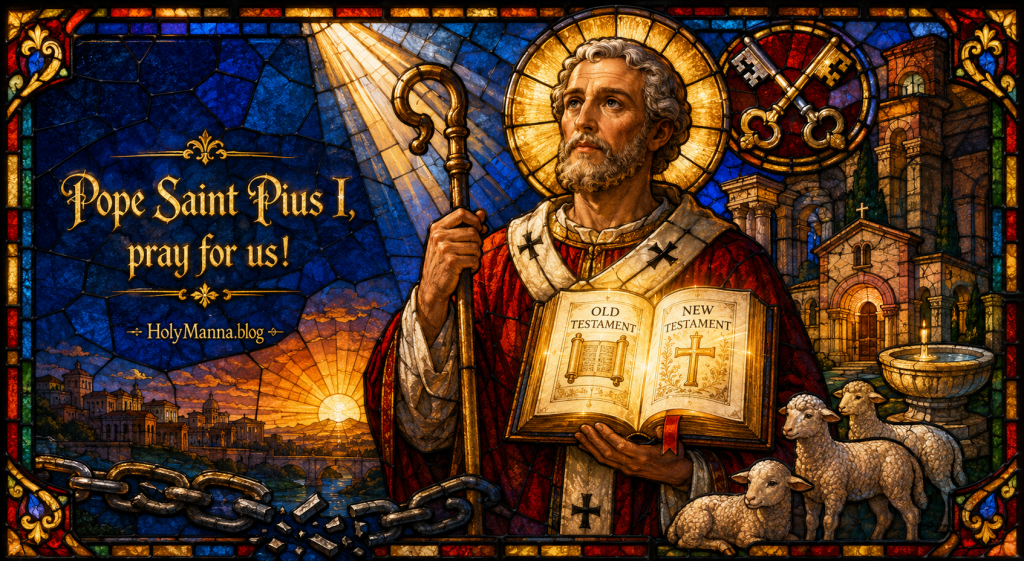
How a Quiet Pope Saved the Whole Bible
Some saints thunder across history with dramatic conversions, famous miracles, and words that echo through the centuries. Others stand quietly at a hinge point of the faith, hold the line when everything is at stake, and then slip back into the shadows of history so completely that most Catholics today could not say a single thing about them. Pope Saint Pius I, whose feast the Church keeps on July 11, belongs to that second kind of sainthood, and his story deserves to be far better known.
Pius was the tenth pope, the ninth successor of Saint Peter, and he governed the Church of Rome for roughly fourteen years in the middle of the second century, from about the year 140 to about 154. He shepherded the flock during the reign of the Roman Emperor Antoninus Pius, at a moment when Christianity was still young, still illegal, and still fighting for its very identity. During his pontificate, the most dangerous heresies of the early Church converged on Rome at the same time, and the decisions made under his watch shaped what every Christian believes to this day. When you open your Bible and find the Old Testament sitting right there next to the New, when you celebrate Easter on a Sunday, when you profess that the God who created the heavens and the earth is the same God who is the Father of our Lord Jesus Christ, you are living downstream of the pontificate of Pius I.
The Church has always understood that the successors of the apostles carry a sacred trust. The Catechism teaches that “in order that the full and living Gospel might always be preserved in the Church the apostles left bishops as their successors. They gave them their own position of teaching authority” (CCC 77). Pius received that trust in an hour of crisis, and he did not fail it.
From Aquileia to the Chair of Peter
The historical record of the second century is thin, and honesty demands saying so up front. What is known about the origins of Pius comes primarily from the Liber Pontificalis, an ancient book of papal biographies, and from a remarkable second century document called the Muratorian Fragment, which is one of the oldest surviving lists of the books of the New Testament.
According to the Liber Pontificalis, Pius was an Italian, born in the city of Aquileia in the north of the peninsula, and his father was a man named Rufinus. Aquileia was a bustling Roman commercial hub near the head of the Adriatic Sea, a crossroads of trade, soldiers, and ideas. Catholic scholarship notes, however, that the compiler of the Liber Pontificalis wrote centuries later and may have been guessing, so the Aquileian birthplace is best held as the received tradition rather than an established certainty.
Far more securely attested is the most fascinating detail of his family life. Both the Muratorian Fragment and the ancient Liberian Catalogue record that Pius was the brother of Hermas, the author of one of the most beloved and widely read Christian books of the entire early Church, a work of visions and parables called The Shepherd. The Muratorian Fragment states it plainly: “But Hermas wrote The Shepherd very recently, in our times, in the city of Rome, while bishop Pius, his brother, was occupying the chair of the church of the city of Rome.” Because that fragment was written within living memory of the events, this family connection stands on unusually firm ground for the era.
Here the story takes a turn that should give hope to anyone who has ever felt that their background disqualifies them from serving God. In The Shepherd, Hermas describes himself as a man who had been sold into slavery and later freed. If his account is autobiographical, then the brother of a pope, and quite possibly the pope himself, came from a family that had known the humiliation of being bought and sold. Scholars caution that Hermas may have been writing a literary framing rather than strict autobiography, so this cannot be asserted as fact. Yet even the possibility is stunning. The Church that Jesus founded was already lifting the lowly to her highest offices within a century of the Resurrection. Saint Paul had written that in Christ “there is neither slave nor free… for you are all one in Christ Jesus” (Galatians 3:28), and the family of Pius may well have lived that promise in their own flesh.
Nothing is known of a dramatic conversion moment for Pius. Like so many of the early Roman Christians, he seems to have grown into the faith within a believing household and a persecuted community, formed by the liturgy, the Scriptures, and the living memory of the apostles, which was then only two generations old. What is certain is that by around the year 140, following the death of Pope Saint Hyginus, the Church of Rome chose Pius to sit in the Chair of Peter. Saint Irenaeus of Lyons, writing only a few decades later, preserved the unbroken list of the popes and placed him exactly there, writing of the Roman succession, “Hyginus; after him, Pius; then after him, Anicetus.” That list, from Against Heresies, Book III, Chapter 3, is one of the treasures of the early Church, because it shows that Catholics of the second century already understood what the Catechism still teaches today, that the pope, “by reason of his office as Vicar of Christ, and as pastor of the entire Church has full, supreme, and universal power over the whole Church” (CCC 882).
Guarding the Flock in an Age of Wolves
It is important to say clearly and honestly that no miracles are recorded of Pope Saint Pius I, either in the ancient sources or in later Catholic tradition. The Church has never needed to embellish his story, because what he actually did was miracle enough in its consequences. His sanctity showed itself not in wonders but in the steady, unglamorous, utterly necessary work of a shepherd defending his sheep. Jesus had said, “I am the good shepherd. The good shepherd lays down his life for the sheep” (John 10:11), and Pius, the brother of the man who wrote a book called The Shepherd, spent his entire pontificate doing exactly that kind of guarding.
Consider what Rome looked like when he took office. The city was the magnet of the empire, and every teacher, genuine or false, eventually made his way there. During the pontificate of Pius, three of the most dangerous heretics in the history of the Church were all active in Rome at the same time. Valentinus, the most brilliant of the Gnostics, had arrived under Pope Hyginus and continued to draw followers with his elaborate mythology of secret knowledge and hidden divine realms. Cerdon, another Gnostic teacher, was spreading the poisonous idea that the God of the Old Testament was a different and lesser being than the Father revealed by Jesus. And then came the most dangerous of them all, a wealthy shipowner from Sinope on the Black Sea named Marcion.
Marcion took Cerdon’s idea and built it into an entire counterfeit Christianity. He taught that the God of Israel, the Creator, was a harsh and inferior deity of law and wrath, while Jesus revealed an entirely different God of pure love who had nothing to do with creation or with the Jews. The practical consequence was breathtaking in its audacity. Marcion threw out the entire Old Testament. He then took a knife to the New, keeping only an edited version of The Gospel of Luke and ten letters of Saint Paul, carefully trimmed of everything that connected Jesus to the God of Abraham, Isaac, and Jacob. He was persuasive, he was organized, and he was rich. When he arrived in Rome around the year 140, he even made a large donation to the Church.
The Church of Rome examined his teaching, and under Pope Pius, around the year 144, Marcion was excluded from communion, and tradition holds that his donation was returned to him. Saint Irenaeus records the outcome in Against Heresies, Book III, Chapter 3, noting that Marcion, cut off from the Church, went out and founded his own sect. Some sources place the excommunication as late as the year 150, and that uncertainty in dating deserves to be acknowledged, but the substance of the event is among the best attested facts of the second century Church.
It is hard to overstate what was at stake in that decision. If Marcion had prevailed, Christianity would have been severed from Israel, from the Psalms, from the prophets, from the promises, and from the very story of salvation that Jesus came to fulfill. Jesus himself had said, “Do not think that I have come to abolish the law and the prophets; I have come not to abolish but to fulfill” (Matthew 5:17). By standing against Marcion, Pius defended that word of the Lord for every generation to come. The Catechism enshrines the truth he protected: “The Old Testament is an indispensable part of Sacred Scripture. Its books are divinely inspired and retain a permanent value, for the Old Covenant has never been revoked” (CCC 121). It even adds a direct reference to this very battle, teaching that “Christians venerate the Old Testament as true Word of God” and that “the Church has always vigorously opposed the idea of rejecting the Old Testament under the pretext that the New has rendered it void (Marcionism)” (CCC 123). When you read those words in the Catechism, you are reading the legacy of Pope Saint Pius I.
His pontificate was not only a story of confrontation. It was also a season of remarkable flourishing. Saint Justin Martyr, the great philosopher convert who would later give his life for Christ, opened his school in Rome and taught the faith publicly during the reign of Pius and his successor. Justin’s writings from these very years, including his First Apology, defended Christian worship before the emperor himself and gave the world its earliest detailed description of the Mass. Rome under Pius stands out in the historical record as the vibrant center of the Christian world, exactly as Saint Irenaeus would soon describe it when he wrote of the Roman Church that “it is a matter of necessity that every Church should agree with this Church, on account of its preeminent authority” (Against Heresies III.2).
One more tradition belongs to this period of his life. The Liber Pontificalis holds that Pius decreed that Easter, the feast of the Lord’s Resurrection, should be celebrated only on a Sunday, rather than on whatever day of the week the fourteenth of the Jewish month of Nisan happened to fall. Because the Liber Pontificalis was compiled centuries later and sometimes attributes later customs to earlier popes, this decree is best received as a venerable tradition rather than verified history, and it should be said plainly that it cannot be verified. What is certain is that the question of the date of Easter was very much alive in his lifetime, and that the practice of the Roman Church, keeping the feast always on the day of the Resurrection, ultimately became the practice of the whole Catholic world. The Catechism teaches that “Easter is not simply one feast among others, but the ‘Feast of feasts,’ the ‘Solemnity of solemnities’” (CCC 1169), and the tradition of the Church has long honored Pius as one of the shepherds who helped anchor that feast to the Lord’s Day.
Why should you remember and emulate this man? Because he shows what faithfulness looks like when there is no applause. Pius performed no recorded wonders, wrote no surviving books, and received no crowds. He simply refused to let the deposit of faith be corrupted on his watch. Saint Paul’s charge to Timothy could stand as the motto of his whole life: “Guard what has been entrusted to you. Avoid the profane babble and contradictions of what is falsely called knowledge” (1 Timothy 6:20). That phrase, falsely called knowledge, is in Greek a swipe at the very word gnosis from which the Gnostics took their name. Pius lived that verse, and the Church still stands on his fidelity.
Shepherding Under the Shadow of the Empire
Every day of the pontificate of Pius unfolded under a legal death sentence. Christianity was an illicit religion in the Roman Empire, and although the reign of Antoninus Pius was calmer than the bloodbaths that came before and after, the threat never lifted. A Christian in Rome could be denounced by a neighbor, hauled before a magistrate, and executed for nothing more than refusing to burn a pinch of incense to the genius of the emperor. Justin Martyr, teaching in Rome under Pius, wrote his defenses of the faith precisely because Christians were being punished, as he protested, for the name alone. To accept the office of bishop of Rome in such a world was to paint a target on one’s own back. Every pope of that era took the chair knowing that Peter, Linus, Cletus, Clement, and so many of their successors had died violently, and that the same end likely awaited him.
Beyond the empire, Pius bore the interior hardship that may be heavier still for a pastor, the wound of watching false teachers lead souls away. Heresy is not an abstraction to a shepherd; it is the sight of sheep walking willingly toward wolves. The Catechism defines the wound precisely: “Heresy is the obstinate post-baptismal denial of some truth which must be believed with divine and catholic faith” (CCC 2089). Valentinus and Marcion were not outsiders attacking the Church; they were baptized men tearing her from within, and the sorrow of excommunicating Marcion, a step taken to protect the faithful and to call the sinner to repentance, would have weighed on Pius as it weighs on every pastor forced to such a remedy.
Was he martyred? Here honesty is owed to you, the reader. An old tradition, which entered the early editions of the Roman Breviary and was first placed in the martyrologies by Ado of Vienne in the ninth century, held that Pius died a martyr in Rome. For centuries his feast was kept as the feast of a martyr. But the ancient sources closest to his own time say nothing of it, and he is notably absent from the list of martyred popes in the Liber Pontificalis. When the Church revised her calendar in 1969, she stated plainly that there are no grounds for regarding Pius I as a martyr, and the current Roman Martyrology does not present him as one. The tradition of his martyrdom is therefore a story, and it cannot be verified. What can be said with confidence is this: he died in Rome around the year 154, after roughly fourteen years of governing the Church under constant peril, and whether or not his blood was shed, his whole pontificate was a long act of the courage that makes martyrs. He was succeeded by Pope Saint Anicetus.
A Legacy Written into Every Bible on Earth
Just as no miracles are recorded of Pius during his life, no miracles are attributed to his intercession after his death in the ancient sources or in the standard Catholic accounts of his life, and none will be invented here. His relics have no famous shrine, and even his burial place is uncertain. An old tradition held that he was buried in the Vatican near the tomb of Saint Peter, but modern excavations have not substantiated that claim, and it must be left as an unverified tradition.
One beautiful story does attach to his memory in Rome. A later tradition holds that Pius founded the church now known as Santa Pudenziana, one of the most ancient and beloved churches of the city, along with the church of Santa Prassede, and that he built a baptistry beside the former and exercised his episcopal ministry there. The tradition connects him to the household of the Roman senator Pudens, in whose home the early Christians of the city were said to have gathered. It is a lovely picture of a pope baptizing new believers in a hidden house church while the empire raged outside. Catholic scholarship, however, holds that these churches as buildings arose in the fourth century, and the story of their foundation by Pius cannot be verified.
Yet to measure the afterlife of this saint by shrines and healings would be to miss the point entirely. His true monument is invisible because it is everywhere. Every Catholic Bible with its seventy three books, Old Testament and New together, is a monument to Pius. Every Easter Sunday morning, with its lilies and its alleluias, stands in the stream of the tradition his era secured. Every profession of the Creed, when the Church declares her faith in one God, “maker of heaven and earth, of all things visible and invisible”, repudiates Marcion exactly as Pius did, for the Catechism teaches that belief in God the Creator is “the first proclamation” of the faith and the foundation of all the rest (CCC 198). His name itself became a legacy; eleven later popes took the name Pius after him, including two canonized saints, Pius V and Pius X, and the Church of both East and West venerates him among the saints.
His feast day is July 11. Though it no longer appears on the General Roman Calendar following the reforms of 1969, he remains inscribed in the Roman Martyrology, and his memorial may still be celebrated on that day. The communion of saints knows nothing of forgotten popes, for as the Catechism teaches, “being more closely united to Christ, those who dwell in heaven fix the whole Church more firmly in holiness… they do not cease to intercede with the Father for us” (CCC 956). Somewhere beyond the veil, the shepherd’s brother still prays for the flock.
What a 2nd Century Pope Says to a 21st Century Heart
Pope Saint Pius I has three gifts to offer you, and each one lands squarely in modern life.
The first is the courage to hold the whole truth when the world offers you an edited version. Marcion’s temptation never really died. Every generation produces voices that want a trimmed down Jesus, a faith with the demanding parts deleted, a Bible cut to fit the fashions of the moment. Pius teaches that love and truth are not rivals. He did not hate Marcion; he refused to let a lie devour the flock. The Catechism teaches that the faithful “guard the faith… penetrate it more deeply with right judgment, and apply it more fully in daily life” (CCC 785). When you feel pressure to quietly drop an unpopular teaching of the Church at work, online, or at the family dinner table, what would it look like to respond with both the firmness and the charity of Pius?
The second gift is the dignity of hidden faithfulness. Pius left behind no books, no famous sayings, and no recorded miracles, and yet the whole Church rests partly on his shoulders. Most lives are like his. The world will never write articles about the parent who prays the Rosary over a sleeping child, the coworker who refuses to join the office gossip, or the young adult who gets up for Sunday Mass when every friend is sleeping in. Heaven writes about them constantly. Where in your own life is God asking for quiet faithfulness that no one will ever see or praise?
The third gift is his witness that no background is too lowly for greatness in the Kingdom. If the tradition of his family’s servitude holds any truth, then a household that once knew slavery gave the Church a pope and gave Christian literature one of its most cherished early books. Whatever your family history, whatever poverty or brokenness sits in your past, God is not hindered by it. Consider taking three practical steps this week in the spirit of this saint. Read one chapter of the Old Testament, perhaps beginning with Psalm 34 or the call of Moses in Exodus 3, and thank God that the whole story was preserved for you. Make this coming Sunday a true celebration of the Resurrection, arriving at Mass early and receiving the Eucharist with deliberate gratitude. And choose one truth of the faith you find difficult, then look it up in the Catechism instead of letting it drift, asking the Holy Spirit for the docile and courageous heart of Pius.
Engage With Us!
The story of Pope Saint Pius I proves that God builds His Church through steady, faithful souls just as surely as through dazzling ones, and your reflections are part of that same living conversation of faith. Share your thoughts in the comments below; the HolyManna community grows richer every time you do. Here are some questions to pray with and to discuss.
- Marcion wanted a Christianity without the Old Testament. Are there parts of God’s Word or the Church’s teaching that you are tempted to quietly set aside, and what would it take to embrace them instead?
- Pius defended the faith with no recorded miracles and no earthly glory. Where is God calling you to hidden, unrewarded faithfulness right now?
- The family of Pius may once have known slavery, yet gave the Church a pope. How does that change the way you view the limitations of your own background or past?
- Every Sunday is a little Easter, a tradition the era of Pius helped secure. What is one concrete way you can make this Sunday feel more like the Feast of feasts in your home?
- Pius corrected Marcion out of love for the flock and for the man’s own soul. How can you speak a difficult truth to someone you love this week while keeping charity at the center?
May the witness of Pope Saint Pius I stir up courage in your heart to guard the faith you have received, to serve God faithfully even when no one is watching, and to trust that He can raise up greatness from the humblest of beginnings. Go into this week determined to do everything, the seen and the unseen alike, with the love and mercy that Jesus taught us.
Pope Saint Pius I, pray for us!
Follow us on YouTube, TikTok, Instagram and Facebook for more insights and reflections on living a faith-filled life.


Leave a Reply