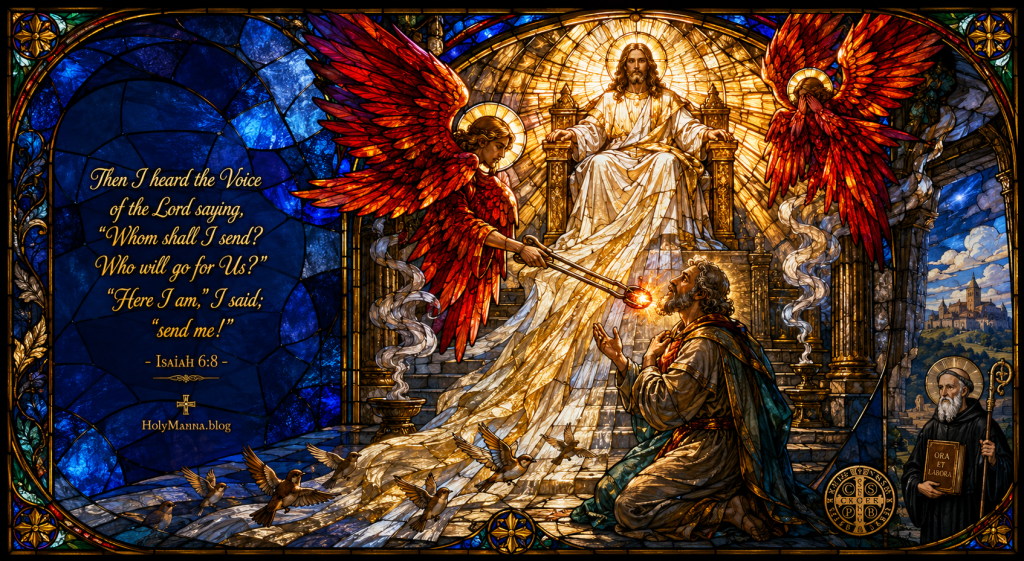
Memorial of Saint Benedict, Abbot – Lectionary: 388
When the Doorframe Shakes
Some mornings the readings feel like a gentle nudge. This is not one of those mornings. Today the Church throws open the doors of the heavenly throne room, fills the house with smoke, and lets the hinges rattle.
On this Memorial of Saint Benedict, Abbot, the Father of Western Monasticism and Patron of Europe, the liturgy presents a stunning pairing. In the First Reading, the prophet Isaiah sees the Lord enthroned in unbearable glory, cries out in terror over his own sinfulness, and is purified by a burning ember before answering the most famous yes in the Old Testament. The Responsorial Psalm then sings of that same King, robed in majesty, whose throne stands firm from everlasting. Finally, in the Gospel, Jesus takes that vision of the all-holy, all-knowing God and does something breathtaking with it. He turns it into the reason His disciples should never be afraid of anyone.
Here is the central theme uniting all of today’s readings: a true encounter with the holiness of God transforms fear into mission. The God whose glory fills the earth is the same Father who counts the hairs on every head, and the only sane response to meeting Him is Isaiah’s response, “Here I am, send me!”
Saint Benedict understood this. Around the year 500, a young student looked at the moral collapse of Rome, heard the voice of the King, and walked away from everything to seek God alone. From his cave at Subiaco grew a movement that rebuilt a civilization. The readings he never chose for his own feast day tell his story perfectly.
First Reading — Isaiah 6:1-8
The Throne Room and the Ember: When a Sinner Sees the King
Around the year 740 BC, King Uzziah of Judah died after more than fifty years on the throne. His reign had brought prosperity and stability, and his death left the nation staring nervously eastward at the rising war machine of Assyria. Into that moment of national anxiety, God gave a young man named Isaiah a vision that would define his entire life. Judah’s earthly throne had just been emptied, and God answered by showing Isaiah the throne that is never empty. This scene sets the tone for the whole day: before anyone is sent, someone must first see the King. The Church treasures this passage so deeply that she places its central hymn on the lips of the faithful at every single Mass.
Isaiah 6:1-8 – New American Bible (Revised Edition)
The Sending of Isaiah. 1 In the year King Uzziah died, I saw the Lord seated on a high and lofty throne, with the train of his garment filling the temple. 2 Seraphim were stationed above; each of them had six wings: with two they covered their faces, with two they covered their feet, and with two they hovered. 3 One cried out to the other:
“Holy, holy, holy is the Lord of hosts!
All the earth is filled with his glory!”4 At the sound of that cry, the frame of the door shook and the house was filled with smoke.
5 Then I said, “Woe is me, I am doomed! For I am a man of unclean lips, living among a people of unclean lips, and my eyes have seen the King, the Lord of hosts!” 6 Then one of the seraphim flew to me, holding an ember which he had taken with tongs from the altar.
7 He touched my mouth with it. “See,” he said, “now that this has touched your lips, your wickedness is removed, your sin purged.”
8 Then I heard the voice of the Lord saying, “Whom shall I send? Who will go for us?” “Here I am,” I said; “send me!”
Detailed Exegesis
Verse 1: “In the year King Uzziah died, I saw the Lord seated on a high and lofty throne, with the train of his garment filling the temple.”
The timing is the theology. Precisely when human power fails, God reveals that His kingship never wavered. The train of the garment filling the Temple signals overwhelming majesty; even the hem of God’s glory is more than the largest sacred space on earth can contain.
Verse 2: “Seraphim were stationed above; each of them had six wings: with two they covered their faces, with two they covered their feet, and with two they hovered.”
The seraphim, whose name means “burning ones,” appear only here in all of Scripture. Notice that even these sinless fiery spirits cover their faces before God. If the angels veil themselves in His presence, the creature made of dust has every reason for awe.
Verse 3: “Holy, holy, holy is the Lord of hosts! All the earth is filled with his glory!”
Hebrew expresses the superlative by repetition, and a triple repetition is the strongest form possible. God is not merely holy; He is holiness itself, utterly beyond every created thing. Christian tradition has also long heard in this threefold cry a whisper of the Trinity. This is the source of the Sanctus, which the faithful sing at every Mass just before the Eucharistic Prayer, joining their voices to the seraphim in the one heavenly liturgy.
Verse 4: “At the sound of that cry, the frame of the door shook and the house was filled with smoke.”
The very architecture trembles at the praise of God. The smoke recalls the cloud of glory that filled the tabernacle in Exodus 40 and the Temple in 1 Kings 8, the visible sign that God Himself is present.
Verse 5: “Then I said, ‘Woe is me, I am doomed! For I am a man of unclean lips, living among a people of unclean lips, and my eyes have seen the King, the Lord of hosts!’”
Isaiah’s first reaction is not excitement but devastation. Standing in pure holiness, he sees his own sin with total clarity, and he names his lips specifically, for the mouth reveals the heart. Every one of the prophets and saints knows this moment; genuine encounter with God always begins with honest self-knowledge.
Verse 6: “Then one of the seraphim flew to me, holding an ember which he had taken with tongs from the altar.”
God does not leave Isaiah in his misery. Purification comes from the altar, the place of sacrifice, and it comes as fire, which burns away impurity without destroying what it touches.
Verse 7: “He touched my mouth with it. ‘See,’ he said, ‘now that this has touched your lips, your wickedness is removed, your sin purged.’”
The unclean lips are not condemned; they are cleansed. Isaiah did nothing to purify himself. Grace does what guilt alone never could. The Church Fathers loved this image; Saint John Chrysostom and other Fathers saw in the burning coal touching the prophet’s lips a figure of the Holy Eucharist, in which the faithful receive the living fire of God upon their own lips.
Verse 8: “Then I heard the voice of the Lord saying, ‘Whom shall I send? Who will go for us?’ ‘Here I am,’ I said; ‘send me!’”
Only after purification does Isaiah hear the call, and notice that God asks rather than commands. The Lord of hosts, who could compel anything, invites a free response. Isaiah’s answer becomes the pattern for every vocation that follows, from Mary’s fiat to the yes spoken by every priest, religious, and baptized believer.
Teachings
The Catechism turns to this exact scene when teaching about the holiness of God. In CCC 208, the Church teaches: “Faced with God’s fascinating and mysterious presence, man discovers his own insignificance. Before the glory of the thrice-holy God, Isaiah cries out: ‘Woe is me! I am lost; for I am a man of unclean lips.’” The same paragraph adds the essential good news: “But because God is holy, he can forgive the man who realizes that he is a sinner before him.” Holiness and mercy are not rivals in God; His holiness is precisely why His forgiveness is possible.
Saint Benedict built an entire way of life on this vision of the majestic, present God. The very first word of his Rule is a summons to the attentiveness Isaiah showed in the Temple: “Listen carefully, my son, to the master’s instructions, and attend to them with the ear of your heart.” For Benedict, as for Isaiah, everything begins with hearing the voice of the King and answering promptly. His monks rose in the night to sing psalms because, like the seraphim, they believed the praise of God is the most important work on earth, which is why the Rule calls the liturgy the Work of God.
Reflection
Isaiah’s story maps onto every believer’s spiritual journey: vision, conviction, purification, and mission, always in that order. The temptation is to skip straight to mission while avoiding the uncomfortable middle steps. A concrete way to live this reading is to make a sincere examination of conscience tonight and to seek the Sacrament of Reconciliation soon, allowing the divine fire to touch what is unclean rather than hiding it. Another is to pray the Sanctus at Mass this week with full attention, remembering whose throne room it echoes.
When has an experience of God’s greatness made personal sin suddenly visible? Is there an area of life still waiting for the ember from the altar? If God asked aloud, “Whom shall I send?”, what would keep the answer from being “Here I am”?
Responsorial Psalm — Psalm 93:1-2, 5
The Throne That Never Shakes
Psalm 93 belongs to a family of ancient hymns known as the enthronement psalms, songs that Israel sang in the Temple to proclaim one defiant truth in a chaotic world: the Lord reigns. Scholars connect these psalms to Temple worship celebrating God’s kingship over creation and history, sung by a small nation surrounded by empires that rose and fell like waves. Placed immediately after Isaiah’s vision, the psalm becomes the congregation’s response to what the prophet saw. Isaiah glimpsed the King once; the Church sings His kingship every day. The psalm anchors the day’s theme by declaring that the God who sends His servants into a frightening world is Himself unshakeable.
Psalm 93:1-2, 5 – New American Bible (Revised Edition)
God Is a Mighty King
1 The Lord is king, robed with majesty;
the Lord is robed, girded with might.
The world will surely stand in place,
never to be moved.
2 Your throne stands firm from of old;
you are from everlasting.5 Your decrees are firmly established;
holiness befits your house, Lord,
for all the length of days.
Detailed Exegesis
Verse 1: “The Lord is king, robed with majesty; the Lord is robed, girded with might. The world will surely stand in place, never to be moved.”
Ancient kings displayed power through royal garments; the Lord is clothed in majesty itself. Because His reign is absolute, creation is stable rather than random. Behind the apparent chaos of history stands a world held firmly in place by its King.
Verse 2: “Your throne stands firm from of old; you are from everlasting.”
Uzziah’s throne had just been emptied by death when Isaiah saw the Lord’s throne. This verse explains the difference: God’s throne was never established by conquest or election, because God simply is, from everlasting. Every human institution has a start date and an expiration date, while His reign has neither.
Verse 5: “Your decrees are firmly established; holiness befits your house, Lord, for all the length of days.”
The psalm ends by joining three realities that belong together: God’s word, God’s house, and holiness. Because the King is holy, His decrees are trustworthy and His dwelling must reflect His character. Under the New Covenant, that dwelling includes every baptized soul, for Saint Paul teaches in 1 Corinthians 3:16 that the faithful are the temple of God.
Teachings
The Catechism teaches in CCC 269: “The Holy Scriptures repeatedly confess the universal power of God.” Divine omnipotence is not a distant abstraction; it is the ground of Christian peace. Saint Benedict wove this psalm’s confidence into the fabric of monastic life through his vow of stability, the promise to remain rooted in one community for life. In a collapsing Roman world where everything was moving, Benedictine stability was a lived proclamation that God’s throne stands firm, so His servants do not need to run. In Chapter 72 of the Rule, Benedict gives the interior form of that stability: “prefer nothing whatever to Christ.” A heart anchored to the everlasting King can endure any passing storm.
Reflection
Modern life often feels like Judah after Uzziah, familiar certainties dying one after another while anxieties multiply. This psalm offers a practical discipline: begin the day by declaring God’s kingship before reading a single headline. Praying even one verse of Psalm 93 each morning reorders the heart, placing the eternal throne above the daily chaos.
Which earthly “throne,” whether a job, a plan, or a relationship, has been carrying weight that only God’s throne can bear? What would change if the day started with worship instead of worry?
Holy Gospel — Matthew 10:24-33
Sparrows, Housetops, and the End of Fear
This passage sits at the heart of the Missionary Discourse in The Gospel of Matthew, the second of the five great teaching blocks of the Gospel. Jesus has just chosen the Twelve and is preparing to send them out to preach, heal, and cast out demons, and He is brutally honest about what awaits them: rejection, slander, courts, and violence. Yet the entire passage pivots on one repeated command, spoken three times: do not be afraid. Jesus grounds that command not in a promise that persecution will be avoided but in the character of the Father whom Isaiah saw enthroned. The all-holy King of the First Reading is now revealed as the Father who numbers hairs and watches sparrows. Holiness and tenderness meet, and fear loses its grip.
Matthew 10:24-33 – New American Bible (Revised Edition)
24 No disciple is above his teacher, no slave above his master. 25 It is enough for the disciple that he become like his teacher, for the slave that he become like his master. If they have called the master of the house Beelzebul, how much more those of his household!
Courage Under Persecution. 26 “Therefore do not be afraid of them. Nothing is concealed that will not be revealed, nor secret that will not be known. 27 What I say to you in the darkness, speak in the light; what you hear whispered, proclaim on the housetops. 28 And do not be afraid of those who kill the body but cannot kill the soul; rather, be afraid of the one who can destroy both soul and body in Gehenna. 29 Are not two sparrows sold for a small coin? Yet not one of them falls to the ground without your Father’s knowledge. 30 Even all the hairs of your head are counted. 31 So do not be afraid; you are worth more than many sparrows. 32 Everyone who acknowledges me before others I will acknowledge before my heavenly Father. 33 But whoever denies me before others, I will deny before my heavenly Father.
Detailed Exegesis
Verse 24: “No disciple is above his teacher, no slave above his master.”
Jesus begins with a proverb His hearers would have known well. Discipleship in the ancient world meant sharing the master’s life completely, and that includes sharing his treatment by the world.
Verse 25: “It is enough for the disciple that he become like his teacher, for the slave that he become like his master. If they have called the master of the house Beelzebul, how much more those of his household!”
Becoming like Jesus is the whole goal of Christian life, yet Jesus warns that resemblance has a cost. His enemies had already accused Him of casting out demons by the prince of demons, as Matthew 9:34 records, using the name Beelzebul, a mocking title derived from a Philistine deity. Disciples who resemble a slandered Master should expect slander.
Verse 26: “Therefore do not be afraid of them. Nothing is concealed that will not be revealed, nor secret that will not be known.”
Here comes the first “do not be afraid.” Lies have an expiration date. At the final judgment every hidden truth will stand in the light, so the disciple can endure false accusations knowing that God’s verdict, not the crowd’s, is the one that lasts.
Verse 27: “What I say to you in the darkness, speak in the light; what you hear whispered, proclaim on the housetops.”
The Gospel was entrusted quietly to a handful of Galileans, yet it was never meant to stay private. Flat rooftops in ancient Israel served as platforms for public announcements, and Jesus commands maximum publicity for His message. Faith that stays permanently hidden is not yet the faith He describes.
Verse 28: “And do not be afraid of those who kill the body but cannot kill the soul; rather, be afraid of the one who can destroy both soul and body in Gehenna.”
The second “do not be afraid” contains the most sobering sentence in the passage. Human persecutors have a strict limit: the body. The soul, the spiritual principle that bears God’s image, lies beyond their reach. The only fear worth keeping is the reverent fear of God, whose judgment reaches eternity. Gehenna, the ravine outside Jerusalem once defiled by idolatry, had become the standing image of final loss.
Verse 29: “Are not two sparrows sold for a small coin? Yet not one of them falls to the ground without your Father’s knowledge.”
Sparrows were the cheapest meat in the market, food for the poorest of the poor. Jesus chooses the least valuable creature imaginable and declares that its fall registers with the Father. Nothing in creation is beneath God’s attention.
Verse 30: “Even all the hairs of your head are counted.”
The image is almost playful in its extravagance. People do not know the number of their own hairs, yet the Father does. Divine knowledge of each person is more intimate than self-knowledge.
Verse 31: “So do not be afraid; you are worth more than many sparrows.”
The third “do not be afraid” completes the argument. If God attends to sparrows, His care for His children, redeemed at the price of His Son’s blood, is beyond calculation. Christian courage is not the absence of danger but the presence of the Father.
Verse 32: “Everyone who acknowledges me before others I will acknowledge before my heavenly Father.”
Jesus now states the stakes of witness with legal precision. To acknowledge Him publicly on earth is to gain an Advocate who speaks each name before the throne Isaiah saw.
Verse 33: “But whoever denies me before others, I will deny before my heavenly Father.”
The warning is real, and the Church has always read it seriously, while also remembering Peter, who denied the Lord three times and was restored through repentance and love. Denial is not the last word for anyone who returns to Christ, yet the verse forbids the comfortable illusion that private faith without public fidelity is enough.
Teachings
The Catechism cites these final verses directly when teaching on the virtue of faith. In CCC 1816, the Church declares: “The disciple of Christ must not only keep the faith and live on it, but also profess it, confidently bear witness to it, and spread it.” The same paragraph continues: “Service of and witness to the faith are necessary for salvation.” On the soul that no persecutor can touch, CCC 363 teaches: “‘soul’ signifies the spiritual principle in man.” And on the warning of verse 28, CCC 1034 confirms that Jesus often speaks of Gehenna and its unquenchable fire reserved for those who refuse to the very end to believe and be converted.
Saint John Chrysostom, preaching on this passage in his Homilies on the Gospel of Matthew, taught that Christ replaces many small fears with one great and liberating fear, the fear of God alone, so that the disciple who fears God rightly no longer fears any human power. History proved him correct in the martyrs, and in a quieter way in Saint Benedict, who fearlessly confronted the corruption of his age, survived attempts on his life by poisoning according to the account of Pope Saint Gregory the Great in Book II of the Dialogues, and kept proclaiming Christ from the housetop of Monte Cassino. The tradition summarized later as prayer and work flowed from exactly this Gospel confidence.
Reflection
Fear of other people remains one of the most common reasons believers stay silent, whether at work, online, or at the family table. Jesus offers the remedy: remember whose eyes are watching and whose opinion is eternal. A concrete step is to acknowledge Christ once this week in a setting where silence would be easier, perhaps by making the Sign of the Cross before a meal in public, mentioning Mass naturally in conversation, or defending the faith with charity when it is mocked. Another is to bring one persistent anxiety to prayer and place it deliberately beneath verse 30.
Where does fear of others currently silence faith that should be spoken from the housetops? Does the reverent fear of God hold a larger place in the heart than the fear of embarrassment? What would it look like to acknowledge Christ before others in the next seven days?
The King Still Asks: Who Will Go?
Step back and watch the whole day come together like a single story. A young man in Jerusalem sees the thrice-holy King and discovers, in the same instant, both his own sinfulness and God’s eagerness to purify it. A congregation answers by singing that this King’s throne stands firm from everlasting. Then the King Himself, having taken flesh, gathers His friends and tells them the astonishing conclusion: the God whose glory shakes doorframes also counts sparrows and numbers hairs, so His people are free to speak boldly and fear no one.
This is the arc of every Christian life. Encounter leads to purification, purification leads to mission, and mission is carried out under the gaze of a Father whose attention never wavers. Fifteen centuries ago, Saint Benedict walked that same arc. He saw the holiness of God clearly enough to find the noise of a decaying Rome unbearable, let grace purge him in the silence of a cave, and then answered the question Isaiah heard. His answer built monasteries that preserved Scripture, fed the poor, and quietly rebuilt Europe, all under his rule of life that urged every follower to prefer nothing whatever to Christ.
The same voice that filled the Temple with smoke still speaks, and it still asks the same question: “Whom shall I send? Who will go for us?” The question is not reserved for prophets and abbots. It is addressed to every person who will kneel at Mass today and sing the seraphim’s song. Let the ember touch what is unclean, let the everlasting throne steady what is anxious, and then answer with the only words that have ever changed the world: “Here I am, send me!”
Engage With Us!
The conversation does not end here, and every reflection shared in the comments below encourages someone else walking the same road, so please take a moment to add a thought, a question, or a testimony about how today’s readings landed.
- Reflecting on Isaiah 6:1-8, what personal “unclean lips” moment has revealed both the holiness of God and the depth of His mercy, and how did purification change the willingness to be sent?
- Reflecting on Psalm 93:1-2, 5, which unstable thing in life most needs to be placed beneath the throne that stands firm from everlasting?
- Reflecting on Matthew 10:24-33, which of the three “do not be afraid” commands speaks most directly to a current fear, and what one act of public witness could answer it this week?
- Considering all of today’s readings together on this Memorial of Saint Benedict, how is God transforming fear into mission right now, and what is one concrete way to respond with “Here I am, send me”?
Living a life of faith is not about feeling fearless; it is about knowing the King. Walk through this week under His gaze, speak His name with courage, and do everything with the love and mercy Jesus taught us.
Sacred Heart of Jesus, we trust in You!
Immaculate Heart of Mary, pray for us!
Saint Michael the Archangel, defend us in battle!
Follow us on YouTube, TikTok, Instagram and Facebook for more insights and reflections on living a faith-filled life.


Leave a Reply