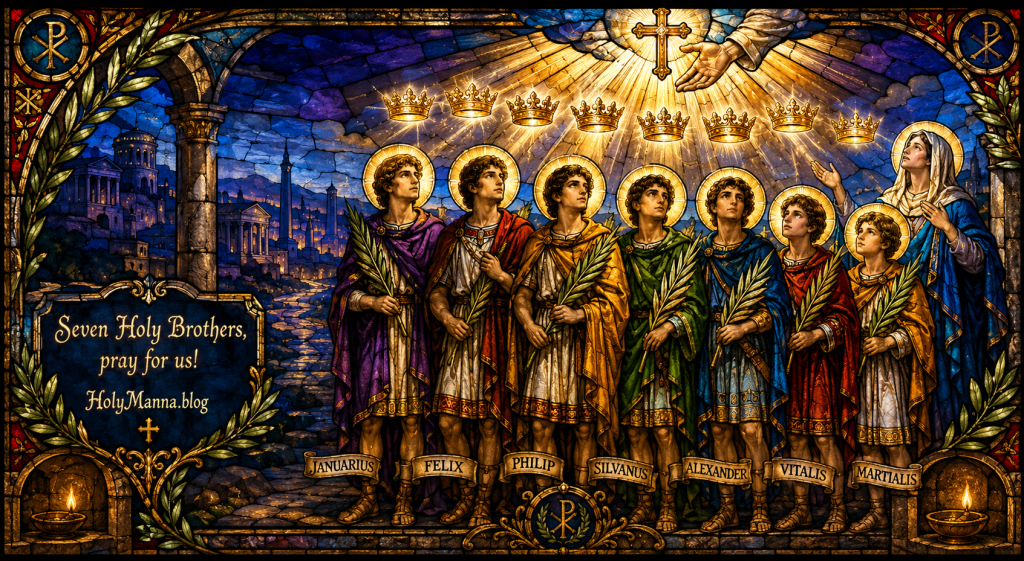
When One Family Shook an Empire
Some saints are remembered for what they built, others for what they wrote, and a rare few for the single, blazing act of refusing to let go of Jesus Christ when everything in the world demanded that they do so. The Seven Holy Brothers belong to that last company. Januarius, Felix, Philip, Silvanus, Alexander, Vitalis, and Martialis were martyred in Rome around the year 162, in the early years of the persecution most historians associate with the emperor Marcus Aurelius. Ancient tradition, preserved in their Acts and cherished by the Church for well over fourteen centuries, honors them as the sons of Saint Felicitas, a wealthy Roman widow whose faith was so radiant that it drew converts to Christianity and drew the fury of Rome down upon her household. In a single day, according to that tradition, all seven brothers gave their lives for Christ while their mother stood by, urging each one toward heaven.
The Church has always seen in this family a living echo of the mother and her seven sons in 2 Maccabees 7, that heroic Jewish family who chose death over apostasy long before the coming of Christ. Scripture says of that earlier mother that “she bore up with a noble spirit because her hope was in the Lord” (2 Maccabees 7:20, RSVCE). The same words could stand as the epitaph of Felicitas and her sons. The Catechism of the Catholic Church teaches that “martyrdom is the supreme witness given to the truth of the faith: it means bearing witness even unto death” (CCC 2473). The Seven Holy Brothers gave that witness seven times over before a single Roman sunset, and the Church of Rome never forgot it. Their feast is kept on July 10, the day the Roman Martyrology still commemorates them, and the day the traditional calendar celebrated them for centuries as simply “the Seven Holy Brothers.”
Sons of a House Built on Faith
The brothers were Romans, born in the capital of the empire in the first half of the second century, when being a Christian in Rome meant belonging to a small, suspected, and often hunted community. According to the ancient Acts of these martyrs, their father died while they were still young, leaving their mother Felicitas a widow of considerable wealth and noble standing. Rather than remarry, Felicitas chose to consecrate her widowhood to God. She gave herself to prayer, to works of mercy among the poor, and above all to the Christian formation of her seven sons.
This detail deserves a moment of honest attention, because it is where documented history and beloved tradition must be carefully distinguished. The oldest record of these martyrs is the Depositio Martyrum, a Roman calendar from the middle of the fourth century, which lists the seven by name on July 10 and notes the four different catacombs where their bodies rested. That ancient calendar confirms beyond reasonable doubt that these seven men were real, that they died for the faith, and that Rome venerated them from the earliest generations. What the calendar does not say is that they were brothers, and it does not mention Felicitas at all. The account of the family bond comes from the Acts of the martyrs, a text that existed by the sixth century, since Pope Saint Gregory the Great drew on it in his Homilies on the Gospels, but whose earliest surviving form scholars date no earlier than that century. The great Catholic scholars who studied the question, including the Bollandists and the authors of the Catholic Encyclopedia, concluded that the martyrdoms themselves are historically certain, while the details of the story, including the identification of the seven as sons of Felicitas, rest on tradition rather than on contemporary documentation. HolyManna presents the story as the Church has received and told it for fifteen centuries, as a sacred tradition, while stating plainly which parts cannot be independently verified.
What the tradition tells is this. Felicitas raised her sons not merely to know about Christ but to belong to Him. She understood what the Church would later articulate so clearly, that “parents have the first responsibility for the education of their children” and that “education in the faith by the parents should begin in the child’s earliest years” (CCC 2223, 2226). Her home became a school of sanctity. Her sons did not stumble into heroism on the day of their trial; they were formed for it across years of ordinary days, ordinary prayers, and the ordinary example of a mother who loved God more than comfort, more than reputation, and, as it would prove, more than life itself. There was no dramatic conversion story for these brothers, because there did not need to be. They were converted the slow way, the way most people are, by the daily witness of someone who actually believed.
That witness did not stay inside the walls of their house. The Acts relate that the visible holiness of Felicitas and her family drew pagans to abandon their idols and embrace the Christian faith. In second century Rome, that was not a private matter. The pagan priests saw their temples losing worshippers and their influence eroding, and they knew exactly whom to blame.
A Trial Instead of a Miracle
Readers who come to a saint’s story looking for wonders should hear this plainly: no miracles are recorded from the earthly lives of the Seven Holy Brothers. No source, ancient or modern, attributes to them healings, visions, or prodigies during their lifetimes. Their greatness lies elsewhere, and in a sense it lies deeper. The Catechism teaches that the Holy Spirit “manifests his power above all in the theological virtues” of faith, hope, and charity, and the supreme act of those virtues is fidelity to Christ under trial (CCC 1813, 2473). What God worked through these brothers was not a suspension of nature but a triumph over it, the triumph of grace over the most natural fear a human being has, the fear of death.
According to the Acts, the pagan priests denounced Felicitas to the emperor, arguing that her open practice of Christianity was turning Romans away from the gods who protected the empire, and that the gods could only be appeased if she and her children were compelled to sacrifice. The case was handed to Publius, the Prefect of Rome. Publius did not begin with cruelty. He began the way persecutors so often begin, with reasonableness. He took Felicitas aside privately and appealed to her maternal heart. As Butler’s Lives of the Saints transmits the exchange from the Acts, the prefect urged her, “Take pity on your children, Felicitas; they are in the bloom of youth, and may aspire to the greatest honors and preferments.” Her answer has rung through the centuries: “Your pity is really impiety, and the compassion to which you exhort me would make me the most cruel of mothers.” Then, turning to her sons, she said, “My sons, look up to heaven, where Jesus Christ with His Saints expects you.” These words come to us from the Acts of the martyrs; as with the rest of the detailed narrative, they are sacred tradition and cannot be verified as a stenographic record.
Then the prefect turned to the sons themselves, one by one, and here the story reaches its quiet, staggering center. Seven young men, each examined separately, each offered life, honor, and advancement in exchange for a pinch of incense to an idol, and each one refused. Not one broke. Not one bargained. The formation of their mother’s house held. The Catechism teaches that “the duty of Christians to take part in the life of the Church impels them to act as witnesses of the Gospel” and that “service of and witness to the faith are necessary for salvation” (CCC 2472). The brothers understood that witness is not a performance for good times. It is who a Christian is when the cost arrives.
Why should you remember them? Because their story strips sanctity down to its essence. Most saints leave behind writings, foundations, or famous deeds. These seven left behind only a choice, repeated seven times, and the Church decided that this choice alone was worth commemorating for two thousand years. When everything else is taken away, what remains of a person’s faith? For the Seven Holy Brothers, what remained was everything.
Seven Deaths in a Single Day
Enraged by the family’s constancy, the prefect referred them for sentencing, and the ancient sources record a detail that has the ring of grim Roman bureaucracy about it: the brothers were handed over to four different judges, who condemned them to different modes of death. The Roman Martyrology preserves the sober catalog. It commemorates “at Rome, the martyrdom of the seven holy brothers, sons of the saintly martyr Felicitas, namely, Januarius, Felix, Philip, Sylvanus, Alexander, Vitalis, and Martial, in the time of the emperor Antoninus, under Publius, prefect of the city” (Roman Martyrology, July 10). Januarius, the eldest, was scourged and imprisoned, and died under blows from whips loaded with lead. Felix and Philip were beaten to death, some accounts saying with clubs, the Martyrology saying scourged. Silvanus was thrown headlong from a height. The three youngest, Alexander, Vitalis, and Martialis, were beheaded.
A word of honesty about the date and the emperor is owed here, because the sources do not perfectly agree. The Acts and the Martyrology say the martyrdom occurred under “the emperor Antoninus,” a name that could indicate Antoninus Pius or Marcus Aurelius, who also bore the name. Archaeology tips the balance: the tomb of Januarius in the catacomb of Praetextatus dates to the end of the second century, which points to the reign of Marcus Aurelius, and most Catholic sources place the martyrdom around the year 162 to 165. Readers should hold the exact year loosely and the martyrdom itself firmly.
The tradition adds the detail that gives this story its terrible beauty. Felicitas begged God for one grace only, that she would not be killed before her sons, so that she could stand beside each one and strengthen him against the temptation to apostatize. Her prayer was granted. She watched all seven die, encouraging each toward heaven, and after each execution she was again given the chance to renounce Christ and again refused. According to tradition she was martyred about four months later, and the Church keeps her own feast on November 23. Pope Saint Gregory the Great, preaching on her centuries later in the basilica that rose over her tomb, gave the Church its most famous words about this family: “She was more than a martyr, for seeing her seven children martyred before her eyes, she was in some sort a martyr in each of them” (Saint Gregory the Great, Homilies on the Gospels, Book I, Homily 3). Gregory marveled that she feared more for her sons’ faith than for their lives, and that she conquered the pain of nature with the joy of hope.
There were no miraculous escapes for these brothers, no angels breaking chains, no fires refusing to burn. God permitted the full weight of martyrdom to fall on them, and their glory is precisely that they carried it. The Catechism teaches that for the Christian, “the obedience of Jesus has transformed the curse of death into a blessing” (CCC 1009), and that death “is the end of earthly life” but for those who die in Christ’s grace it is “a participation in the death of the Lord, so that they can also share his Resurrection” (CCC 1006, 1010). The Seven Holy Brothers staked their young lives on that teaching being true.
The Martyrs Rome Refused to Forget
The Church attributes no specific recorded miracles, healings, or apparitions to the Seven Holy Brothers after their deaths; no such catalog survives in the ancient sources, and none will be invented here. Yet their impact after death is among the best documented facts about them, and it is remarkable.
The brothers were buried in four separate catacombs, matching the four tribunals that condemned them. Januarius was laid in the catacomb of Praetextatus on the Via Appia. Felix and Philip rested in the catacomb of Priscilla. Silvanus was buried in the catacomb of Maximus, beside the tomb of Felicitas herself. Alexander, Vitalis, and Martialis were laid in the catacomb of the Jordani. Three of these cemeteries stand along the Via Salaria, the old salt road leading north out of Rome. By the middle of the fourth century, the Depositio Martyrum records that the Roman faithful kept July 10 by visiting all four burial sites, a kind of stational pilgrimage across the city’s cemeteries in a single day. Ancient records indicate that in the earliest Roman usage these seven were called simply “the Martyrs,” and inscriptions have been found designating July 11 as the day after the Feast of the Martyrs, an astonishing title in a city that had shed rivers of Christian blood. This account of the early solemnity comes from Catholic scholarship on the ancient inscriptions and reflects long-standing tradition regarding the feast’s prominence.
The relics themselves were treasured to the point of scandal. The Depositio Martyrum preserves the blunt note that the body of Silvanus was stolen by the Novatians, a schismatic sect, an ancient theft that testifies to how powerfully these martyrs drew devotion. Veneration of the family only deepened with the centuries. In the fifth century, Saint Peter Chrysologus preached on Felicitas and her sons. An ancient metrical epitaph, written by Pope Saint Damasus or shortly after his time, honors the mother who died with her children: “This woman feared not the sword, but perished with her sons. She confessed Christ and merited an eternal renown.” The crypt of Felicitas on the Via Salaria was enlarged into an underground chapel, lost for centuries, and rediscovered by archaeologists in 1885. On its rear wall a seventh century fresco can still be seen, showing Felicitas surrounded by her seven sons while Christ above them bestows the eternal crown. The stones of Rome, in other words, independently confirm the antiquity of this devotion, even where they cannot confirm every detail of the story. Relics associated with Saint Felicitas are venerated today at the Capuchin church in Montefiascone and at the church of Santa Susanna in Rome, and the catacombs of Priscilla and Praetextatus remain places of pilgrimage where visitors walk the same corridors where these martyrs were laid.
One final point of scholarly honesty belongs to this section. The Acts of Saint Symphorosa, another Roman era mother martyred with seven sons, are strikingly similar to the Acts of Felicitas, and Catholic scholars have long noted that the two traditions may have influenced or been confused with one another. None of this touches the core: seven real martyrs, honored in Rome on July 10 since at least the fourth century, and a woman named Felicitas, honored as a martyr beside one of them. The Church proposes their communion with us as a present reality, for “being more closely united to Christ, those who dwell in heaven fix the whole Church more firmly in holiness” and “they do not cease to intercede with the Father for us” (CCC 956).
What Seven Brothers Ask of You
It is tempting to file a story like this under ancient history, admirable but remote. That would be a mistake, because the Seven Holy Brothers pose questions that land squarely in modern life. Few readers of this post will ever face a Roman prefect, but every single one will face the quieter tribunals of the modern world: the workplace where faith is mocked, the friend group where Church teaching is treated as bigotry, the family gathering where staying silent feels so much easier than speaking truth with love. The brothers were offered exactly what the world still offers, honors and preferments in exchange for a small compromise. Where in your life is the pinch of incense being asked of you?
Their story also speaks powerfully to families. These seven did not become martyrs in the arena; they became martyrs at their mother’s table, years before, through formation, prayer, and example. The Catechism calls the family “the domestic church” where “parents should initiate their children at an early age into the mysteries of the faith” (CCC 1666, 2225). Parents reading this might consider that the most important evangelization they will ever do lives inside their own walls. Does your home form souls who could stand when standing costs something? And those who are not parents still form others, younger siblings, coworkers, godchildren, friends, because holiness is always contagious in one direction or apathy in the other.
Practical steps flow naturally from their witness. A person could choose one small, visible act of faith this week and refuse to hide it, grace before a meal in public, ashes worn without embarrassment, a calm word of truth spoken kindly. A family could adopt one fixed daily prayer together, however brief, trusting that ordinary faithfulness is what forged these seven. Anyone could take up the Church’s ancient habit of asking the martyrs’ intercession, since “martyrdom is the supreme witness” (CCC 2473) and the martyrs are the Church’s most credible friends in heaven. And everyone could practice, in little daily deaths to pride, comfort, and human respect, the surrender these brothers made once and completely. If fidelity in small things prepares the soul for fidelity in great things, what small fidelity is God asking of you today?
Engage With Us!
The story of the Seven Holy Brothers has stirred Christian hearts for nearly two thousand years, and HolyManna would love to hear how it stirs yours. Share your thoughts, your questions, and your own experiences of standing firm in the faith in the comments below. To help the conversation begin, here are a few questions for prayerful reflection.
- The brothers were formed for heroism through years of ordinary family faithfulness. What one ordinary habit of faith could you begin this week that might bear fruit years from now?
- Publius offered the brothers honors and advancement in exchange for compromise. What does the world offer you in exchange for softening or hiding your faith, and how do you respond?
- Saint Felicitas feared her sons losing the faith more than she feared their deaths. What would it look like to love the souls of the people in your life that fiercely?
- No miracles are recorded from the brothers’ lives, only fidelity. Does knowing that sanctity can consist entirely of faithfulness, without wonders, change how you view your own path to holiness?
- The early Romans called them simply “the Martyrs” and visited all four of their tombs in one day. How might you honor the martyrs in your own devotional life, perhaps beginning this July 10?
However these questions land, take courage from this family. Seven young men and one valiant mother looked at everything the world could threaten and everything it could promise, and they chose Jesus Christ without hesitation. You are called to the same choice, made daily in a thousand small ways, and the same grace that carried them stands ready to carry you. Live this day, and every day, with the love and mercy that Jesus taught us, and let nothing on earth talk you out of heaven.
Seven Holy Brothers, pray for us!
Follow us on YouTube, TikTok, Instagram and Facebook for more insights and reflections on living a faith-filled life.


Leave a Reply