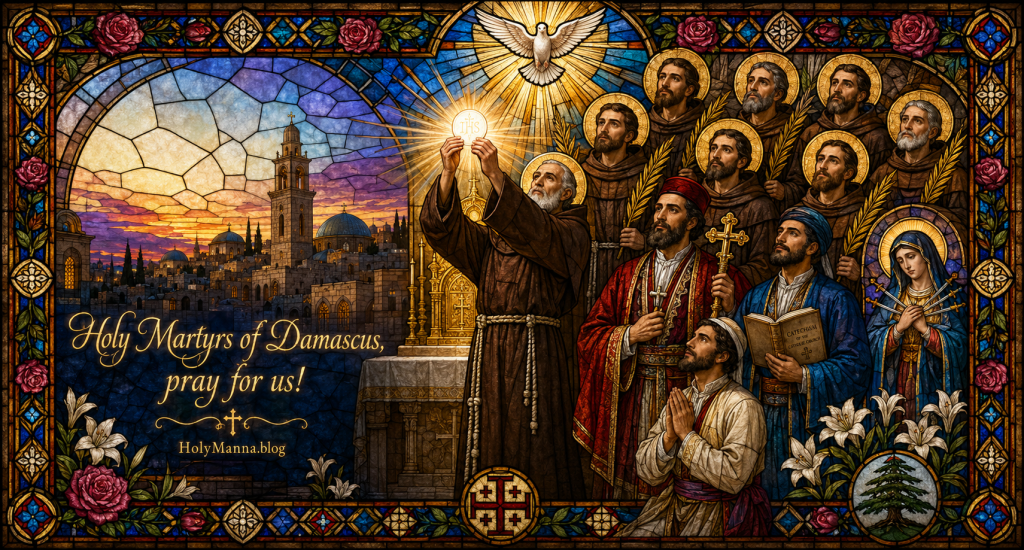
When East and West Bled Together
Some saints are remembered for towering intellects, others for founding great religious orders, and still others for miracles that stunned entire cities. The Martyrs of Damascus are remembered for something simpler and, in a way, more demanding. On a single night in July of 1860, eleven men were each asked the same question, and each gave the same answer. They were told they could live if they renounced Jesus Christ and embraced another faith. Every one of them refused, and every one of them died for it.
The eleven were not a uniform group. Eight of them were Franciscan friars of the Custody of the Holy Land, seven from Spain and one from Austria, led by their superior, Father Emmanuel Ruiz. Three of them were laymen, blood brothers from an old Maronite Catholic family of Damascus: Francis, Abdel Moati, and Raphael Massabki. Priests and laymen, Europeans and Syrians, Latin rite and Maronite rite, they were slaughtered together inside the Franciscan convent of Saint Paul in the Christian quarter of Damascus, and they were buried together in a single tomb. In them, the Church of the West and the Church of the East mingled their blood and were crowned together.
Pope Pius XI beatified all eleven in 1926, and Pope Francis canonized them on October 20, 2024, World Mission Sunday, before the crowds of Saint Peter’s Square. At that Mass the Holy Father summed up their witness in one line: “These new saints lived Jesus’ way: service.” The Church keeps their feast on July 10, the anniversary of their martyrdom. The Catechism teaches that by canonizing certain of the faithful, the Church “recognizes the power of the Spirit of holiness within her and sustains the hope of believers by proposing the saints to them as models and intercessors” (CCC 828). The group as a whole holds no formal universal patronage, though one of its members, Saint Engelbert Kolland, is the documented patron of his home parish of Zell am Ziller in Austria and the second patron of the Franciscan Province of Austria and South Tyrol.
From a Spanish Village and a Tyrolean Valley to the Streets of Damascus
The story of these martyrs begins in places far removed from Syria. Emmanuel Ruiz, whose name appears in Spanish sources as Manuel Ruiz López, was born on May 5, 1804 in the small village of San Martín de las Ollas in the province of Burgos, Spain, to Manuel and Agustina. It is worth noting that a few older English summaries place his birth in the province of Santander, but the official biographies prepared by the Franciscan Order and the Custody of the Holy Land consistently identify Burgos, and that identification is the reliable one. His parents gave him a sound religious upbringing, and his parish priest introduced him to Latin grammar. At nineteen he entered the Order of Friars Minor, professed his vows, and was ordained a priest in 1830. The following summer he boarded a ship at Cádiz with a band of fellow missionaries bound for the Holy Land, landing at Jaffa in August of 1831. Among his shipmates was Father Carmelo Bolta of Valencia, the man who would one day be martyred at his side.
Father Emmanuel had a gift for Eastern languages, and it opened doors that remained closed to many European missionaries. He served the Christians of Damascus with such gentleness and steadiness that the Arabs gave him a nickname that tells you everything about the man: they called him Father Patience. He knew hardship long before his final night. Illness sent him back to Europe more than once, and when he returned to Spain in 1847 he found the convents closed by government suppression, so that he, a friar, had to lodge in his brother’s house in his home village. He eventually returned to the mission he loved, and in 1858 he was appointed guardian of the convent of Saint Paul in Damascus, in the Bab Touma quarter of the Old City.
The one non-Spaniard among the friars had perhaps the most surprising origin of all. Engelbert Kolland was born Michael Kolland on September 21, 1827 in Ramsau im Zillertal, a valley in the Austrian Tyrol, and here is the remarkable part: his family background was Protestant. His father Kajetan, a woodcutter, was a spokesman for the underground Lutherans of the valley, and when the Protestant families were expelled from the Zillertal in 1837, the Kollands relocated to Styria. Yet the boy’s path bent decisively toward the Catholic Church. The Archbishop of Salzburg took an interest in him, he studied in Salzburg, and in 1847 he entered the Franciscan friary there, receiving the religious name Engelbert. He was ordained a priest in Trent in 1851, and because of his talent for languages he was sent to the Holy Land in 1855. In Damascus the faithful found his name too long, so they shortened it and called him Abuna Malak, Father Angel. He was young, energetic, and beloved; when the parish priest fell ill, Father Engelbert carried practically the whole pastoral load himself, and he even had the boldness to build a bell tower for the convent church, hanging a bell of half a ton in a city where the convent stood opposite a mosque.
The three Massabki brothers needed no journey to reach Damascus, because Damascus was their home and had been their family’s home for over four hundred years. The family traced its line back to a Maronite priest of the fourteenth century, and the Muslim notables of the city spoke of the Massabki clan as a household that gathered for prayer and spiritual reading every evening. Francis, the eldest of the three, was a successful silk merchant, married to Elizabeth Chiha and the father of eight children. His reputation for honesty was so solid that he served as the authorized representative of the Franciscan friars in their business affairs and as the representative of the Maronite Patriarch in Syria. Abdel Moati was also married, the father of five, and he walked to the convent of Saint Paul every day, both to pray and to teach the boys in the friars’ school. Raphael, the youngest, remained unmarried and was apparently of delicate health; simple-hearted and deeply devoted to the Blessed Mother, he spent long hours praying in the friary church and helped the friars as a sacristan with whatever was needed. There was a fourth brother, Father Abdallah, a priest, who was absent on the night of the massacre and survived. One family had given the Church a priest and three martyrs.
Ordinary Holiness in an Extraordinary City
None of the eleven worked wonders during their lifetimes, and honesty requires saying so plainly: no miracles are attributed to any of them before their deaths. What the historical record shows instead is something the Church insists is just as much the work of God, a long, patient fidelity in ordinary things. The Catechism teaches that “the Eucharist is ‘the source and summit of the Christian life’” (CCC 1324), and the daily rhythm of these men’s lives orbited around exactly that center. Father Emmanuel shepherded a small, vulnerable flock of Latin, Armenian, Syriac, and Greek Catholics in a city where Christians were a minority hemmed in by law and custom. Father Engelbert taught, visited the poor, the sick, and the dying, and won hearts with his fluent Arabic. Father Carmelo Bolta served as parish priest, and the other friars, Nicanor Ascanio, Nicolás Alberca, and Pedro Soler among the priests, with the lay brothers Francisco Pinazo, the sacristan, and Juan Jacob Fernández, the cook, kept the humble machinery of the mission running.
The Massabki brothers show why this group matters so much for laypeople today. Francis proved that a man can handle serious money, run a demanding business, raise eight children, and still put Christ unmistakably first; his generosity to the poor was famous across Damascus. Abdel Moati stood in front of schoolboys and taught them the catechism, and witnesses later recalled that only hours before his death he gathered his students and explained the grace of martyrdom, urging them to bear witness without fear. Raphael simply prayed, served, and loved Our Lady. Not one of the three wore a habit. They are, in fact, the first Maronite laymen ever declared saints of the universal Church, a point the Maronite Patriarchate emphasized when it petitioned for their canonization. The reader should remember these men precisely because their holiness looked so unremarkable from the outside, a merchant, a teacher, a helpful younger brother, right up until the night it was tested by fire.
The Night of July 9, 1860
The summer of 1860 brought catastrophe to the Christians of Lebanon and Syria. A civil conflict in Mount Lebanon between the Druze and the Maronites spilled over into massacre, and by July the violence had reached Damascus. Estimates of the dead across the whole persecution vary widely among sources, with figures running into many thousands in Lebanon and thousands more in Syria, and the exact numbers cannot be fixed with certainty. What is certain is that on July 9 a mob invaded the densely populated Christian quarter of Damascus, a district of thousands of homes, setting fires and killing as they went. It deserves to be said, because it is documented and because justice requires it, that a number of prominent Muslims of Damascus acted heroically to protect their Christian neighbors, above all the exiled Algerian Emir Abdelkader, who sheltered well over a thousand Christians and is honored for it to this day.
As the violence closed in, Father Emmanuel gathered everyone inside the convent of Saint Paul, the friars, the schoolchildren, and laypeople who had taken refuge there, including the three Massabki brothers, whose home stood nearby. He led them into the church, where they went to confession, prayed, and received Holy Communion. Testimony preserved by the Maronite community relates that the refugees prayed the words of Psalm 27, “The Lord is my light and my salvation; whom shall I fear?” Sometime after midnight, in the first hours of July 10, armed attackers broke into the convent through a hidden door pointed out to them by a traitor.
The Dicastery for the Causes of Saints records what Father Emmanuel did first. His thought was not for escape but for the Blessed Sacrament: he went to the church and consumed the Eucharistic hosts reserved in the tabernacle so that they could not be profaned, and he was put to death at the foot of the altar. A moving account preserved in Maronite testimony adds that when the attackers seized him, he told them, “Come, let me lead you to a treasure inside the church,” and after consuming the Sacred Hosts he said, “This is the treasure. I have nothing else.” That account comes from testimony gathered from survivors and, while cherished, its exact wording cannot be independently verified.
The killers then found Francis Massabki kneeling before the statue of Our Lady of Sorrows. They recognized him at once, for he was a man of standing in the city, and they came with an offer. A Muslim notable, Sheikh Abdallah, owed Francis an enormous debt; sources disagree on the figure, with Maronite accounts speaking of eight hundred thousand pounds and the New Catholic Encyclopedia recording eight thousand napoleons, so the post asserts only that it was a vast sum. The men told Francis that the Sheikh would spare him, his brothers, their families, and all who depended on them, if only they would embrace Islam. According to the testimony of his young nephew, who hid nearby and survived, Francis answered: “Sheikh Abdallah can take the money I lent him; he can also take my life, but my faith no one can make me deny. I am a Maronite Christian, and in the faith of Christ I will die.” The fuller accounts add that he closed with an echo of his Lord’s own words in The Gospel of Matthew, that we are not to fear those who can kill the body. He was cut down where he knelt. Abdel Moati was seized at the chapel door and given the same choice. He answered in a clear voice, “I am a Christian, kill me, I am ready,” and he was killed minutes after his brother, in the sight of two of his own sons, pupils of the school, who survived to bear witness. Raphael was found last of the three; ordered to convert, he fell to his knees in prayer and was slain.
The friars met the same fate throughout the convent, at the altar, on the terrace, in the street, each refusing to apostatize. Father Engelbert had slipped out to a nearby house, where a Maronite named Metri, who survived, witnessed his end. Discovered and exhorted to become a Muslim to save his life, the young Tyrolean answered simply: “I cannot, because I am a Christian and a servant of Jesus Christ.” The biographical accounts of his life relate that his tormentors severed one arm when he first refused, then the other when he refused again, and beheaded him when he confessed Christ a third time, afterward leaving his body unburied for days before throwing it into a cistern. That harrowing detail rests on his hagiographic biography and the surviving testimony, and its precise particulars cannot be fully verified, though the fact of his brutal martyrdom is beyond doubt. Accounts likewise relate that Brother Juan Jacob Fernández, the cook, was thrown from the roof of the church and, still living, prayed that God would accept his sacrifice until he was finally killed; this account too comes from later retellings of the testimony and cannot be independently verified in its details.
Here the Church’s teaching illuminates what happened in that convent. The Catechism declares: “Martyrdom is the supreme witness given to the truth of the faith: it means bearing witness even unto death” (CCC 2473). And it adds that “the Church has painstakingly collected the records of those who persevered to the end in witnessing to their faith” (CCC 2474). That is exactly what happened in the decades that followed, as sworn testimony from survivors, including children who had watched their own father die, was gathered, examined, and preserved.
A Common Tomb That Became a Wellspring
The bodies of the eleven were recovered a few days after the massacre and buried together in a common tomb. When the convent church was rebuilt and consecrated in 1866, that tomb became a destination of devotion for the Christians of Damascus, and it has remained so ever since. To this day, many relics of the martyrs are preserved at the Franciscan convent in Bab Touma, on the very ground where they died, and a chapel dedicated to the Massabki brothers stands in the Maronite church of the Old City. Every year on July 10 the Custody of the Holy Land commemorates the martyrs, and in Damascus the Latin and Maronite communities often celebrate the feast together, a living sign of the unity sealed in their mingled blood.
Honesty requires a plain statement here: no specific, formally documented miracles of healing or intervention are attributed to the intercession of these martyrs. Their beatification in 1926 and their canonization in 2024 both proceeded on the basis of martyrdom itself, since the Church does not require a proven miracle for those who died as martyrs of the faith. Maronite prayers honor their relics as sources of grace and blessing, and the faithful of Syria and Lebanon have sought their intercession for generations, but no individual miracle stories exist to recount, and none will be invented here. In a sense, the ongoing survival and courage of the Christian community of Damascus, decimated by war and hardship yet still gathered around that tomb, is the living fruit their sacrifice has borne. The ancient observation of Tertullian in his Apologeticum, that “the blood of the martyrs is the seed of Christians,” finds a quiet confirmation there.
The path to canonization is itself part of their story. The Franciscans opened the cause for the eight friars in 1872. In 1926, at the request of the Maronite Patriarchate and by a special procedure authorized by Pope Pius XI, the three Massabki brothers were joined to the cause, and all eleven were beatified together in Saint Peter’s Basilica on October 10, 1926, fittingly in the seventh centenary year of the death of Saint Francis of Assisi. Nearly a century later, in 2022, the Holy Synod of Maronite Bishops petitioned Pope Francis for their canonization, joined by the Minister General of the Friars Minor and the Custos of the Holy Land, who saw in these martyrs a message of dialogue, peace, and unity for a Middle East once again shaken by war. Pope Francis canonized all eleven on October 20, 2024.
The cultural footprint of the martyrs reaches from Syria to the Alps. Saint Engelbert Kolland became the first Austrian canonized in over a century, and his homeland has embraced him: his birthplace still stands in the Zillertal, his relics are venerated in Zell am Ziller, Austria has issued commemorative stamps bearing his image, and high on a Tyrolean mountain at over two thousand meters stands the striking Garnet Chapel, a crystal-shaped shrine designed by the architect Mario Botta in his honor. In the Maronite world, the Massabki brothers hold a singular place as the first lay Maronite saints, models of holiness for every father, businessman, teacher, and quiet helper in the pews.
What Eleven Ordinary Men Can Teach You
It is tempting to read a martyrdom story as something remote, heroism on a scale that has nothing to do with grocery lists, work deadlines, and family obligations. The Martyrs of Damascus close off that escape route, because most of them were living exactly that kind of life. Francis Massabki managed contracts and raised eight children. Abdel Moati graded catechism lessons. Raphael set up the sacristy. Brother Juan Jacob cooked dinner for the community. Their final answer on the night of July 10 was not conjured out of nothing; it was the harvest of thousands of small, prior decisions to put Christ first, in prayer, in honesty, in generosity to the poor, in daily Mass and daily duty. The Catechism teaches that the disciple of Christ must not only keep the faith and live on it, but also profess it and confidently bear witness to it: “Service of and witness to the faith are necessary for salvation” (CCC 1816). Witness rarely looks dramatic. Most days it looks like integrity when cutting a corner would be easier, patience with a difficult person, or simply being known, as Francis was known, as someone whose faith is not negotiable.
If someone offered you everything you had ever earned in exchange for quietly setting your faith aside, what in your daily life right now would make the refusal easy, and what would make it hard? The martyrs also model a Eucharistic center of gravity. Father Emmanuel’s last free act was to protect the Blessed Sacrament, because for him the Eucharist really was the treasure, the source and summit named in CCC 1324. A practical resolution flows naturally from that: arrive a few minutes early for Mass, make an occasional visit to the tabernacle during the week, and receive Communion with the deliberate awareness that generations of Christians died rather than see that gift profaned. Finally, the story carries a lesson about communion across differences. Spaniards, an Austrian, and Syrians; friars and family men; Latin and Maronite rites; one tomb. The Catechism reminds the faithful that the communion of saints binds heaven and earth together, and that the saints’ “intercession is their most exalted service to God’s plan” (CCC 2683). You are not asked to face your trials alone. Ask these eleven brothers to pray for you, and ask them especially for the grace of perseverance in small things, so that fidelity in great things, should it ever be demanded, will already be second nature.
Engage With Us!
The story of the Martyrs of Damascus is not merely history; it is an invitation, and every reader will hear it a little differently. Share your thoughts and reflections in the comments below, whether this is the first time you have met these eleven saints or their witness has accompanied you for years. To help the conversation along, here are some questions to pray with:
- Francis Massabki refused a fortune and his own life rather than deny Christ. What is the “Sheikh Abdallah’s offer” in your own life, the thing most likely to tempt you to compromise your faith quietly?
- Father Emmanuel’s first instinct in mortal danger was to protect the Eucharist. What would change in your week if you treated the Eucharist as your greatest treasure?
- Abdel Moati taught his students about courage only hours before he had to live it. Who is watching your example of faith right now, and what are they learning from it?
- Raphael served quietly and prayed much, and the Church canonized him alongside priests and merchants. Where is God asking you to embrace hidden, unglamorous faithfulness?
- The martyrs’ feast is celebrated jointly by Latin and Maronite Catholics in Damascus. How can you build unity with fellow Christians whose traditions differ from your own?
However these questions land in your heart, let the eleven Martyrs of Damascus remind you that sanctity is built one ordinary, faithful day at a time, and that the God who strengthened a merchant, a teacher, a cook, and a young friar from the Alps will strengthen you too. Go out this week and live your faith openly, generously, and without fear, doing everything with the love and mercy that Jesus taught us.
Holy Martyrs of Damascus, pray for us!
Follow us on YouTube, TikTok, Instagram and Facebook for more insights and reflections on living a faith-filled life.


Leave a Reply