Love Has Let Himself Be Seen
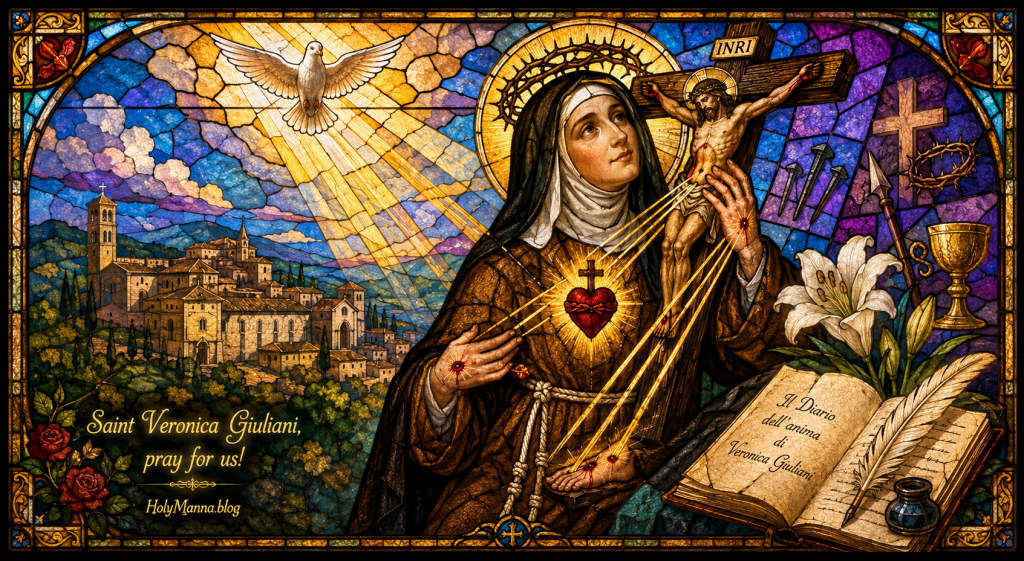
Some saints are remembered for the cities they built or the crowds they preached to. Saint Veronica Giuliani is remembered for something quieter and, in a way, far more daring. For fifty years she never left one small monastery in the Umbrian hills, and yet her heart stretched out to embrace the whole world. She was a Capuchin Poor Clare nun and one of the most remarkable mystics in the history of the Church, a woman who asked God for one thing above all others, that she might become a living likeness of Jesus crucified. The very name she received in religious life pointed to that desire, because Veronica means true image, and she spent her whole life trying to become one.
What makes her so compelling for a reader today is that she was not a distant figure of the early Church shrouded in mist. She lived into the eighteenth century, kept a diary of thousands of pages, governed a convent with common sense, and was investigated with real suspicion by Church authorities before her holiness was recognized. She received the stigmata, the five wounds of Christ, in her own flesh. She was praised by popes across three centuries. Pope Benedict XVI devoted an entire teaching to her and called her a courageous witness of the beauty and power of divine love. The Church honors her because, in canonizing the saints, she proposes them to the faithful “as models and intercessors” (CCC 828). Veronica is exactly that, a model of love poured out and an intercessor whose heart, as this story will show, carried the Passion of the Lord in a way almost too astonishing to describe.
A Child of Charity in the Metauro Valley
She was born on December 27, 1660, in Mercatello sul Metauro, a town in the Metauro Valley within the Duchy of Urbino, and she was baptized the very next day with the name Orsola, or Ursula. Her father, Francesco Giuliani, was an ensign who commanded the town garrison, and her mother was Benedetta Mancini. The household was devout and comfortable, and Ursula was the youngest of seven daughters, two of whom had died in infancy and three of whom would give their lives to God in the cloister. It is worth pausing on one point where the sources differ, since honesty matters more than a tidy tale. One well known reference work mistakenly places her birth near Milan, but the reliable weight of evidence, including the testimony of Pope Benedict XVI and the records of her own region, fixes her birthplace firmly at Mercatello. Where accounts disagree, the reader deserves to know it.
Traditional accounts of her childhood glow with early signs of holiness. It is told that as a small girl she would set aside part of her own food for the poor and even hand over her clothing to a poorly dressed child she met. These stories come to us mainly through the accounts gathered for her canonization and through later devotional writers, so they are best received as cherished tradition rather than as documented fact. Even so, they point to something real that would define her whole life, a heart that could not bear to keep anything for itself when someone else was in need. In this she lived out from childhood what the Church calls the works of mercy, the very love that clothes the naked and feeds the hungry (CCC 2447).
There is another moving story attached to her mother’s death, which came when Ursula was only seven years old. It is said that as Benedetta lay dying she gathered her living daughters and entrusted each one to a different wound of the crucified Jesus, and that the little Ursula was given to the wound in his side, close to his heart. This account is told lovingly in Catholic sources but cannot be independently verified, so it is offered here as a treasured family story rather than as established history. If it is true, it reads almost like a prophecy, because the side of Christ, so near to his Sacred Heart, is precisely where Veronica’s whole spiritual life would come to dwell.
After her mother’s death her father moved the family to Piacenza, where he had found work, and it was there, Pope Benedict XVI tells us, that the young woman’s desire to give herself entirely to Christ grew ever more pressing. She had to overcome her father’s opposition, since he loved his youngest daughter dearly and wanted her to marry and remain near him. Her resolve won out. On October 28, 1677, before she had even turned seventeen, she was clothed in the habit of the Capuchin Poor Clares in Città di Castello, in Umbria, the monastery that would be her home for the rest of her earthly life. There she received the name Veronica, which means true image, and the sisters, charmed by the youngest member of their community, took to calling her “la bambina,” the little one. That small nickname would come to seem almost ironic, because this little one was destined to become a spiritual giant.
Fifty Years of Hidden Fire
Why should a busy reader in the twenty first century remember a cloistered nun who died three hundred years ago? Because Veronica shows that holiness is not reserved for the dramatic and the visible, and that a single heart on fire with love can serve the whole Church. The Church teaches that spiritual growth moves toward an “ever more intimate union with Christ” and that this union is rightly called mystical (CCC 2014). Veronica lived that union at a depth few have ever reached, and yet she lived it while scrubbing pots, nursing the sick, and keeping the accounts of a poor monastery.
That balance is one of the most attractive things about her. She was a genuine mystic, but she was also intensely sensible. In her early years she worked in the kitchen, the sacristy, and the infirmary. For decades she served as mistress of novices, and in 1716, at the age of fifty six, she was elected abbess, an office she held until her death. As abbess she enlarged the cramped convent rooms and had water piped inside so her sisters would be more comfortable. She refused to let the novices read lofty books on mysticism, insisting instead that they study the basics of the Christian life, and she gently discouraged the young sisters from imagining themselves to be visionaries. She even taught them to moderate their penances. This is a woman who had seen Heaven in prayer and still made sure the plumbing worked.
Her interior life, meanwhile, was extraordinary. Her configuration to the suffering Christ unfolded through a series of mystical graces, including a mystical crowning with thorns, the espousal of her soul to Christ, a wound in her heart, and finally the stigmata. On Good Friday, April 5, 1697, she received in her own body the five wounds of the crucified Lord. She described the moment in her diary, and her own words are more vivid than any summary could be. She wrote, “In an instant, I saw five radiant rays issue from his most holy wounds; and they all shone on my face. And I saw these rays become, as it were, little tongues of fire. In four of them were the nails; and in one was the spear, as of gold, red hot and white hot: and it went straight through my heart, from one side to the other, and the nails pierced my hands and feet. I felt great pain but in this same pain I saw myself, I felt myself totally transformed into God” (Diary, I, 897).
The Church has always understood such gifts with care. Private mystical experiences, however genuine, do not add anything to the faith once handed on. Their role, the Catechism teaches, is “to help live more fully” the one Gospel of Christ in a particular moment of history (CCC 67). Veronica understood this perfectly. Her visions never pulled her away from Scripture and the liturgy but drove her more deeply into them, and she offered everything she received back to God for the good of others.
That is the beating heart of her mission, and she stated it plainly. She did not see her cloistered life as an escape from the world but as a hidden engine of grace for it. She wrote, “We cannot go about the world preaching to convert souls but are bound to pray ceaselessly for all those souls who are offending God, particularly with our sufferings, that is, with a principle of crucified life” (Diary, IV, 877). She experienced Christ as a bridegroom who invited her into his very wounds, recording how he spoke to her, “‘My Bride’, the Crucified Christ whispers to me, ‘the penance you do for those who suffer my disgrace is dear to me’” (Diary, I, 37). And she knew a tender closeness to the Mother of God as well, writing down words she heard from Our Lady, “I made you rest on my breast, you were united with my soul, and from it you were taken as in flight to God” (Diary, IV, 901). The Church confirms this instinct of hers, teaching that Mary’s union with her Son runs through the whole work of salvation, from his conception to his death (CCC 964).
Perhaps the most practical fruit of all this was her conviction that suffering, joined to Christ, becomes a doorway rather than a dead end. She called the ability “to suffer with joy” the very key to love. That is not the sentiment of someone who had avoided pain. It is the hard won wisdom of a woman who had walked straight through it.
Her Wounds Put on Trial
It would be a mistake to imagine that a life so favored by God was therefore easy. It was not. Veronica was never martyred, and this account will not pretend otherwise, but she suffered in ways that were long and grinding and, at times, deeply humiliating. Her hardships came from two directions at once, from her own fierce desire to share in the Cross and from the suspicion of the very Church she loved.
In her early years in the cloister she was tormented by interior trials, temptations to abandon her vocation, and long stretches of spiritual dryness in which God seemed silent. She pressed forward through prayer and penance, sometimes with a severity that she herself would later regret. Looking back once the fever of her youth had cooled, she spoke honestly of that harsh self discipline as “the crazy things that love had me do.” It is a remarkably human confession, and it is part of why the Church later held her up as a guide who taught her novices balance rather than extremes.
The greater trial came from outside. When the marks of Christ’s Passion began to appear on her body, Church authorities responded not with applause but with careful skepticism, which in that era was entirely proper. In 1697 she was denounced to the tribunal of the Holy Office. Her wounds were examined and probed, she was separated from her community and watched closely for any sign of deception, her diary was taken from her, and in 1699 she was even deprived of her right to vote and to hold office within the convent. For a woman whose only desire was to be a faithful daughter of the Church, this must have been an agony sharper than any physical wound. She endured all of it with humility and obedience, never protesting, never posturing, simply continuing to love. In time the investigation reversed itself. After thorough and even suspicious scrutiny, the authorities became convinced that her experiences were authentic, and she was restored to the ordinary life of her sisters.
Her final hardship was her death itself. It came after thirty three days of prolonged and painful agony. Yet even here the pattern of her life held true, because the suffering was transfigured by joy. The Church teaches that Christ has given “a new meaning to suffering” so that it can unite the believer to his own redemptive Passion (CCC 1505), and in Veronica that teaching took visible flesh. Her endurance was not grim resignation. It was love straining toward its fulfillment.
The Secret Hidden in Her Heart
If Veronica’s life was a hidden fire, her death revealed the flame for all to see. During her lifetime she had told her confessor, and her trusted confidante and eventual successor Blessed Florida Cervoli, something almost impossible to believe, that the instruments of the Lord’s Passion were imprinted upon her physical heart, and that their arrangement shifted over the years. She even drew what she perceived, more than once, so that a record existed of her claim.
After she died on July 9, 1727, the claim was tested. By order of the Diocesan Bishop, roughly two and a half months after her death, surgeons conducted an official examination of her heart. This was done not in secret but before witnesses, in the presence of the bishop, the mayor, medical men, and others gathered to observe. According to these witnessed accounts, the examination of her heart revealed within it a number of minute figures corresponding to the very symbols she had described and sketched during her life, marks associated with the cross, the crown of thorns, and other emblems of Christ’s Passion. Some accounts add that her body showed a curvature of the shoulder, as though she had carried a heavy cross. Because the examination was formal and witnessed, the event itself belongs to the documented record of her life, though the meaning the faithful draw from it is received, as all such wonders are, in the light of faith. Veronica is often portrayed in sacred art holding a heart marked with a cross, a fitting image for a woman whose interior love left its imprint on her very flesh.
Her holiness, so painstakingly tested, was formally recognized by the Church. She was beatified by Pope Pius VII in 1804 and canonized by Pope Gregory XVI on May 26, 1839. Two small errors circulate online, one giving a wrong canonization year and another a wrong pope’s name, but the correct facts are these dates and these popes, confirmed across the reliable sources. Her body rests enshrined in the Capuchin Poor Clare monastery in Città di Castello, where the community reports it to be incorrupt, and where pilgrims come to venerate her still. The Church encourages exactly this turning to the saints, teaching that “Their intercession is their most exalted service to God’s plan” and that the faithful can and should ask them to pray for the whole world (CCC 956).
Her influence has only grown with time. The great Capuchin friar and stigmatist Padre Pio is reported to have kept an icon of Veronica in his cell and to have regarded her as his own patroness, a striking bond between two saints who each bore the wounds of Christ. In a development that would have delighted her missionary heart, devotion to Veronica has taken root far beyond Italy. A Lebanese religious discovered her writings in 1994 and was so moved that he worked to spread her memory in his homeland, where the first church in the world dedicated to Saint Veronica Giuliani outside of Italy was raised in her honor. There are even those who advocate that this humble abbess, whose diary runs to some twenty two thousand pages, should one day be declared a Doctor of the Church. She has not been given that title, and this account will not claim it for her, but the very fact that it is discussed says much about the depth of what she left behind.
Learning to Suffer with Joy
It would be easy to read Veronica’s story as a museum piece, a collection of wonders safely locked behind three centuries of glass. That would be a mistake, because her life speaks with uncomfortable directness to anyone trying to follow Christ today. Her deepest lesson is that love is proven in the willingness to suffer for the sake of another, and that such suffering, when handed to God, does not crush a person but transforms them. The Catechism puts it starkly, teaching that “The way of perfection passes by way of the Cross” (CCC 2015). Veronica did not merely accept that truth. She ran toward it.
A reader does not need the stigmata to walk her path. The heart of her spirituality can be lived in an ordinary kitchen, office, or living room. It begins with the daily offering of small hardships, the headache, the interruption, the difficult relative, the tiredness at the end of a long day, quietly given to Christ for someone who needs grace. Veronica teaches that nothing is wasted when it is offered in love. What if the frustrations you cannot escape today were quietly turned into prayers for someone who is far from God?
Her example also invites a healthier relationship with hiddenness. In a culture that measures worth by visibility, Veronica spent five decades unseen and considered it the richest life imaginable. She was convinced that a soul in a quiet room, praying and loving, could touch the ends of the earth. Where in your life are you tempted to believe that only the visible and the impressive really matter to God?
Finally, she offers a rare and needed balance. She was a mystic who distrusted spiritual showiness, an ascetic who told her novices to moderate their penances, a visionary who insisted they study the basics of the faith first. Her wisdom guards against both extremes, the coldness that never dares to love, and the excess that mistakes intensity for holiness. The Church holds up such disciples so that others may take up their own cross and follow. As the Catechism reminds the faithful, quoting Saint Rose of Lima, “Apart from the cross there is no other ladder by which we may get to heaven” (CCC 618). Veronica climbed that ladder rung by rung, and she left it standing for anyone willing to follow. Is there one cross in your life right now that God may be asking you to carry with joy rather than resentment?
Engage With Us!
The story of Saint Veronica Giuliani is not meant to end on the page. It is meant to move into your own life and your own prayer, and there is no better place to begin than by sharing what stirred in you as you read. You are warmly invited to leave your thoughts and reflections in the comments below, so that this community can grow together in faith and encourage one another along the way.
To help you go deeper, consider praying with the following questions:
- Veronica longed to become a “true image” of Christ. In what specific way is Jesus inviting you to resemble him more closely this week?
- She offered her sufferings for sinners she would never meet. Whose conversion or healing could you begin offering your own daily difficulties for?
- When her holiness was questioned and her gifts were put on trial, Veronica responded with humility and obedience rather than defensiveness. How do you tend to react when you are misunderstood or unfairly judged?
- She called the ability to suffer with joy the key to love. Where do you most need that grace right now, and what would it look like to ask for it?
- Veronica believed a hidden life of prayer could reach the whole world. How might God be calling you to serve others in quiet, unseen ways?
May the example of Saint Veronica Giuliani give you courage to love without holding anything back. Whatever crosses this day places before you, carry them the way she did, with patience, with hope, and with the same love and mercy that Jesus poured out for us all. Go out and let that love be seen.
Saint Veronica Giuliani, pray for us!
Follow us on YouTube, TikTok, Instagram and Facebook for more insights and reflections on living a faith-filled life.


Leave a Reply