120 Witnesses Written in Letters of Blood
On July 9th the Church pauses to honor not one saint but a whole company, one hundred and twenty men, women, and children who gave their lives for Jesus Christ on Chinese soil. They are remembered together under the name of Saint Augustine Zhao Rong and his companions, and their story stretches across nearly three centuries, from the middle of the seventeenth century to the early decades of the twentieth. Pope Saint John Paul II canonized all one hundred and twenty of them together in Rome on October 1st in the Jubilee Year 2000, on the very feast of Saint Thérèse of the Child Jesus, the patroness of the missions. Of that number, eighty-seven were native Chinese and thirty-three were foreign born missionaries who had left everything to bring the Gospel to China.
These saints are invoked today for the people of China and for the Church there, and as heavenly friends of everyone who suffers for the name of Christ. The Church holds their memory close because they show, in the plainest possible way, what it costs to love God above life itself. The Catechism of the Catholic Church teaches that “Martyrdom is the supreme witness given to the truth of the faith” (CCC 2473), and it goes on to describe the records of the martyrs as “the archives of truth written in letters of blood” (CCC 2474). The Chinese martyrs belong to those archives. Among them are bishops and beggars, priests and farmers, a doctor bound by opium addiction who could not receive Communion for thirty years, and a fourteen year old girl who smiled at her executioners. Their witness is not a museum piece. It is a living seed. How ready are you to let your own faith cost you something today?
From an Emperor’s Soldier to a Priest of Christ
The saint whose name leads this whole company, Augustine Zhao Rong, was born in 1746 in Wuchuan, in the province of Guizhou in southwestern China. He was not raised a Christian. As a young man he joined the imperial army of the Qing dynasty and served the emperor as a soldier. The path that led him from the barracks to the altar began with an assignment that was meant to be nothing more than guard duty.
At a time when the practice of the Catholic faith was forbidden and punished, Zhao Rong was placed in charge of escorting a European prisoner, Bishop Gabriel-Taurin Dufresse of the Paris Foreign Mission Society, who had been arrested and was being taken from Chengdu toward Beijing. Sources differ on the exact year of this journey, with some placing Zhao Rong’s contact with the bishop in the seventeen eighties, yet they agree on what happened in his heart. Watching the bishop endure his suffering with calm, prayer, and kindness rather than bitterness, the soldier was moved to the depths. He began to ask questions about the faith that could give a condemned man such peace. In time he asked to be baptized, took the name Augustine, was sent to the seminary, and was ordained a diocesan priest. He became the first native Chinese priest to be martyred for the faith, and it is for this reason that the entire group carries his name.
Zhao Rong’s conversion captures something true about this whole company of saints. Very few of them came from famous families or places of power. The eighty-seven Chinese martyrs were, for the most part, ordinary people, including parents and children, catechists and seminarians, farmers, servants, laborers, and cooks, ranging in age from a boy of nine to elders in their seventies. The thirty-three missionaries were Franciscans, Dominicans, Jesuits, and members of the Paris Foreign Mission Society, along with religious sisters, who had crossed the world to serve a people not their own. Pope Saint John Paul II said of these missionaries that they “sought to immerse themselves in the Chinese world” out of love for the people they came to serve.
The roots of this company reach back long before Augustine Zhao Rong. The first of the one hundred and twenty to die was a Spanish Dominican priest, Francisco Fernández de Capillas, who was arrested, imprisoned, and beheaded in the province of Fujian on January 15th, 1648. According to the accounts handed down, he was praying the Sorrowful Mysteries of the Rosary with other prisoners when the sword fell. He is honored as the protomartyr of China, the first in a line that Augustine Zhao Rong would one day join.
Doctors, Catechists, Children, and the Ordinary Grace of Faithfulness
It is worth being honest about what kind of saints these are. The Chinese martyrs are not remembered for spectacular wonders worked during their lives. The tradition does not hand down long lists of healings or visions performed by them before their deaths. What it hands down instead is something quieter and, in its own way, just as miraculous, namely the grace of ordinary people remaining faithful to Christ in a place and time where that fidelity could get them killed.
Consider Mark Ji Tianxiang, one of the most beloved figures in this group. He was born in 1834 in what is now Hebei province, raised in a Catholic family, and trained as a physician. He was known for treating the poor without charge. After a severe stomach illness he treated himself with opium, which was a common medicine of the day, and he fell into an addiction he could never break. In nineteenth century China, addiction was regarded as a shameful scandal, and his confessor, who like almost everyone in that era did not understand addiction as a disease, eventually judged that he lacked a firm purpose of amendment and withheld absolution from him. For roughly thirty years Mark Ji could not receive the Eucharist. He kept coming to church anyway. He kept praying. He raised his family in the faith and, according to the accounts of his life, prayed to die a martyr, since that seemed to him the one road to heaven still open to him. His perseverance is a living picture of the virtue of fortitude that the Church honors and encourages in every believer (see CCC 1808).
Others in this company are remembered for concrete works of mercy and courage. The four French Jesuit priests who died in 1900, among them Father Leo Mangin, were shepherds who stayed with their people to the end rather than flee to safety. The seven Franciscan Missionaries of Mary, sisters from France, Italy, Belgium, and Holland, led by Sister Mary Hermina of Jesus, had come to nurse the sick and care for children. The Chinese catechists spent their lives teaching the faith village by village, often traveling and evangelizing at great personal risk. Peter Wu, a catechist born of a non-Christian family and baptized in 1796, spent the rest of his life proclaiming the faith and refused every attempt to make him renounce it.
So when the Church speaks of miracles in connection with these saints, the first miracle to notice is the transformation of frightened, ordinary human beings into witnesses who would not bend. That is the work of grace, and it is the reason the reader is invited to remember them. When have you seen God turn an ordinary, struggling person into someone quietly heroic?
The Boxer Storm and the Courage That Would Not Bend
The one hundred and twenty saints honored on this day were all martyrs. They died across a long span of Chinese history, between 1648 and around 1930, in waves of persecution that rose and fell with the empire’s fear of foreign influence. Many were tortured before they died. Augustine Zhao Rong himself, after his arrest, is said in the accounts of his life to have suffered cruel tortures and to have died in prison in 1815. Bishop Dufresse, the man whose patient suffering had first drawn Zhao Rong to Christ, was beheaded that same year.
By far the largest number of these martyrs, eighty-six of them, died in a single terrible year, 1900, during the uprising known as the Boxer Rebellion. The rebels belonged to a movement called the Society of Righteous and Harmonious Fists, nicknamed the Boxers because many of them practiced martial arts. They were determined to drive every foreign influence out of China, and because Christianity was seen as a foreign religion, Chinese Christians and missionaries alike became targets. Tens of thousands of Chinese believers were killed in that persecution. The saints canonized in 2000 are a small, representative company drawn from that vast multitude.
The testimonies that survive from that year are almost unbearable in their courage. In the city of Taiyuan, in Shanxi province, the Italian Franciscan bishop Francis Fogolla stood before the governor who was about to have him killed. According to the record of his martyrdom, he answered calmly with the words, “We never wronged anyone. On the contrary, we have done good to many.” He and Bishop Gregory Grassi were put to death, along with the seven Franciscan sisters and many others.
The children among them shame the strongest adults. Pope Saint John Paul II, in the homily he preached at their canonization, told the story of a fourteen year old girl named Ann Wang. Surrounded by torturers who demanded that she renounce Christ, she refused. The Pope recounted that, ready for her beheading, she declared with a radiant face, “The door of heaven is open to all,” and then quietly murmured the name “Jesus” three times. In the same homily he remembered an eighteen year old named Chi Zhuzi. After his captors had cut off his right arm and were preparing to flay him alive, the young man cried out without fear, “Every piece of my flesh, every drop of my blood will tell you that I am Christian.”
The martyrdom of Mark Ji Tianxiang gathers up the whole meaning of the day. In 1900 he was arrested together with members of his own family, including a son, grandchildren, and daughters in law. Offered his life if he would deny Christ, this man who had been kept from Communion for thirty years refused. According to the accounts of his death, he begged his captors to kill him last, so that not one of his relatives would have to die alone and so that he could stand beside each of them and strengthen them to the end. It is said that he went to his execution singing the Litany of the Blessed Virgin Mary. Sources differ on the exact day, with some placing his death on July 7th and others on July 9th of 1900. This detail cannot be verified with certainty, though the sources agree entirely on how he died, faithful at last to the Lord who had never abandoned him.
The Church understands such deaths not as defeat but as victory. The Catechism teaches that those who suffer death for the faith are “baptized by their death for and with Christ” (CCC 1258), so that even a catechumen not yet baptized with water receives, through martyrdom, the fruits of Baptism. For these saints, the sword did not end the story. It opened the door of heaven that young Ann Wang spoke of.
Seeds Buried in Chinese Soil, and the Harvest Still Rising
When Christians ask what miracles followed the deaths of these martyrs, the most truthful answer points not to a tidy list of healings but to the Church that grew from their graves. In The Gospel of John, the Lord promised that “unless a grain of wheat falls into the earth and dies, it remains alone; but if it dies, it bears much fruit” (Jn 12:24). The ancient Christian writer Tertullian gave the Church a saying that The Catechism itself preserves, that “the blood of martyrs is the seed of Christians” (CCC 852). China has proven those words true. Christianity had first reached Chinese soil centuries earlier, arriving by way of Syria as early as the six hundreds, and over the long centuries it was sometimes free to grow and sometimes forced underground. Through every persecution, the witness of the martyrs kept the seed alive. Today, though Catholics remain a small minority in a nation of well over a billion people, the faith endures in China, watered by the blood of those who would not deny it.
The path to their canonization itself unfolded over many decades. The martyrs were beatified in several groups across the late eighteen hundreds and the first half of the nineteen hundreds as their individual causes were examined, and then Pope Saint John Paul II raised all one hundred and twenty of them to the altars together on October 1st, 2000. That date carried its own weight. October 1st is the national day of the People’s Republic of China, and the government of that nation objected strongly to the canonization, both to its timing and to the honoring of figures it associated with the foreign powers of the colonial era. The Church, for her part, presented the day as an act of love for the Chinese people and a recognition of sons and daughters of China who had loved their homeland even as they loved Christ.
Devotion to these martyrs has spread well beyond China. The story of Mark Ji Tianxiang in particular has found a powerful new life in the present day. Because he remained faithful through decades of addiction and separation from the sacraments, many people who struggle with addiction, along with the families who love them, have begun to turn to him as an intercessor and a sign of hope. This is a growing popular devotion rather than a formal patronage decreed by the Church, yet it has borne real fruit. A shrine in Fall River, Massachusetts came to house a statue of Saint Mark Ji, where visitors have left written prayers pleading for loved ones caught in the grip of drugs.
A word of honesty is owed to the reader here. Because these saints number one hundred and twenty and died across nearly three centuries, the Church does not carry down a single famous account of a healing at their tombs in the way she does for some individual saints. Their relics are venerated and their intercession is sought, especially for the Church in China, but many of the individual miracle stories attached to these martyrs that circulate online cannot be independently verified, and they are best received as pious stories rather than established fact. What can be verified, and what matters most, is the harvest of faith that their deaths made possible.
What Their Blood Still Whispers to You
The witness of the Chinese martyrs lands close to home, even for a reader who will almost certainly never face a sword. Their lives ask a series of pointed questions about the shape of an ordinary Catholic life.
Begin with Augustine Zhao Rong, the soldier who was converted simply by watching a suffering man pray. He is a reminder that faith is often caught before it is taught, and that the way a Christian carries pain, disappointment, and injustice may preach a more convincing sermon than any words. When people watch you suffer, what do they learn about the God you serve?
Consider Mark Ji Tianxiang, who kept walking into church for thirty years while carrying a burden he could not put down, unable to receive the Eucharist he longed for. His life is a rebuke to the temptation to walk away from God whenever faith becomes uncomfortable or whenever a person feels unworthy. He teaches that showing up, again and again, is itself an act of love, and that God’s mercy is not canceled by human weakness. The Church honors exactly this kind of steadiness under trial as the virtue of fortitude (see CCC 1808). Is there some area of failure or shame that has tempted you to give up on prayer altogether?
Remember the children, Ann Wang and Chi Zhuzi, whose courage outran that of grown men. They strip away every excuse built on comfort or convenience. A fourteen year old who could say that heaven’s door is open to all, with a sword at her neck, calls the reader to a faith that is not merely a Sunday habit but a treasure worth everything.
Practical ways to live in their spirit are within reach of anyone. A Christian can begin by praying for the Church in China and for all who are persecuted for their faith, remembering that in many parts of the world the age of the martyrs is not over. A Christian can practice small, daily fidelities, keeping Sunday Mass, returning to Confession, and choosing honesty when a lie would be easier, so that the muscle of faithfulness is already strong when a real test comes. And a Christian can imitate Mark Ji by refusing to let personal weakness become a reason to abandon God, choosing instead to keep showing up. If your faith cost you a friendship, a promotion, or your safety this year, would there be enough evidence to convict you of being a Christian?
Engage With Us!
The Church remembers these one hundred and twenty saints not to leave the reader admiring them from a distance but to invite each person into the same courage. Please share your thoughts and reflections in the comments below, and let this holy company accompany you this week through the following questions.
- Augustine Zhao Rong was converted by watching a condemned bishop suffer with peace and prayer. Whose quiet witness first drew you toward Christ, and whose faith might you be strengthening now by the way you carry your own trials?
- Mark Ji Tianxiang kept coming to church for thirty years even when he could not receive Communion. What would it look like for you to keep showing up to God in a season when you feel unworthy or stuck?
- Fourteen year old Ann Wang told her executioners that the door of heaven is open to all. Where is God asking you to speak or live your faith boldly, even when it is unpopular or costly?
- These martyrs refused to deny Christ under torture. What are the smaller, everyday pressures that tempt you to hide or water down your faith, and how might you resist them?
- The blood of these martyrs became a seed for the Church in China. Where in your own family, workplace, or neighborhood might God be asking you to plant seeds of faith, trusting him for a harvest you may never see?
As a final question to carry with you, ask this. Given all that these witnesses surrendered for love of Jesus, what is one thing he is inviting you to surrender for love of him? Let their example move you to live each day with the same love and mercy that Jesus taught, holding nothing back, so that your own ordinary faithfulness might become, in God’s hands, a seed for others.
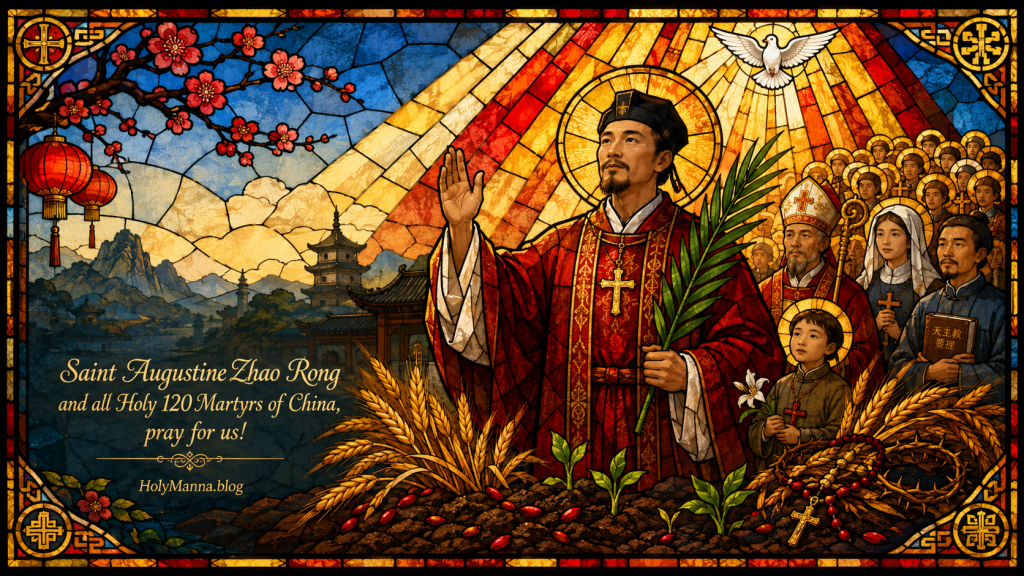
Saint Augustine Zhao Rong and all Holy 120 martyrs of China, pray for us!
Follow us on YouTube, TikTok, Instagram and Facebook for more insights and reflections on living a faith-filled life.


Leave a Reply