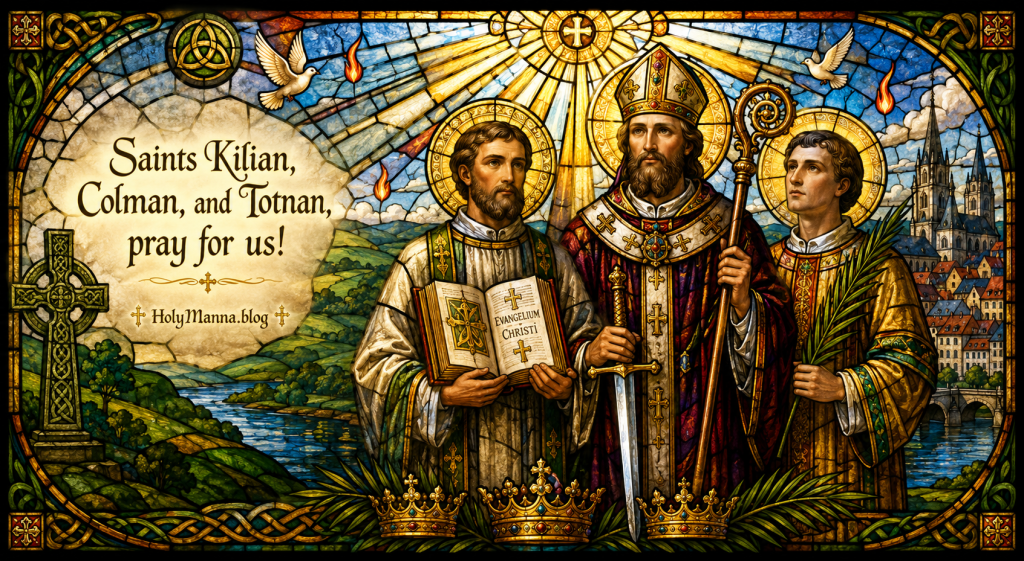
Three Irishmen and a City That Never Forgot Them
Sometime in the seventh century, three Irishmen left the only home they had ever known and walked into a pagan land to hand strangers the greatest treasure they possessed, faith in Jesus Christ. Their names were Kilian, a bishop, Colman, a priest, and Totnan, a deacon. The Church remembers all three of them together, companions in mission and companions in death, martyred for the truth in the German city of Würzburg around the year 689.
Kilian is honored across the Catholic world as the Apostle of Franconia, the region that makes up much of what is now northern Bavaria. He is the patron saint of the Diocese of Würzburg, where his feast on the eighth of July is still kept with great solemnity, and he is venerated in Ireland and in Vienna as well. Older devotional writers also name the three martyrs as patrons of whitewashers, and they record that the faithful once invoked them against gout and rheumatism.
What sets these three apart is not a long catalogue of dramatic wonders worked in their lifetimes. It is something quieter, and in a way more demanding. They left home for good. They preached until an entire duchy began to turn toward Christ. And when the truth of the Gospel collided with the sins of the powerful, they refused to soften the message in order to save their own lives. The Catechism teaches that “Martyrdom is the supreme witness given to the truth of the faith” (CCC 2473), and the deaths of Kilian, Colman, and Totnan are precisely that kind of witness. Their story is old, and parts of it reach us wrapped in the memory of the people who loved them, yet the heart of it has never been in serious doubt.
From the Green Hills of Ireland to a Calling Beyond the Sea
Kilian was born around the year 640 into a noble family. A strong and cherished Irish tradition places his birthplace at Mullagh, in the south of what is now County Cavan, near a townland remembered as Cloughballybeg. That local memory is honored to this day, though it should be received as treasured tradition rather than as a fact fixed by contemporary documents. Some medieval writers described his homeland with a Latin phrase that could mean either Ireland or Scotland, but the fuller early account settles the matter by naming the land of his birth as the country that is also called Hibernia, which is Ireland. His companions Colman and Totnan were Irishmen as well, bound to him by a shared homeland and a shared hunger to spread the Gospel.
Various accounts describe Kilian as a man devoted from his youth to prayer and study. Later writers say that he embraced the monastic life, and Irish tradition connects his formation to the schools of his native island, with some sources pointing to the famous monastery on the island later known as Iona. These formation details differ from one source to another and are best held as tradition rather than as settled history. What every source agrees upon is the shape of his soul. Here was a man forged in the fierce and joyful discipline of the early Irish Church, a Church that had produced a whole movement of monks who chose to leave Ireland forever for the love of Christ.
That movement is the key to understanding Kilian, Colman, and Totnan. The Irish called it the pilgrimage for Christ, a permanent exile undertaken not because home was hated but because souls elsewhere had never heard the name of Jesus. This is what a deepening faith looks like when it reaches full maturity. It is not merely a single moment of conversion but a life handed over, piece by piece, until nothing is held back. The three of them answered the same command that the Catechism places at the center of the Church’s mission, the words of the Risen Lord, “Go therefore and make disciples of all nations” (Matthew 28:19, cited in CCC 849). They took that command literally, and it would cost them everything.
The Apostle of Franconia and the Harvest He Gathered
Around the year 686, according to the older accounts of his life, Kilian set out with eleven companions and journeyed across Gaul toward Rome, seeking the blessing and the missionary faculties of the Pope before beginning his work. These accounts describe him receiving papal approval to evangelize Franconia and eastern Thuringia. It is worth stating plainly that scholars have long disagreed about this Roman journey. The older Passio and the Catholic Encyclopedia treat it as reliable, while the New Catholic Encyclopedia regards the account of the journey and the meeting with the Pope as unhistorical. Honesty asks that this difference be flagged rather than smoothed over. What no serious historian disputes is that Kilian labored as a missionary bishop in eastern Franconia and Thuringia and that he gave his life there.
The three companions made the town of Würzburg their base. From there Kilian’s preaching spread across an ever widening territory, and the harvest was remarkable. He converted Duke Gozbert, the local ruler, along with a great many of his subjects. A pagan stronghold began to become a Christian land, one household and one heart at a time.
It is important to be honest about what the earliest sources do and do not record. They do not hand down a list of spectacular miracles worked by Kilian during his lifetime. Instead they dwell on the miracle that mattered most to them, the conversion of a whole people. In the eyes of the Church, that is no small thing. To lead a duke and his people from paganism to the waters of Baptism is to see God’s grace at work as surely as in any healing. Kilian matters, then, not because he dazzled crowds with signs but because he was faithful, courageous, and fruitful, and because his blood would prove to be a seed. The Catechism, echoing an ancient Christian writer, states the principle beautifully, that “the blood of martyrs is the seed of Christians” (CCC 852). Franconia would learn the truth of those words at Kilian’s grave.
This is why the reader should remember these three and long to imitate them. They show that holiness is not reserved for those who work wonders, but is offered to anyone willing to go where God sends them and to stay faithful once they arrive.
One Truth Too Bold for a Duke’s Household
The mission ran into a wall, and the wall was a marriage. Duke Gozbert had taken as his wife Geilana, who had been married to his own brother. Under the law of the Church this union could not stand, and the Irish missionaries, like their countrymen before them, were not in the habit of keeping silent about sin, even the sin of a duke. Kilian went to Gozbert and told him plainly that the marriage was not lawful.
The scene echoes one of the most famous confrontations in the Gospel. When John the Baptist rebuked King Herod for taking his brother’s wife, he said, according to The Gospel of Mark, “It is not lawful for you to have your brother’s wife” (Mark 6:18). Kilian stepped into the same dangerous role, speaking an unwelcome truth to a powerful man, and like John the Baptist he would pay for it with his head. The older account relates that Gozbert, moved by the bishop’s words, was prepared to give up the unlawful union. That resolve set in motion the anger that would end the mission.
Geilana was enraged. According to the earliest Passio, she waited until the duke was away and then arranged for the three missionaries to be seized and put to death in secret. Kilian, Colman, and Totnan were beheaded, and their bodies were buried on the spot where they fell, hidden together with the sacred vessels, the vestments, and the holy books they had used in their ministry. This is generally held to have taken place on the eighth of July in the year 689, though the sources vary about the exact year.
Here again honesty is owed to the reader. The fact of the martyrdom is accepted by everyone and rests on early and serious evidence. Some of the finer details of how it happened come specifically from the Passio, the early account of their suffering, and a few critics have questioned particular circumstances. What stands firm is that these three men died as martyrs because they would not bless a lie. They chose death rather than trade the truth of God for the favor of a court, and that is the very witness the Church holds up for veneration.
Cures at the Grave and a City That Carries Their Skulls in Procession
The story did not end at the grave, and the aftermath is where devotion truly took root. The early accounts relate that when the duke returned, Geilana at first denied knowing anything about what had become of the missionaries. Those same accounts say that the man who carried out the killing lost his mind and confessed the crime before dying wretchedly, and that Geilana herself died insane. These details come from the earliest telling of the martyrs’ passion and are handed down as part of their story, yet they cannot be independently verified, and they are best received as the tradition preserved by those who first honored the martyrs.
What can be said with confidence is that the burial place of the three became known for wonderful cures, and that this renown drew the attention of the whole region. In the year 743, Saint Burchard, the first bishop of Würzburg, had the relics of the martyrs taken up and moved to the Church of Our Lady, where they rested for a time. After Pope Zachary granted permission for their public veneration, the relics were solemnly transferred, most likely on the eighth of July in the year 752, to a newly finished cathedral. In time they came to rest in a church raised over the very ground where tradition says the martyrs were killed.
One story handed down among the faithful pictures a blind priest receiving his sight at the grave of the three martyrs. It is a tender image of the mercy that flowed from that holy place, and it belongs to the devotion that surrounded them for centuries. It should be shared as a story that has been treasured rather than as a documented event, and it cannot be verified.
The devotion that grew around Kilian, Colman, and Totnan is extraordinary and visible to this day. Their skulls were preserved and adorned, and on the feast of Saint Kilian a case holding the three skulls is brought up and carried through the streets of Würzburg before great crowds, then set out for veneration in the cathedral that bears his name. Kilian is most often shown in art wearing a bishop’s mitre and holding a sword, the instrument of his martyrdom. A book of the Gospels associated with him was treasured among the possessions of Würzburg Cathedral until the early nineteenth century and is now preserved in a university library, a quiet and remarkable link back to the saint himself.
The impact reached far beyond a single grave. Saint Boniface, the great apostle of the Germans, later found traces of Kilian’s influence in the region and established Würzburg as a bishopric in his honor. Every July the city keeps a great festival tied to the martyrs that has become the chief civic and religious celebration of the whole area. Most touching of all is the affection that Ireland has kept for these sons who never came home. Irish pilgrims have honored them at Würzburg across the centuries, an Irish monastic presence took root there in the twelfth century, and in the village of Mullagh a heritage center dedicated to Kilian was opened in the late twentieth century, built by the local community together with the German diocese that owes so much to him.
All of this flows from a single conviction the Church has always held about her holy ones. The Catechism teaches that “we love the martyrs as the Lord’s disciples and imitators” (CCC 957). Würzburg has loved these three for more than thirteen centuries, and the love has never grown cold.
What Three Irish Missionaries Ask of You Today
The lives of Kilian, Colman, and Totnan press three simple questions into the heart of anyone who takes them seriously. The first is about leaving. These men walked away from a homeland they loved because there were souls who had never heard of Jesus. Few people are called to cross a sea and never return, but everyone is called to leave behind something, whether a comfort, a reputation, an old grudge, or a safe and shrunken version of the faith. What is God asking you to leave behind so that you can carry His love to someone who needs it?
The second question is about courage. Kilian did not die simply for preaching in general. He died because he told a powerful man that a particular sin was a sin. It would have been so easy to stay quiet, to admire the duke’s conversion and look the other way about his marriage. The Irish missionaries did not know how to do that. Speaking the truth in love, especially to people who would rather not hear it, is one of the costliest things a Christian can do. When have you softened the truth to keep someone’s approval, and what would it look like to speak with both honesty and gentleness instead?
The third question is about a fruitfulness that outlasts a lifetime. Kilian’s work was cut short. He did not live to see the harvest of what he planted, and for a time his mission seemed to end with his death. Yet from that grave a whole Christian culture grew, and a city still carries his memory in procession thirteen hundred years later. Faithfulness is rarely rewarded on a human timetable. Are you willing to be faithful in something whose fruit you may never live to see?
The path forward is not complicated, though it is demanding. It means beginning each day by asking the Lord where He is sending you, even if that mission field is only your own household or workplace. It means resolving to be clear and kind about the truth rather than cowardly or cruel. And it means trusting that the seed of every faithful act, watered by grace, will bear fruit in God’s time and not merely in yours. Compassion, resilience, and faith are not abstractions in the story of these three martyrs. They are the very texture of how they lived and how they died.
Engage With Us!
The story of Saints Kilian, Colman, and Totnan is meant to be more than admired from a distance, so please share your thoughts and reflections in the comments below. Let their courage and their love become the beginning of a conversation about your own walk with Christ.
Consider these questions as you pray:
- What comfort, habit, or false sense of safety is God gently asking you to leave behind in order to follow Him more freely?
- Where in your life is the Lord inviting you to speak the truth with courage, and how can you do it with genuine love rather than harshness?
- Whose faith first carried the Gospel to you, and how can you become that kind of witness for someone else?
- When you feel that your efforts are bearing no visible fruit, how can the example of these martyrs help you stay faithful anyway?
- Which of the three, the bishop, the priest, or the deacon, speaks most to your heart today, and why?
May the witness of Kilian, Colman, and Totnan give you fresh courage to go where God sends you and to hold nothing back. Live this day, and every day, doing everything with the love and the mercy that Jesus taught, and trust that the smallest faithful act offered in His name is never wasted.
Saints Kilian, Colman, and Totnan, pray for us!
Follow us on YouTube, TikTok, Instagram and Facebook for more insights and reflections on living a faith-filled life.

 Holy Manna!
Leave a comment