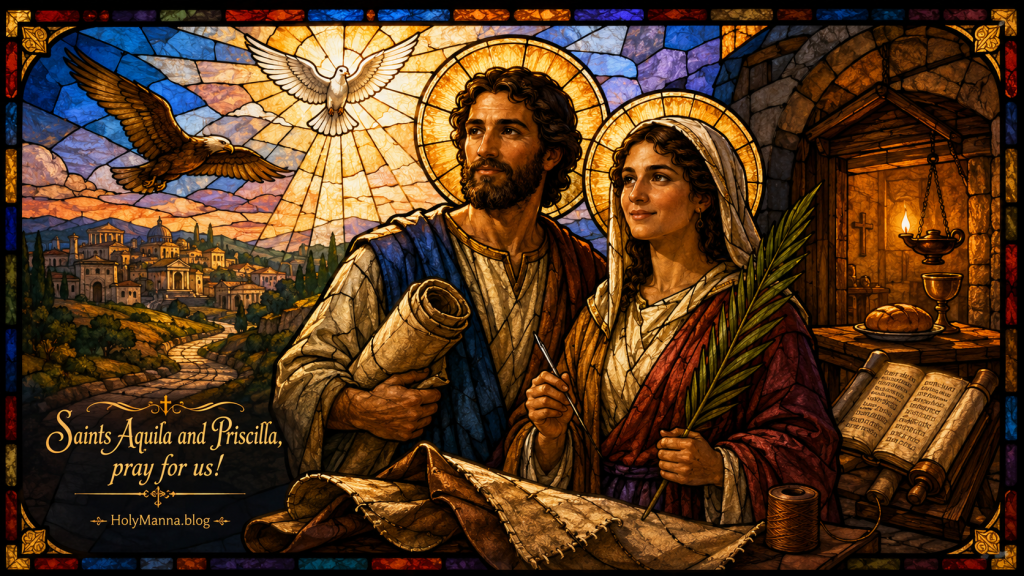
A Power Couple Who Sheltered the Early Church
Some saints preached to thousands. Some founded orders or wrote books that shaped centuries. Saints Aquila and Priscilla did something quieter and, in its own way, just as world changing. They opened their front door. This married couple, tentmakers by trade, took the ordinary raw materials of a shared life, a home, a marriage, a workshop, a dinner table, and let God turn all of it into a cradle for the infant Church. They appear six times across four books of the New Testament, in the Acts of the Apostles, the Letter to the Romans, the First Letter to the Corinthians, and the Second Letter to Timothy, and in every single mention they are named together, never apart. That detail alone tells a story. Their names are almost fused, two people so joined in faith and mission that the early Christians could hardly think of one without the other.
They were close friends and co-workers of Saint Paul, who called them “my fellow workers in Christ Jesus” (Romans 16:3). They taught the gifted young preacher Apollos, hosted the local Christians in their own house so those believers had somewhere to hear the Word of God and celebrate the Eucharist, and on at least one occasion they risked their very lives to protect Paul. Pope Benedict XVI, reflecting on this couple, honored them as “models of conjugal life responsibly committed to the service of the entire Christian community.” The Church keeps their memory every year on July 8, and she holds them up as a living picture of what a marriage can become when two people put Jesus Christ at the very center of their home.
From Pontus to Rome to a Refugee’s Road
Aquila was a Jew born in Pontus, a region of northern Anatolia along the Black Sea coast in what is now Turkey (Acts 18:2). Priscilla, most likely, was a Jewish woman of Rome. Their names are Latin, which was common among Jews living far from Jerusalem, though the couple themselves were of Hebrew origin. Somewhere along the way their paths joined, they married, and they built a life in the great capital of the Empire, working as tentmakers, the same demanding, hands on trade that Paul himself practiced. There is something beautiful in the fact that God chose to plant one of the first Christian marriages we know by name not among the powerful or the scholarly, but among ordinary working people who sewed and stitched for a living.
Their comfortable Roman life did not last. Around the year 49, the Emperor Claudius expelled the Jewish population from Rome, and Aquila and Priscilla were swept out with everyone else. The Roman historian Suetonius says the Jews were expelled because of disturbances stirred up by someone he calls “Chrestus.” Benedict XVI observed that Suetonius did not really understand what he was reporting, that he had written “Chrestus” when he meant Christ, and that the real cause was the deep division within the Jewish community over whether Jesus was the promised Messiah. In other words, the arguments about Christ had grown loud enough to reach the emperor’s ears, and Aquila and Priscilla became refugees because of the very name they would spend the rest of their lives proclaiming.
When exactly they came to full Christian faith is not certain, and honest sources admit as much. Benedict XVI reasoned that the couple had likely embraced the faith already back in the 40s, before they ever met Paul. Other Catholic sources suggest Paul himself may have brought them to Christ. On the question of their baptism the traditions actually conflict. One tradition holds that Saint Peter baptized them while they were still in Rome. Another account says that Paul baptized them later in Corinth. Neither claim is recorded in Scripture, so both are best received as pious stories about the couple rather than as established fact, and it cannot be verified which, if either, is true. What Scripture does make unmistakably clear is where their exile led them. Driven from Rome, they resettled in the bustling Greek port city of Corinth, and there, around the year 50, a traveling preacher and fellow tentmaker walked into their lives and changed everything.
The House Where the Whole Church Could Fit
That preacher was Paul. Luke tells us that Paul sought the couple out precisely because they shared his craft, and the friendship formed over needle and thread. “Because he was of the same trade he stayed with them, and they worked, for by trade they were tentmakers” (Acts 18:2-3). Picture it plainly. Three adults in a modest workshop, hands busy with canvas and leather, talking through the deepest questions a human being can ask while they earned their daily bread. The Gospel did not spread only from pulpits. It spread across workbenches, over shared meals, in the trust that grows between people who labor side by side. This is a large part of why Aquila and Priscilla matter, and why the reader would do well to remember them. They show that faith is carried not only by the famous and the ordained, but by working people who take their ordinary vocations seriously and offer them to God.
When Paul moved on toward Syria, the couple went with him and settled in Ephesus, and it was there that they gave the Church one of their finest gifts. A brilliant and eloquent Jewish preacher named Apollos arrived, powerful in his knowledge of the Scriptures yet incomplete in his grasp of the full Christian message. Rather than embarrass him in public, Aquila and Priscilla did something marked by both courage and humility. They quietly took him aside and, as Luke records, “they took him and expounded to him the way of God more accurately” (Acts 18:26). Two tentmakers gently completed the formation of a gifted orator, and Apollos went on to become one of the great evangelists of the first generation. Their willingness to teach with gentleness rather than pride is a model of the lay vocation itself. The Catechism teaches that the lay faithful share in the prophetic mission of Christ through evangelization, described as “the proclamation of Christ by word and the testimony of life” (CCC 905). Aquila and Priscilla proclaimed Christ with both.
Above all, they are remembered for turning their home into a church. Wherever they lived, whether Corinth, Ephesus, or Rome, the believers gathered under their roof to hear the Word of God and to celebrate the Sacred Mysteries. Writing from Ephesus, Paul relayed their greeting, “Aquila and Prisca, together with the church in their house, send you hearty greetings in the Lord” (1 Corinthians 16:19). The Catechism describes exactly this reality when it recalls that from the beginning whole households became believers and that these families were “islands of Christian life in an unbelieving world” (CCC 1655). Before there were cathedrals, before there were parish buildings, there were homes like this one, where a married couple simply made room. Benedict XVI drew out the wonder of it when he said that in the house of Aquila and Priscilla “the Church gathered, the convocation of Christ, which celebrates here the Sacred Mysteries.”
It is worth being honest about one thing here. Neither Scripture nor any reliable tradition records a single miracle, healing, or wonder worked by the hands of Aquila or Priscilla. There is no story of a sudden cure, no dramatic sign in the sky. Their marvel was of a different kind. It was the quiet, unglamorous, faithful labor of building up the Body of Christ, one guest, one convert, one shared Eucharist at a time. Sometimes the greatest work God does through a person cannot be captured in a miracle story at all. It is measured instead in the steady warmth of a home where Christ is always welcome.
Necks Laid Down and a Martyrs’ Crown
The life of this couple was not free of danger or cost. They knew the sting of exile, the disruption of being uprooted from Rome and forced to rebuild a livelihood in a foreign city. They knew the constant risk that shadowed anyone closely tied to Paul, whose preaching stirred up riots, arrests, and mobs wherever he went. Paul himself points to the sharpest instance of their sacrifice. He tells the Romans, “Greet Prisca and Aquila, my fellow workers in Christ Jesus, who risked their necks for my life, to whom not only I but also all the churches of the Gentiles give thanks; greet also the church in their house” (Romans 16:3-5). Benedict XVI suggested that this reference to risking their lives is probably tied to some intervention on Paul’s behalf during one of his imprisonments, perhaps during the violent troubles at Ephesus. Whatever the exact circumstances, the meaning is clear. This husband and wife put their own safety on the line so that the great apostle could keep preaching, and the whole early Church knew it and gave thanks.
Their final witness is honored by the Church, though the details come to us through tradition rather than through Scripture. The Roman Martyrology, the Church’s official book of her saints, commemorates Aquila and Priscilla as spouses and martyrs and places their death in Asia Minor. Alongside this, a separate Roman tradition holds that the couple were martyred in Rome, a belief linked to the ancient Church of St. Prisca on the Aventine Hill. The New Testament itself does not record how or where either of them died. So the honest picture is this. The Church venerates them as martyrs who gave their lives in witness to Christ, yet the place and the manner of their death are matters of tradition, and the sources do not agree. It would be wrong to dress up a dramatic death scene that the record does not support. What the Church does hold firmly is the meaning of their sacrifice, for the Catechism teaches that “Martyrdom is the supreme witness given to the truth of the faith” (CCC 2473). Whether their final witness was offered in Ephesus or in Rome, Aquila and Priscilla belong to that great company who loved Christ more than their own lives.
The Church on the Aventine and a Witness That Outlived Them
As with miracles during their lives, no verified miracles are recorded as occurring after their deaths. There are no documented accounts of healings at their tomb or wonders worked through their relics. Their legacy is written instead in stone, in Scripture, and in the ongoing life of Christian families. In Rome, on the Aventine Hill, stands the ancient Church of St. Prisca, which tradition has long identified with the very site of the couple’s house, the home where the Roman believers once gathered. Benedict XVI, however, urged a careful honesty here. He noted that later devotion gave great importance to Priscilla, “even if the problem of identifying her with the martyr Priscilla remains.” He also mentioned the nearby Catacombs of Priscilla on the Via Salaria, which carry a related name but are associated with a Priscilla whose identity scholars still debate. The threads of history and tradition are tangled here, and the honest response is simply to hold them loosely and gratefully rather than to force them into false certainty.
Several traditions gathered around Aquila in particular. He is counted among the Seventy Disciples whom the Lord sent out, and some ancient sources, including the Apostolic Constitutions, say that Paul later made him a bishop in Asia Minor, with one tradition naming the city of Heraclea. These are traditions handed down through the centuries, and they cannot be verified from Scripture or from firsthand record. In modern times a minority of scholars have even floated the idea that Priscilla was the anonymous author of the Letter to the Hebrews, a striking suggestion that remains an unproven hypothesis and is not the teaching of the Church, so it should be treated as speculation and nothing more.
What can be said with confidence is that this couple’s witness reached across the centuries and is still being drawn upon today. Their feast is kept on July 8 in the Roman calendar, while the Christian East honors them on February 13. Two recent popes have held them up before the whole Church. Benedict XVI devoted a General Audience to them in February of 2007, and Pope Francis returned to them in November of 2019, calling them, in Benedict’s own words, a couple who offered “the humus for the growth of the faith.” Their greatest monument is not a building or a relic at all. It is every Christian marriage that quietly becomes a place of prayer, welcome, and mission, which is to say it is a living monument that is still being built in kitchens and living rooms all over the world.
Making Room in Your Own Home
It is tempting to think that real holiness belongs to people with dramatic vocations, that sainthood is for the mystic in the desert or the missionary in far off lands. Aquila and Priscilla gently dismantle that assumption. They were a married couple with jobs, bills, and a business to run, and they became saints precisely inside that ordinary life, not by escaping it. The Catechism reminds every believer that the Church proposes the saints as “models and intercessors” (CCC 828), and this particular pair models something almost every reader can imitate directly. They made room in their marriage, their schedule, and their home for Jesus Christ and for His people.
Their example speaks first to the meaning of marriage itself. The Catechism teaches that in matrimony a man and a woman establish “a partnership of the whole of life” which, between the baptized, Christ has raised “to the dignity of a sacrament” (CCC 1601). Aquila and Priscilla lived that partnership as a shared mission rather than a private arrangement. Their love pointed beyond themselves, which is exactly what Paul describes when he tells husbands, “Husbands, love your wives, as Christ loved the church and gave himself up for her” (Ephesians 5:25). A marriage rooted in that self giving love naturally becomes what the Church calls the domestic church. The Catechism says that believing families are “of primary importance as centers of living, radiant faith” (CCC 1656), and that the Christian family itself “can be called a domestic church” (CCC 2204). Aquila and Priscilla show the reader that this is not a lofty ideal reserved for a select few, but a real possibility for any home where Christ is honored.
There are concrete ways to walk in their footsteps. A person can practice deliberate hospitality, opening the table and the home to those who are lonely, searching, or new to the faith, so that the house becomes a place of welcome rather than a fortress of privacy. A person can evangelize the way this couple did with Apollos, gently and without arrogance, choosing to build others up in private rather than to correct them in public. A person can sanctify ordinary work, offering the daily grind of a job to God as Aquila and Priscilla offered their tentmaking. And a person can make faith the shared center of a marriage or a household, praying together, learning together, and serving together rather than treating faith as a solitary hobby. What would it look like for your home to become a place where others encounter Christ simply by being welcomed inside? Is there someone in your life, like Apollos, whom God may be asking you to encourage quietly and patiently rather than to correct harshly? And where might the Lord be inviting you to lay down your own comfort, as this couple laid down their necks, for the good of someone else?
Engage With Us!
The story of Aquila and Priscilla is really an invitation, and their example belongs in the hands of people willing to live it. So please share your thoughts and reflections in the comments below. Tell others how this married couple speaks to your own vocation, your marriage, your friendships, or your home, because your witness may be exactly the encouragement someone else needs today.
To help you go deeper, sit prayerfully with these questions:
- When Paul praised Aquila and Priscilla as those “who risked their necks for my life” (Romans 16:3-4), what did their courage cost them, and where in your own life is God asking you to take a risk for the good of another?
- Aquila and Priscilla “expounded to him the way of God more accurately” (Acts 18:26) by teaching Apollos gently and in private. Who has God placed in your path to encourage in the faith, and how can you do so with humility rather than pride?
- Their home became a place where “the church in their house” (1 Corinthians 16:19) could gather. What is one practical change that would make your own home more welcoming to Christ and to His people?
- The Catechism calls the Christian family a “domestic church” (CCC 2204). What habit of prayer or service could you begin, alone or with your household, to help your home live up to that name?
- As a single unifying question, if your ordinary daily life, your work, your relationships, and your home, were offered fully to God the way this couple offered theirs, what is the one area you most need to surrender to Him first?
Aquila and Priscilla remind us that sanctity is not reserved for the extraordinary few. It is woven into the fabric of everyday faithfulness, into open doors and shared meals and quiet acts of courage. So go and do the same. Live your daily life with the love and the mercy that Jesus taught us, make room in your heart and your home for Him and for everyone He sends your way, and trust that God can build something eternal out of the ordinary materials of your life, just as He did with two humble tentmakers two thousand years ago.
Saints Aquila and Priscilla, pray for us!
Follow us on YouTube, TikTok, Instagram and Facebook for more insights and reflections on living a faith-filled life.


Leave a Reply