Wednesday of the Fourteenth Week in Ordinary Time – Lectionary: 385
A God Who Will Not Stop Searching
Something tender runs underneath the fire of today’s readings, and it rewards a reader who slows down to notice it. The thread that stitches all three passages together is a single, restless word, and that word is “seek.” Israel had stopped seeking the Lord, so the prophet Hosea watched a prosperous nation quietly fall apart from the inside. The more the harvest grew, the more altars went up to false gods, until the whole kingdom was one divided heart waiting to break.
To feel the weight of it, a little history helps. Hosea preached to the Northern Kingdom in the eighth century before Christ, when everything looked successful on the surface. Years earlier, after the kingdom divided, King Jeroboam had built golden calves at Bethel and Dan so his people would not travel south to worship in Jerusalem. The prophets were so disgusted that they renamed Bethel, “house of God,” as Beth-aven, “house of iniquity.” The Assyrian army was already gathering on the horizon, and Samaria would fall in the year 722 before Christ.
Into that ache the psalmist answers with an invitation rather than a scolding, urging every heart to seek the face of the Lord and to remember His wonders. Then the Gospel turns the whole thing inside out. God does not wait passively to be found. He goes hunting for the lost, calling twelve ordinary men and sending them straight toward the scattered sheep of Israel. The central message of the day is simple and life changing. The heart that seeks the Lord is found and filled with joy, while the heart that seeks idols is left standing among the ruins.
First Reading — Hosea 10:1-3, 7-8, 12
A Divided Heart Cannot Hold
This reading opens on a nation that had everything and was losing the one thing that mattered. Hosea speaks to a people rich in crops and confident in their strength, yet hollow at the center because their worship had wandered. The prophet’s genius is that he does not attack their poverty. He attacks their prosperity, showing how the very blessings that should have drawn Israel closer to God were being spent on idols instead. This is the day’s theme in its rawest form, a portrait of what happens when a people stops seeking the Lord and starts seeking substitutes.
Hosea 10:1-3, 7-8, 12 – New American Bible (Revised Edition)
Destruction of Idolatrous Cultic Objects
1 Israel is a luxuriant vine
whose fruit matches its growth.
The more abundant his fruit,
the more altars he built;
The more productive his land,
the more sacred pillars he set up.
2 Their heart is false!
Now they will pay for their guilt:
God will break down their altars
and destroy their sacred pillars.
3 For now they will say,
“We have no king!
Since we do not fear the Lord,
the king—what could he do for us?”7 Samaria and her king will disappear,
like a twig upon the waters.
8 The high places of Aven will be destroyed,
the sin of Israel;
thorns and thistles will overgrow their altars.
Then they will cry out to the mountains, “Cover us!”
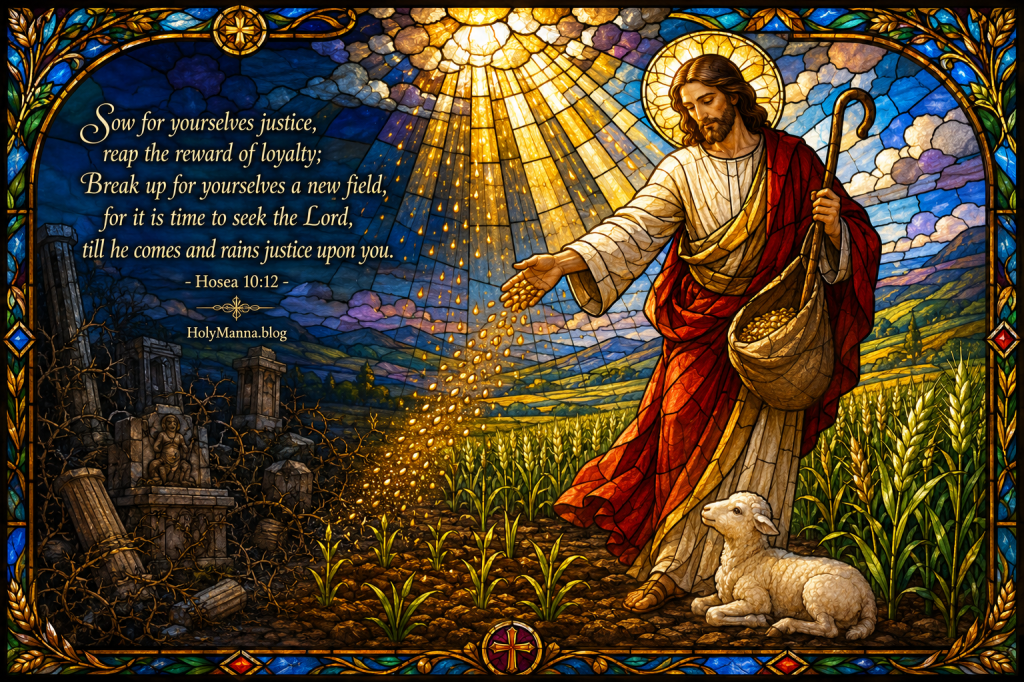
and to the hills, “Fall upon us!”12 “Sow for yourselves justice,
reap the reward of loyalty;
Break up for yourselves a new field,
for it is time to seek the Lord,
till he comes and rains justice upon you.”
Detailed Exegesis
1 Israel is a luxuriant vine whose fruit matches its growth. The more abundant his fruit, the more altars he built; the more productive his land, the more sacred pillars he set up.
The image of the vine is loving before it is critical, because Israel truly was planted and tended by God. The tragedy sits in the second half of the verse. Every increase in blessing produced an increase in idolatry, as though gratitude had been rerouted toward false gods. Abundance is never neutral, and this verse shows that comfort can grow altars to the wrong things just as easily as it can grow thanksgiving.
2 Their heart is false! Now they will pay for their guilt: God will break down their altars and destroy their sacred pillars.
The Hebrew points to a heart that is divided, split between the Lord and the idols. Scripture treats the heart as the center of the whole person, so a false heart poisons everything that flows from it. The judgment is not cruelty. It is God removing what the people had wrongly trusted, so that nothing false would remain standing between them and Him.
3 For now they will say, “We have no king! Since we do not fear the Lord, the king—what could he do for us?”
Here is the bitter fruit of abandoning God. A people who cast off the fear of the Lord end up with no true security at all, not even in their earthly rulers. When the highest loyalty is gone, every lesser loyalty crumbles, and the nation is left admitting that its own king cannot save it.
7 Samaria and her king will disappear, like a twig upon the waters.
Samaria was the proud capital of the Northern Kingdom, and the prophet reduces its king to a snapped twig swept along by a current. Human power that is not anchored in God is that fragile. What looked permanent proves weightless the moment the flood arrives.
8 The high places of Aven will be destroyed, the sin of Israel; thorns and thistles will overgrow their altars. Then they will cry out to the mountains, “Cover us!” and to the hills, “Fall upon us!”
Aven is the prophet’s mocking name for Bethel, the shrine that had become the very “sin of Israel.” The thorns and thistles recall the curse of Genesis 3, a sign that idolatry drags creation back toward chaos. The desperate cry to the mountains is striking, because the Lord Jesus places these same words on human lips as He walks toward Calvary in Luke 23:30, and Revelation 6:16 repeats them at the end of history.
12 Sow for yourselves justice, reap the reward of loyalty; break up for yourselves a new field, for it is time to seek the Lord, till he comes and rains justice upon you.
After all the warning, mercy breaks through. The farming images turn hopeful, calling the people to plant justice and to plow up hardened ground. The heart of the whole reading lands right here in the phrase “it is time to seek the Lord.” God promises to rain down justice on those who turn back to Him.
Teachings
The Church names Israel’s core failure precisely. The Catechism teaches that “Idolatry consists in divinizing what is not God. Man commits idolatry whenever he honors and reveres a creature in place of God, whether this be gods or demons… power, pleasure, race, ancestors, the state, money, etc.” in CCC 2113. That list makes Hosea uncomfortably current, since the modern altars are rarely carved from wood. The remedy is also spelled out, for CCC 2114 teaches that “Human life finds its unity in the adoration of the one God. The commandment to worship the Lord alone integrates man and saves him from an endless disintegration.” A divided heart disintegrates, exactly as Samaria did.
The call to “sow for yourselves justice” connects to the virtue the Church holds dear. According to CCC 1807, “Justice is the moral virtue that consists in the constant and firm will to give their due to God and neighbor. Justice toward God is called the ‘virtue of religion.’” To seek the Lord and to practice justice are therefore two sides of one conversion.
Reflection
The honest question this reading asks is not whether a person has idols, but which ones. Prosperity, reputation, control, and comfort can each become a golden calf that quietly collects a person’s best energy. One concrete step is to name a single false altar and starve it this week, redirecting the time or money it consumes toward prayer, almsgiving, or an act of justice for a neighbor in need. Another step is to “break up new field” by returning to a spiritual practice that has grown hard and neglected, whether that is Confession, Scripture, or the Rosary. Where has abundance made your heart lazy rather than grateful? What one altar is God gently asking you to let fall so that He can rain justice on the soil underneath?
Responsorial Psalm — Psalm 105:2-7
Remember, Rejoice, and Seek His Face
If Hosea shows the ruin of a people who stopped seeking God, this psalm shows the joy of a people who start again. Psalm 105 is a great hymn of memory, walking Israel back through the wonders God worked for their ancestors. The verses chosen for today lift out the response that remembering should produce, which is praise, joy, and a steady seeking of the Lord’s face. This is the day’s theme sung in a major key, turning the command to seek into an invitation to rejoice.
Psalm 105:2-7 – New American Bible (Revised Edition)
2 Sing praise to him, play music;
proclaim all his wondrous deeds!
3 Glory in his holy name;
let hearts that seek the Lord rejoice!
4 Seek out the Lord and his might;
constantly seek his face.
5 Recall the wondrous deeds he has done,
his wonders and words of judgment,
6 You descendants of Abraham his servant,
offspring of Jacob the chosen one!7 He the Lord, is our God
whose judgments reach through all the earth.
Detailed Exegesis
2 Sing praise to him, play music; proclaim all his wondrous deeds!
Worship here is active and even loud, involving song, instruments, and public proclamation. Faith that remembers God’s goodness cannot stay silent, because gratitude naturally overflows into praise that others can hear.
3 Glory in his holy name; let hearts that seek the Lord rejoice!
To glory in the holy name means to find one’s whole boast and identity in God rather than in self. The second line is the emotional center of the psalm, promising that seeking the Lord is a path to joy and not to dread.
4 Seek out the Lord and his might; constantly seek his face.
The word “seek” appears twice for emphasis, and the call to seek “constantly” makes clear this is a lifelong pursuit rather than a single moment. To seek God’s face is to long for personal closeness with Him, not merely His gifts or His help.
5 Recall the wondrous deeds he has done, his wonders and words of judgment,
Biblical remembering is never idle nostalgia. It is an act of faith that makes past mercy present, strengthening trust that the God who acted before will act again. Even His “words of judgment” are counted among the wonders, because His justice is part of His faithfulness.
6 You descendants of Abraham his servant, offspring of Jacob the chosen one!
The psalmist grounds the whole summons in the covenant, addressing the listeners as heirs of Abraham and Jacob. Identity comes before activity, since they seek the Lord precisely because they already belong to Him.
7 He the Lord, is our God whose judgments reach through all the earth.
The horizon suddenly widens. The God of one chosen family is in fact the Lord of all the earth, whose justice extends everywhere. This universal reach quietly prepares the way for the Gospel, where the mission that begins with Israel is destined to touch the whole world.
Teachings
This psalm sits so close to the heart of the Christian life that the Church opens her entire Catechism near it. In CCC 30 she takes up the very words of this psalm, teaching that “‘Let the hearts of those who seek the LORD rejoice.’ Although man can forget God or reject him, He never ceases to call every man to seek him, so as to find life and happiness.” The seeking described here is not the anxious searching of someone chasing a hidden God. It is the response of a heart that has already been sought first. St. Augustine gave this longing its most famous voice when he wrote that the human heart was made for God and remains restless until it rests in Him, a line the Catechism also treasures. Israel forgot the wonders in Hosea’s day, and forgetting was the first step toward idolatry. The cure the psalm prescribes is deliberate remembrance that keeps the heart soft, grateful, and aimed at the face of God.
Reflection
Seeking the Lord “constantly” sounds daunting until it is broken into small, repeatable acts. One practical habit is to begin each day by recalling a single concrete mercy God has already shown, which trains the memory the psalm calls for. Another is to turn ordinary music, chores, or a commute into quiet praise, so that seeking His face becomes woven into the day rather than crammed into a spare moment. Joy is meant to be the fruit, so a person who feels only duty in prayer might ask the Lord for the rejoicing this psalm promises. When you seek God, are you seeking His face or only His hands? What wonder from your own life have you stopped remembering, and how might recalling it renew your joy today?
Holy Gospel — Matthew 10:1-7
The Search Party Has a Name
Everything in today’s Mass has been building toward this moment. Hosea showed a people lost in idolatry, and the psalm called hearts to seek the Lord, and now the Gospel reveals the astonishing truth that God is the one doing the seeking. Jesus gathers twelve ordinary men, shares His own power with them, and sends them straight toward the lost. The scene is deliberately shaped like the birth of a new Israel, with twelve apostles standing in for the twelve tribes. The God who seemed to be waiting to be found has organized a search party, and He has written down every member’s name.
Matthew 10:1-7 – New American Bible (Revised Edition)
The Mission of the Twelve. 1 Then he summoned his twelve disciples and gave them authority over unclean spirits to drive them out and to cure every disease and every illness. 2 The names of the twelve apostles are these: first, Simon called Peter, and his brother Andrew; James, the son of Zebedee, and his brother John; 3 Philip and Bartholomew, Thomas and Matthew the tax collector; James, the son of Alphaeus, and Thaddeus; 4 Simon the Cananean, and Judas Iscariot who betrayed him.
The Commissioning of the Twelve. 5 Jesus sent out these twelve after instructing them thus, “Do not go into pagan territory or enter a Samaritan town. 6 Go rather to the lost sheep of the house of Israel. 7 As you go, make this proclamation: ‘The kingdom of heaven is at hand.’
Detailed Exegesis
1 Then he summoned his twelve disciples and gave them authority over unclean spirits to drive them out and to cure every disease and every illness.
Jesus does not send the Twelve out empty. He shares His own authority with them, the same power He had been using over demons and sickness throughout the Gospel. This is the pattern of the whole Church, where the mission always flows from Christ and never from human ambition.
2 The names of the twelve apostles are these: first, Simon called Peter, and his brother Andrew; James, the son of Zebedee, and his brother John;
The list is careful and personal, and Peter is placed “first” every time the apostles are named. Simon, Andrew, James, and John were fishermen, not scholars or nobles, which underlines that God builds His kingdom on people the world would overlook.
3 Philip and Bartholomew, Thomas and Matthew the tax collector; James, the son of Alphaeus, and Thaddeus;
One detail glows with humility. Matthew, the author of this Gospel, labels himself “the tax collector,” naming the despised profession Jesus lifted him out of. He hides none of his past, letting his own name preach the mercy that found him.
4 Simon the Cananean, and Judas Iscariot who betrayed him.
The list holds together a zealot and a future traitor, which shows how wide the Lord’s call reaches. That Judas is included, with his betrayal named plainly, is a sober reminder that being chosen is not the same as staying faithful.
5 Jesus sent out these twelve after instructing them thus, “Do not go into pagan territory or enter a Samaritan town.”
This restriction can sound strange until it is read in order. Jesus follows a deliberate plan, gathering the scattered children of Israel first before the mission opens to all nations after the Resurrection. It fulfills the psalm’s hint that God’s justice, though it reaches all the earth, unfolds in His own wise sequence.
6 Go rather to the lost sheep of the house of Israel.
Here the whole day comes to a point. Israel had wandered like sheep without a shepherd, exactly the condition Hosea described, and Jesus refuses to abandon them. The Good Shepherd sends His apostles to seek precisely the ones who are most lost.
7 As you go, make this proclamation: “The kingdom of heaven is at hand.”
The message is urgent and joyful. The reign of God has drawn near in the person of Jesus Himself, and the only fitting response is repentance and faith. The seeking of the whole Mass is answered in this announcement that God has come close.
Teachings
The Church treasures this scene as the very foundation of her structure. According to CCC 551, “From the beginning of his public life Jesus chose certain men, twelve in number, to be with him and to participate in his mission.” This choice is the reason the mission continues to this day, for CCC 858 teaches that “Jesus is the Father’s Emissary,” and that the apostles are sent to carry on His own work. The whole enterprise begins in God, since CCC 2 opens the Catechism by teaching that “So that this call should resound throughout the world, Christ sent forth the apostles he had chosen, commissioning them to proclaim the gospel.”
The Church Fathers loved this passage. St. John Chrysostom noticed the humility hidden in Matthew’s self-description, writing in his first homily on this Gospel of “Matthew the Publican, for I am not ashamed to name him by his trade.” In his thirty-second homily, Chrysostom marveled that Christ made the apostles shine “even before the signs, by their own virtue,” stripping them of possessions so their holiness alone would convince the world. Origen, reading the number twelve, saw the tribes of Israel gathered up and pointed outward toward a mission meant in the end for every nation.
Reflection
Two truths from this Gospel are meant to change ordinary days. First, God seeks the lost, which means no one is ever too far gone to be pursued, and the person reading this may well be the sheep He is chasing right now. Second, God seeks the lost through people, ordinary and flawed ones like a tax collector and a few fishermen. A concrete way to live this is to identify one “lost sheep” in one’s own circle, perhaps a friend who has drifted from the faith, and to seek them out this week with a call, a meal, or honest prayer. Another is to receive Christ’s authority through the sacraments before trying to give anything away, since mission flows from Him. Who is the lost sheep God is nudging you to go find? And if Jesus wrote down twelve unlikely names then, why would He hesitate to write down yours now?
The Kingdom Is Already Near
Step back and look at the whole sweep of today’s Mass, because it tells one seamless story. Hosea stood in a crumbling kingdom and watched a people discover that idols cannot save, that a divided heart cannot hold, and that broken altars are what remain when the fear of the Lord is thrown away. Yet even there, mercy whispered that it was still time to seek the Lord and to sow justice in fresh soil. The psalmist picked up that whisper and turned it into song, promising that the heart which seeks God’s face does not find dread but deep and lasting joy. Then the Gospel revealed the secret hiding underneath both, which is that the God being sought is already out searching, calling twelve unremarkable men by name and sending them toward the very sheep who had wandered farthest.
The invitation for today is warm and personal. Every reader carries a few altars that need to fall and a heart that grows forgetful, and every reader is also, at this very moment, being sought by a Shepherd who refuses to give up. The kingdom of heaven is not a distant reward for the flawless. It is a nearness that has already arrived in Christ and now stands at hand. The right response is the oldest one in Scripture, which is to turn around, seek His face, and let the joy begin. Go find your own lost sheep this week, and remember that the search party has your name on the roster too.
Engage With Us!
The comments below are the perfect place to keep this conversation going, so share the reflection that struck you most and let the community be encouraged by your voice.
- In Hosea 10:1-3, 7-8, 12, the prophet shows how abundance multiplied altars to false gods. What blessing in your own life has quietly become an idol, and what would it look like to let that altar fall?
- In Psalm 105:2-7, the psalmist calls hearts to seek the Lord’s face constantly and rejoice. Are you seeking God’s face or only His gifts, and what wonder from your past might reignite your joy?
- In Matthew 10:1-7, Jesus sends the Twelve to the lost sheep of the house of Israel. Who is the one lost sheep God is asking you to go and seek this week?
- Holding all three readings together, the day pleads that it is time to seek the Lord because He is already seeking you. Where in your life is God pursuing you right now, and what is keeping you from turning to meet Him?
However you answer, remember that a life of faith is not built on flawless days but on a heart that keeps turning back and keeps seeking. Do everything, even the small and hidden things, with the love and mercy that Jesus taught, and trust that the Shepherd who called twelve unlikely names is calling yours with the very same tenderness today.
Sacred Heart of Jesus, we trust in You!
Immaculate Heart of Mary, pray for us!
Saint Michael the Archangel, defend us in battle!
Follow us on YouTube, TikTok, Instagram and Facebook for more insights and reflections on living a faith-filled life.

 Holy Manna!
Leave a comment