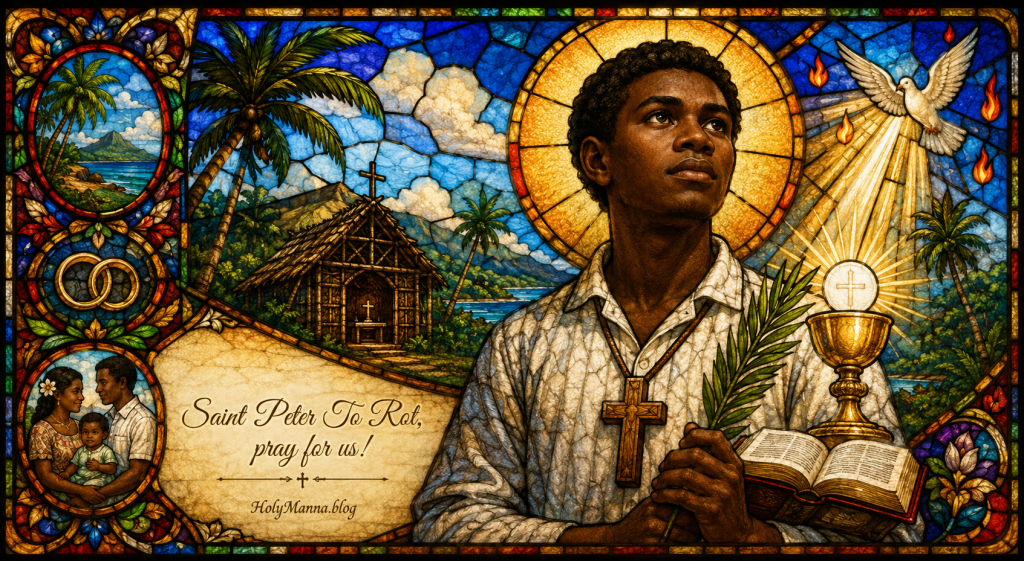
The Catechist Who Would Not Stop
Every so often the Church lifts up a saint who looks less like a stained glass window and more like the person sitting next to you at Mass. Saint Peter To Rot is exactly that kind of saint. He was not a priest, not a bishop, and not a member of a religious order. He was a married man, a father of three, and a village catechist from a small island in the Pacific who kept the faith of his people alive when the priests were dragged away and prayer itself was outlawed. He carried a Bible on his person, wore a catechist’s cross on his chest, and walked for hours through the bush to bring Holy Communion to families who had no other way to receive the Lord.
On 19 October 2025, on World Mission Sunday, Pope Leo XIV canonized him in Saint Peter’s Square, and Papua New Guinea received its very first saint. Because he gave his life defending marriage and the family and refusing to deny his faith, the Church honors him as a patron of married couples and of catechists, and he is especially venerated in his home village of Rakunai. He was also named a patron of World Youth Day 2008 in Sydney, which means that an entire generation of young Catholics has already been entrusted to his prayers. Pope Francis, who longed to raise him to the altars, once called him something that should stop every reader in their tracks, describing him as “the kind of saint the Church needs today.”
A Chief’s Son Raised in a Brand New Faith
Peter To Rot was born on 5 March 1912 in Rakunai, a village on the island of New Britain, in what was then German New Guinea. His father, Angelo To Puia, was a respected chief, and his mother was Maria Ia Tumul. What makes the family remarkable is how young their Catholic faith was. Peter’s parents were among the very first people in that region to be baptized, having received the faith from the Missionaries of the Sacred Heart around 1898. In other words, Peter belonged to the first generation of his people to be born into a Catholic home. The seed of the Gospel had only just been planted in that soil, and Peter would grow up to water it with his blood.
His father took his son’s formation seriously. He taught the boy the basics of the catechism at home and, in 1919, sent him to the local mission school even though schooling was not required at the time. The stories that survive paint a picture of a good and generous child rather than a troublemaker. He was agile enough to scramble up coconut trees, and he happily did so to bring coconuts down for the older villagers who could no longer climb. He was honest, and he was quick to help anyone in need.
When Peter was around eighteen, the parish priest of Rakunai, Father Laufer, saw something in him and asked his father whether the young man might study for the priesthood. His father judged that the time was not yet right for that, but he gladly agreed that Peter should train as a catechist. So Peter went off to Saint Paul’s College of the Missionaries of the Sacred Heart at Taliligap, finished his studies in 1933, and returned home commissioned as a catechist, with a catechist’s cross given to him by the bishop. He assisted Father Laufer, organized his classes with real skill, and became known as an excellent teacher.
Anyone tempted to think a catechist is a minor helper should hear how the Church describes the role. A catechist softens the soil where the seed of faith will be planted, prepares the way, and knows his own people, their language, and their way of thinking in a way no foreign missionary can. The Church teaches that “Catechesis is an education in the faith of children, young people, and adults which includes especially the teaching of Christian doctrine imparted, generally speaking, in an organic and systematic way, with a view to initiating the hearers into the fullness of Christian life” (CCC 5). Peter To Rot lived that vocation to its very limit.
In 1936, on 11 November, Peter married Paula Ia Varpit in the Catholic church, and the couple began a family. They would have three children, though the family knew deep sorrow. One child died in infancy, another died shortly after the war ended, and the third was born only after Peter’s death and lived to a great old age. Peter’s love for his wife and children, and his defense of the bond that held families together, would become the very thing his persecutors could not tolerate.
The Man Who Carried a Bible and a Cross
It is important to be honest about the shape of this saint’s holiness. There are no stories of Peter To Rot working wonders during his lifetime, no accounts of him healing the sick with a touch or multiplying food. His greatness was of a quieter and, in some ways, more demanding kind. He was holy in the way that most Christians are actually called to be holy, which is in the faithful carrying out of ordinary duties with extraordinary love.
His days were filled with teaching the faith, preparing couples for marriage, instructing children, praying with his people, caring for the sick, and looking after the poor. At the center of everything was the Eucharist. Those who knew him testified that he had loved Jesus in the Blessed Sacrament since he was a child, and that even under the threat of death he risked everything to carry Holy Communion to isolated families. This is the beating heart of his story, because the Church teaches that the Eucharist is “the source and summit of the Christian life” (CCC 1324), and that in it “the body and blood, together with the soul and divinity, of our Lord Jesus Christ and, therefore, the whole Christ is truly, really, and substantially contained” (CCC 1374). Peter believed that with his whole life, and he was willing to walk for five or six hours to make sure the Lord truly present in the Eucharist reached those who hungered for Him.
This is why the reader should remember him and want to imitate him. Peter To Rot proves that a person does not need a pulpit or a habit to become a saint. He shows that a husband changing the course of his day to visit the sick, a father teaching his children to pray, and a layman refusing to keep quiet about the truth can be the very holiness God is looking for. The Church says as much when it teaches that “All Christians in any state or walk of life are called to the fullness of Christian life and to the perfection of charity” (CCC 2013), and that lay people are called to sanctify the world from within, offering their ordinary work and daily lives to God (CCC 901). Saint John Paul II, at the beatification, described him with tender simplicity, saying that “he was a devoted husband, a loving father, and a dedicated catechist known for his kindness, gentleness, and compassion. Daily Mass and Holy Communion, and frequent visits to Our Lord in the Blessed Sacrament sustained him”.
A Death Disguised as Medicine
In March 1942, during the Second World War, Japanese forces occupied the territory and forced out the Australian garrison. At first the occupiers interned the foreign missionaries but did not forbid religious practice outright. When Rakunai’s priest was taken away, he turned to Peter and, according to accounts that have come down through the community, told him to “help them, so that they don’t forget about God.” Peter accepted the charge of the whole parish and threw himself into caring for the sick and the poor while continuing to teach the faith.
The situation grew darker toward the end of 1943, when local authorities began restricting religious services, and within a few months they forbade them completely. Peter refused to let the faith die. When the church building was destroyed, he built a hidden chapel of branches and leaves outside the village, a place often called a bush church, and there he continued to pray with the people, to baptize, and to keep careful records of baptisms and weddings. He knew the danger and he accepted it.
The final collision came over marriage. In order to win favor with certain influential men and to pull the people back toward their pre Christian customs, the Japanese authorities encouraged the return of polygamy. Peter To Rot stood against it without flinching, because he understood that the practice was contrary to the Gospel. The Church teaches that Christ restored marriage to its original beauty as a faithful and exclusive union, insisting that “what therefore God has joined together, let no man put asunder” (Mk 10:9), and it states plainly that “polygamy is contrary to conjugal love which is undivided and exclusive” (CCC 1645), naming it among the offenses against the dignity of marriage (CCC 2387). When a Christian policeman working for the occupiers tried to seize a married woman as a second wife, Peter and the woman’s father intervened and had her returned to her husband. That act of courage marked him for destruction.
Spies were paid to watch him, and eventually a couple reported him to the authorities. When the police searched his home and found religious objects, they arrested him. By one account he was seized around Christmas of 1944 while he was planting vegetables that he had intended to give to the Japanese as an act of charity, a detail that captures the man perfectly, since even toward his persecutors his instinct was generosity. Dragged before the chief of police, he was asked whether he had been preaching. He answered yes. For that honesty he was struck across the face and the back of the neck and thrown into prison. Two Christian leaders tried to have him freed and failed. Peter confided to his mother that he knew he would die, and he assured her that he was more than ready to die for Jesus Christ.
He was held first in a cramped, windowless cell and then sentenced to a period of confinement in a camp. His wife came to visit with their children and begged him to give up being a catechist so that he could be safe. He would not do it. Speaking about his imprisonment, he explained without a trace of self pity, “I am in prison for those who break their marriage vows and for those who do not want to see God’s work go forward. That is all. I must die. I have already been condemned to death.” On the day of his death he was clear eyed about what was coming. He told his mother, “The police told me that, this evening, a Japanese doctor will come to give me some medicine. This is surprising since I’m not sick. I suspect this is a trick.” He asked his wife to bring him his cross and his best clothes, so that he could meet God properly dressed. The night before, when Paula pleaded with him to think of their children, he answered with the words that now define him, “this is not my work, but God’s work. I cannot deny my faith.”
The end came as he had foreseen. A doctor came into the prison and injected him, then gave him something to drink. When the poison worked too slowly, the guards forced him down while his mouth was covered so that he could not expel it. As he convulsed, they held him and struck the back of his neck. Afterward a policeman went to Rakunai and announced coldly, “Your catechist is dead.” When the village chief demanded to know what had been done, the officer lied and said, “He fell ill and died.” Peter’s uncle went with the commander to collect the body and found it still warm, curled up with cotton stuffed in the ears and nose, blood and a red scarf around the neck, the neck swollen and wounded, and a needle mark on the arm. The Church has recognized what the evidence made plain. Peter To Rot was killed in odium fidei, in hatred of the faith, and so he is a true martyr, for as the Catechism teaches, “Martyrdom is the supreme witness given to the truth of the faith: it means bearing witness even unto death” (CCC 2473). His murder was disguised as medicine, but the Church saw it for the crown it truly was.
Because the occupiers destroyed so many church records, some exact dates in his life cannot be established with certainty, and the Church has affixed his feast to 7 July 1945, the traditional date of his death. Sources also differ on small details, such as his age at death and the number of his brothers and sisters, and where they disagree it is honest to say so rather than to pretend to a precision the records do not allow.
From a Silent Grave to Saint Peter’s Square
Peter To Rot was buried at Rakunai with the honors due a chief, laid to rest in the Catholic cemetery. Yet even his funeral had to be held in silence, out of fear of the soldiers who still held the island. It was a hidden ending for a hidden ministry. What no one could bury was the memory of his witness, which spread quietly through the community and then across the whole Pacific.
Reports of favors and healings obtained through his intercession have long circulated among the people of Papua New Guinea. The vice-postulator of his cause has been candid that these stories were carried mostly by word of mouth in an oral culture, so that people remembered extraordinary healings but often forgot the year or the details, which made them difficult to document with the precision the Church requires. In fairness to the reader, then, these particular accounts of post death miracles are best received as the living memory and devotion of his people rather than as individually verified events, and it is honest to say that they have not been documented with confirmable specifics. The Communion of Saints, however, remains a truth of the faith regardless of which stories can be catalogued, for the Church teaches that the saints in heaven “do not cease to intercede with the Father for us” and that their intercession is their most exalted service to God’s plan (CCC 2683, CCC 956).
His cause moved through the proper stages over many years. Saint John Paul II beatified him on 17 January 1995 in Port Moresby, during an apostolic visit, calling him the first Blessed of Papua New Guinea and holding him up especially to catechists and to families. Pope Benedict XVI, in 2012, encouraged married couples everywhere to look to Peter’s example of courage and marked the centenary of his birth. Pope Francis carried a deep affection for him, and when the Holy Father visited Papua New Guinea in 2024 he recalled Peter’s witness to love, saying that “Blessed Peter To Rot, spouse, father, catechist, and martyr of this land gave witness to love by word and example. He gave his life precisely to defend the unity of the family in the face of those who wanted to undermine its foundations.” Pope Francis signed the decree opening the path to canonization in March 2025, and Pope Leo XIV set the date and carried it to completion, canonizing Peter To Rot on 19 October 2025.
The details of that day speak volumes. Relics of the saint, two of his fingers, were presented at the ceremony, with one to remain in Rome and the other to return home to a shrine at Rakunai, where the Church honors the veneration of the relics of saints as a legitimate expression of popular piety (CCC 1674). At Rakunai his remains rest in a simple shrine, kept in a wooden box in a quiet and peaceful place, where children from a nearby school slip in during their breaks to pray. The timing carried a national weight as well, since Papua New Guinea marked fifty years of independence in 2025, and church and civic leaders alike received their first saint as a gift to the whole nation. The Archbishop of Rabaul, who is himself descended from Peter’s own family, put it beautifully when he said the saint is not a hero of the past but a guide for the present, calling his people to integrity in leadership, honesty in society, and responsibility in family life.
Holiness in an Ordinary Life
It would be easy to admire Peter To Rot from a safe distance and then set him back on the shelf with the other heroes. He deserves better than admiration, because he is meant to be imitated. His whole life is a quiet argument against the lie that holiness belongs only to priests and nuns, or to people in some other, holier century. He was a working layman with a wife, children, bills of his own kind, and neighbors who did not always make life easy, and he became a saint precisely inside that ordinary life rather than by escaping it.
For the reader who is married, Peter offers a model of fidelity that cost him everything. He did not merely believe in marriage as an idea; he defended a real woman’s marriage at the risk of his life, and he refused every convenient compromise. Where in your own marriage or friendships are you being asked to defend the truth quietly, even when it would be easier to look away? For the reader who teaches, parents, mentors, or simply passes the faith to anyone younger, Peter is the patron of exactly that work. He shows that catechesis is not a hobby but a mission that can demand real courage. Who has God placed in your life who is depending on you not to let them forget about God?
There is also his relationship with the Eucharist, which was the engine of everything else. Peter walked for hours to bring Communion to others because he was already in love with the Lord he carried. A reader who wants to grow in his courage should probably begin where Peter began, which is on his knees before the Blessed Sacrament. When was the last time you let yourself simply sit with Jesus truly present in the Eucharist, without rushing off to the next thing? And there is his final freedom, the freedom of a man who could say, without drama, that he could not deny his faith. Most people will never face a lethal injection for the Gospel, but everyone faces smaller versions of that choice, the moment when honesty is costly and silence is comfortable. Peter’s answer can become the reader’s answer. Compassion, resilience, and faith were not abstractions for him. They were the way he treated the sick, the way he endured prison, and the way he faced death dressed in his best clothes with his cross in hand.
Engage With Us!
The community here at HolyManna.blog would love to hear from you, so please share your thoughts, your questions, and your own reflections in the comments below. Saint Peter To Rot lived his faith out loud in the hardest of circumstances, and talking honestly about how his witness lands in your own life is one small way to keep his flame burning. Take a few minutes with the questions below, and let them lead you somewhere real.
- Peter To Rot became a saint inside an ordinary lay life of work, marriage, and parenting. What is one ordinary part of your daily life that God might be asking you to offer to Him as a path to holiness?
- The Eucharist was the source and summit of Peter’s whole life, as the Church teaches in CCC 1324. How might a deeper devotion to Jesus in the Blessed Sacrament change the way you live your week?
- Peter defended the truth about marriage even when it endangered him. Where are you being invited to stand for the truth gently but firmly, and what makes that difficult right now?
- A priest once told Peter to help the people so that they would not forget about God. Who in your life is quietly depending on you to keep pointing them toward the Lord?
- On the night before he died, Peter told his wife that this was God’s work and that he could not deny his faith. What would it look like for you to trust that your own good efforts are ultimately God’s work and not only your own?
- Peter To Rot shows that catechists, husbands, wives, and parents can all be saints. As you look at his life as a whole, what single virtue of his do you most want to ask him to help you grow in this month?
Saint Peter To Rot did everything, even facing his executioners, with the love and mercy that Jesus taught us, and he proved that such love is not reserved for the extraordinary few. May his courage steady you, may his tenderness soften you, and may his fidelity draw you closer to the Eucharistic Lord he adored. Go and live your faith boldly and gently, right where you are, and do it all for love.
Saint Peter To Rot, pray for us!
Follow us on YouTube, TikTok, Instagram and Facebook for more insights and reflections on living a faith-filled life.


Leave a Reply