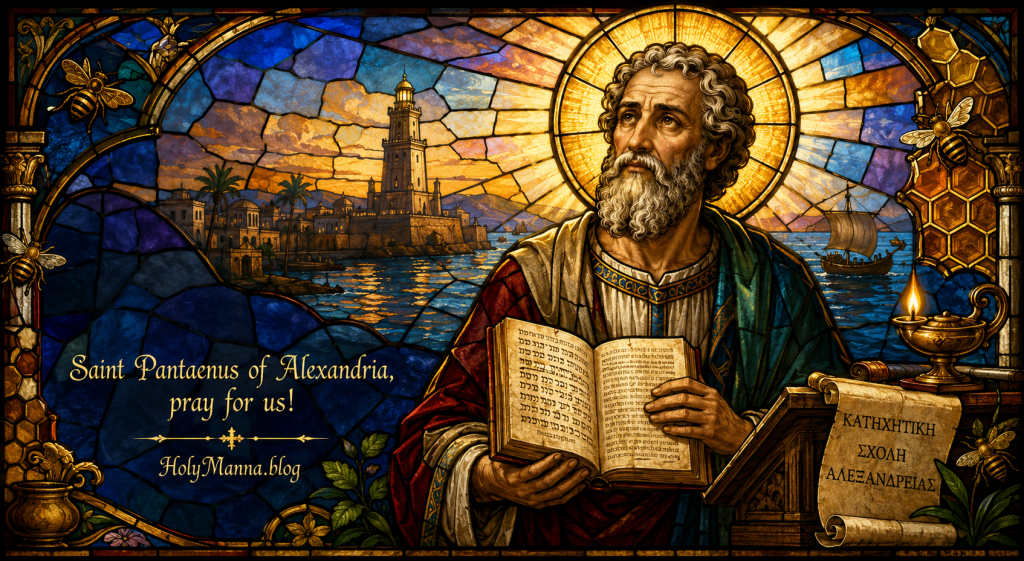
A Pagan Philosopher Became a Missionary of the Word
Some saints are remembered for the drama of their deaths. Others are remembered for the quiet, steady fire of a life spent handing on the truth. Saint Pantaenus of Alexandria belongs firmly to the second group, and the Church has not forgotten him for eighteen centuries. He lived in the second century, at a moment when the Christian faith was still young, still suspicious to the Roman world, and still working out how to speak to the brilliant pagan minds all around it. Into that moment stepped a former Stoic philosopher who had gone looking for wisdom and found instead the Person who is Wisdom himself.
Pantaenus is best known as the head of the Catechetical School of Alexandria, the earliest Christian school of its kind in the world. He was the man who taught Clement of Alexandria, who in turn helped form the intellectual soil that later produced Origen and the whole Alexandrian tradition of reading Scripture. He is also remembered as a missionary who is said to have carried the Gospel far to the East. He is venerated as a Father of the Church, and his feast is kept in the Western martyrologies on the seventh of July.
What makes his story so encouraging is that the desire that first moved him is the same desire buried in every human heart. The Catechism teaches that the longing for God is not an accident or a phase. It puts it plainly, that the desire for God is written into human nature, because man is created by God and for God, and God never ceases to draw man to himself (CCC 27). Pantaenus felt that pull while he was still a pagan, and he had the courage to follow it all the way home. His whole life afterward became an act of catechesis, that patient education in the faith which the Church describes as an initiation of hearers into the fullness of Christian life (CCC 5).
From the Painted Porch to the Feet of the Apostles’ Disciples
According to the tradition that comes down through his own most famous student, Pantaenus was a native of Sicily. Because so little of his early life was written down, historians flag some uncertainty about his origins, and a few ancient accounts suggest other homelands. The strongest tradition, however, is Sicilian, and it comes from a source close to him, so that is the account most Catholic writers have followed.
By profession he was a Stoic philosopher, a man of the Painted Porch, trained in the demanding school of thought that prized reason, virtue, self mastery, and the search for a rational order behind all things. This matters, because Pantaenus did not stumble into Christianity out of ignorance. He came to it as a serious thinker who had already given his life to the pursuit of truth. That background is a beautiful illustration of a conviction the Church holds with confidence, that God can truly be reached by the honest use of the mind. The Catechism states that the Church holds and teaches “that God, the first principle and last end of all things, can be known with certainty from the created world by the natural light of human reason” (CCC 36). Pantaenus had followed that natural light as far as it could carry him. He was ready for the light of revelation that natural reason cannot supply on its own.
Butler’s Lives of the Saints preserves how the change came about. Pantaenus, it says, was led toward the Christians by his esteem for virtue, and once he came to know them, he was charmed by the innocence and holiness of their way of life, so that he opened his eyes to the truth. There is something quietly powerful in that detail. It was not first a clever argument that won him over. It was the visible goodness of ordinary believers, the way they lived, the way they treated one another, the peace they carried. Their lives were the first sermon he ever heard, and it converted a philosopher.
After his conversion he did not consider his education finished. He studied the Holy Scriptures under the disciples of the apostles, apprenticing himself to the living memory of the Church. His hunger for sacred learning eventually drew him to Alexandria, the intellectual capital of the ancient Mediterranean world, where the followers of Saint Mark had established a school of Christian doctrine. Butler notes that Pantaenus did not go there to show off his gifts in that great marketplace of learning; his humility actually led him to try to hide his talents. They were discovered anyway, as such things usually are, and he was drawn out of the obscurity he had sought.
His pupil Clement gave him a title that has stuck to him ever since. Clement called his teacher “the Sicilian Bee,” an image of a soul that flew from flower to flower across the whole meadow of Scripture and tradition and returned laden with sweetness for others. It is one of the few things said about Pantaenus in his own century that can be verified, and it captures him perfectly. He was a gatherer and a giver, a man who collected the honey of divine truth so that others could be fed.
A Mind Set on Fire, and a School Set Ablaze
Sometime before the year 179, Pantaenus was placed at the head of the Catechetical School of Alexandria, and this is where his lasting greatness lies. Under his direction the school became something the ancient world had never quite seen, a place where the Christian faith was taught with the same rigor, depth, and intellectual seriousness that the great philosophical schools claimed for themselves. Butler records that by his learning and his gift for teaching he raised the school’s reputation above the schools of the philosophers, and that his lessons, drawn from the words of the prophets and the apostles, carried real light into the minds of everyone who heard him. Clement described that same teaching as a gathering of “the flowers of the prophetic and apostolic meadow,” a harvest of wisdom deposited in the souls of his hearers.
Why should a Catholic today remember him and want to imitate him? Because Pantaenus modeled something the Church still desperately needs. He refused to treat faith and reason as enemies. As a converted philosopher, he took everything true and good in Greek thought and pressed it into the service of the Gospel, using it as a tool rather than a rival. This was, in a sense, his great contribution to Christian history, the deliberate and confident use of philosophy as a servant of theology, a method his student Clement would refine and his successors would carry further. The Church has made this same conviction her own. She teaches that “methodical research in all branches of knowledge, provided it is carried out in a truly scientific manner and does not override moral laws, can never conflict with the faith, because the things of the world and the things of faith derive from the same God” (CCC 159). Pantaenus lived that truth long before it was written down in those words. He believed that every real truth belongs to God, so a Christian has nothing to fear from an honest question.
Here an honest word is needed, because this blog does not embellish. No miracles are recorded of Pantaenus during his lifetime. The Catholic sources describe no healings worked by his hands and no wonders performed at his word. His greatness was not the greatness of the miracle worker. It was the greatness of the teacher, the scholar, and the faithful servant of the Church, and that kind of greatness is no less holy. His true marvel was the school he shaped and the students he formed. Chief among them was Clement of Alexandria, who succeeded him as head of the school and whose writings still nourish the Church. Through that school and its tradition, Alexandria became one of the two great centers of biblical interpretation in the ancient world, and the ripples of Pantaenus’s work reached far beyond anything he could have seen in his own lifetime. A single faithful teacher, it turns out, can set centuries on fire.
The Long Road to India and the Cost of Carrying Christ
Pantaenus lived in dangerous times for a Christian. The second century was an age of intermittent and often brutal persecution, when confessing Christ could cost a person everything, and the great persecution under the emperor Septimius Severus would fall hard on Alexandria in the years that followed. To hold a public position as a Christian teacher in that world was itself a quiet act of courage, a daily willingness to be known as a follower of a forbidden faith.
There is a famous account of his greatest journey, and it should be told for what it is, a tradition preserved by Eusebius rather than a fully documented episode. The story goes that Indian merchants trading at Alexandria begged Pantaenus to come and preach in their homeland, and that he left his beloved school and set out as a missionary to the East. According to Eusebius, he found that seeds of the faith had already been planted there before him, and that the Christians he met possessed a copy of The Gospel of Matthew written in Hebrew, said to have been brought to them by the Apostle Bartholomew. Pantaenus is said to have carried that treasured book back with him to Alexandria after spending some years teaching the faith to those distant peoples.
It is important to be careful and honest with this account. Eusebius himself reported it as something that “was said,” and Saint Jerome, who repeats it, seems to have depended entirely on Eusebius for it. Scholars have also long debated what “India” even meant to ancient Greek writers, since the word was sometimes used loosely for South Arabia, Ethiopia, or the Malabar Coast of what is now Kerala, and some have wondered whether the reference to Bartholomew arose from a confusion with the Saint Thomas Christians of India. This is a genuine and treasured tradition of the early Church, and it beautifully expresses the missionary heart of Pantaenus, yet it cannot be independently verified beyond the testimony of Eusebius. It is offered here as the story the Church has handed down, told as a story rather than as settled fact.
Whatever its precise geography, the account points to something true and admirable about the man. He was willing to leave the comfort and prestige of the greatest school in the empire in order to carry the Gospel to strangers who might never have heard it. That is the very heart of the Church’s mission, which she describes as a respectful proclamation of the Gospel offered to those who do not yet know Christ (CCC 856), a going out to all peoples in obedience to the Lord’s own command, “Go therefore and make disciples of all nations, baptizing them in the name of the Father and of the Son and of the Holy Spirit” (Mt 28:19).
One more thing must be stated plainly, because this blog never invents a martyrdom that did not happen. Pantaenus was not martyred. He returned from his mission, continued to teach privately in Alexandria, and died a peaceful and natural death, honored by the Church as a confessor and a Father of the Church rather than as a martyr. The Catechism reserves the word martyrdom for the supreme witness given to the truth of the faith even unto death (CCC 2473), and Pantaenus did not shed his blood. Yet his whole life was a witness of another kind, the long, unglamorous, faithful witness of a man who told the truth about Christ for decades and never grew tired of it.
No Recorded Wonders, but a Legacy That Would Not Die
The same honesty must shape the account of his death and what followed. No miracles are recorded at his tomb, no famous healings are attributed to his relics, and no great pilgrimage grew up around his memory. The sources are quiet here, and that quiet should not be filled with invention. If the reader is looking for dramatic posthumous wonders, this saint does not offer them.
What he offers instead is arguably rarer and more enduring. His legacy was not a shrine but a school, and not a relic but a tradition of thought and holiness that outlived him by many generations. Through his student Clement, and through the Alexandrian school he had raised to such heights, his method and his spirit passed to later teachers, and the fruit of his labor continued to ripen long after he was gone. He left no writings of his own that survive, which makes his influence all the more striking. A man whose books have vanished entirely is still remembered eighteen hundred years later because of the people he formed and the faith he handed on.
Historians note a genuine discrepancy about when he died, and it is worth flagging rather than smoothing over. Several sources, following the timeline in which Clement succeeded him, place his death around the year 200. Butler’s account instead has him teaching privately until a happy death during the reign of Caracalla, before the year 216. The Church has never needed to settle the exact year in order to honor the man, and both accounts agree on what matters, that he ended a noble and generous life in peace. His name was inserted into the Western martyrologies on the seventh of July, and there it has remained.
The deeper cultural impact of Pantaenus is really the impact of the school he led. Alexandria became a fountainhead of Christian learning, a place where the faith was thought through, defended, and taught with confidence in an intellectually demanding world. That is how the living faith of the apostles is meant to be passed on, for the Gospel is handed down in the Church both through the living preaching of the faith and through the Scriptures, guarded and carried forward from one generation to the next (CCC 76). Pantaenus stands near the beginning of that great river of Catholic learning, one of the first to show that a mind fully alive and a heart fully surrendered are not rivals but partners.
What the Sicilian Bee Still Teaches Us
The life of Pantaenus speaks with surprising directness to Catholics living now. He was a thinker in a skeptical age, a convert surrounded by people who found his new faith strange, and a teacher who chose to spend himself on others rather than on his own reputation. Anyone who has ever felt the tension between faith and intellect, or wondered whether their ordinary, hidden work could ever matter to God, has a friend in this saint.
His first lesson is that the mind is meant to be offered to God, not left at the church door. Pantaenus did not abandon his education when he became a Christian; he baptized it. He took the sharpest thinking of his culture and turned it into a tool for proclaiming Christ. The transmission of the faith, the Catechism reminds every believer, consists first of all in proclaiming Jesus Christ so as to lead others to faith in him (CCC 425). Whatever gifts a person has, whether a quick mind, a warm heart, a practical skill, or a way with words, those gifts are meant to be gathered like the bee gathers honey and then given away for the good of others.
His second lesson is the beauty of hidden faithfulness. Pantaenus tried to bury his talents in humility, and God drew them out anyway. He worked no miracles, died no martyr, and left no surviving books, yet he is a canonized Father of the Church remembered across the centuries. That should be enormously freeing for anyone who feels ordinary. Holiness is not reserved for the spectacular. It is available to the faithful teacher, the patient parent, the reliable worker, and the quiet believer who simply keeps telling the truth about Christ, day after day, without applause.
His third lesson is the courage of the missionary heart. Whether his journey took him to India, Arabia, or Ethiopia, he was willing to leave what was comfortable and prestigious for the sake of souls who did not yet know the Lord. That same willingness is asked, in smaller ways, of every Catholic. Saint Peter urges believers to be always ready “to make a defense to any one who calls you to account for the hope that is in you, yet do it with gentleness and reverence” (1 Pet 3:15). Pantaenus lived that verse. He carried the reason for his hope into hostile lecture halls and distant lands, and he did it with the calm confidence of a man who had found the truth.
Where in your own life has God given you a gift, a skill, or an education that you have been keeping for yourself rather than offering back to him? Who first showed you the beauty of the faith, not by argument but simply by the goodness of their life, the way the Christians of Alexandria once showed it to Pantaenus? And where might the Lord be inviting you to leave something comfortable in order to carry his hope to someone who has never truly heard it?
Engage With Us!
The story of Saint Pantaenus is an invitation to reflect, and this space is meant to be a conversation. Please share your thoughts and reflections in the comments below, and let others be encouraged by what the Lord is stirring in you. Take a few quiet minutes with these questions before you scroll on.
- Pantaenus was drawn to Christ first by the holiness he saw in ordinary Christians. Whose everyday example of faith first drew you closer to God, and how can you become that kind of witness for someone else?
- He offered his sharp philosophical mind to God rather than setting it aside. What gift or talent of yours has God been waiting for you to consecrate fully to him?
- He tried to hide his abilities out of humility, yet God brought them into the light for the good of the Church. Where is God asking you to serve openly, even when you would rather stay comfortable and unseen?
- The Church teaches that faith and honest inquiry both come from the same God (CCC 159). What is one question about the faith that you have been afraid to ask, and who could help you explore it?
- Pantaenus worked no miracles and died no martyr, yet he is remembered as a saint. How does his hidden, faithful life change the way you measure whether your own life is fruitful?
- As one unifying question, what is the single truth about Jesus that God is asking you, like the Sicilian Bee, to gather up and carry to the people around you this week?
May the example of Saint Pantaenus give you fresh courage to love God with your whole mind and your whole heart, and to trust that even your hidden faithfulness bears fruit that will outlast you. Go out and offer your gifts freely, speak the truth about Christ with gentleness, and do everything, in the classroom, the home, and the far country of another person’s heart, with the same love and mercy that Jesus taught us.
Saint Pantaenus of Alexandria, pray for us!
Follow us on YouTube, TikTok, Instagram and Facebook for more insights and reflections on living a faith-filled life.


Leave a Reply