Tuesday of the Fourteenth Week in Ordinary Time – Lectionary: 384
The God Who Lives and the Gods Who Cannot
There is a quiet question hiding beneath every ordinary day, and it asks what a person truly leans on when life grows heavy. Today’s readings answer that question with startling honesty. The central theme running through all three is the difference between the living God and lifeless idols, and the sobering way that worship slowly shapes the worshiper into its own image.
In the First Reading, the prophet Hosea speaks to the northern kingdom of Israel during the eighth century before Christ, a time of political chaos and covenant infidelity. Israel crowned kings by intrigue and melted its silver and gold into calves, and the prophet warns that such worship yields only ruin. Psalm 115 sharpens the point with holy mockery, describing idols that possess mouths and eyes and ears yet cannot speak or see or hear. The psalm then delivers its verdict, that those who make them grow to resemble them.
The Gospel steps onto this same stage and answers Israel’s ache. A man who cannot speak is carried to Jesus, and the living God gives back his voice. The crowds marvel while the Pharisees harden their hearts, and Christ looks on the tired multitudes with a shepherd’s compassion. He calls for laborers because the harvest of living souls is vast.
Across these three readings runs one luminous truth. Dead gods leave their servants mute and blind, while the living God opens lips, heals hearts, and sends his friends into the fields. The shadow of exile hangs over Israel, yet mercy walks the roads of Galilee. Every reader is invited to weigh which altar quietly receives the devotion of an ordinary Tuesday.
First Reading — Hosea 8:4-7, 11-13
When a People Trade the Living God for a Calf of Gold
Hosea preached in the last, unstable decades of the northern kingdom, when thrones changed hands through violence and the nation drifted from the God who had rescued it out of Egypt. The prophet’s message is not abstract theology. It is the grief of betrayed love, the same heartbreak Hosea carried in his own marriage. Today’s verses gather several charges into one indictment: a people who make their own rulers, craft their own gods, pile up their own altars, and treat God’s law as if it came from a stranger. This reading sets the day’s theme by exposing the emptiness of every self-made god, the very emptiness Psalm 115 will mock and the Gospel will overturn.
Hosea 8:4-7, 11-13 – New American Bible (Revised Edition)
4 They made kings, but not by my authority;
they established princes, but without my knowledge.
With their silver and gold
they made idols for themselves,
to their own destruction.
5 He has rejected your calf, Samaria!
My wrath is kindled against them;
How long will they be incapable of innocence
in Israel?
6 An artisan made it,
it is no god at all.
The calf of Samaria
will be dashed to pieces.7 When they sow the wind,
they will reap the whirlwind;
The stalk of grain that forms no head
can yield no flour;
Even if it could,
strangers would swallow it.11 When Ephraim made many altars to expiate sin,
they became altars for sinning.
12 Though I write for him my many instructions,
they are considered like a stranger’s.
13 They love sacrifice,
they sacrifice meat and eat it,
but the Lord is not pleased with them.
Now he will remember their guilt
and punish their sins;
they shall return to Egypt.
Detailed Exegesis
Verse 4. “They made kings, but not by my authority; they established princes, but without my knowledge. With their silver and gold they made idols for themselves, to their own destruction.” The northern monarchy was built on coups rather than divine appointment, unlike the anointed line of David in Judah. The tragedy compounds when the people take the silver and gold that God had given as blessing and reshape it into idols. The ruin is self-inflicted, because a nation that manufactures its own gods manufactures its own downfall.
Verse 5. “He has rejected your calf, Samaria! My wrath is kindled against them; How long will they be incapable of innocence in Israel?” The calf of Samaria recalls the golden calves that Jeroboam I set at Bethel and Dan when the kingdom divided (1 Kings 12:28-30). God rejects this counterfeit worship, and the aching question about innocence carries the tone of a spouse longing for a beloved to return home.
Verse 6. “An artisan made it, it is no god at all. The calf of Samaria will be dashed to pieces.” The reasoning is devastatingly simple. A craftsman made the calf, so it is no god at all, and what human hands assemble, judgment will shatter. This is the same holy logic that Psalm 115 is about to press within the same liturgy.
Verse 7. “When they sow the wind, they will reap the whirlwind; The stalk of grain that forms no head can yield no flour; Even if it could, strangers would swallow it.” Empty worship is seed that produces a storm. The grain that forms no head, yielding no flour, and would be devoured by foreigners even if it did, foretells both the futility of Israel’s efforts and the coming Assyrian conquest.
Verse 11. “When Ephraim made many altars to expiate sin, they became altars for sinning.” More places of false worship meant more occasions of sin. A great quantity of religion is never the same as fidelity of heart.
Verse 12. “Though I write for him my many instructions, they are considered like a stranger’s.” God’s own Torah, his covenant love written down, is treated as foreign correspondence rather than the word of the Lord who redeemed his people.
Verse 13. “They love sacrifice, they sacrifice meat and eat it, but the Lord is not pleased with them. Now he will remember their guilt and punish their sins; they shall return to Egypt.” Here is the sharpest line for today. Israel loved the ritual and enjoyed the feast that followed, yet the Lord was not pleased, because the heart was absent. The threat of a return to Egypt reverses the Exodus itself, warning a forgetful people with a return to bondage.
Teachings
The Church names this sin plainly. As the Catechism of the Catholic Church teaches, “Idolatry consists in divinizing what is not God. Man commits idolatry whenever he honors and reveres a creature in place of God” (CCC 2113). Hosea’s calves were only the visible form of a deeper disorder, a heart that had enthroned something less than God.
Scripture had already handed Israel the cure two chapters earlier, when the Lord declared through the same prophet that he desires mercy and not sacrifice (Hosea 6:6), the exact words Jesus would one day quote in The Gospel of Matthew (9:13). The problem was never the sacrifices themselves but the absent heart behind them.
Saint Augustine diagnosed the same restlessness that drives every idolatry. In his Confessions he prayed, “You have made us for yourself, O Lord, and our hearts are restless until they rest in you” (Confessions, Book I). The calf of Samaria failed because no work of human hands can satisfy a soul made for the living God.
Reflection
The golden calf still gets recast in every generation. It may take the shape of a bank balance, a career, an image on a screen, a relationship asked to carry the weight only God can bear, or the quiet idol of control. The warning of Hosea is that these gods do not merely disappoint, they slowly hollow out the one who serves them.
A concrete first step is an honest inventory of the heart, naming whatever currently receives the time, money, and anxiety that belong first to God. A second step is to bring true worship back to its center, especially the Eucharist, where the living God gives himself rather than being fashioned by human hands. A third step is to let mercy, not mere ritual, mark daily life, since God has already said which he prefers.
Where has something good quietly taken the place that belongs to God alone? What would it look like this week to worship with the heart fully present rather than only going through the motions?
Responsorial Psalm — Psalm 115:3-10
A Living God Among Gods That Cannot Move
This psalm belongs to the collection sung at Passover, the songs of a people remembering that the Lord alone had freed them. It answers Hosea’s indictment with a hymn that is almost playful in its seriousness, holding up the idols of the nations and asking what exactly they can do. The answer is nothing. Placed here in the liturgy, the psalm deepens the day’s theme by contrasting the God who acts with the gods who cannot, and by revealing the frightening truth that people come to resemble whatever they adore.
Psalm 115:3-10 – New American Bible (Revised Edition)
3 Our God is in heaven
and does whatever he wills.4 Their idols are silver and gold,
the work of human hands.
5 They have mouths but do not speak,
eyes but do not see.
6 They have ears but do not hear,
noses but do not smell.
7 They have hands but do not feel,
feet but do not walk;
they produce no sound from their throats.
8 Their makers will be like them,
and anyone who trusts in them.9 The house of Israel trusts in the Lord,
who is their help and shield.
10 The house of Aaron trusts in the Lord,
who is their help and shield.
Detailed Exegesis
Verse 3. “Our God is in heaven and does whatever he wills.” Everything begins with the freedom of God. Heaven is his throne, and his will is sovereign. The idols about to be described can will nothing at all.
Verse 4. “Their idols are silver and gold, the work of human hands.” The indictment matches Hosea word for theme. Idols are silver and gold shaped by human craft, the same metals Israel had melted into calves.
Verse 5. “They have mouths but do not speak, eyes but do not see.” The catalog begins. A god that cannot speak a single word and cannot see a single worshiper is no god worth the name.
Verse 6. “They have ears but do not hear, noses but do not smell.” The false gods cannot hear the prayers offered to them, nor receive the incense burned before them. They are deaf to every cry.
Verse 7. “They have hands but do not feel, feet but do not walk; they produce no sound from their throats.” Hands that cannot help, feet that cannot come to the rescue, throats that produce no sound. The psalmist strips every idol of the very powers that make a living God worth loving.
Verse 8. “Their makers will be like them, and anyone who trusts in them.” Here is the verdict that pierces the heart. Worship is never neutral. It forms the worshiper into the likeness of the thing adored, so those who trust in the dead become like the dead.
Verse 9. “The house of Israel trusts in the Lord, who is their help and shield.” Against that grim picture rises the summons to trust. The whole household of Israel is called to lean on the Lord, who is named both help and shield.
Verse 10. “The house of Aaron trusts in the Lord, who is their help and shield.” The priestly house is called to the same trust, because those who lead the worship of others must first rest entirely on the living God themselves.
Teachings
The Church reads this psalm as a permanent warning. The Catechism of the Catholic Church gathers its very words, teaching that “These empty idols make their worshippers empty: ‘Those who make them are like them; so are all who trust in them.’ God, however, is the ‘living God’ who gives life and intervenes in history” (CCC 2112). The living God is not a distant abstraction but the One who acts, saves, and speaks.
The remedy is not merely to avoid statues but to reorder the whole of life around the one God. The Catechism continues, “Human life finds its unity in the adoration of the one God. The commandment to worship the Lord alone integrates man and saves him from an endless disintegration” (CCC 2114). Idolatry scatters a person among many masters, while true worship gathers a person back into wholeness.
Reflection
The most sobering line in the psalm is that worshipers become like what they worship. Attention is formative. A life spent gazing at what is shallow slowly grows shallow, and a life fixed on the living God slowly comes alive. This is not a threat so much as an invitation, because the same principle that warns against idols promises transformation to those who behold the Lord.
A practical response is to guard the gaze, noticing what fills the hours and quietly reshapes desire. Another is to return often to prayer before the living God, especially before the Blessed Sacrament, where a Christian beholds not silver and gold but the face of Christ. A third is to let trust replace anxiety, since the psalm names the Lord as help and shield precisely for those who feel unprotected.
What does the pattern of daily attention reveal about the God actually being worshiped? If a person becomes like what they gaze upon, what is being formed in you right now?
Holy Gospel — Matthew 9:32-38
The Living God Gives a Voice and Calls for Laborers
This Gospel closes a long series of miracles in The Gospel of Matthew and opens the door to the mission of the apostles. Everything the previous readings promised now takes flesh. The lifeless idols of Psalm 115 have mouths that cannot speak, and a man bound by a demon cannot speak either, yet Jesus, the living God, restores his voice. What follows is a portrait of divine compassion and a summons that still echoes in the Church, a plea for workers to gather a waiting harvest.
Matthew 9:32-38 – New American Bible (Revised Edition)
The Healing of a Mute Person. 32 As they were going out, a demoniac who could not speak was brought to him, 33 and when the demon was driven out the mute person spoke. The crowds were amazed and said, “Nothing like this has ever been seen in Israel.” 34 But the Pharisees said, “He drives out demons by the prince of demons.”
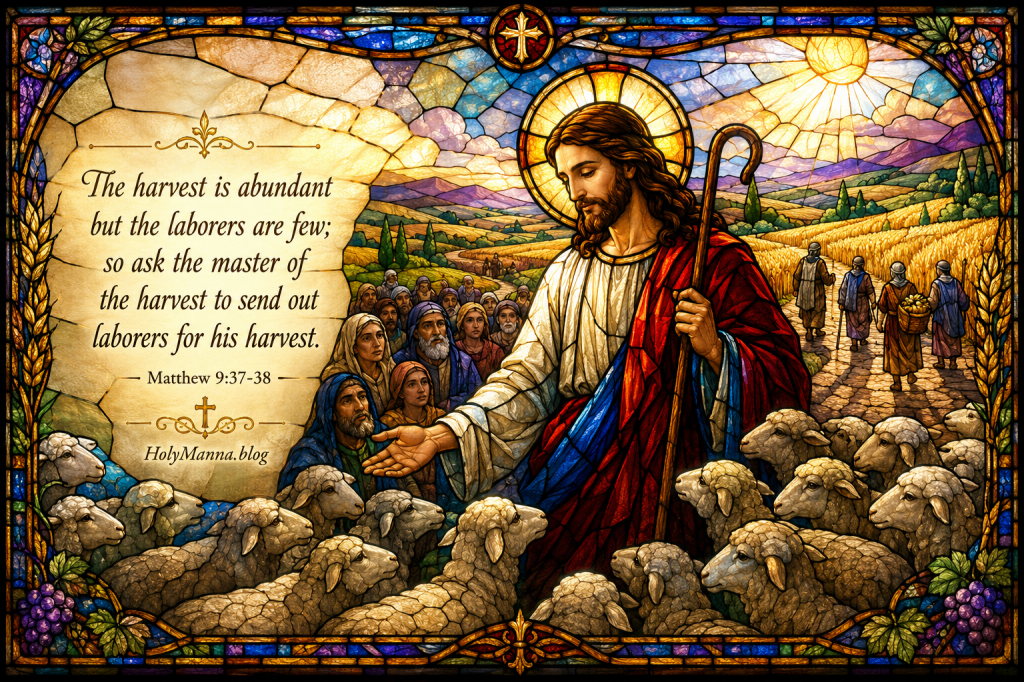
The Compassion of Jesus. 35 Jesus went around to all the towns and villages, teaching in their synagogues, proclaiming the gospel of the kingdom, and curing every disease and illness. 36 At the sight of the crowds, his heart was moved with pity for them because they were troubled and abandoned, like sheep without a shepherd. 37 Then he said to his disciples, “The harvest is abundant but the laborers are few; 38 so ask the master of the harvest to send out laborers for his harvest.”
Detailed Exegesis
Verse 32. “As they were going out, a demoniac who could not speak was brought to him,” The man is carried to Jesus by others, since he cannot ask for himself. His healing begins with the charity of neighbors who bring the voiceless to the only One who can help.
Verse 33. “and when the demon was driven out the mute person spoke. The crowds were amazed and said, ‘Nothing like this has ever been seen in Israel.’” The demon is cast out and speech returns. This is the exact reversal of the idol theme, for the silent one now speaks by the power of the God who is anything but silent, and the crowds confess that such a thing is unprecedented in Israel.
Verse 34. “But the Pharisees said, ‘He drives out demons by the prince of demons.’” Unable to deny the miracle, the Pharisees slander its source. The Fathers, and Saint John Chrysostom in his homilies on The Gospel of Matthew, observed that the wonder itself was undeniable, so envy attacked its origin rather than face the truth.
Verse 35. “Jesus went around to all the towns and villages, teaching in their synagogues, proclaiming the gospel of the kingdom, and curing every disease and illness.” Matthew summarizes the Lord’s ministry in three verbs, teaching, proclaiming, and healing, echoing an earlier summary in the same Gospel (Matthew 4:23). This is what the living God actually does among his people.
Verse 36. “At the sight of the crowds, his heart was moved with pity for them because they were troubled and abandoned, like sheep without a shepherd.” Here is the beating heart of the passage. The Lord is stirred in his inmost being at the sight of exhausted people. The phrase about sheep without a shepherd recalls the prayer of Moses in Numbers 27:17 and the failed shepherds condemned in Ezekiel 34.
Verse 37. “Then he said to his disciples, ‘The harvest is abundant but the laborers are few;’” The tired crowds are not a burden but a field ripe for gathering into the kingdom. The image turns weariness into promise.
Verse 38. “so ask the master of the harvest to send out laborers for his harvest.’” The remedy begins with prayer. The disciples are told to ask the Lord of the harvest for workers, and the very next chapter shows the answer, as Jesus sends out the Twelve.
Teachings
The compassion of Christ in this scene fulfills an ancient longing for a true shepherd. Where Ezekiel 34 condemned the shepherds of Israel who fed themselves and neglected the flock, the Church confesses that Christ is the shepherd God promised to send. The Catechism of the Catholic Church proclaims him “the Good Shepherd and the prince of the shepherds, who gave his life for the sheep” (CCC 754). The crowds abandoned in the Gospel have finally found the One who will not abandon them.
Saint Gregory the Great, preaching on this very saying of the Lord in his Forty Gospel Homilies, taught that the words could not be spoken without sorrow, since many stood ready to hear the good news while few were willing to go out and preach it. His counsel was to obey the Lord’s own instruction and pray earnestly for laborers, and then to ask whether the one praying might himself be among them. The harvest belongs to God, yet God chooses to gather it through human hands sent in his name.
Reflection
The Gospel offers two movements to imitate. The first is the compassion of Christ, who looked at a crowd and saw not a nuisance but sheep needing a shepherd. A Christian grows into that same gaze by choosing to see the tired, the searching, and the harassed people of daily life with mercy rather than irritation.
The second movement is the response Jesus commands, which is prayer for laborers. That prayer is answered in part by the one who prays, since asking God to send workers often ends with the sender walking into the field. A concrete step is to pray daily for priests, religious, and vocations, and to notice the small mission field already at hand, in a family, a workplace, or a friendship. Another step is to imitate the neighbors who carried the mute man, by bringing those who cannot pray for themselves to the feet of Christ.
Who in your daily life is troubled and abandoned, waiting for someone to bring them closer to Jesus? Is the prayer for laborers perhaps an invitation for you to become one?
Mercy Walking the Roads of Galilee
The day began with a warning and ends with a rescue. Hosea watched a nation pour its treasure into golden calves and reap the whirlwind, and Psalm 115 laughed at gods with unseeing eyes while warning that their makers grow just as blind. Both readings hold up a mirror to every heart tempted to trust in what human hands can build.
Then the Gospel answers the ache. The living God, so different from the silent idols, steps into a crowd of exhausted people and gives a mute man back his voice. He does not turn away from the troubled and the abandoned. His heart is moved, and his response is not judgment but a harvest, and a call for workers to gather it.
That is the story of these readings woven into one. Dead gods leave their servants empty, but the living God fills, heals, and sends. The choice set before every reader is quietly urgent, whether to keep feeding the small idols that cannot love back, or to turn to the God who does whatever he wills and yet bends down in mercy.
The call to action is simple and demanding at once. Let this ordinary Tuesday become a return to the living God, in true worship rather than empty ritual, in trust rather than anxiety, and in a compassion that carries others to Christ. The fields are ready, the Shepherd is near, and the invitation to labor in his harvest is addressed to anyone willing to say yes.
Engage With Us!
Share your reflections in the comments below, because the journey of faith was never meant to be walked in isolation. These readings press gently on the heart, and your thoughts may be exactly what another reader needs to hear today.
- In Hosea 8:4-7 and 11-13, the people loved the ritual of sacrifice while their hearts were far from God. Where might you be tempted to go through the motions of faith without offering your heart?
- Psalm 115:3-10 warns that idol-makers become like their idols. When you look honestly at what captures your attention each day, what is it slowly forming in you?
- In Matthew 9:32-38, others carried the voiceless man to Jesus. Who in your life is waiting for someone to bring them closer to Christ?
- Taken together, these readings contrast dead idols with the living God who heals and sends. What would it look like this week to trade one small idol for deeper trust in the God who truly lives?
Keep walking forward in faith, one honest step at a time. The living God who opened the mute man’s lips longs to fill every ordinary day with his mercy, and he invites his friends to carry that same love and mercy to everyone they meet, doing all things with the tenderness that Jesus himself taught.

 Holy Manna!
Leave a comment