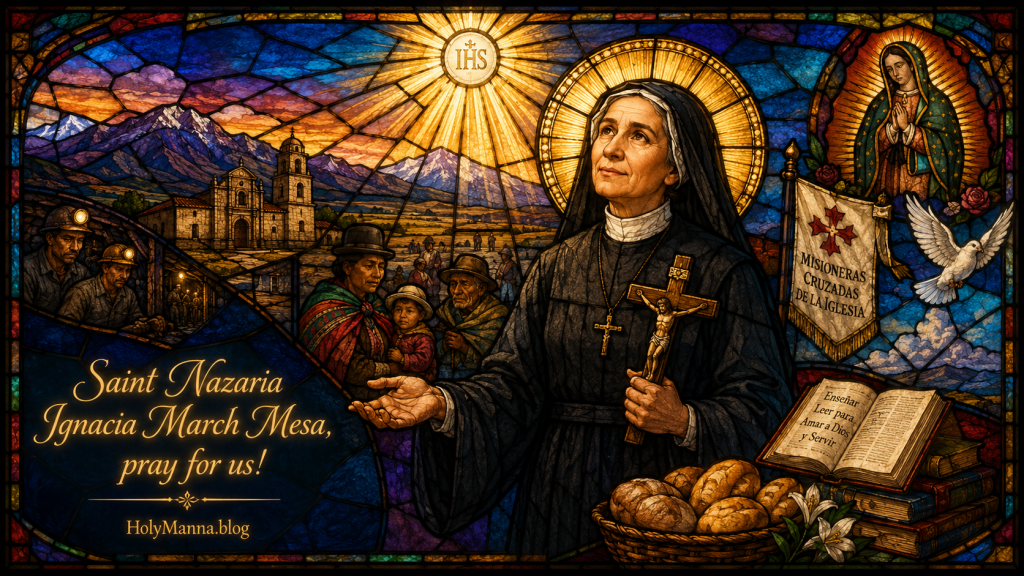
A Love That Crossed the Ocean
Every so often the Church gives us a saint whose life reads less like a quiet biography and more like a sprint toward heaven, and Saint Nazaria Ignacia March Mesa is exactly that kind of saint. She was a Spanish girl who heard the voice of Christ before she was ten years old, and she spent the rest of her days trying to catch up to that voice with everything she had. She would cross an ocean, learn to love a country that was not her own, walk into mines and prisons and marketplaces where few priests dared to go, and finally gather a handful of Bolivian women around her to found a whole new religious congregation. On October 14, 2018, Pope Francis raised her to the honors of the altar, canonizing her in Saint Peter’s Square alongside Saint Paul VI and Saint Óscar Romero. She stands today as the patroness of the Missionaries of the Crusade, the congregation she brought to life.
What makes her worth remembering is not a string of dramatic wonders but a single, stubborn, blazing love. She loved the Church, she loved the poor, and she loved Jesus with a directness that unsettled comfortable people and lifted up forgotten ones. The Church teaches that every baptized person, without exception, is called to this same fullness of holiness. As the Catechism puts it, all Christians “are called to the fullness of the Christian life and to the perfection of charity” (CCC 2013). Nazaria simply took that call at its word. When the Church canonizes a saint, she does something very particular. She “proclaims that they practiced heroic virtue and lived in fidelity to God’s grace” (CCC 828), holding them up as examples and asking for their prayers. Nazaria’s heroic virtue was her fearlessness, and her whole story is an invitation to be a little less careful with our own yes to God.
A Voice at the Communion Rail
She was born in Madrid on January 10, 1889, into a large and busy household. Most sources describe her as the fourth of eighteen children, with a twin sister at her side and a father, José Alejandro March, who worked as a merchant and industrialist. She was baptized on the very day she was born, which tells you that at least the sacramental rhythms of the faith were present in the home, even if the deeper fire of it was not. Her family was comfortable enough in worldly terms, but they were largely indifferent to religion, and as Nazaria grew more devoted they grew more impatient with her. There is a striking detail that has come down to us from her early years. Her parents, worn out by her piety, once punished her by forbidding her to go to Mass, so that a little girl who wanted nothing more than to be near Jesus was grounded from the altar.
The turning point of her childhood came at her First Communion, which she received on November 21, 1898, when she was nine years old. According to her own testimony, she heard Christ speak to her heart in that moment, calling her by name, “You, Nazaria, follow me.” She answered him at once with the words that would become the motto of her entire life, “I will follow Jesus, as near as possible to a human creature.” From that day forward she carried a settled certainty that she belonged to God, and the ordinary opposition of her family only sharpened her resolve.
This clash between a child’s calling and a household’s resistance is not unusual in the lives of the saints, and the Church has words for it. Family love is a real and holy good, yet it is not the highest good, and the Catechism teaches plainly that “family ties are important but not absolute” and that following Jesus can require a person to place the call of God above every other loyalty (CCC 2232). Nazaria found an ally in her grandmother, who nurtured her faith during a period of study in Seville and encouraged her to join the Franciscan Third Order. She was confirmed in 1902 by Blessed Marcelo Spínola y Maestre, the Archbishop of Seville, and she began to draw others in her own family back toward the practice of the faith.
When economic pressures pushed the family to emigrate to Mexico in the years that followed, Nazaria’s calling did not fade. It grew. Around the time of that great uprooting she encountered members of the Little Sisters of the Abandoned Elderly, and their humble, prayerful way of life struck her deeply. She entered that congregation in July of 1908, was sent for a time to Bolivia, returned to Spain for her novitiate in Palencia, and took the religious name Nazaria Ignacia of Saint Teresa of Jesus. She made her perpetual vows in 1915. The girl who had answered a voice at the Communion rail was now bound to Christ by the vows of religious life, and the Church honors that consecration as a way of following the Lord more nearly, a life given over “to the honor of God, the building up of the Church, and the salvation of the world” (CCC 916).
The Streets of Oruro Became Her Cloister
Her congregation sent her to Oruro, a hard mining town high in the Bolivian altiplano, and it was there that the real shape of her mission became clear. Oruro was poor, restless, and desperately short of priests. Whole populations lived far from the sacraments, and the ordinary machinery of parish life simply did not reach them. Nazaria refused to let that distance stand. She carried the Gospel into the mines where the men worked, onto the farms of the indigenous poor, into the prisons, and out among the stalls of the marketplace. She spent years quite literally begging alms so that the elderly in her care would not go hungry, and she came to see the suffering people around her as the living members of Christ’s own body.
That vision is exactly what the Church means when she speaks of the works of mercy. The Catechism describes them as “charitable actions by which we come to the aid of our neighbor in his bodily and spiritual necessities” (CCC 2447), and it insists that love for the poor is not an optional flourish of the Christian life but a demand at its very center, so that the Church’s love for the poor “is a part of her constant tradition” (CCC 2444). Nazaria lived that tradition with her hands. She opened soup kitchens for the hungry, shelters for orphans and for women displaced by war, and small schools where those who had never learned to read could finally open a book.
Her charity reached into the structures of society as well. Convinced that the dignity of the poor and of women deserved real protection and not merely sympathy, she is credited with founding the first women’s trade union in Bolivia and the first Catholic magazine for women in that country. She defended workers and pressed for the advancement of women at a time and in a place where few thought to do so. Here again the Church’s teaching illuminates her instincts, for authentic social justice “can be obtained only in respecting the transcendent dignity of man” (CCC 1929), and Nazaria saw that dignity shining in people the world had written off.
All of this flowed from a call she received during an Ignatian retreat in 1920, a sense that God wanted something new from her. On June 16, 1925, she left the Little Sisters of the Abandoned Elderly, and she gathered a small band of Bolivian women around her vision. Accounts differ on the exact number of these first companions, ranging from six to ten across the sources, and the honest thing is to say that the precise figure is uncertain. What is certain is that in December of 1926 she founded the Congregation of the Missionary Crusaders of the Church, first known as the Missionary Sisters of the Papal Crusade, and that it received diocesan approval on February 12, 1927. She built its Rule on the spirituality of Saint Ignatius of Loyola, with the encouragement of the papal representative in Bolivia, Monsignor Filippo Cortesi. In 1930 her sisters unanimously elected her Superior General. It is worth noting plainly that the sources record no miracles worked by her own hand during these years. Her wonder was of a quieter and more demanding kind. It was the daily miracle of a woman who kept pouring herself out for the least, understanding that the Church exists to carry the Gospel to every corner of the earth, since “the ultimate purpose of mission is none other than to make men share in the communion between the Father and the Son” (CCC 850).
Willing to Die, Sent to Live
Nazaria’s life was full of hardship, though it did not end in martyrdom, and it is important to say that clearly. She was not killed for her faith. She was a confessor, a saint whose sanctity was proven not by a violent death but by a lifetime of faithful, costly love. The Church has always honored both kinds of holiness, for the Lord invites every disciple to “take up his cross and follow him” (CCC 618), and the cross Nazaria carried was long and heavy in its own way.
She knew the hardship of family opposition in her youth, the hardship of leaving her homeland, and the daily grind of poverty in a mining town at the edge of the world. She knew the strain of holding a young congregation together through the years of the Chaco War, when she opened her doors to war orphans and cared for the wounded on both sides of the conflict. And she knew the sorrow of watching her native Spain torn apart by civil war, even as the retreat house she had established in Madrid was mercifully spared.
There is one moment from these years that the sisters have handed down with special tenderness. In 1934 Nazaria traveled to Rome to seek approval of her Rule and was granted a private audience with Pope Pius XI. At his feet she is said to have told him that she was willing to die for the Church. The Pope answered her with words she never forgot, telling her that she must not die but “live and work for the Church.” And live and work she did, right up to the end. Her final years brought failing health, and in 1943 she fell ill with pneumonia. She died in Buenos Aires on July 6, 1943, at the age of fifty four, worn out in the best possible way, having spent herself completely. The courage that carried her through all of it is the virtue the Church calls fortitude, which “strengthens the resolve to resist temptations and to overcome obstacles in the moral life” (CCC 1808). Few saints have resisted more obstacles with more cheerful stubbornness than she did.
When Heaven Answered From Bolivia
Death did not end Nazaria’s work; in many ways it multiplied it. Her reputation for holiness spread quickly, and her congregation grew and spread across the Spanish-speaking world, where it continues its mission today. In 1947, four years after her death, Pope Pius XII granted the congregation full Vatican recognition, a confirmation of the enduring soundness of what she had built.
Her mortal remains had their own journey. She was first buried in the Chacarita cemetery in Buenos Aires, then re-interred at a house of her congregation in 1957, and finally, in 1972, her relics were enshrined in the crypt of the mother house in Oruro, Bolivia, the very town where she had spent herself for the poor. That crypt has become a place of prayer and pilgrimage for those who love her, a fitting home for a woman whose heart had always belonged to that rugged and beloved place.
The cause for her canonization moved forward on the strength of miracles granted through her intercession. Pope John Paul II declared her heroic virtue in 1988 and, after the Church accepted a healing attributed to her prayers, beatified her in Saint Peter’s Square on September 27, 1992. The miracle that opened the way to her canonization concerned a woman who had lost her speech along with her mobility. After prayers were offered invoking Nazaria’s intercession, she reportedly began to recover her speech on October 22, 2010, and went on to a complete recovery that the Church’s medical and theological reviewers judged to be beyond natural explanation. Pope Francis approved the miracle on January 27, 2018, and canonized her that October. The Church understands such healings not as magic but as signs, for miracles are among the works by which God “invites belief in him” (CCC 156), and she teaches that the saints in glory continue to help us, since the intercession of the saints is their “most exalted service to God’s plan” (CCC 2683). When heaven answered from Bolivia, it was answering through the prayers of a woman who had never stopped working for the Church, even from the other side of death.
Following as Close as You Can
It is tempting to admire a saint like Nazaria from a safe distance, to file her under great missionaries and move on with the day. But her life will not let anyone off that easily, because the heart of her holiness is available to absolutely everyone. She did not become a saint by working miracles. She became a saint by loving without hedging her bets, by answering God’s call and then refusing to take the answer back. Her whole spirituality is captured in that childhood promise to follow Jesus as closely as a human creature possibly can, and that is a promise any reader can make this very day.
Consider where God is asking for that kind of nearness in an ordinary life. Nazaria found Christ in the elderly she begged for, in the miners no one visited, in the orphans of a distant war. The reader will find him no less truly in a difficult coworker, a lonely relative, a neighbor in need. The Church reminds us that this love is not sentiment but the very form of holiness, since charity “is the source and the goal of their Christian practice” for all the baptized (CCC 1822). Where in your own life is Christ hiding in plain sight, waiting to be served?
Consider, too, her courage in the face of opposition. She was grounded from Mass as a child and doubted by her own family, yet she never let discouragement decide her direction. Many people carry a quiet calling they have never dared to act on because someone once made them feel foolish for it. What good thing has God placed in your heart that fear has kept you from pursuing? And notice that her mission was profoundly ordinary in its materials. She taught reading, she cooked meals, she defended the overlooked. The Church calls every lay person and every religious to exactly this kind of engaged love, for the apostolate “is a participation in the saving mission of the Church itself” and belongs to all the faithful (CCC 863). What small, practical work of mercy could you begin this week, without waiting to feel ready?
The lesson of Saint Nazaria Ignacia March Mesa is finally very simple and very demanding. Holiness is not reserved for extraordinary people in extraordinary places. It is the fruit of an ordinary person who decides to follow Jesus as closely as a human creature can and then keeps that decision when it is inconvenient, unpopular, and hard. That decision is within reach today.
Engage With Us!
Readers are warmly invited to share their thoughts and reflections in the comments below. Saint Nazaria’s story tends to stir something in people, and this community grows stronger when those stirrings are spoken aloud. Take a few quiet minutes with the questions that follow, and let her fearless love challenge and encourage your own walk with Christ.
- When you imagine Jesus saying to you, by name, “follow me,” what is the very first thing you would want to hold back, and what would it take to hand even that over to him?
- Saint Nazaria crossed an ocean to serve people who were not her own. Who are the “far from you” people in your daily life, and how might God be inviting you closer to them?
- She refused to let family indifference or open opposition decide her direction. Where do you need the courage to keep saying yes to God even when others do not understand?
- Her holiness showed itself in soup kitchens, classrooms, and the defense of the forgotten. What single, concrete work of mercy could you begin this week?
- Nazaria promised to follow Jesus as near as a human creature can. What would “as near as possible” look like in your own state of life right now?
May the example of Saint Nazaria Ignacia March Mesa give you the boldness to love without measuring the cost. Go out into your ordinary day and do everything, the great tasks and the small ones alike, with the same love and mercy that Jesus poured out for you. Saint Nazaria Ignacia March Mesa, who followed the Lord as closely as a human creature can, pray for us.
Saint Nazaria Ignacia March Mesa, pray for us!
Follow us on YouTube, TikTok, Instagram and Facebook for more insights and reflections on living a faith-filled life.

 Holy Manna!
Leave a comment