Monday of the Fourteenth Week in Ordinary Time – Lectionary: 383
A Love That Refuses to Let Go
Some love stories end the moment betrayal walks into the room. The love story running through today’s readings does the opposite. It grows fiercer precisely where unfaithfulness, sickness, and even death seem to have the last word. On this Monday of the Fourteenth Week in Ordinary Time, the Church sets before every reader a single, breathtaking truth. The love of God is a pursuing, healing, life restoring love that no failure can exhaust. The prophet Hosea, preaching in the Northern Kingdom of Israel during the turbulent eighth century before Christ, watched his own people trade the living God for the fertility idols of Canaan. Into that spiritual adultery God speaks not a sentence of divorce but a proposal of remarriage, promising to lead his wandering bride back into the wilderness and to betroth her to himself forever. Psalm 145 answers that promise with pure praise, celebrating a God who is gracious and merciful, slow to anger, and good to all his works. Then the Gospel of Matthew brings this covenant love into a crowded street, where a woman worn down by twelve years of illness and a father crushed by his daughter’s death both discover that a single touch of faith unlocks the power of the Lord of life. The unifying theme shines clearly. God’s faithful love reaches into the valley of trouble and into the shadow of death to restore his people, and faith is the door through which that love enters. The wilderness of Hosea, the mercy of the Psalm, and the healing hand of Jesus all tell one story, the story of a Bridegroom who will not let his beloved go.
First Reading — Hosea 2:16-18, 21-22
The Wilderness Where God Wins Back His Bride
Hosea prophesied to Israel at a moment when the nation was materially comfortable and spiritually bankrupt. The people still went through the outward motions of religion, yet their hearts had wandered after Baal, the Canaanite storm and fertility god whom many Israelites credited for their grain, their wine, and their prosperity. God commanded Hosea to marry Gomer, an unfaithful wife, so that the prophet’s own aching marriage would become a living picture of the covenant between God and his people. Today’s verses come from the tender center of that picture. After sober warnings of judgment, God suddenly turns to woo. This passage fits the day’s theme perfectly, because it reveals the opening movement of the divine love story. Here is a God who responds to betrayal not by walking away but by drawing his people back into the desert to fall in love with him again.
Hosea 2:16-18, 21-22 – New American Bible (Revised Edition)
16 Therefore, I will allure her now;
I will lead her into the wilderness
and speak persuasively to her.
17 Then I will give her the vineyards she had,
and the valley of Achor as a door of hope.
There she will respond as in the days of her youth,
as on the day when she came up from the land of Egypt.18 On that day—oracle of the Lord—
You shall call me “My husband,”
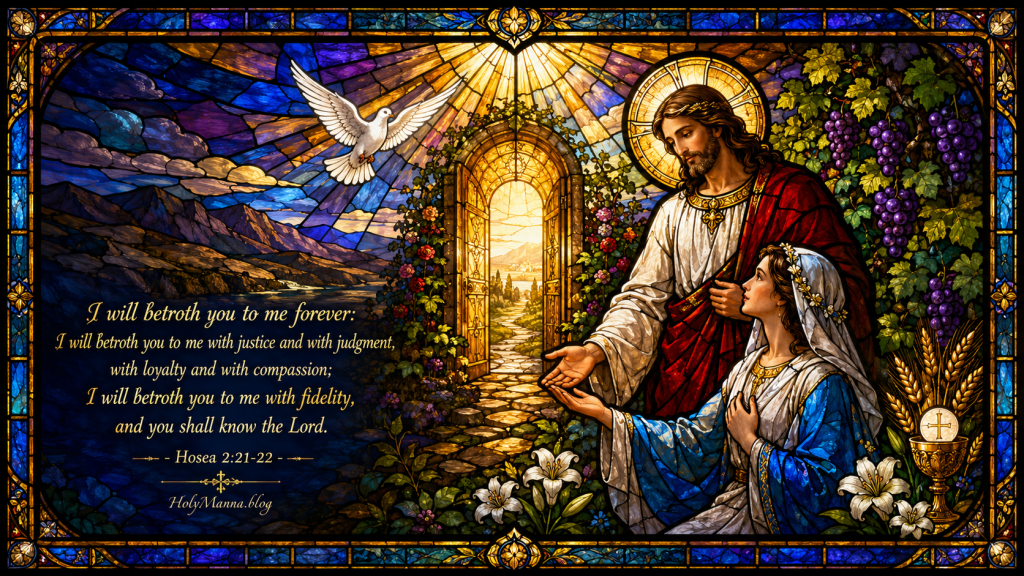
and you shall never again call me “My baal.”21 I will betroth you to me forever:
I will betroth you to me with justice and with judgment,
with loyalty and with compassion;
22 I will betroth you to me with fidelity,
and you shall know the Lord.
Detailed Exegesis
16 Therefore, I will allure her now; I will lead her into the wilderness and speak persuasively to her.
The word “allure” carries the language of courtship, the way a young man woos the woman he loves. The wilderness is not a place of punishment here but a place of memory and romance, the very desert where Israel first fell in love with God after the Exodus. God chooses to strip away the distractions of Baal worship and comfortable idolatry so that his bride can hear his voice again, tenderly and without competition.
17 Then I will give her the vineyards she had, and the valley of Achor as a door of hope. There she will respond as in the days of her youth, as on the day when she came up from the land of Egypt.
The valley of Achor means the “Valley of Trouble,” named for the sin of Achan, who was judged there as Israel entered the Promised Land in the Book of Joshua. God now promises to transform that monument of failure into a “door of hope.” The place associated with sin and defeat becomes the very gateway to a new beginning, and the bride responds with the fresh joy of her youth.
18 On that day—oracle of the Lord— You shall call me “My husband,” and you shall never again call me “My baal.”
A beautiful play on words hides in this verse. In Hebrew the word for “my husband” speaks of intimacy and partnership, while the word for “my baal” means “my master” and echoes the very name of the idol Israel had chased. God is promising to move the relationship from cold ownership to loving marriage, and to purge from his bride’s lips the very name of her false lovers.
21 I will betroth you to me forever: I will betroth you to me with justice and with judgment, with loyalty and with compassion;
Three times God repeats the words “I will betroth you,” like a bridegroom pronouncing his vows. The betrothal is not temporary but forever. God offers as his wedding gift the virtues of justice, right judgment, loyalty, and compassion, the very qualities that will keep this marriage from ever collapsing again.
22 I will betroth you to me with fidelity, and you shall know the Lord.
Fidelity crowns the vows, and the goal of it all is that the bride will finally “know” the Lord. In Scripture this knowing is the deep, personal intimacy of covenant love, not merely knowing facts about God but truly belonging to him heart and soul.
Teachings
The Church reads this passage as far more than an ancient poem about a broken marriage. It is a window into the very heart of God. The Catechism of the Catholic Church teaches, “God’s love for Israel is compared to a father’s love for his son. His love for his people is stronger than a mother’s for her children. God loves his people more than a bridegroom his beloved; his love will be victorious over even the worst infidelities” (CCC 219). That single line captures the whole drama of Hosea. God’s love outlasts betrayal.
The Church also sees in these spousal images a preparation for something greater still. The Catechism explains that “Seeing God’s covenant with Israel in the image of exclusive and faithful married love, the prophets prepared the Chosen People’s conscience for a deepened understanding of the unity and indissolubility of marriage” (CCC 1611). Hosea points forward to Christ, the true Bridegroom. As the Catechism continues, “The nuptial covenant between God and his people Israel had prepared the way for the new and everlasting covenant in which the Son of God, by becoming incarnate and giving his life, has united to himself in a certain way all mankind saved by him, thus preparing for the wedding-feast of the Lamb” (CCC 1612). The betrothal Hosea announces finds its fulfillment on the Cross, where the Bridegroom pours out his life for his bride, the Church.
Reflection
Every soul has its own valley of Achor, some place of trouble, failure, or shame that feels like a monument to sin. The astonishing promise of Hosea is that God delights in turning those very valleys into doors of hope. He does not wait for his people to become worthy before he pursues them. He allures first, and the beauty follows. A concrete way to live this reading is to name one area of past failure and bring it deliberately to God in confession or in quiet prayer, asking him to make it a door rather than a dead end. Where in your life have you been calling God your “master” out of fear rather than your “husband” out of love? What idol, however respectable it looks, has been quietly receiving the trust that belongs to God alone? If God is speaking tenderly to you in your own wilderness right now, what is he inviting you to leave behind so you can hear him more clearly?
Responsorial Psalm — Psalm 145:2-9
Praise That Rises Every Single Day
Psalm 145 is a carefully crafted hymn of praise, built as an acrostic in which each verse begins with a successive letter of the Hebrew alphabet, as if to say that God deserves praise from A to Z. It is the only psalm the Hebrew tradition titles a “Praise,” and from it the ancient people of God drew a prayer they recited daily. Placed beside Hosea, this psalm gives voice to the bride’s grateful response. Having been wooed back by her faithful Bridegroom, she now sings of his greatness, his goodness, and his mercy. The psalm fits the day’s theme by describing the very character of the God who pursues, betroths, and heals, a God whose love is not a fleeting mood but an everlasting disposition of goodness toward all he has made.
Psalm 145:2-9 – New American Bible (Revised Edition)
2 Every day I will bless you;
I will praise your name forever and ever.
3 Great is the Lord and worthy of much praise,
whose grandeur is beyond understanding.
4 One generation praises your deeds to the next
and proclaims your mighty works.
5 They speak of the splendor of your majestic glory,
tell of your wonderful deeds.
6 They speak of the power of your awesome acts
and recount your great deeds.
7 They celebrate your abounding goodness
and joyfully sing of your justice.
8 The Lord is gracious and merciful,
slow to anger and abounding in mercy.
9 The Lord is good to all,
compassionate toward all your works.
Detailed Exegesis
2 Every day I will bless you; I will praise your name forever and ever.
Praise here is not reserved for special occasions but woven into the rhythm of ordinary life. The psalmist commits to bless God every single day, and even into eternity, echoing the endless faithfulness God promised his bride in Hosea.
3 Great is the Lord and worthy of much praise, whose grandeur is beyond understanding.
God’s greatness is boundless, past the reach of any mind to measure. This confession of majesty keeps praise humble, reminding the worshiper that the God who stoops to woo his people is at the same time infinitely beyond them.
4 One generation praises your deeds to the next and proclaims your mighty works.
Faith is handed down like a treasure from parents to children. The praise of God is meant to be a family inheritance, a story told and retold so that no generation forgets the mighty works of the Lord.
5 They speak of the splendor of your majestic glory, tell of your wonderful deeds.
The community lingers over the beauty of God, savoring his glory in conversation. To speak of his splendor is itself an act of worship that draws the heart deeper into wonder.
6 They speak of the power of your awesome acts and recount your great deeds.
Alongside beauty stands power. God’s saving acts inspire holy awe, and the faithful respond by recounting them, keeping the memory of his deliverance alive and vivid.
7 They celebrate your abounding goodness and joyfully sing of your justice.
Goodness and justice are not opposites in God but partners. The psalmist celebrates both, singing with joy because the God who judges rightly is also overflowing with generous goodness.
8 The Lord is gracious and merciful, slow to anger and abounding in mercy.
This verse stands at the heart of the psalm and repeats one of the most treasured lines in all of Scripture. It is the very self description God gave to Moses on Mount Sinai. Mercy, not wrath, is the deepest and most enduring truth about the God of Israel.
9 The Lord is good to all, compassionate toward all your works.
God’s goodness has no borders. It reaches every creature and every corner of creation, revealing a Father whose compassion overflows onto everything his hands have made.
Teachings
The refrain of verse 8 is no accident. It reaches all the way back to the moment God revealed his own name and nature to Moses, declaring himself merciful and gracious, slow to anger, and rich in kindness. The Catechism of the Catholic Church draws on that same revelation when it teaches that God “has made himself known as ‘abounding in steadfast love and faithfulness’” (CCC 231). This is the same faithful love Hosea proclaimed, now set to music. When the psalmist sings that the Lord is slow to anger and abounding in mercy, he is describing the exact character of the Bridegroom who refuses to abandon his unfaithful bride. The praise of Psalm 145 is therefore the natural echo of Hosea’s promise. A God whose mercy outlasts every infidelity is a God worthy of praise every single day, forever and ever.
Reflection
It is striking that the psalmist resolves to bless God “every day,” not only on the days when life feels blessed. Gratitude that depends on good circumstances is fragile, but praise rooted in God’s unchanging goodness can survive any season. A practical way to live this psalm is to begin each morning by naming one specific mercy from the day before, training the heart to notice the abounding goodness that verse 8 describes. Praise also has a mission, since verse 4 insists that one generation must proclaim God’s works to the next. Who first told you about the goodness of God, and whom might you be called to tell now? When you picture God’s face turned toward you, do you see the slow to anger and abounding mercy this psalm celebrates, or have you imagined him harsher than he truly is? What would change in an ordinary day if you truly believed the Lord is good to all, including you?
Holy Gospel — Matthew 9:18-26
One Touch, and the Power of Life Breaks Loose
Matthew tells this story with masterful craft, weaving two miracles together so that one unfolds inside the other. A synagogue official, named Jairus in the parallel accounts of the Gospel of Mark and the Gospel of Luke, begs Jesus to raise his dead daughter, and on the way a suffering woman interrupts everything with her own desperate hope. Both figures share a heavy burden under the Law of Israel. The woman’s twelve years of bleeding made her ritually unclean, cut off from worship and from ordinary human contact, and a corpse likewise rendered anyone who touched it impure. In the ancient world, uncleanness spread by contact, so that touching the sick or the dead would defile the healthy. Jesus reverses that entire logic. Instead of catching their impurity, his holiness flows outward to cleanse the woman and to raise the child. This Gospel brings the whole day’s theme to its climax, for here the faithful love of the divine Bridegroom steps into the street and touches the untouchable, proving that his mercy is stronger than sickness and stronger than death.
Matthew 9:18-26 – New American Bible (Revised Edition)
The Official’s Daughter and the Woman with a Hemorrhage. 18 While he was saying these things to them, an official came forward, knelt down before him, and said, “My daughter has just died. But come, lay your hand on her, and she will live.” 19 Jesus rose and followed him, and so did his disciples. 20 A woman suffering hemorrhages for twelve years came up behind him and touched the tassel on his cloak. 21 She said to herself, “If only I can touch his cloak, I shall be cured.” 22 Jesus turned around and saw her, and said, “Courage, daughter! Your faith has saved you.” And from that hour the woman was cured.
23 When Jesus arrived at the official’s house and saw the flute players and the crowd who were making a commotion, 24 he said, “Go away! The girl is not dead but sleeping.” And they ridiculed him. 25 When the crowd was put out, he came and took her by the hand, and the little girl arose. 26 And news of this spread throughout all that land.
Detailed Exegesis
18 While he was saying these things to them, an official came forward, knelt down before him, and said, “My daughter has just died. But come, lay your hand on her, and she will live.”
A man of standing kneels before Jesus in raw grief and astonishing faith. He does not ask merely for comfort but for resurrection, believing that a single touch of Jesus can undo death itself. His desperation has become the doorway to trust.
19 Jesus rose and followed him, and so did his disciples.
Jesus responds without hesitation. He rises and goes, and his willingness to be interrupted for the sake of one grieving father reveals the compassionate heart at the center of his mission.
20 A woman suffering hemorrhages for twelve years came up behind him and touched the tassel on his cloak.
Into this urgent journey slips a woman who has suffered for twelve long years. She approaches from behind, hidden and ashamed, and reaches for the tassel of his garment, the fringe a devout Jewish man wore to remember the commandments of God. Her boldness and her humility meet in that trembling touch.
21 She said to herself, “If only I can touch his cloak, I shall be cured.”
Her faith speaks in a whisper only she can hear. She is convinced that even the edge of Jesus is enough, that his power is so abundant it can heal through the smallest point of contact.
22 Jesus turned around and saw her, and said, “Courage, daughter! Your faith has saved you.” And from that hour the woman was cured.
Jesus stops and turns to her, refusing to let her healing remain anonymous. He calls her “daughter,” the only woman in the Gospels he addresses that way, restoring her not only to health but to belonging. He credits her faith, teaching everyone watching that trust is the channel through which his saving power flows.
23 When Jesus arrived at the official’s house and saw the flute players and the crowd who were making a commotion,
The scene shifts to the wailing and hired flute players of a funeral already underway. Death has thoroughly claimed the household, and the noise of mourning fills the air, setting the stage for an even greater sign.
24 he said, “Go away! The girl is not dead but sleeping.” And they ridiculed him.
Jesus speaks of death as sleep, hinting that for him the grave is not final but a slumber from which he can awaken his children. The crowd laughs, mistaking his authority for foolishness, unaware that the Lord of life stands among them.
25 When the crowd was put out, he came and took her by the hand, and the little girl arose.
Once the mockers are removed, Jesus takes the child by the hand. The same touch that would have made him unclean instead pours life into her body, and she rises as though waking from rest.
26 And news of this spread throughout all that land.
The report races across the whole region. A deed of such power cannot be hidden, and the raising of the little girl becomes a testimony that reaches far beyond that single home.
Teachings
The Church treasures this Gospel as a vivid revelation of Christ the physician. The Catechism of the Catholic Church teaches that “Christ’s compassion toward the sick and his many healings of every kind of infirmity are a resplendent sign that ‘God has visited his people’ and that the Kingdom of God is close at hand,” and that “he has come to heal the whole man, soul and body; he is the physician the sick have need of” (CCC 1503). The bleeding woman touches the fringe of his cloak, and the Catechism draws the very lesson of this scene when it says, “Often Jesus asks the sick to believe. The sick try to touch him, ‘for power came forth from him and healed them all.’ And so in the sacraments Christ continues to ‘touch’ us in order to heal us” (CCC 1504). The healing that flowed from Jesus in that street still flows today through the sacraments of the Church.
The Fathers pondered this passage with wonder. St. John Chrysostom, in his Homilies on the Gospel of Saint Matthew, marvels at the quiet greatness of the woman’s trust and asks, “Do you see the woman superior to the ruler of the synagogue?” Though her illness had bound her for years, Chrysostom says that “her faith had given her wings.” He also explains why Jesus allowed the child to be truly dead before arriving, teaching that the Lord waited on purpose so that the proof of the resurrection might be beyond all doubt, just as he later waited before raising Lazarus. In both miracles, faith opens the door and the power of God does the rest.
Reflection
The woman in this Gospel offers a model for every believer who feels unworthy to approach God. She did not wait until she was clean or presentable. She came exactly as she was, broken and afraid, and reached for whatever part of Jesus she could touch. Faith does not require a perfect prayer or a spotless soul, only a hand stretched out in trust. A concrete way to imitate her is to bring one long standing wound, whether of body, memory, or spirit, deliberately into the presence of Christ, especially through the sacraments where he still promises to touch and heal. The synagogue official teaches a second lesson, that hope is worth carrying even into the room where death seems to have won. What illness or grief have you stopped bringing to Jesus because you assumed it was too late? Do you believe that his touch can reach the parts of your life you consider dead beyond recovery? If Jesus turned to you today and called you “daughter” or “son,” how might that single word begin to heal the shame you have carried?
The Door He Is Still Holding Open
Three scenes, and one relentless love. Hosea shows a God who follows his unfaithful bride into the wilderness to win her heart again, turning her valley of trouble into a door of hope. Psalm 145 teaches the song that rises in response, the daily praise of a people who have discovered that their God is gracious and merciful, slow to anger and abounding in mercy. Then the Gospel brings that mercy near enough to touch, as Jesus heals a woman whom everyone else avoided and raises a little girl whom everyone else had already mourned. Taken together, these readings proclaim that no failure is too deep for God to redeem, no wound too old for him to heal, and no death too final for him to reverse. The same love that betrothed Israel forever reaches through the crowd to lay a hand on the ones the world has written off. The door of hope Hosea promised is not locked away in ancient history. It is the very heart of Christ, thrown open to anyone willing to reach out in faith. The invitation of today is simple and searching. Every reader is asked to bring some valley of trouble, some hidden illness, some grief that feels like a grave, and to press it against the edge of Christ’s mercy, trusting that his power still comes forth to heal. He is not slow to anger toward the one who returns to him, but quick with compassion. He calls his wandering people “beloved,” and his sick and sorrowing children “daughter” and “son.” The Bridegroom who refuses to let go is standing at the door, and he is still holding it open.
Engage With Us!
The story does not end on the page, and this space belongs to the reader as much as to the writer. Take a moment to share your reflections in the comments below, because the deeds of the Lord are meant to pass from one generation and one heart to the next, and your voice may be exactly the encouragement another reader needs today.
- In Hosea 2:16-22, God promises to lead his bride into the wilderness and to betroth her to himself with fidelity forever. What idol or false security is God gently inviting you to leave behind so that he can speak tenderly to your heart?
- In Psalm 145:2-9, the psalmist resolves to bless the Lord every single day and celebrates a God who is slow to anger and abounding in mercy. What is one specific mercy from this past week that you can name and praise God for right now?
- In Matthew 9:18-26, a suffering woman reaches out to touch the tassel of Jesus and a grieving father begs him to raise his daughter. What long standing wound or fear have you hesitated to bring to Christ, and what would it take to reach for him in faith today?
- Across all three readings, God pursues, restores, and heals the very people the world had given up on. Where in your own life is God turning a valley of trouble into a door of hope, and how will you walk through it?
However heavy the burden feels, the God revealed in today’s readings is a God who draws near, who betroths in fidelity, and who touches even the untouchable to bring them back to life. May every reader carry this truth into the ordinary hours ahead, living each day in the faith of the woman who reached for Christ and the hope of the father who knelt before him, and doing all things with the same love and mercy that Jesus so freely poured out.
Sacred Heart of Jesus, we trust in You!
Immaculate Heart of Mary, pray for us!
Saint Michael the Archangel, defend us in battle!
Follow us on YouTube, TikTok, Instagram and Facebook for more insights and reflections on living a faith-filled life.


Leave a Reply