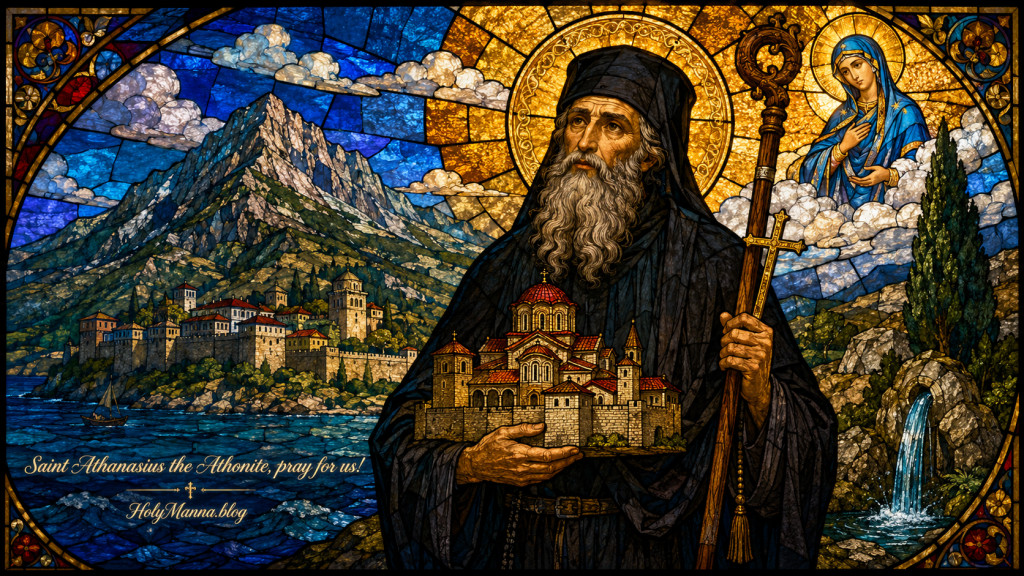
The Monk Who Gathered a Holy Mountain
When the sun rises over the Aegean and touches the great peak in northern Greece, it lights up a peninsula that has been given over almost entirely to prayer. For more than a thousand years monks have lived on Mount Athos in silence, in fasting, and in constant worship, and the man most responsible for turning that wild mountain into the greatest school of monastic prayer in the Christian East was Saint Athanasius the Athonite. He was born around the year 920 and died around the year 1000, and in that single lifetime he took a scattering of lonely hermits and shaped them into an ordered community whose descendants still fill the Holy Mountain today.
Athanasius is remembered above all as the founder of the Great Lavra, the first true monastery on Mount Athos and still the first in rank among the twenty ruling houses there. He gave the mountain a written rule, a common life, a church, a library, and a school, and he did it against fierce opposition and through real personal danger. Because he lived and died before the tragic division of East and West in 1054, the Catholic Church honors him as a saint of the undivided first millennium, and his feast is kept on July 5th.
There is one more thing worth saying at the very start. Athanasius did not set out to be famous. He spent much of his strength trying to disappear, fleeing honors and hiding in his cell, and God kept drawing him back into the open to build something enormous. That tension, between the longing to vanish into God and the call to serve the Church out in the open, runs through his whole story, and it is exactly the tension that makes his life so useful for anyone trying to follow Christ in a noisy world.
From an Orphan of Trebizond to a Teacher in the Imperial City
Athanasius was born in Trebizond, a port city on the Black Sea in what is now northeastern Turkey, and at his baptism he was given the name Abraham. The early accounts of his life say that he lost his parents while he was still very young and was raised by a devout nun who taught him to pray, to fast, and to love the ascetic life while he was still a boy. Whatever the exact details of his family, and the sources differ on whether his people were wealthy or simply pious, the pattern of his childhood was set early. He learned to treat prayer and self denial as the most natural things in the world.
After the death of the good woman who raised him, Abraham was brought to Constantinople, the dazzling capital of the Byzantine Empire, and there he studied under a famous teacher of rhetoric who happened also to be named Athanasius. The young man was gifted. He mastered his lessons so quickly that he soon outpaced his own teacher and became an instructor of others. He could have chased a brilliant career in the greatest city in the Christian world, yet even then he kept the habits of a monk while surrounded by the comforts of the court, eating plain bread, drinking water, sleeping little, and often sleeping upright on a stool rather than lying down in comfort.
His true turning point came when he met Saint Michael Maleinos, the abbot of a monastery on Mount Kyminas in Bithynia. Abraham opened his heart to the old abbot and confessed his desire to give himself entirely to God. Michael received him, tonsured him as a monk, and gave him the name by which the whole Church would come to know him, Athanasius. This was his real conversion, not a turning from unbelief, since he had always been a Christian, but a turning of his whole life over to Christ without holding anything back. The Church has always cherished this kind of radical self gift, and she teaches that the consecrated life, born in the Christian East in the first centuries of the faith, is a gift she received from her Lord and a special sign of the world to come (CCC 925).
At Kyminas, Athanasius grew close to the abbot’s nephew, the great general Nikephoros Phokas, who would one day become emperor. Nikephoros came to trust Athanasius as his spiritual guide. That friendship would later become the human means by which God accomplished great things, but at the time it created a problem, because the brothers began to whisper that Athanasius should be made their next abbot. Terrified of honor and hungry only for hiddenness, he did what he would do again and again in his life. He ran. Around the year 958 he fled to the far tip of Mount Athos, to a lonely place called Melana, and there he built himself a small cell and set out to live as an unknown hermit, wanting nothing more than to be forgotten by everyone except God.
The Great Lavra Rises, and Heaven Sends a Stewardess
God, however, had no intention of leaving Athanasius forgotten. His old friend Nikephoros tracked him down and begged for his help and his prayers as the general prepared a campaign to drive the Saracens out of Crete around the year 961. That campaign succeeded, and Nikephoros, grateful and mindful of his own long standing desire to become a monk, gave Athanasius a large sum of money and asked him to build a proper monastery on the Holy Mountain. Reluctant at first, because a monastery meant crowds and a monastery meant an end to his solitude, Athanasius nevertheless obeyed. The Great Lavra was dedicated around the year 963, and it stands and functions to this day. Some Catholic sources place the founding a year or two earlier, around 961, which reflects the difference between when the funds were secured and when the church was dedicated.
What Athanasius built was not simply a set of buildings. He introduced a cenobitic rule, a rule of common life, in which monks lived, prayed, ate, and worked together under one discipline rather than each man following his own schedule in isolation. He modeled this rule on the great monastic fathers Saint Basil the Great and Saint Theodore the Studite, and Catholic scholars have long noticed how closely his vision echoes the spirit of the Rule of Saint Benedict in the West. Services were kept with great strictness, no one dared to arrive late or leave early or chatter during the prayers, and the whole community was ordered toward the worship of God. He insisted on the study of Scripture, established a library, planted hundreds of trees on the rocky ground, and gave the Holy Mountain the shape it would keep for a thousand years.
The most tender stories from these years concern the Mother of God, and they are best told as the traditions that the Holy Mountain has treasured for centuries. According to a story long cherished at the Great Lavra, a terrible famine once struck the community. There was no food and no money, the monks scattered one by one, and even Athanasius, in a rare moment of weakness, decided to abandon the half built monastery and walk to Karyes to seek advice. On the path he met a beautiful woman wearing a long veil, who asked him where he was going and gently rebuked his lack of faith. He feared he was being deceived, and he asked for a sign. She told him to strike a nearby rock with his staff in the name of the Holy Trinity, and when he did, the rock split and a spring of water burst forth. She told him to appoint no other steward, for she herself would be the Stewardess of his monastery from that day forward, and then she vanished. When Athanasius returned, he found every storeroom overflowing with wheat, wine, and oil. From this story comes the title of the Mother of God honored there as the Panagia Oikonomissa, Our Lady the Stewardess. This account is a beloved tradition rather than documented history, and it cannot be verified.
Whatever a careful reader makes of that story, it points to a truth the Church holds with complete confidence, that Mary’s care for God’s children did not end when she was taken up to heaven. The Catechism teaches that from her place in glory she continues to intercede for God’s children, and that she is invoked in the Church under the titles “Advocate, Helper, Benefactress, and Mediatrix” (CCC 969). It also points to the deeper lesson of the famine itself, that God provides. Christ Himself asks for that childlike trust in the providence of a Father who cares for the smallest needs of His children (CCC 305). Athanasius learned in his hunger what every builder for God must learn, that a work of faith rests finally on grace and not on a full storeroom. Scripture had said it long before him, that “Unless the Lord builds the house, those who build it labor in vain” (Psalm 127:1).
Resentment, Exile, and a Death Beneath the Dome
It would be a mistake to imagine that Athanasius floated through his life on a cushion of miracles. His path was hard, and much of the hardship came from within the very world he was trying to serve. The hermits already living on the mountain deeply resented his arrival. They had grown used to living each in his own way, answering to no one, and here came a newcomer with an emperor’s gold and a written rule, trying to organize their freedom into obedience. They accused him of relying on imperial favoritism, they resisted him at every turn, and at least twice, according to the accounts of his life, angry monks came close to killing him. He met all of it with patience, and he kept building.
The greatest blow came in 969, when his friend the Emperor Nikephoros was assassinated in a palace conspiracy. With his protector gone, the enemies of Athanasius gained the upper hand, and he was forced to leave Athos altogether and withdraw to the island of Cyprus. His great experiment might have collapsed there, except that the new emperor, John I Tzimiskes, chose to renew the imperial patronage. In 971 or 972 John granted the Holy Mountain its first charter, the document known as the Tragos because it was written on thick goatskin parchment, and it is still preserved as the most precious treasure in the archives of Athos. Strengthened by this and, according to his own testimony, by a vision that commanded him to return, Athanasius came back to the Great Lavra and resumed his work.
His death, when it came around the year 1000, was sudden and strange. Athanasius was a strong man who never asked his monks to do anything he would not do himself, and he was up among the workmen helping to raise a new church. The dome of the unfinished building collapsed, and he was killed along with several companions beneath the falling stone. The early Life records that he had foretold his death and asked the brothers not to be troubled, and that his final words were “Glory to you, God”; this detail comes from the traditional accounts of his passing.
Here an honest word is needed. Saint Athanasius the Athonite was not a martyr. He did not die for confessing the faith under persecution, and it would be wrong to dress up his death as something it was not. He died in an accident, in the middle of ordinary work, doing the humble and dangerous labor of building a house for God. Yet the Church has never taught that holiness requires a violent death. She teaches instead that “The way of perfection passes by way of the Cross. There is no holiness without renunciation and spiritual battle” (CCC 2015). Athanasius carried that cross for a lifetime, in fasting, in exile, in the patience he showed toward men who wanted him dead, and in the plain willingness to give his last hour to manual labor. The Church also reminds her children to be ready, since no one knows the day, and she encourages the faithful to prepare their hearts for the hour of death (CCC 1014). Athanasius met that hour with his tools in his hands and God’s name on his lips, which is not a bad way to be found.
A Spring That Still Flows and a Tomb Still Kept
The influence of Athanasius did not end when the dome fell. His body was laid to rest in the Great Lavra, and to this day pilgrims to the Holy Mountain venerate his sealed tomb, which sits beside the icon of the Mother of God the Stewardess in the main church. His iron cross and his staff are kept among the treasures of the monastery, and near the entrance stands an ancient cypress said to be more than a thousand years old, a living link to the saint who planted so many trees on that stony ground. The holy spring associated with him is said to flow still, and pilgrims have long spoken of its healing waters, though such claims of healing belong to tradition and cannot be verified.
The tradition of the Panagia Oikonomissa remains alive as well. The icon of Our Lady the Stewardess rests enthroned in the narthex of the great church, and by long custom the Lavra appoints no human steward over its provisions, keeping instead only an assistant who serves under the Mother of God herself. Whether or not every detail of that story can be documented, and it cannot, it has shaped the prayer and the trust of that community for more than a thousand years.
The largest legacy of Athanasius is the Holy Mountain itself. What began as a handful of quarreling hermits became, under his rule, an ordered republic of prayer. Over the centuries the number of communities multiplied, at one point the Great Lavra alone counted hundreds of monks, and today twenty ruling monasteries and their many dependencies still cover the peninsula, which is now recognized as a treasure of Christian civilization and a place of pilgrimage. In 1963 the Holy Mountain celebrated the thousandth anniversary of the founding of the Lavra, a thousand years of unbroken monastic prayer flowing from the work of one determined monk.
An honest account has to name one more thing. The community Athanasius founded is today an Eastern Orthodox community, since Mount Athos remained with the Christian East after the sorrowful split of 1054. Athanasius himself, however, belongs to the shared inheritance of the whole Church from before that division, and Catholics can claim him gladly as their own. The Church holds that the saints in heaven do not grow distant from the faithful but “constantly care for those whom they have left on earth” (CCC 2683), and she proposes them to believers across every boundary as “models and intercessors” (CCC 828). Pope Saint John Paul II loved to say that “The Church must breathe with her two lungs!” (Ut Unum Sint, n. 54), meaning the great traditions of East and West together. Saint Athanasius the Athonite is a saint of that eastern lung, and his witness invites Catholics to breathe deeply and to pray for the day when all who love Christ may again be one.
Building Something That Will Outlast You
The life of Saint Athanasius offers a great deal to a person living in a restless and self promoting age. Consider first his flight from honor. Twice he ran from being made a superior, and he wanted nothing so much as to be hidden and forgotten in his cell. In a world that teaches everyone to build a brand and chase attention, here is a saint who fled applause and found God in obscurity, and who was only useful to the Church because he had first learned to seek nothing for himself. When you imagine a life well spent, does it look more like being noticed by many people or more like being known deeply by God?
Consider next his willingness to build something he would not live to enjoy. He raised churches, wrote rules, planted trees, and trained monks for a community that would flourish for a thousand years after his death. Most of the good that came from his labor happened when he was already in his grave. That is a quiet rebuke to the modern hunger for instant results. Faithfulness often means planting trees whose shade you will never sit in and pouring yourself into work whose fruit you may never see. What good thing might God be asking you to begin now, even though its harvest will belong to people you will never meet?
Consider finally his response to opposition and to scarcity. He was slandered, resisted, exiled, and nearly murdered, and he answered with patience rather than bitterness. When the storerooms were empty and everyone else had abandoned the work, he was tempted to quit, and grace turned him around and taught him to trust in God’s provision. The practical lesson is not complicated. A believer can meet unfair treatment with calm instead of revenge, can keep showing up to the work when it is thankless, and can trust that the God who fed Israel in the desert has not forgotten His children now. These are small daily choices, made in offices and homes and parishes, and they are exactly how ordinary people grow into saints. Where in your own life is God inviting you to keep building, keep praying, and keep trusting, even when the storeroom looks empty?
Engage With Us!
Readers are warmly invited to share their thoughts and reflections in the comments below, because the story of a saint is meant to be talked over, prayed with, and carried into real life rather than simply read and set aside. Consider spending a few quiet minutes with the questions that follow, and feel free to bring your answers into the conversation.
- Athanasius kept the habits of prayer and self denial even while surrounded by comfort and success in Constantinople. What is one small practice of prayer or sacrifice you could keep no matter how busy or comfortable your life becomes?
- He fled from honor and longed to be hidden in God. Is there a place in your life where the desire to be noticed has quietly crowded out the desire to please God alone?
- When the famine came, Athanasius was tempted to abandon the work, and trust in God’s provision turned him around. Where do you most need to trade anxiety about scarcity for childlike trust in the Father’s care?
- He built patiently for a future he would never see. What is one good thing you can begin now for the sake of your family, your parish, or the next generation, without needing to see the results yourself?
- He answered slander and even threats on his life with patience rather than revenge. Who in your life is God asking you to treat with that same steady, forgiving patience this week?
May the example of Saint Athanasius the Athonite give you courage to keep building quietly and faithfully wherever God has placed you, to trust His provision when your own strength runs out, and to seek His glory rather than your own. Go and do the work in front of you, however small or hidden it seems, and do all of it with the love and mercy that Jesus taught us, so that whatever your hands help to raise may become, in the end, a house that the Lord Himself has built.
Saint Athanasius the Athonite, pray for us!
Follow us on YouTube, TikTok, Instagram and Facebook for more insights and reflections on living a faith-filled life.

 Holy Manna!
Leave a comment