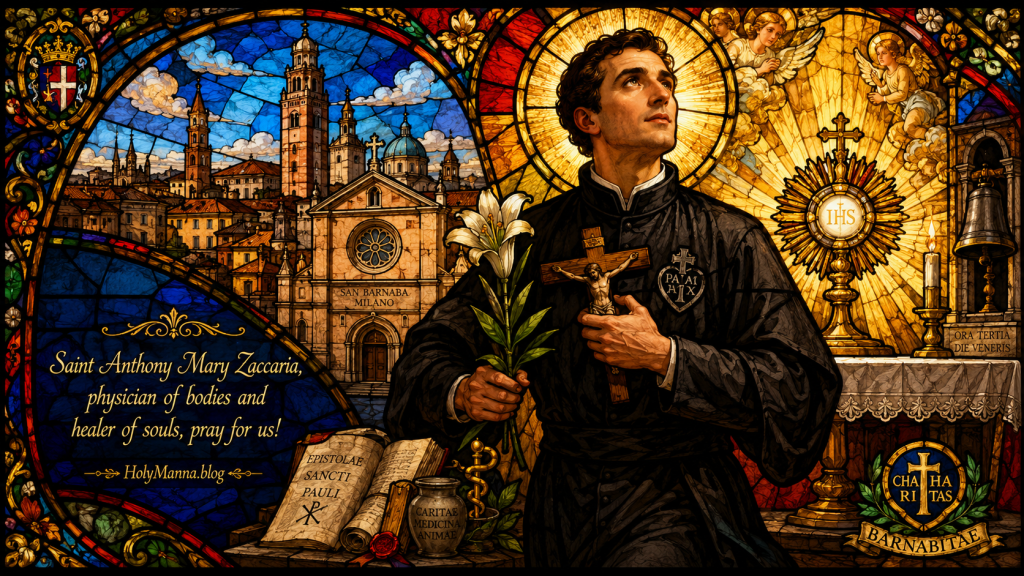
The Doctor Who Ran Like a Madman Toward God
Every so often, when the Church grows tired and cold, God raises up a soul on fire. In the early sixteenth century, when the clergy of northern Italy had grown lax and ordinary believers had drifted into a kind of spiritual sleep, that fire arrived in the form of a young doctor from Cremona named Anthony Mary Zaccaria. He had trained to heal the body, and he was good at it, earning his doctorate in medicine at only twenty-two. Yet the longer he sat at the bedsides of the sick and the dying, the more he became convinced that the deepest sickness in the people around him was not in their bodies at all. It was in their souls. So he set down his physician’s tools and picked up a far more demanding calling, becoming a priest, a preacher in the streets, and the founder of three religious families that still bear the mark of his zeal.
Saint Anthony Mary Zaccaria is remembered as one of the earliest voices of the Catholic Reformation, a man who refused to complain about the state of the Church and instead poured out his life to renew it. He is honored today as the patron saint of physicians, a beautiful nod to the profession he left behind for love of Christ, and as the father of the Barnabites. He gave the Church a renewed hunger for the Eucharist through the Forty Hours’ Devotion, a tender devotion to the Passion of Jesus, and a rallying cry that still stirs the heart. He wanted Christians to stop tiptoeing toward holiness and to sprint toward it instead. His feast is kept on the fifth of July.
The Boy Whose Mother Taught Him to See the Poor
Anthony was born in Cremona, in the region of Lombardy, in 1502, into a family of the nobility. His story turned sorrowful almost immediately. When he was about two years old, his father, Lazzaro, died, leaving his mother, Antonia Pescaroli, a widow at only eighteen. Rather than remarry or hand her son off to be raised by others, she devoted herself entirely to him. She taught him to pray, and she taught him to love the poor in a way that would shape the rest of his life. According to the accounts of his early biographers, she made the young Anthony her almoner, the one who personally carried the family’s charity to those in need, so that giving to the poor would never be an abstract idea to him but a face he had looked upon and a hand he had touched.
There is a story often told of his boyhood that captures this tenderness. On a cold day, returning home from church, the young Anthony is said to have met a shivering beggar who had almost nothing to wear, and, having no money on him, he took off his own fine cloak and wrapped it around the poor man’s shoulders. His mother, so the account goes, was moved to joy rather than anger at the loss of the costly garment, and her reaction encouraged him to make such generosity a lifelong habit. This is a cherished story passed down in his tradition rather than a documented historical event, and it cannot be verified.
He was a gifted student. He studied the humanities at home, philosophy at the University of Pavia beginning around 1520, and medicine at the celebrated University of Padua, where he received his doctorate in 1524. He returned to Cremona and began to practice as a physician, spending himself especially on the poor. Yet even as a doctor, his ministry was never only physical. He urged his patients to pray for healing, to receive the Sacraments, and to turn away from sin, tending the soul while he tended the body. He also gathered children to teach them the faith and began to preach, even as a layman, drawing people back to God. The pull toward a total gift of himself grew stronger, until at last he made a notarized renunciation of his inheritance, took up the study of theology, and prepared for the priesthood. He was ordained around 1528, with several accounts giving the precise date of the twentieth of February, 1529. The sources differ slightly on the exact year, and where they conflict it is honest to hold both possibilities rather than pretend to a certainty the records do not give.
The Priest Who Set a Sleeping City on Fire
Why should a Catholic today, five centuries later, remember Anthony Mary Zaccaria? Because he answers a temptation that every believer feels. When we look at a Church full of scandal, lukewarmness, and confusion, the easy response is to grumble, to withdraw, or to despair. Anthony did the opposite. He looked at the corruption of his age and decided that the remedy was not less zeal but more, not retreat but a bold and joyful advance. He is worth emulating precisely because he shows that renewal begins not with reforming everyone else but with a heart so captivated by Christ that it cannot sit still.
There is a story attached to his very first Mass that his community has treasured from the beginning. As he stood at the altar and reached the solemn moment of the consecration, those present are said to have seen a marvelous light surround him and a multitude of angels gathered about the altar. Some early accounts report that contemporary witnesses testified to it even after his death. It is best received as a pious tradition and a reported wonder rather than a fact established by historical documentation, and in that sense it cannot be verified. Yet it points to something the documented record confirms beyond doubt, which is that this was a man utterly consumed by love for the Eucharist.
In 1530 he moved to Milan, invited to serve as chaplain to the Countess Ludovica Torelli of Guastalla, and there his life’s work took shape. Joining a group devoted to spiritual renewal and guided by his Dominican confessor, Battista da Crema, he and two like minded noblemen, Bartolomeo Ferrari and Giacomo Antonio Morigia, laid the foundations of a new congregation of priests. Because his whole vision was drenched in the writings and spirit of the Apostle to the Gentiles, he named it the Clerics Regular of Saint Paul. The people of Milan, however, gave them the name that stuck, calling them the Barnabites after their church of Saint Barnabas. The congregation was approved by Pope Clement VII in 1533. Anthony did not stop there. Together with the Countess he founded the Angelic Sisters of Saint Paul, a community of uncloistered women approved by Pope Paul III in 1535, and he gathered married laypeople into the Laity of Saint Paul, so that priests, consecrated women, and ordinary families might all pursue holiness together and work side by side for the good of the Church.
His genius was to insist that renewal belonged to everyone, not only to the ordained. The Catechism teaches that lay people carry out a real evangelization by the witness of their lives in the ordinary circumstances of the world, and that this witness has its own particular power (CCC 905). Anthony grasped this centuries before it became a slogan, drawing husbands, wives, and working people into the heart of the mission. He preached in churches and in the open streets, performed public penances that startled his hearers into taking their faith seriously, and worked to renew the clergy from within. Above all he rekindled love for the Blessed Sacrament. He revived and spread the Forty Hours’ Devotion, forty continuous hours of prayer before the exposed Eucharist, and he encouraged frequent, even daily, Communion at a time when many received rarely. The Church holds that the Eucharist is the source and summit of the whole Christian life (CCC 1324) and that the faithful do well to adore the Lord truly present in this sacrament of love (CCC 1378). Anthony lived that conviction long before the Church expressed it in these words, teaching a tired city to kneel again before its Lord.
He loved the Cross with the same intensity. To keep the death of Jesus before the minds of the faithful, he revived the custom of ringing the church bells at three o’clock on Friday afternoons, the hour of Christ’s death, so that in the middle of an ordinary working day people would pause and remember the price of their redemption. The Catechism reminds us that Christ’s Cross is the one perfect sacrifice, and that the Lord calls his disciples to take up their own cross and follow him (CCC 618). That single ringing bell was Anthony’s way of pressing the Cross into daily life.
The Cost of Zeal and a Death Worn Out by Love
Anthony Mary Zaccaria was not martyred. It is important to say that plainly, because his story is so full of fire and opposition that one might expect it to end in blood. It did not. His suffering was of a different kind, the slow martyrdom of a man who simply gave himself away until there was nothing left.
His zeal made enemies. In an age of comfortable and sometimes corrupt clergy, a band of young priests who lived in poverty, roamed the streets preaching, and performed public penances was more than a little embarrassing to those who preferred the status quo. Anthony and his companions were accused of heresy and formally investigated, first in 1534 and again in 1537. Both times the charges collapsed, and both times the Paulines, as they were also called, were fully exonerated. He endured this opposition without bitterness. In the sermon of his that the Church still reads on his feast, he echoes Saint Paul and calls himself and his brothers “We are fools for Christ’s sake,” and then, rather than lashing out at those who attacked them, he urges his followers to love their opponents, to pray for them, and to overcome evil with good, keeping their eyes fixed on Jesus and running the race without losing heart. This is the heart of Christian holiness, for The Catechism teaches that the way of perfection passes by way of the Cross, and that there is no holiness without renunciation and spiritual battle (CCC 2015).
His most famous words come from a letter to his first companions, in which he begged them not to crawl toward heaven but to sprint. He wanted them, in his own vivid phrase, to run like madmen not only to God but also to their neighbor. This was no reckless enthusiasm. It flowed straight from the works of mercy, the charitable actions by which the Church says we come to the aid of our neighbor in both spiritual and bodily need (CCC 2447). For Anthony, love of God and love of the person right in front of you were never two separate races. They were one headlong run.
That run eventually consumed him. Years of severe fasting, penance, and unrelenting labor wore his body down. In 1539, while on a mission of peace to Guastalla, he was struck by a fever. Sensing that the end was near, he asked to be carried home to Cremona, traveling by boat up the river Po. He reached his mother’s house, the very house in which he had been born, and there, surrounded by his first companions, he died on Saturday, the fifth of July, 1539, at about three o’clock in the afternoon, the same hour of the day he had taught others to honor as the hour of Christ’s death. He was only thirty six years old, though a few older accounts give his age as thirty seven. His community treasures a tradition that in his final moments he was granted a vision of Saint Paul, the apostle he had loved and imitated all his life. That vision is a cherished part of his story rather than a documented fact, and it cannot be verified.
An Incorrupt Body and a Fire That Never Went Out
Anthony’s death was not the end of his story. In the years that followed, a number of cures and favors were attributed to his intercession, as believers who had known his holiness turned to him in prayer. The Church teaches that the saints in heaven, being more closely united to Christ, do not cease to intercede for us before the Father, offering the merits they gained on earth for our sake (CCC 956). The faithful of Milan and Cremona clearly believed this of Anthony, and they carried their needs to him.
The most striking sign came about twenty seven years after his death. In 1566, when his remains were exhumed, his body was found to be incorrupt, untouched by the decay that time should have brought. The Church does not treat bodily incorruption as a doctrine to be defined, but the faithful have long received such wonders as a sign of God’s favor toward a holy soul, and the veneration of the relics of the saints has an honored place in Catholic devotion (CCC 1674). His mortal remains were eventually enshrined in the Church of Saint Barnabas in Milan, the very church that gave his sons their name, and there pilgrims still come to pray near the body of the founder.
His cause moved forward over the centuries until Pope Pius IX declared him Blessed in 1849, and Pope Leo XIII solemnly canonized him in Saint Peter’s Basilica on the twenty seventh of May, 1897, though one older account records the date as the fifteenth of May of that same year. His feast is celebrated on the fifth of July, and because he died during the octave of Saints Peter and Paul, his memory is forever wrapped in the company of the great apostles he so admired.
His impact outlived his short years. The Barnabites, though never a large order, spread from Italy into France, Germany, Belgium, and eventually the Americas, choosing again and again to work among the poorest and the most forgotten. The Angelic Sisters and the Laity of Saint Paul carried his vision of a shared holiness into the world. The city of Cremona honored its son with a monument, and the small collection of his letters and sermons continues to feed the spiritual life of those who read them. Not bad for a country doctor who died before his thirty seventh birthday.
Learning to Run When You Would Rather Walk
The life of Saint Anthony Mary Zaccaria lands with particular force on anyone who has ever felt that their faith has gone lukewarm. He lived in a Church full of problems, and he could have spent his short life diagnosing them, the way a physician diagnoses a disease. Instead he became the cure. His holiness was not passive. It was an active, running, breathless pursuit of Christ that swept others along with it. His great gift to the modern believer is the reminder that the answer to a cold Church is a warm heart, and that renewal always begins with one soul deciding to stop making excuses.
Consider his habit of putting the Cross at the center of ordinary life. He asked people to pause at three o’clock on Fridays and remember what Jesus did for them. A reader today could take up something just as simple. When was the last time you let the death and love of Jesus interrupt the middle of your busy day? A quiet moment of prayer at three in the afternoon on a Friday, an intentional pause before the noise rushes back in, is a small and beautiful way to live in his spirit.
Consider, too, his love for the Eucharist. Anthony gave a sleeping city back its hunger for the Blessed Sacrament through adoration and frequent Communion. Is there a hunger for the Eucharist in your own life that has quietly faded, and could you feed it again with even fifteen minutes before the tabernacle this week? His whole priesthood was an invitation to draw near to the Lord who waits for us there.
And consider his tenderness toward those who opposed him. Falsely accused of heresy, he chose to pray for his accusers and to overcome evil with good rather than repay bitterness with bitterness. Who in your life is difficult to love right now, and what would it look like to heap good works upon them like burning coals of charity instead of nursing resentment? This is not weakness. It is the strength of a soul that has learned to run toward its neighbor and not away.
His most practical lesson may be the one hidden in a saying handed down from his own writings. That which God commands seems difficult and a burden. The way is rough; you draw back; you have no desire to follow it. Yet do so and you will attain glory. He knew that holiness rarely feels easy in the moment, and he refused to let that feeling have the final word. The next time obedience to God feels heavy, his voice from five centuries ago urges the reluctant heart to do it anyway, and to trust that glory lies on the far side of the effort.
Engage With Us!
The comments below are a wonderful place to continue this reflection, so please share your thoughts, your questions, and the ways Saint Anthony Mary Zaccaria’s example is speaking to your own walk with Christ. His story is meant to be lived, not just read, and hearing how it moves you may be exactly the encouragement another reader needs today.
- Anthony left a good and respectable career as a physician to answer a deeper call. Is there something God is quietly asking you to lay down so that you can pick up something greater?
- He wanted Christians to run like madmen toward God and neighbor rather than crawl. Where in your spiritual life have you settled for crawling, and what would running actually look like this week?
- He looked at a struggling Church and chose to be part of the cure instead of the complaint. What is one concrete way you could bring renewal to your parish, your family, or your own heart?
- He revived love for the Eucharist and the Cross in ordinary daily life. What simple, repeatable habit could you begin that keeps Jesus at the center of your everyday routine?
- Falsely accused, he still prayed for his accusers. Is there someone you need the grace to forgive and to love with the mercy of Christ?
May the burning zeal of Saint Anthony Mary Zaccaria set your own heart on fire, and may you never be content to walk when God is calling you to run. Go out into your ordinary day, into your work and your family and your neighborhood, and do everything, even the hard and unglamorous things, with the same love and mercy that Jesus poured out for you from the Cross. The world does not need more people who point at what is broken. It needs saints who run toward it with the healing love of Christ.
Saint Anthony Mary Zaccaria, physician of bodies and healer of souls, pray for us!
Follow us on YouTube, TikTok, Instagram and Facebook for more insights and reflections on living a faith-filled life.


Leave a Reply