Fourteenth Sunday in Ordinary Time – Lectionary: 100
The Gentle King and the Rest He Offers
Some kings arrive on warhorses, with trumpets blaring and armies at their backs. The King the Church meets this Sunday arrives on a borrowed donkey, and that single image carries the whole message of the day.
The central theme of the Fourteenth Sunday in Ordinary Time is the gentle and humble reign of God, a kingship that saves not by force but by mercy, and that offers rest to every weary heart. The prophet Zechariah, writing to a small and struggling people who had returned from exile in Babylon and were rebuilding their Temple, promised a king who banishes the warhorse and proclaims peace to the nations. King David, in the psalm, sang of a Lord whose reign lasts for all ages, who is gracious and merciful, and who raises up all who are bowed down. Saint Paul reminded the Christians in Rome that the same Spirit who raised Jesus from the dead now dwells within the baptized, giving life even to mortal bodies. And in the Gospel, the meek and humble Savior speaks the tenderest invitation in all of Scripture, calling the exhausted and the overloaded to come to him and find rest.
Together these readings sketch a portrait of a God who reigns from a place of lowliness, who reveals his deepest mysteries to the childlike rather than to the self sufficient, and who fits his yoke gently to the shoulders of anyone willing to learn from him. This is the King worth following, and this is the rest worth seeking.
First Reading — Zechariah 9:9-10
A Warrior’s Silence and a King’s Arrival
Picture a people who have just come home from decades of captivity. Their city is half rebuilt, their Temple is a construction site, and their memory of a mighty kingdom feels like a story from a grandparent. Into that fragile hope, the prophet Zechariah speaks a promise about a king who will change everything, and who will do it in the most unexpected way imaginable. Rather than a conqueror who tramples his enemies, this king comes lowly and peaceful, and the Church has always recognized his face as the face of Christ entering Jerusalem. The reading anchors the whole day in the paradox of a strength that looks like gentleness.
Zechariah 9:9-10 – New American Bible (Revised Edition)
The King’s Entry into Jerusalem
9 Exult greatly, O daughter Zion!
Shout for joy, O daughter Jerusalem!
Behold: your king is coming to you,
a just savior is he,
Humble, and riding on a donkey,
on a colt, the foal of a donkey.
10 He shall banish the chariot from Ephraim,
and the horse from Jerusalem;
The warrior’s bow will be banished,
and he will proclaim peace to the nations.
His dominion will be from sea to sea,
and from the River to the ends of the earth.
Detailed Exegesis
Verse 9: “Exult greatly, O daughter Zion! Shout for joy, O daughter Jerusalem! Behold: your king is coming to you, a just savior is he, humble, and riding on a donkey, on a colt, the foal of a donkey.”
The prophet addresses Jerusalem tenderly as a beloved daughter, and the command to rejoice is urgent and full. The reason for the joy is the arrival of a king who is both just and a savior, a ruler who sets things right and delivers his people. Yet the very next word turns every worldly expectation upside down, because this king is humble and arrives on a donkey rather than a warhorse. Kings rode horses into battle, but they rode donkeys in times of peace, so the animal itself is a message. The Gospel writers saw this verse fulfilled to the letter when Jesus rode into Jerusalem, and the Catechism teaches in CCC 559 that “Jesus conquers the Daughter of Zion, a figure of his Church, neither by ruse nor by violence, but by the humility that bears witness to the truth.”
Verse 10: “He shall banish the chariot from Ephraim, and the horse from Jerusalem; the warrior’s bow will be banished, and he will proclaim peace to the nations. His dominion will be from sea to sea, and from the River to the ends of the earth.”
Here the humble king reveals his program, and it is disarmament rather than domination. He removes the chariot, the horse, and the bow, the whole apparatus of war, from both Ephraim in the north and Jerusalem in the south, which together stand for the entire people. His mission is to proclaim peace to the nations, a peace that reaches even the Gentiles. The final line stretches his rule across the whole earth, from sea to sea and to the ends of the world, an unmistakable claim that this peaceful king is a universal king. The peace Christ brings is not merely the absence of conflict but the reconciliation of humanity with God.
Teachings
The Church reads this prophecy through the lens of Palm Sunday, and the Catechism draws the connection plainly. Reflecting on the entrance into Jerusalem, CCC 559 explains that the acclaimed “King of glory” enters his City “riding on an ass.” The lowliness is not a disguise that hides the king’s true power. The lowliness is the true power. A God who empties himself is stronger than any army, because he conquers hearts rather than territory. This is the same mystery Saint Paul would later sing in Philippians 2, that Christ “emptied himself, taking the form of a servant.” The warrior’s silence in Zechariah is the silence of a Savior who chooses the Cross over the sword.
Reflection
The gentle king asks a hard question of a culture that prizes dominance and image. He invites the reader to examine where genuine strength is being confused with force, control, or the need to win. Living out this reading might look like laying down a grudge that has become a private war, or choosing patience with a difficult family member instead of the last word. It might mean letting Christ reign in one corner of life that has stayed stubbornly barricaded. Where in your life are you still riding a warhorse when Christ is asking you to climb down onto a donkey? What weapon, whether it is sarcasm, resentment, or the drive to control, might the King be asking you to banish this week?
Responsorial Psalm — Psalm 145:1-2, 8-11, 13-14
A Song for a King Who Never Tires of Mercy
If the First Reading shows the King arriving, the psalm shows the heart of the one who prays to him. This is a psalm of praise attributed to David, and the Church places it here because it describes the very kind of ruler Zechariah promised, a Lord whose kingship is defined by mercy rather than menace. The psalm gathers up the whole day and turns it into worship, teaching that the right response to a gentle King is a heart that blesses him every single day. It carries the reader from the throne room of heaven down to the person who has stumbled and fallen.
Psalm 145:1-2, 8-11, 13-14 – New American Bible (Revised Edition)
The Greatness and Goodness of God
1 Praise. Of David.
I will extol you, my God and king;
I will bless your name forever and ever.
2 Every day I will bless you;
I will praise your name forever and ever.8 The Lord is gracious and merciful,
slow to anger and abounding in mercy.
9 The Lord is good to all,
compassionate toward all your works.
10 All your works give you thanks, Lord
and your faithful bless you.
11 They speak of the glory of your reign
and tell of your mighty works,13 Your reign is a reign for all ages,
your dominion for all generations.
The Lord is trustworthy in all his words,
and loving in all his works.
14 The Lord supports all who are falling
and raises up all who are bowed down.
Detailed Exegesis
Verse 1: “I will extol you, my God and king; I will bless your name forever and ever.”
David does not merely admire God from a distance, he crowns him as his own personal King. Praise here is not a passing mood but a lasting commitment that reaches into forever.
Verse 2: “Every day I will bless you; I will praise your name forever and ever.”
The word every is the key. Worship is meant to be daily bread rather than a rare feast, a steady rhythm that shapes ordinary time.
Verse 8: “The Lord is gracious and merciful, slow to anger and abounding in mercy.”
This line is the beating heart of the psalm, and it deliberately echoes the moment God revealed his own name to Moses. The Catechism recalls that scene in CCC 210, where the Lord proclaims himself “a God merciful and gracious, slow to anger, and abounding in steadfast love and faithfulness.” The God who reigns is patient with sinners by his very nature.
Verse 9: “The Lord is good to all, compassionate toward all your works.”
God’s goodness is not rationed to a favored few. It reaches every creature he has made, a universal tenderness woven into creation itself.
Verse 10: “All your works give you thanks, Lord, and your faithful bless you.”
Creation itself becomes a choir. The stars, the seas, and the faithful all lift a single hymn back to their Maker.
Verse 11: “They speak of the glory of your reign and tell of your mighty works.”
The faithful are not silent admirers but heralds. Those who know this King cannot help announcing his kingdom to others.
Verse 13: “Your reign is a reign for all ages, your dominion for all generations. The Lord is trustworthy in all his words, and loving in all his works.”
This everlasting reign matches the worldwide dominion Zechariah described. God’s kingship never expires and never fails, and every one of his words can be trusted completely.
Verse 14: “The Lord supports all who are falling and raises up all who are bowed down.”
Here the psalm bends low to reach the reader personally. This King does not stand above the fallen. He stoops to lift them, which is exactly what the Gospel invitation will do a moment later.
Teachings
The mercy proclaimed in verse eight is not sentimentality, it is the very identity of God. The Catechism teaches in CCC 211 that “By going so far as to give up his own Son for us, God reveals that he is ‘rich in mercy.’” The image in verse fourteen, of a Lord who raises up all who are bowed down, is the same movement the Blessed Virgin Mary would later praise in her Magnificat, where God lifts up the lowly. The King of the psalm and the King of Zechariah share one heart, tender toward the weak and endlessly patient with the sinner.
Reflection
The psalm gently corrects a picture many people secretly carry, of a God who is mostly disappointed in them. Praying these verses slowly can retrain the imagination to see a King who is slow to anger and quick to lift. A concrete practice is to begin each morning by blessing God for one specific mercy, making verse two a literal habit rather than a poetic idea. Another is to bring one area of failure to him, trusting the promise that he supports all who are falling. When you imagine God looking at you, what expression do you see on his face? Would you dare to let today’s psalm rewrite that image into the face of a King who bends down to raise you up?
Second Reading — Romans 8:9, 11-13
The Spirit of the Risen Christ Living Inside You
Saint Paul now takes the gentle reign of God and places it somewhere astonishing, inside the human soul. Writing to the Christians in Rome, he explains that belonging to Christ is not mainly about effort or willpower but about who is living within a person. The same divine power that shattered the tomb on Easter morning is described as dwelling in the baptized. This reading fits the day’s theme by showing that surrender to the humble King is not a defeat but a homecoming, because the King moves in and gives life. It answers the question of how anyone could ever carry even an easy yoke, and the answer is that the Spirit carries it with them.
Romans 8:9, 11-13 – New American Bible (Revised Edition)
9 But you are not in the flesh; on the contrary, you are in the spirit, if only the Spirit of God dwells in you. Whoever does not have the Spirit of Christ does not belong to him.
11 If the Spirit of the one who raised Jesus from the dead dwells in you, the one who raised Christ from the dead will give life to your mortal bodies also, through his Spirit that dwells in you. 12 Consequently, brothers, we are not debtors to the flesh, to live according to the flesh. 13 For if you live according to the flesh, you will die, but if by the spirit you put to death the deeds of the body, you will live.
Detailed Exegesis
Verse 9: “But you are not in the flesh; on the contrary, you are in the spirit, if only the Spirit of God dwells in you. Whoever does not have the Spirit of Christ does not belong to him.”
Paul draws a clear line between two ways of living. The “flesh” here does not mean the body, which God created good, but rather human nature curved in on itself and turned away from God. The decisive question is whether the Spirit truly dwells within, and Paul quietly reveals the Trinity by naming this same Spirit both the Spirit of God and the Spirit of Christ.
Verse 11: “If the Spirit of the one who raised Jesus from the dead dwells in you, the one who raised Christ from the dead will give life to your mortal bodies also, through his Spirit that dwells in you.”
This is one of the most hope filled sentences Paul ever wrote, and the Church treasures it. The Catechism quotes it in CCC 989 to teach that “our resurrection, like his own, will be the work of the Most Holy Trinity.” The Spirit is not only a comfort for now but a promise for the body’s future, a guarantee that death will not have the final word.
Verse 12: “Consequently, brothers, we are not debtors to the flesh, to live according to the flesh.”
Paul presses the practical point. A Christian owes the flesh nothing, and is under no obligation to obey its demands. The old master has no more legal claim on a freed soul.
Verse 13: “For if you live according to the flesh, you will die, but if by the spirit you put to death the deeds of the body, you will live.”
Two roads open here, one leading to death and one to life. The striking phrase is put to death, which the tradition calls mortification, yet Paul insists it is accomplished by the spirit and not by raw human grit. Even the dying to sin is a gift of grace, a work of the Spirit within.
Teachings
The Church has always guarded the goodness of the body against any suggestion that “flesh” means the physical is evil. The Catechism clarifies in CCC 990 that “the term ‘flesh’ refers to man in his state of weakness and mortality.” The battle Paul describes is against sin, not against the body God made and will one day raise. And because the indwelling Spirit does the heavy lifting, the Christian life is finally a partnership rather than a solo performance. The one who accepts the humble King receives the very power of Easter as a permanent guest.
Reflection
This reading reframes the whole struggle against sin. Instead of white knuckled self improvement, it invites a daily turning to the Holy Spirit who already lives inside the baptized soul. A practical step is to name one habit “according to the flesh” and, before fighting it, to ask the Spirit to do the putting to death from within. Frequent recourse to the sacraments, especially Confession and the Eucharist, keeps that indwelling Spirit at the center rather than the edge of life. If the same power that raised Jesus from the dead truly lives in you, how might that change the way you face your most stubborn temptation? What would it look like to stop fighting alone and start fighting from within his strength?
Holy Gospel — Matthew 11:25-30
The Tenderest Invitation Ever Spoken
Everything the day has been building toward arrives in these six verses. The humble King of Zechariah, the merciful Lord of the psalm, and the life giving Spirit of Romans all meet in the person of Jesus, who opens his own heart and calls it meek and humble. This Gospel comes right after Jesus had grieved over towns that refused to repent, so his words are not naive optimism but a deliberate turn toward the little ones who will receive him. He praises the Father for a stunning reversal, then extends an invitation so gentle that it has drawn the weary to Christ for two thousand years. It is the perfect crown for a Sunday about the gentle reign of God.
Matthew 11:25-30 – New American Bible (Revised Edition)
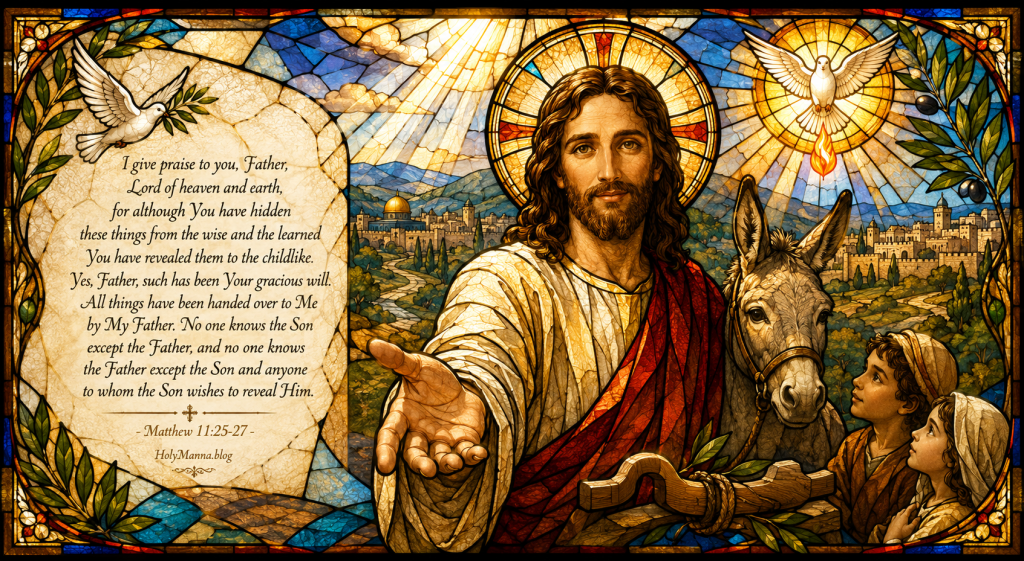
The Praise of the Father. 25 At that time Jesus said in reply, “I give praise to you, Father, Lord of heaven and earth, for although you have hidden these things from the wise and the learned you have revealed them to the childlike. 26 Yes, Father, such has been your gracious will. 27 All things have been handed over to me by my Father. No one knows the Son except the Father, and no one knows the Father except the Son and anyone to whom the Son wishes to reveal him.
The Gentle Mastery of Christ. 28 “Come to me, all you who labor and are burdened, and I will give you rest. 29 Take my yoke upon you and learn from me, for I am meek and humble of heart; and you will find rest for yourselves. 30 For my yoke is easy, and my burden light.”
Detailed Exegesis
Verse 25: “At that time Jesus said in reply, ‘I give praise to you, Father, Lord of heaven and earth, for although you have hidden these things from the wise and the learned you have revealed them to the childlike.’”
Jesus bursts into praise over a divine reversal. The self sufficient “wise and learned,” confident they need no teacher, miss the kingdom entirely, while the “childlike,” those humble enough to receive, are handed its secrets. The Catechism captures this in CCC 544, teaching that to the little ones “the Father is pleased to reveal what remains hidden from the wise and the learned.”
Verse 26: “Yes, Father, such has been your gracious will.”
Jesus does not merely accept this arrangement, he delights in it. The Father’s good pleasure, freely chosen, is something the Son celebrates rather than merely tolerates.
Verse 27: “All things have been handed over to me by my Father. No one knows the Son except the Father, and no one knows the Father except the Son and anyone to whom the Son wishes to reveal him.”
In a single breath Jesus reveals his divine identity. The mutual knowledge of Father and Son is total and unique, and no one reaches the Father except through the Son who chooses to reveal him. This verse is a window into the inner life of God and a quiet claim to full divinity.
Verse 28: “Come to me, all you who labor and are burdened, and I will give you rest.”
Now the tone softens into pure invitation. The call goes out to all who are exhausted and loaded down, whether by sin, sorrow, or the crushing weight of religious rules imposed by others. The promised gift is rest, the deep repose of a soul that has finally come home.
Verse 29: “Take my yoke upon you and learn from me, for I am meek and humble of heart; and you will find rest for yourselves.”
A yoke was the wooden harness that joined an animal to its work, and rabbis spoke of the “yoke of the Law.” Jesus offers his own yoke instead, which is discipleship to him. This is the only place in the Gospels where Jesus describes his own heart, calling it meek and humble, which is why CCC 459 names him the model of holiness in exactly these words, “Take my yoke upon you, and learn from me.”
Verse 30: “For my yoke is easy, and my burden light.”
The yoke is not weightless, but it is well fitted and carried together with Christ. Saint Augustine preached on this very passage and taught that humility is the foundation of everything, saying, “Thou wishest to be great, begin from the least. Thou art thinking to construct some mighty fabric in height; first think of the foundation of humility.” Love makes the burden light, because what is carried for someone loved never feels as heavy.
Teachings
The Fathers of the Church saw in this Gospel the secret of the whole Christian life. Saint Augustine insisted that what Christ asks the disciple to learn is not how to work miracles but how to be humble, and he taught that the higher a soul wishes to rise in holiness, the deeper it must first dig the foundation of lowliness. This is why the Catechism joins this text to the mystery of the Incarnation, presenting the meek and humble Christ as the pattern every believer is called to trace. The rest Jesus promises is not the rest of laziness but the rest of a heart that has stopped striving to be its own king and has finally accepted the gentle one.
Reflection
The invitation is stunningly personal, because Jesus does not say come to a system or a rulebook but come to me. A first concrete step is simply to accept the invitation as literally true and bring one specific burden to him in prayer today, refusing to carry it alone. A second is to practice a single act of hidden humility, choosing the lower place, which is how one actually “learns” from a meek and humble heart. Over time the yoke that once looked like a restriction reveals itself as an embrace. What is the heaviest thing you are carrying right now, and have you ever actually handed it to Jesus, or only talked about it? What would change if you believed his yoke really is lighter than the one you made for yourself?
Climbing Down onto the Donkey with Him
The whole of this Sunday can be held in a single picture. A King rides into his city on a donkey, and the crowd that recognizes him is made up of children and the poor, the very little ones to whom the Father loves to reveal his secrets. Zechariah promised that gentle King, and he abolished the weapons of war to proclaim a peace that reaches the ends of the earth. King David sang of him, praising a Lord who is slow to anger, rich in mercy, and always ready to raise up whoever has been bowed down. Saint Paul revealed the astonishing next chapter, that the Spirit of this risen King now dwells inside the baptized, giving life to mortal bodies and empowering the daily death to sin. And Jesus himself opened his heart and called it meek and humble, then held out the tenderest invitation ever spoken to a tired world.
The thread running through it all is that God reigns from lowliness, and that true rest is found not in escaping the yoke but in taking his. The wise and learned who trust only themselves walk right past this kingdom, while the childlike who dare to lean on Christ walk straight into it.
So the call to action is simple and searching. The reader is invited to climb down from every private warhorse this week, to bring one real burden to the one who promised rest, and to take up the easy yoke of a Savior who is gentle enough to be trusted with everything. The King is already riding toward each heart. The only question is whether the door of the city will be opened to him.
Engage With Us!
The team behind this reflection would love to hear how these readings are speaking to you, so please share your thoughts in the comments below. Honest reflections often become the very encouragement another reader needed on a heavy day.
- In Zechariah 9:9-10, the king arrives humble and riding on a donkey and banishes the weapons of war. What “weapon” of control, pride, or resentment might Christ be inviting you to lay down so that his peace can reign in you?
- In Psalm 145:1-2, 8-11, 13-14, the Lord is slow to anger and raises up all who are bowed down. When you picture God looking at you, does your image match the merciful King of this psalm, and if not, what needs to change?
- In Romans 8:9, 11-13, Saint Paul teaches that the Spirit who raised Jesus now dwells in the baptized. How would facing your most stubborn temptation from within the Spirit’s strength differ from fighting it alone?
- In Matthew 11:25-30, Jesus calls the weary to take his easy yoke and learn from his meek and humble heart. What is the heaviest burden you are carrying right now, and are you ready to hand it to him today?
- Considering all the readings together, they reveal a God who reigns through gentleness and offers rest to the lowly. Where is Christ asking you to trade your own kingship for his, and to find your rest in him?
Living a life of faith is far less about carrying heavier loads and far more about carrying them with the meek and humble King who never lets go of the yoke beside you. May every reader move through this week doing all things with the love and the mercy that Jesus taught, trusting that the gentle One who lifts up the bowed down is walking each step alongside them.
Sacred Heart of Jesus, we trust in You!
Immaculate Heart of Mary, pray for us!
Saint Michael the Archangel, defend us in battle!
Follow us on YouTube, TikTok, Instagram and Facebook for more insights and reflections on living a faith-filled life.


Leave a Reply