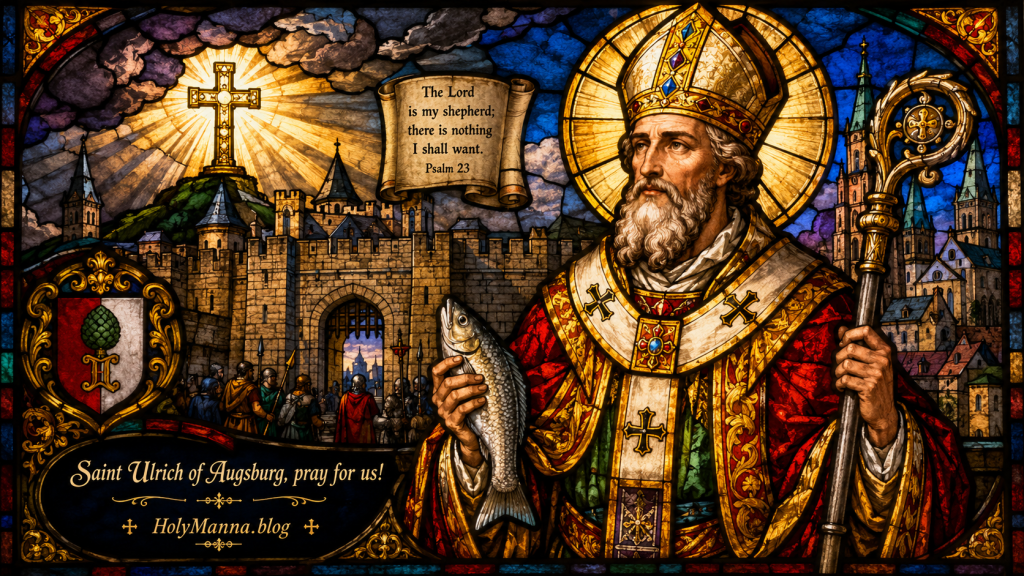
The Bishop at the Gate
Every so often the Church gives us a saint who quietly changed the way she does things, and Saint Ulrich of Augsburg is exactly that kind of figure. He was a bishop in tenth century Germany, a tireless shepherd who spent roughly fifty years caring for one diocese, and yet his name carries a distinction that belongs to no one who came before him. He was the very first saint ever canonized by a pope. For a thousand years the Church has followed the path his cause first opened, and most Catholics have no idea that the road runs back to a humble bishop from a city called Augsburg.
His life is worth knowing for more than that milestone, though. Ulrich is the bishop who stood at the gate of his city when everyone had every reason to run. He is the reformer who cleaned up a struggling clergy not with speeches but with the plain force of his own holiness. He is the friend of the poor who kept nothing back for himself. And in the art of the Church he is almost always shown holding a fish, a detail that comes from one of the most charming stories ever attached to a saint.
The faithful honor him as the patron of the city and the Diocese of Augsburg, and as a co-patron of the Diocese of Paderborn. Beyond that his patronage stretches surprisingly wide. He is invoked as a protector of pilgrims and travelers, of the dying and all who long for a peaceful and holy death, of weavers, of fishermen, and of those who tend the vineyards. Expectant mothers turn to him in difficult births, and over the centuries people have called on him against fever, against dizziness and faintness, against diseases of the eyes, against the bite of rabid animals, against floods and violent storms, and even against plagues of mice and rats. That long and almost homely list tells you something about how close his people felt to him. Ulrich was the kind of saint you called on for the ordinary troubles of an ordinary day.
A Sickly Boy Sent to the School of Saint Gall
Ulrich was born around the year 890, most likely at Kyburg near Zürich in what is now Switzerland, into a family of real standing. His father was Count Hupald, also written Hucpald, and his mother was Dietpirch of Swabia, sometimes called Theoberga. The family was tied by blood to the dukes of Alamannia and to the imperial house that would soon produce Otto the Great. A sister of his gave her life to God as a nun. This was a household where faith and nobility ran together, and it shaped the boy in both directions at once.
He was, by every account, a sickly child. In keeping with the custom of the age, his parents offered him to the Church while he was still very young, and at the age of seven he was sent off to the famous monastery school of Saint Gall. Something happened there that surprised everyone. The frail little boy turned out to be a gifted student, and the discipline of monastic life, far from breaking him, seemed to strengthen him in body and soul alike. He grew into a young man capable of the long labors and the deep prayer that would define the rest of his years.
While he was at Saint Gall he became friends with a holy recluse named Wiborada, herself a saint, who lived a life of prayer near the monastery. Tradition holds that she looked at her young friend and foretold that he would one day be a bishop. That story cannot be verified with certainty, but it fits the pattern of a life that seemed marked out from the beginning for the shepherd’s staff.
Ulrich felt the pull toward the priesthood and wrestled with how to answer it. He was uncertain whether to enter the Benedictine life at Saint Gall or to serve as a diocesan priest out among the people. In the end he was sent for further training to his kinsman Adalbero, the Bishop of Augsburg, who made him his chamberlain. When Adalbero died in the spring of 910, Ulrich returned home, and there he waited through more than a decade of ordinary life. God, it turned out, was simply getting him ready.
The Shepherd Who Led by Example
The waiting ended in 923. Through the influence of his uncle Burchard, Duke of Alamannia, and other relatives, Ulrich was named Bishop of Augsburg by King Henry the Fowler, and he was consecrated on the twenty eighth of December that year. He would hold that office for half a century, and the see of Augsburg reached the height of its splendor under his care.
The best short description of him as a bishop comes from the older Catholic accounts, which say that he was a ruler who united severity with gentleness. He found a clergy that had grown lax in both moral and social life, and he set out to reform them. What makes Ulrich such a compelling figure is how he did it. He did not rely on harsh decrees or grand pronouncements. He raised the standard of his priests by raising the standard of his own life, and holiness has a way of spreading when people can actually see it. He reformed the schools and founded new ones, he held synods and made his visitations parish by parish, and above all he set an example that shamed no one but quietly called everyone higher.
His personal austerity was remarkable, and it was never for show. The Roman Martyrology praises him especially for temperance, liberality, and vigilance, and the accounts of his life fill in what those words meant in practice. He slept only a few hours on a bed of straw and spent much of the night in prayer. He wore wool and a rough hair shirt rather than fine linen. He took a single simple meal, and by tradition he never ate meat himself, though he made sure it was served to guests and to the poor. So complete was his frugality that one old account says his whole life could be called one continued fast. Whatever remained of his income after he had rebuilt his churches went straight to the needy, for whom he provided grain, clothing, and shelter. Some of the poor ate at his own table every day, and there were times when the bishop himself waited on them while a holy book was read aloud.
The fish that appears in nearly every image of Saint Ulrich comes from a beloved story about this very austerity, and it is a story rather than a verified fact, so it is best received in that spirit. As it is told, Ulrich was once so absorbed in holy conversation with the Bishop of Constance, often named as Saint Conrad, that the two men talked straight through the night and into the beginning of a fast day. A servant then appeared with a piece of meat, and by tradition his motive was not kindness at all. He meant to trap the two holy men, to catch them eating meat when the fast forbade it, so that he could go off and ruin their good names. When the meat was placed into Ulrich’s hands, the story says, it changed into a fish, so that the slanderer was exposed and the saint was shown to be innocent. That tale cannot be verified, yet it has been told with delight for centuries, and it carries a truth worth keeping. A man who guards his integrity when no one is watching has nothing to fear from those who would twist the truth against him.
When the City Would Not Fall
Ulrich lived in dangerous times, and his faith was tested not by a single dramatic martyrdom, for he died peacefully in his bed, but by a long series of hardships that would have crushed a lesser man. He remained loyal to Emperor Otto the Great through the bitter revolt of Otto’s own son Liudolf, and he suffered real harm from Liudolf’s partisans for that loyalty. When father and son stood ready to make war on each other in the summer of 954, it was Ulrich, together with another bishop, who stepped into the middle of the quarrel and worked to make peace, persuading the rebels to seek the king’s pardon. He was a man who spent himself trying to hold a fracturing world together.
Then came the moment for which he is most remembered. In the year 955 the Magyars, the fierce raiders from Hungary, poured into Germany, burning and plundering as they came, and they laid siege to Augsburg. The city stood in real danger of destruction, and many people were gripped by terror. Ulrich did not run. He took the lead in the defense himself, and the sight of it must have been unforgettable. On the first day of the attack the bishop rode out to the gate, dressed not in armor but in his ecclesiastical robes, to encourage the soldiers guarding the city. While the fighting raged around him he steadied his frightened men with the words of the psalm, “Even though I walk through the valley of the shadow of death, I will fear no evil, for you are with me” (Psalm 23:4).
The heaviest fighting fell on the eastern gate, where the defenders held firm, struck down the leader of the assault, and forced the raiders back. That night, rather than resting, Ulrich directed the repair and strengthening of the walls so the city could survive another day. It was his courage and his leadership, more than anything else, that allowed Augsburg to hold out until the emperor could bring his army south. On the tenth of August the imperial forces broke the Magyar advance for good at the Battle of Lechfeld.
Here it is worth being careful, because a later story grew up that placed Ulrich himself in the thick of that famous battle, carrying a relic of the True Cross given to him by an angel. The sober Catholic sources make clear that Ulrich did not fight at Lechfeld, and could not have. His heroism belonged to the siege of the city, to the bishop at the gate in his vestments, unarmed except for the word of God on his lips. That truth is more powerful than the story that tried to improve on it, and it is the one worth telling.
Even after such glory, Ulrich was not spared humiliation, and the way he bore it may be the holiest thing about him. Late in his life, worn down by illness and longing to retire, he appointed his own nephew as his coadjutor to help carry the burden of the diocese. At a great assembly in 972 he was charged with nepotism, and a synod ruled that the arrangement was not permitted under Church law. Ulrich did not bristle or defend his honor. He submitted, he did penance like any other sinner, and word of his reconciliation reached him near the very end of his life. A celebrated bishop, the hero who had saved his city, humbling himself and accepting correction. That is a rare and beautiful thing to see.
One more shadow deserves a word, because it still circulates today. About a hundred years after his death, a forged letter appeared under Ulrich’s name, arguing against priestly celibacy. The forger was counting on Ulrich’s reputation for strictness to give the argument weight, hoping people would think that if so rigorous a saint opposed celibacy, then the discipline must be unjust. The Catholic sources are clear that the letter was a fraud, and that Ulrich in fact held that discipline firmly, upon himself first of all.
His holy death, when it came on the fourth of July in 973, was as deliberate and prayerful as his life had been. As morning broke, Ulrich had ashes strewn on the ground in the shape of a cross and sprinkled with holy water, and he was laid upon it. His nephew Richwin arrived at sunrise with a greeting from the young emperor, and at that very moment, while the clergy sang the Litany, Saint Ulrich passed from this world. He was buried in the Church of Saint Afra, which he himself had rebuilt, and the funeral was carried out by another great saint of that age, Saint Wolfgang, the Bishop of Regensburg.
Wonders at the Tomb and a First for Rome
The story of Saint Ulrich did not end at his grave. It might be truer to say it began there. Almost at once, the faithful began reporting wonders at his tomb in the Church of Saint Afra. The near contemporary account of his life, written by Gerhard of Augsburg within a decade of his death, gathers roughly thirty miracle reports connected to his memory, including cures of blindness, of paralysis, and of fever, along with accounts of the possessed being set free at his shrine. The pilgrims came, and they kept coming.
Around that flourishing devotion grew a whole cluster of popular stories and customs, and these belong to tradition rather than to documented fact, so they are best received as the tender folk piety they are. In Swabia people came to believe that earth taken from his grave, if scattered in a house or a field, would drive away rats and mice, and so much of it was carried away over the centuries that the custom became famous. Tradition also held that expectant mothers who drank from his chalice were granted easier deliveries, which is where his patronage of pregnant women was born, and that the touch of his pastoral cross could heal those bitten by rabid dogs. None of these can be verified, and yet each one shows a people who trusted their holy bishop with the smallest fears of daily life.
The greatest thing that happened after his death, though, was not a folk story at all. It was an act of the Church that changed her history. Barely twenty years after Ulrich died, his cause was judged at a Lateran synod at the very start of the year 993, and Pope John XV issued a confirming decree naming him a saint. With that act Ulrich became the first person the Church knows to have been canonized by a pope rather than by a local bishop or a regional authority. This did not mean there had been no saints before. Local churches had honored their holy dead for centuries. What it meant was that Ulrich’s case became the pattern for a more careful, more universal process, the process that in time became the canonization the whole Church now follows.
That is a good moment to remember what canonization actually is, because it is often misunderstood. The Church does not make a person holy by canonizing them. She recognizes a holiness that God has already worked. The Catechism of the Catholic Church teaches that when the Church canonizes the faithful, she solemnly proclaims that “they practiced heroic virtue and lived in fidelity to God’s grace”, and she does so in order to hold them up as “models and intercessors” for the rest of us (CCC 828). In Ulrich the Church saw exactly that heroic virtue, and in naming him she gave the whole world a new friend in heaven and a new pattern for honoring the saints.
His relics were given a place of even greater honor in 1187, when they were transferred to a newly built church in Augsburg, the great basilica now known as Saints Ulrich and Afra, where his grave remains a place of pilgrimage to this day. His memory took visible form in another way as well, through small souvenir crosses called Ulrich crosses, which pilgrims received at his tomb. These were modeled on that relic of the True Cross kept in the basilica, and by later centuries they were carried as blessed objects for protection against misfortune. Pilgrims also gathered water from springs named for him in the Swabian countryside, water they believed could help diseases of the eyes, and they received a blessed wine known as Ulrich wine, taken for health and unity. Whatever one makes of these customs, and many of them belong to tradition rather than certainty, together they paint a portrait of a saint woven deep into the ordinary life of his people.
That devotion never really faded. A special liturgical office was composed for his feast within a couple of generations, litanies across southern Germany begged his prayers, and an old litany printed at Augsburg gave him honorific titles that capture how his people saw him, calling him the shield of the city, the physician of the sick, and the comforter of the afflicted. His feast is still kept on the fourth of July, most warmly of all in the Diocese of Augsburg, where he is honored as its patron. The communion of the saints is no distant abstraction here. As the Catechism reminds us, those who have gone before us into the kingdom “constantly care for those whom they have left on earth” (CCC 2683), and for more than a thousand years Ulrich has been doing exactly that for the people who call on him.
What the Bishop at the Gate Still Teaches
It is easy to read the life of a saint like Ulrich and feel that he belongs to a world impossibly far from the one you live in, a world of sieges and emperors and monastery schools. Look a little closer, though, and his life turns out to be full of lessons that land squarely in the middle of an ordinary modern one.
The first is the sheer power of quiet example. Ulrich reformed a whole clergy not by scolding them but by outloving and outpraying them, by letting his own holiness set a standard that words never could. That is a challenge worth sitting with. The people around you, at home and at work and in your parish, are shaped far more by what they see you do than by anything you tell them to do. Where in your life are people watching to see whether your faith is real, and what would change if you decided to lead them by example rather than by argument?
The second lesson is the courage of the bishop at the gate. Ulrich did not run when his city shook, and he faced the danger armed with nothing but his vestments and the word of God. Most people will never face an army, but everyone faces moments of fear when the honest and faithful thing is also the frightening thing. The saint at the gate reminds you that courage is not the absence of fear but the decision to stand anyway, trusting that the Lord walks with you even through the valley of the shadow of death. What is the gate you have been avoiding, and what would it look like to stand there and refuse to run?
The third lesson is the humility of a great man accepting correction. Ulrich had every worldly reason to defend his reputation when he was charged near the end of his life, and instead he simply submitted and did penance. That kind of humility is almost countercultural now, in an age that treats every criticism as an insult to be repelled. There is deep freedom, though, in a heart that can say it was wrong and make things right. When you are corrected, do you rush to defend yourself, or can you receive it the way Ulrich did, as a chance to grow in holiness?
Finally there is his tender care for the poor, the meals shared at his own table, the grain and clothing and shelter provided out of what he refused to keep for himself. Holiness always ends up looking like love made practical. You do not need a bishop’s income to live that way. You need only the willingness to keep a little less for yourself and to see the person in front of you the way Ulrich saw the poor at his table. The saints are not meant to be admired from a safe distance. They are meant to be imitated, one small and stubborn act of love at a time.
Engage With Us!
The story of Saint Ulrich is really an invitation, and the best way to answer an invitation is to respond. Take a moment to share your thoughts and reflections in the comments below, because your voice may be exactly the encouragement another reader needs today.
To help you go a little deeper, sit with these questions and let them work on your heart:
- Ulrich reformed those around him mostly through the example of his own life. Who in your life is quietly watching your faith, and what example are you setting for them?
- When fear meets you at the gate, whether in your family, your work, or your prayer, where do you turn for courage, and how might the words of Psalm 23 steady you the way they steadied Ulrich?
- The saint accepted an unjust sounding charge with humility and penance rather than pride. When was the last time you received correction gracefully, and what would it take to grow in that virtue?
- Ulrich kept almost nothing for himself and gave the rest to the poor. What is one concrete thing you could give up this week so that someone in need is fed, clothed, or comforted?
Whatever season of faith you find yourself in, remember that a saint like Ulrich was once an ordinary, sickly boy who simply kept saying yes to God, one day at a time. You can do the same. Go out and stand at your own gate with courage, serve the people God has placed in front of you, and do everything, every task and every act of mercy, with the love and mercy that Jesus taught us. Heaven is cheering you on, and you are never standing at that gate alone.
Saint Ulrich of Augsburg, pray for us!
Follow us on YouTube, TikTok, Instagram and Facebook for more insights and reflections on living a faith-filled life.


Leave a Reply