The Queen Who Traded a Crown of Gold for a Crown That Never Fades
Every so often the Church hands down a life that reads less like a dusty history lesson and more like a story worth telling around a table with good friends and a pot of coffee. Saint Elizabeth of Portugal is exactly that kind of saint. Known in her homeland as Rainha Santa Isabel, the Holy Queen Elizabeth, she wore a real crown, ruled beside a real king, buried a husband who broke her heart for years, and still became one of the most tender and courageous peacemakers the Middle Ages ever produced. Hers is not the story of a woman who ran from the world into a quiet cloister. Hers is the story of a woman who found holiness in the middle of palace intrigue, family war, and a marriage that would have crushed almost anyone else.
She is remembered above all by a single title that fits her like a glove, and that title is “the Peacemaker.” She earned it honestly, by placing her own aging body between armies drawn up for battle. The faithful have long invoked her as the patron of peace and reconciliation, of widows, and of brides and newlyweds. Those trapped in difficult and painful marriages turn to her with great confidence, and so do the falsely accused and the victims of adultery and jealousy. Charitable societies and their workers claim her as their own patron, and she is honored as a co-patron of the Diocese of San Cristóbal de La Laguna in the Canary Islands. Her feast is celebrated on July 4, though in the United States it is kept on July 5 so that it does not collide with Independence Day. When the Lord Jesus said, “Blessed are the peacemakers, for they will be called children of God” (Mt 5:9), He could have been describing the whole shape of her days.
A Princess Born to Bring People Back Together
Elizabeth came into the world on January 4, 1271, in Aragon, in what is today part of Spain. Her father was the man who would become King Peter III of Aragon, remembered by history as Peter the Great, and her mother was Constance of Sicily, a granddaughter of the Emperor Frederick II. This was royalty at the very top of the medieval world, and Elizabeth was surrounded by power from her first breath. She was named after her famous great-aunt, Saint Elizabeth of Hungary, the young landgravine who had given everything to the poor and died at only twenty-four. That name would turn out to be a kind of prophecy.
There is a beautiful story handed down about her birth. Her grandfather, King James I of Aragon, had fallen into a bitter quarrel with her father over her parents’ marriage, and the two men had refused to speak. When baby Elizabeth was born, the joy over the child is said to have melted the ice between grandfather and father and brought the family back together. It is a lovely tale that captures who she would become, though it should be received as a cherished story rather than as documented fact, since it cannot be verified.
What can be said with confidence is that Elizabeth was serious about God from the time she was very small. She was not a saint who needed a dramatic conversion later in life, with some thunderbolt on a road. Instead she simply kept deepening. As a girl she prayed the full Divine Office every single day, the same rhythm of psalms that monks and priests pray. She fasted on the days the Church prescribed, she gave herself to penance, and she went to Mass faithfully. While other children of the court chased amusements, this little princess was already learning to prefer the things of Heaven. She was gentle and warm rather than harsh, and even as a child her charity toward the poor and the suffering set her apart. Her holiness was never cold or stiff. It was the kind that made people feel loved.
A Marriage That Became a Furnace of Holiness
When Elizabeth was still very young, her marriage to King Denis of Portugal was arranged. The betrothal came around 1282, when she was only eleven, and the wedding itself was celebrated in 1288, when she was seventeen and Denis was twenty-six. Denis was no small figure. He was a gifted poet, a hardworking ruler, and a builder of his nation. The people fondly called him Rei Lavrador, the Farmer King or Working King, because he planted forests to protect the soil, rebuilt cities scarred by war, and founded the university that would eventually become the great University of Coimbra.
For all his gifts, Denis carried a serious flaw. He was unfaithful to Elizabeth, and he fathered several children outside their marriage. The royal court around him was, by the honest account of the old chroniclers, a corrupt and immoral place. Imagine being a devout teenage bride dropped into that world. Elizabeth grieved, but here is the detail that reveals the depth of her heart. The chroniclers tell us she was pained less by the wound to her own pride and more by the fact that her husband was offending God. She kept her sorrow almost entirely to herself, pouring it out to God alone in patient prayer rather than in bitter complaints to the court.
Her response to his infidelity is almost startling. Rather than nursing resentment, she is said to have shown remarkable kindness even to some of his illegitimate children, helping to care for them alongside her own. Her own two children were Constança, who would marry King Ferdinand IV of Castile, and Afonso, who would one day rule as King Afonso IV of Portugal. Through years of gentleness, forbearance, and unfailing prayer, Elizabeth quietly worked on her husband’s hardened heart. The change did not come quickly. The old accounts admit that Denis only reformed late in life. Yet reform he did, and he died repentant, with Elizabeth nursing him faithfully to the end. Here is a woman who proved that a wife’s holiness, lived without nagging and without despair, can be a slow and steady flame that finally warms even the coldest hearth.
Bread, Roses, and the Hands That Touched the Untouchable
If you want to understand what Elizabeth did with her days as queen, look at where she spent her money and her time. She founded a convent of Poor Clares at Coimbra, and around it she built a whole world of mercy. There was a hospital for the sick, an orphanage for children left alone, a hospice for the aged poor, and a shelter for women who had nowhere else to turn. She did not simply write checks from a safe distance either. The accounts say she drew up the plans herself and oversaw the building, so much so that later scholars point to a distinct architectural style they connect to her patronage.
Her charity was deeply personal and often startling. There is a story that she would bring lepers into her own rooms, wash and bandage their wounds with her own hands, dress them in clean clothes, and feed them. One account tells of her washing the foot of a sick woman whose flesh was eaten away by a terrible sore. When the woman was ashamed to show the ruined foot, Elizabeth gently insisted, washed the wound, and kissed it, and the accounts say the wound was healed in that very moment. This is a treasured story of the queen’s charity, and it deserves to be shared, though it belongs to the devotional tradition and cannot be independently verified.
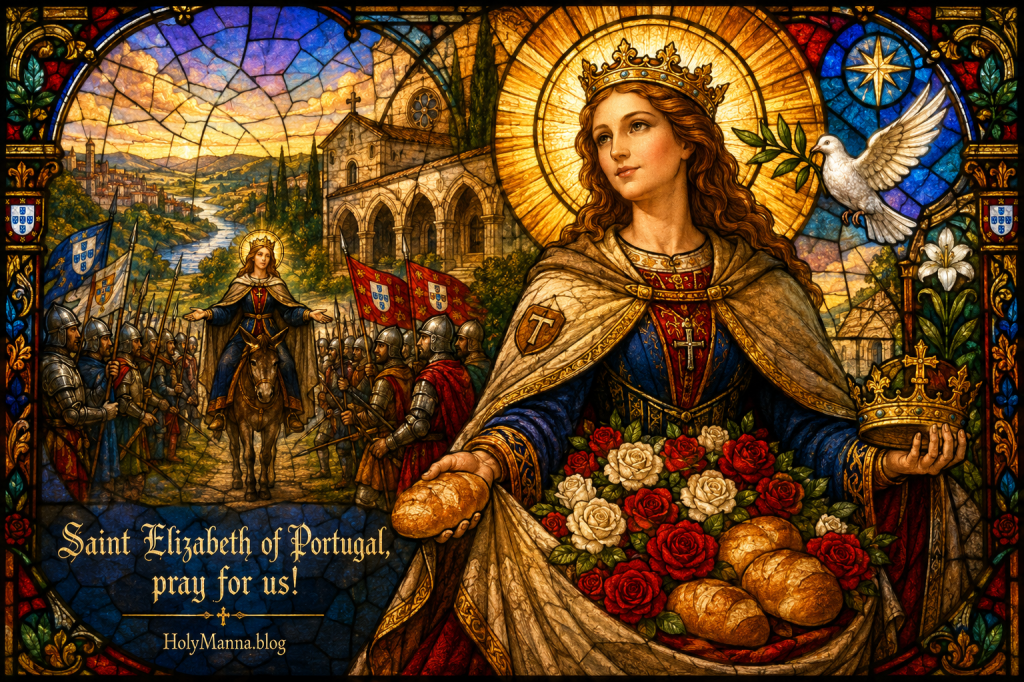
The most famous story of all is the one Portugal has loved for centuries, the story often called the Miracle of the Roses. As the tale goes, Elizabeth was carrying bread hidden in her cloak to give secretly to the poor when King Denis stopped her and demanded to know what she was hiding. She answered that she carried roses. It was the dead of winter, when no roses bloom, and when she opened her cloak the bread had become a spill of fresh roses. It is a gorgeous image, and the great painter Zurbarán captured it in a canvas that still hangs in the Prado in Madrid. Honesty requires a gentle note here. This exact story is also told, almost word for word, of her great-aunt Saint Elizabeth of Hungary and of a few other holy women, and the more careful lives of the saints do not include it. It is best loved as a beautiful story of her hidden generosity rather than as a verified historical event, and it cannot be verified.
Whether or not the roses bloomed, the meaning behind them was absolutely real, because Elizabeth truly did carry bread to the poor and truly did pour out her wealth on the least of the least. She was living out the words of Jesus, “Whatever you did for one of these least brothers of mine, you did for me” (Mt 25:40). Her Marian devotion ran just as deep. In the year 1320 she obtained from the Bishop of Coimbra a formal celebration of the Immaculate Conception of Mary on December 8, a devotion she helped spread through Portugal centuries before the Church solemnly defined that dogma in 1854. This queen was ahead of her time in loving Our Lady.
The Woman Who Rode Between Armies
Elizabeth’s greatest public gift was making peace, and she did it again and again when the men around her were ready to shed blood. Early in her reign she played a decisive role in the reconciliation that led to the Treaty of Alcañices in 1297, which settled a dangerous dispute between Portugal and Castile. Her most dramatic act of peacemaking came within her own family. Her son Afonso rose in rebellion against his father Denis, and the two sides took the field against each other. Rather than wringing her hands in the palace, the queen climbed onto a mule and rode out to place herself physically between the two armies, refusing to move until father and son laid down their weapons. Picture the scene. A queen on a simple mule, out in the open between spears and swords, staking her own life to stop a war. That is not sentiment. That is holiness with dust on its boots.
The Church teaches that this longing for peace is no soft or optional thing. The Catechism reminds us that “Peace is not merely the absence of war” (CCC 2304), and it borrows from Saint Augustine the beautiful description of peace as the tranquility of order. Elizabeth understood this in her bones. For her, peace was not simply the moment the fighting stopped. It was the fruit of justice, of charity, and of a heart surrendered to God. She built that kind of peace in her home, in her court, and between kingdoms, and she paid for it with her own comfort and safety.
The Slandered Queen and the Long Road Home
No life this luminous passes without suffering, and Elizabeth carried real crosses. Beyond the long ache of her husband’s unfaithfulness, there is a striking story of how she was slandered at court. According to the tale, a jealous page told a lie about the queen, accusing her of improper closeness with another page. King Denis, believing the lie in a fit of anger, ordered the young man he thought guilty to be thrown into a lime burner’s furnace. On his way to that death, the innocent page stopped to attend Mass, as was his holy habit, and stayed for a second Mass as well. Meanwhile the wicked page who had told the lie was sent by the king to check whether the sentence had been carried out, and he arrived first. In the strange justice of the moment, it was the slanderer who was thrown into the furnace, while the innocent man was spared. When the truth came out, the king saw the hand of God protecting his wife’s honor. It is a powerful story of divine justice and the vindication of the innocent, and it belongs to the popular tradition surrounding the saint, so it cannot be verified.
When King Denis finally died in 1325, Elizabeth did not cling to the trappings of royalty. She made a pilgrimage to the shrine of Santiago de Compostela, and then she embraced the poverty of Saint Francis by becoming a Third Order Franciscan, living simply in a house she had built beside her Poor Clare convent at Coimbra. She spent those widowed years in prayer, penance, and endless service to the needy, welcoming everyone who came to her for counsel.
Elizabeth was not a martyr in the sense of dying by the sword, yet the way she died is its own quiet form of laying down her life. In 1336, when she was already old and frail, her son, now King Afonso IV, marched toward war against her grandson, Alfonso XI of Castile. Despite her age and the brutal summer heat, Elizabeth insisted on traveling to Estremoz to stand once more between warring kings and beg for peace. She succeeded. She stopped the war one final time. The journey, however, drained the last of her strength, and she was struck down by a fever. Tradition tells us that as she lay dying she asked a companion to bring a chair for Our Lady, whom she said had appeared to her in glory. After reciting the Creed, she breathed her last words, “Maria, mater gratiae,” which means “Mary, Mother of grace.” She died on July 4, 1336, her life poured out for peace to the very end.
The Queen Who Would Not Decay
The stories of Elizabeth did not end at her tomb. As her body was carried on the long summer journey back to Coimbra to be buried in the convent she had founded, her family feared it would quickly decay in the heat. Instead, according to the accounts, a sweet and unexplained fragrance rose from the coffin, and those who carried her began to sense that they were bearing not mere remains but relics. Miracles and healings were reported at her tomb almost immediately after her burial. These early wonders belong to the devotional record and cannot be independently verified, yet they were taken so seriously that they helped carry forward her cause for sainthood.
The most remarkable sign came much later. In the year 1612, nearly three centuries after her death, her tomb was opened before doctors, church officials, religious sisters, and many witnesses. Her body was found to be incorrupt. One account describes a slightly opened eyelid revealing green eyes, and a few golden locks escaping her headdress, as though she were only sleeping. Her body was examined again as recently as 1912, and the examiners once more reported that it remained free of decay. Because the Mondego River kept flooding her first resting place, the Poor Clares moved her remains uphill in 1677 to the Monastery of Santa Clara-a-Nova in Coimbra, where she rests today in a magnificent tomb of silver and crystal. Her incorrupt right hand, visible through the tomb, has long been the focus of loving devotion, and many cures have been attributed to her intercession by those who came to pray there. The reports of her incorruption come from these examinations and from the tradition of the faithful, and the specific healing stories connected to her relics cannot be independently verified.
The Church moved carefully, as she always does. Elizabeth was beatified in 1516, and she was canonized by Pope Urban VIII in 1625. Her feast was placed on July 4, the day of her holy death. There is a quiet poetry in that date for readers who know it now as a day of national celebration in the United States. Long before July 4 meant fireworks and freedom for a young nation, it belonged to a queen who taught the world that the truest freedom is freedom from sin and from the tyranny of our own pride. Her memory is woven into the life of Portugal, where the people of Coimbra still honor her with candlelight processions, and her image, holding roses in her lap, has inspired artists and pilgrims for centuries. She remains a national treasure and a heavenly friend to a whole nation.
Wearing the Crown That Never Fades
It would be easy to admire Saint Elizabeth from a comfortable distance and leave it there, but her life is far too practical for that. She speaks directly to the ordinary struggles that fill real homes and real workplaces today.
Consider first her patience in a painful marriage. Elizabeth did not pretend her husband’s sins were nothing, yet she refused to let bitterness rule her heart. She prayed for him, she treated him with unfailing kindness, and she trusted God with the outcome across long and discouraging years. Anyone carrying the cross of a difficult relationship can learn from her that steady love and hidden prayer are not weakness. They are a slow and holy power that can change a life.
Consider next her hunger to make peace. Most people will never ride a mule between two armies, but everyone knows the small battlefields of family gatherings, group chats, offices, and parishes, where wounded pride keeps people apart. Elizabeth challenges the follower of Christ to be the one who steps into the middle and works for reconciliation instead of choosing a side and stoking the fire. Being a peacemaker often costs something, and she was willing to pay it.
Consider finally her radical charity. Elizabeth was a queen who touched lepers and fed the hungry with her own hands. A believer today can imitate her not by grand gestures alone but by small, personal, inconvenient acts of mercy, the kind that require actually showing up for a struggling neighbor, a lonely relative, or a stranger in need. A concrete step this week might be as simple as visiting someone who is sick or forgotten, giving quietly to the poor without being noticed, or forgiving a hurt that has festered too long.
Above all, Elizabeth shows the way to hold the good things of this world with an open hand. She had wealth, beauty, and a throne, and she spent all of it for God and the poor rather than clutching it for herself. Scripture promises that those who serve the Lord faithfully will receive “the unfading crown of glory” (1 Pt 5:4). Elizabeth traded a crown of gold, which any queen must eventually surrender, for that crown that never fades. Her whole life is an invitation to prefer the eternal over the temporary and to live, even in the middle of comfort or conflict, for the Kingdom that will never end.
Engage With Us!
Take a moment to share your thoughts and reflections in the comments below, because your story might be exactly what encourages the next person who reads this. This community grows stronger every time someone opens up about how a saint’s life has touched their own.
Here are a few questions to sit with and discuss:
- Where in your life right now are you being called to be a peacemaker, even if stepping into the middle will cost you something?
- Like Elizabeth, is there a difficult person or relationship you are tempted to give up on, and how might patient prayer and steady kindness change that situation?
- What is one small, personal, and slightly inconvenient act of mercy you could offer this week to someone who is sick, lonely, or forgotten?
- In what ways are you clutching the good things of this world too tightly, and what would it look like to hold them with a more open hand for the sake of God and the poor?
May you go out this week and live as Saint Elizabeth lived, refusing to let bitterness win, choosing reconciliation over resentment, and pouring yourself out for others with the same love and mercy that Jesus taught us. Whatever crown this world offers you, keep your eyes fixed on the crown that never fades, and do everything, great and small, for the love of God.
Saint Elizabeth of Portugal, pray for us!
Follow us on YouTube, TikTok, Instagram and Facebook for more insights and reflections on living a faith-filled life.

 Holy Manna!
Leave a comment