Saturday of the Thirteenth Week in Ordinary Time – Lectionary: 382
When God Outgrows the Container
There is something almost reckless about the way God makes promises. He does not offer modest improvements or careful upgrades. He tears down fallen huts and raises up kingdoms. He causes mountains to drip with wine. He shows up at a wedding and changes everything.
That is exactly what today’s readings are doing, and they are doing it together with remarkable force. Taken as a whole, July 4th’s liturgy is carrying one great central theme from the first reading all the way through the Gospel: God’s promises always outrun our containers.
Amos delivers the closing oracle of his prophetic book to a Northern Kingdom drunk on its own prosperity and blind to its own ruin. After nine chapters of thundering judgment, God speaks five verses of almost shocking tenderness, promising to raise the fallen hut of David from its rubble and pour out a harvest so extravagant the mountains themselves cannot hold it. The psalmist catches the same frequency, singing of a day when love and truth will finally meet, when justice and peace will kiss, when the earth itself will spring forth with what heaven has been waiting to give. And then Jesus arrives in Matthew 9, calling himself the Bridegroom, warning his listeners that the new wine of God’s Kingdom cannot be forced into brittle, old wineskins without catastrophic loss.
The thread running through all three is not merely hope. It is transformation. God is not patching the old system. He is rebuilding, restoring, and renewing with a generosity that demands new containers, new hearts, and a willingness to be stretched beyond what was comfortable before. The question sitting at the center of today’s Mass is this: are the wineskins of daily life supple enough to hold what God is pouring out?
First Reading — Amos 9:11–15
The God Who Builds on Ruins
There is a reason Amos saved his most tender words for last. For eight and a half chapters, this shepherd from Tekoa had been delivering what amounts to one of the most relentless prophetic indictments in all of Scripture. He called out the rich for selling the poor for a pair of sandals. He rebuked the priests for their hollow worship. He warned a prosperous, comfortable Northern Kingdom that its golden age was built on rot. And then, just when the reader might expect one final blow of divine thunder, God does something completely unexpected. He speaks of gardens and vineyards, of mountains dripping with wine, of a fallen hut being raised back up into a kingdom. The Book of Amos ends not with destruction but with a promise so lavish it almost takes the breath away.
This is the oracle the Church places before the faithful on this Saturday in the Thirteenth Week of Ordinary Time, and it does not arrive alone. It arrives as the opening movement of a liturgical symphony whose central theme is this: God’s restoration always exceeds the container that held the original promise.
Amos 9:11-15 – New American Bible (Revised Edition)
11 On that day I will raise up
the fallen hut of David;
I will wall up its breaches,
raise up its ruins,
and rebuild it as in the days of old,
12 That they may possess the remnant of Edom,
and all nations claimed in my name—
oracle of the Lord, the one who does this.
13 Yes, days are coming—
oracle of the Lord—
When the one who plows shall overtake the one who reaps
and the vintager, the sower of the seed;
The mountains shall drip with the juice of grapes,
and all the hills shall run with it.
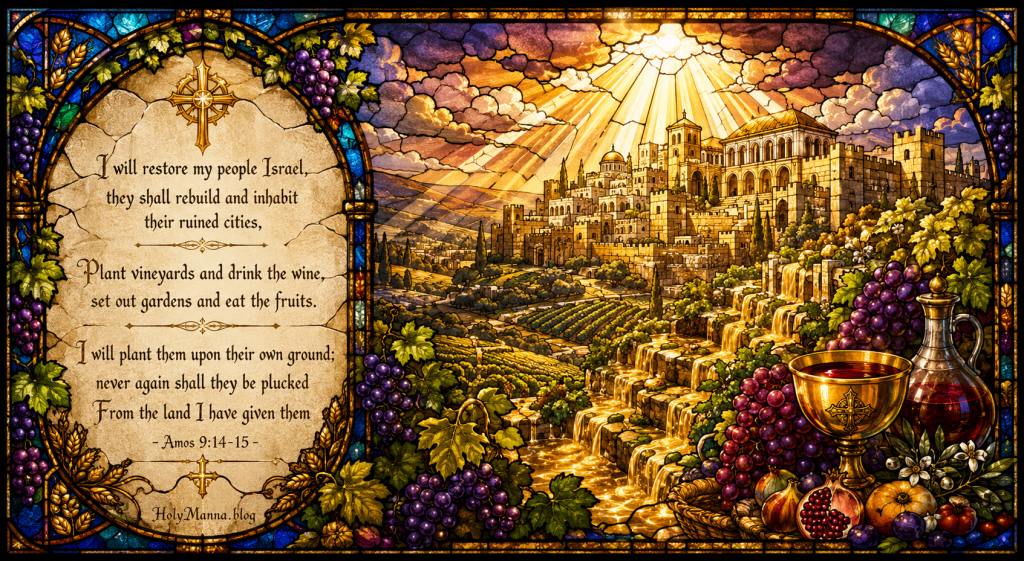
14 I will restore my people Israel,
they shall rebuild and inhabit their ruined cities,
Plant vineyards and drink the wine,
set out gardens and eat the fruits.
15 I will plant them upon their own ground;
never again shall they be plucked
From the land I have given them—
the Lord, your God, has spoken.
Detailed Exegesis
Verse 11 — “On that day I will raise up the fallen hut of David; I will wall up its breaches, raise up its ruins, and rebuild it as in the days of old.”
The word translated here as “hut” or “booth” in the NABRE is the Hebrew sukkah, the same flimsy, temporary structure of branches and leaves used by soldiers in the field or shepherds on a hillside. This is not the grand palace of Solomon. This is a shack. And the image is deliberate. By Amos’s time in the mid-eighth century B.C., the unified Davidic kingdom had already splintered into North and South, and the prophetic eye could see it crumbling further still. Ancient Jewish rabbis would later adopt “Son of the Fallen” as one of the titles of the Messiah, and the early Church understood immediately what this verse was pointing toward: the royal house of David had to collapse to a hut before the Son of David could rebuild it into something the whole world could enter. The Incarnation is the moment God begins to wall up the breaches.
Verse 12 — “That they may possess the remnant of Edom, and all nations claimed in my name — oracle of the Lord, the one who does this.”
The Greek Septuagint renders this verse with a crucial variation: rather than Israel possessing the remnant of Edom, the text reads that the remnant of humanity may seek the Lord. This is not a translating error that slipped past the Church. At the Council of Jerusalem recorded in Acts 15, the Apostle James quotes this very verse from the Septuagint as the Scriptural foundation for welcoming Gentile converts without requiring circumcision. The falling and rebuilding of David’s hut, James argues, was always meant to open a door wide enough for the whole world to walk through. Amos, writing seven centuries before that council, was already proclaiming a Church without borders.
Verses 13–15 — “Yes, days are coming… when the one who plows shall overtake the one who reaps… I will plant them upon their own ground; never again shall they be plucked from the land I have given them.”
The harvest imagery here is purposefully hyperbolic in the tradition of Hebrew prophetic poetry. Plowmen overtaking reapers means the soil is yielding faster than human hands can gather. Mountains dripping with wine means the earth itself cannot contain what God is pouring out. These are not agricultural statistics. They are theological declarations: the covenant life God intends for His people is so abundant, so extravagant, so beyond ordinary calculation that the ordinary language of farming breaks down trying to describe it. And the closing promise, “never again shall they be plucked from the land I have given them,” is the eternal covenant sealed centuries later in the blood of Christ.
Teachings
The Catholic tradition has always read Amos 9:11–15 through a Christological lens, meaning the Church understands these verses to find their ultimate fulfillment not in any earthly political restoration but in the person of Jesus Christ and the establishment of His Church. The USCCB introduction to The Book of Amos describes Amos as a prophet who understood that “the Lord is not some petty national god but the sovereign creator of the cosmos.” The restoration God promises here is accordingly cosmic in its scope.
St. Augustine, in his Exposition on Psalm 85, which is proclaimed as today’s responsorial, makes the connection explicit when he writes that the Psalm’s title pointing “to the end” directs the heart to Christ, because “He is Himself the Truth unto which we are eager to arrive, and He Himself the Way by which we run.” The promise of Amos and the consolation of Psalm 85 are reading from the same script, and that script is the story of the Incarnation.
The Catechism of the Catholic Church teaches in CCC 128 that “the Church, as early as apostolic times, and then constantly in her Tradition, has illuminated the unity of the divine plan in the two Testaments through typology.” Amos 9:11 is a textbook example: the fallen hut is a type of the broken human condition; the rebuilding is a type of the Resurrection; the overflowing harvest is a type of the grace poured out through the Sacraments. Every line is pointing forward.
Reflection
Amos was not a professional prophet. He was a farmer with dirt under his fingernails who got called out of a field and sent to deliver an uncomfortable message to people who did not want to hear it. And yet the same God who sent him with a word of judgment could not end the story there. Even through Amos, the most severe of prophets, mercy found a way to the last page.
What does it look like to sit with the ruins in life, the marriages that fractured, the faith that went cold, the habits that calcified over years, and hear God say “I will raise this up”? The promise of Amos is not sentimental. It is not a participation trophy. It is a declaration from the God of the cosmos that no ruin is beyond His rebuilding, no breach too wide for His repair, no harvest so lost that He cannot cause the mountains to run with wine again.
Is there a “fallen hut” somewhere in daily life that has been given up on, something handed over to the rubble because rebuilding seemed impossible? The oracle of Amos invites the faithful to hand it back to God, not because the ruin is small, but because the Builder is unimaginably great.
Responsorial Psalm — Psalm 85:9–14
Where Justice and Mercy Finally Meet
If Amos 9 is the promise shouted from a mountaintop, Psalm 85 is the same promise whispered in prayer. The psalmist is not thundering. He is listening. He has stilled himself before God, leaned in close, and is waiting to hear what the Lord will say next. And what God says next is extraordinary: salvation is near, glory is coming, and four of the deepest realities in the universe are about to embrace each other in a way the world has never seen.
Psalm 85 is widely believed to have been composed during or shortly after the Babylonian Exile, when the people of Israel had been stripped of everything that defined them: their land, their Temple, their king, their national identity. The first half of the psalm is a lament, recalling how God once favored the land and forgave the sins of His people, and pleading with Him to do so again. The verses selected for today’s Mass are the psalm’s second movement, its consolation, its oracle. The tone shifts from petition to prophecy, and what the psalmist receives in that stillness is a vision so beautiful it reads almost like a love poem written at the intersection of heaven and earth.
Placed between Amos’s promise of restored abundance and Jesus’s declaration of Himself as the Bridegroom, this psalm functions as the liturgy’s theological hinge. It names what is actually happening in the meeting of the Old and New Covenants. It gives language to the moment when God’s justice and God’s mercy stop moving in separate directions and finally, definitively, kiss.
Psalm 85:9-14 – New American Bible (Revised Edition)
9 I will listen for what God, the Lord, has to say;
surely he will speak of peace
To his people and to his faithful.
May they not turn to foolishness!
10 Near indeed is his salvation for those who fear him;
glory will dwell in our land.
11 Love and truth will meet;
justice and peace will kiss.
12 Truth will spring from the earth;
justice will look down from heaven.
13 Yes, the Lord will grant his bounty;
our land will yield its produce.
14 Justice will march before him,
and make a way for his footsteps.
Detailed Exegesis
Verse 9 — “I will listen for what God, the Lord, has to say; surely he will speak of peace to his people and to his faithful. May they not turn to foolishness!”
The psalmist opens with an act of radical receptivity. Before any answer comes, there is a posture: stillness, attentiveness, the deliberate choice to listen rather than demand. This is itself a form of faith, trusting that God will speak and that what He says will be worth waiting for. The word “peace” here is the Hebrew shalom, which carries far more weight than the absence of conflict. It means wholeness, flourishing, right relationship with God and neighbor. The warning against turning to foolishness is a pastoral aside, a reminder that the people have a history of walking away precisely when God is about to act.
Verse 10 — “Near indeed is his salvation for those who fear him; glory will dwell in our land.”
Salvation is not abstract here. It is near. It has an address. The promise that glory will dwell in the land is, for the Catholic reader, a direct foreshadowing of the Incarnation, the moment when the Word of God pitched His tent among humanity and the glory of God took up residence in human flesh. St. John echoes this psalm almost word for word in the prologue of his Gospel: “And the Word became flesh and made his dwelling among us, and we saw his glory” (John 1:14).
Verse 11 — “Love and truth will meet; justice and peace will kiss.”
This is the psalm’s most celebrated verse, and for good reason. In the original Hebrew, the four words paired here are hesed (covenant love), emet (truth or faithfulness), tzedeq (justice or righteousness), and shalom (peace). These are not merely virtues. They are attributes of God Himself, and the psalmist is describing a moment in history when all four will converge in a single event. The Catholic tradition, following St. Augustine, reads this as the Incarnation and the Cross. At Calvary, divine justice and divine mercy did not compromise each other. They kissed. Christ bore the full weight of justice so that mercy could be poured out without measure.
Verse 12 — “Truth will spring from the earth; justice will look down from heaven.”
Augustine’s reading of this verse is the definitive Catholic interpretation. Truth springing from the earth is Christ being born of the Virgin, divine Truth taking on human flesh and emerging from the soil of human history. Justice looking down from heaven is the Father’s righteous gaze turning toward a humanity now clothed in the righteousness of His Son. The vertical and horizontal axes of salvation cross precisely here, and that crossing has a name: the Cross of Jesus Christ.
Verses 13–14 — “Yes, the Lord will grant his bounty; our land will yield its produce. Justice will march before him, and make a way for his footsteps.”
The psalm closes with the same agricultural abundance that closes Amos 9: a land yielding its produce, a God whose arrival is so transformative that justice itself runs ahead to prepare the road. This is the image of a royal procession, a King coming whose approach reorganizes the entire landscape. For the Christian, every Mass is a moment when that King arrives again, and the liturgy itself is the justice that marches before His footsteps.
Teachings
St. Augustine’s Exposition on Psalm 85 is among the most beautiful pieces of patristic writing connected to today’s liturgy. Augustine identifies Christ as the entire subject of the psalm from its very title, writing that “He is Himself the Truth unto which we are eager to arrive, and He Himself the Way by which we run.” For Augustine, the four virtues of verse 11 are not poetic abstractions. They are divine persons and divine actions meeting at a fixed point in history.
Augustine also unpacks verse 12 with characteristic depth, connecting the confession of sin to the springing forth of truth: “If while you are unrighteous, you call yourself just, how can truth spring out of you? But if being unrighteous you confess yourself to be so, truth has sprung out of the earth.” The Incarnation, in Augustine’s reading, is not only something that happened to humanity from the outside. It is something that becomes real inside each person the moment they stop lying to themselves and let God’s truth take root.
The Catechism of the Catholic Church speaks directly to this dynamic in CCC 2304, teaching that “respect for and development of human life require peace. Peace is not merely the absence of war, and it is not limited to maintaining a balance of powers between adversaries. Peace cannot be attained on earth without safeguarding the goods of persons, free communication among men, respect for the dignity of persons and peoples, and the assiduous practice of fraternity.” True peace, the peace the psalmist is singing about, is not a diplomatic achievement. It is a gift that flows from right relationship with God, which is precisely what the Incarnation restores.
Reflection
There is something quietly radical about the opening line of today’s psalm: “I will listen for what God, the Lord, has to say.” Not argue. Not negotiate. Not present a list of demands. Simply listen. In a world that rewards volume and speed, the posture of this psalmist is almost countercultural. He has been through the exile. He has seen the ruins. And his response is to get quiet and wait for God to speak.
What would change if even five minutes of the day were given over to that kind of listening, not talking at God, but waiting in genuine silence to hear what He might say? The psalm promises that what God says will be worth the wait. He speaks of peace. He speaks of salvation drawing near. He speaks of a world where truth and love are no longer strangers to each other.
In which areas of daily life have justice and peace seemed to be pulling in opposite directions, where doing the right thing has felt incompatible with keeping the peace? The psalm does not pretend that tension is easy. But it does promise that in Christ, the One in whom justice and mercy kissed, there is a way through that tension which does not require sacrificing one for the other. The invitation today is to bring those exact tensions to prayer, to listen, and to trust that the God who once caused glory to dwell in the land is still making His way toward us.
Holy Gospel — Matthew 9:14–17
The Bridegroom Has Arrived, and Everything Is Different Now
The question the disciples of John ask Jesus in today’s Gospel sounds, on the surface, like a simple religious debate about fasting practices. It is not. Underneath the surface, it is one of the most important questions anyone could ask about the nature of Jesus and what His arrival actually means for the world. Why do the Pharisees fast, why do John’s disciples fast, but Jesus’s disciples do not? The answer Jesus gives does not merely explain a scheduling difference. It announces a change in the entire order of things.
To understand the weight of this exchange, it helps to remember what came immediately before it in Matthew 9. Jesus has just called Matthew, a tax collector considered ritually unclean by the religious establishment, and sat down to eat with him and his friends. The Pharisees were already bristling. Now the disciples of John, who genuinely respected Jesus but were trained in a school of strict ascetical practice, arrive with their own concern. Fasting was not optional in their world. The Pharisees fasted twice a week. John’s disciples fasted regularly as an expression of repentance and expectation, waiting for the Messiah who was coming. The question they bring to Jesus is sincere: if He is who John says He is, why does His movement look so different from everything that came before it?
Jesus answers them with three images, each one more stunning than the last, and together they form the theological capstone of today’s entire liturgy.
Matthew 9:14-17 – New American Bible (Revised Edition)
The Question About Fasting. 14 Then the disciples of John approached him and said, “Why do we and the Pharisees fast [much], but your disciples do not fast?” 15 Jesus answered them, “Can the wedding guests mourn as long as the bridegroom is with them? The days will come when the bridegroom is taken away from them, and then they will fast. 16 No one patches an old cloak with a piece of unshrunken cloth, for its fullness pulls away from the cloak and the tear gets worse. 17 People do not put new wine into old wineskins. Otherwise the skins burst, the wine spills out, and the skins are ruined. Rather, they pour new wine into fresh wineskins, and both are preserved.”
Detailed Exegesis
Verse 14 — “Then the disciples of John approached him and said, ‘Why do we and the Pharisees fast much, but your disciples do not fast?’”
The question is genuine rather than hostile. John’s disciples are genuinely puzzled, not attacking. They had been formed by a tradition of rigorous fasting rooted in the prophetic call to repentance. Their teacher, John the Baptist, had already identified Jesus as the Bridegroom in John 3:29, saying “the one who has the bride is the bridegroom; the best man, who stands and listens for him, rejoices greatly at the bridegroom’s voice.” So in a real sense, John’s disciples already had the answer encoded in what their own teacher had told them. They simply had not yet understood its full implication.
Verse 15 — “Jesus answered them, ‘Can the wedding guests mourn as long as the bridegroom is with them? The days will come when the bridegroom is taken away from them, and then they will fast.’”
With a single image, Jesus reframes the entire conversation. He is not merely a teacher with a more relaxed rule about fasting. He is the Bridegroom, the one whom all of Israel’s prophets had been describing when they portrayed God as the faithful husband pursuing His wayward bride. Isaiah, Hosea, Jeremiah, and Ezekiel all used spousal imagery to describe God’s covenant relationship with His people. Now Jesus steps into that imagery and claims it as His own identity. His public ministry is the wedding feast. His disciples are the guests. And at a wedding feast in first-century Jewish culture, which could last an entire week, fasting would be not merely inappropriate but unthinkable.
The second half of the verse carries the shadow of the Cross. The bridegroom will be taken away, and then fasting will resume. This is the first hint in Matthew’s Gospel of the Passion, delivered quietly inside an image of joy. Christian fasting, as the Church has always understood it, is not the fasting of those waiting for the Messiah to arrive. It is the fasting of those who know He has come, who love Him, and who ache for the fullness of His return.
Verse 16 — “No one patches an old cloak with a piece of unshrunken cloth, for its fullness pulls away from the cloak and the tear gets worse.”
Jesus shifts from the wedding hall to the tailor’s bench. New, unshrunken cloth has not yet been through the process of washing and shrinking. If sewn onto an old, already-shrunk garment, it will pull away when it inevitably contracts, making the original tear far worse than before. The “old cloak” here is the religious framework of external observance without interior transformation, the religion of rules without the relationship that gives the rules their meaning. The new cloth is the life of grace that Christ brings. These two cannot simply be stitched together. The new is not a patch on the old. It is a whole new garment.
There is remarkable Greek wordplay embedded here that the original audience would have caught. The word translated as “patch” or “fullness” is pleroma, the same word Paul uses in Colossians 1:19 when he writes that “in him all the fullness was pleased to dwell.” The fullness of Christ cannot be sewn onto the old without causing rupture.
Verse 17 — “People do not put new wine into old wineskins. Otherwise the skins burst, the wine spills out, and the skins are ruined. Rather, they pour new wine into fresh wineskins, and both are preserved.”
In the ancient world, wine was stored and fermented in animal skins rather than bottles. New wine was still actively fermenting, still expanding, still generating pressure from within. Fresh wineskins could flex and stretch to accommodate that pressure. Old wineskins, hardened and brittle from previous use, had been stretched to their absolute limit. Pour new wine into an old skin and the result is catastrophic: the skin bursts, the wine is lost, and both are ruined.
The new wine is the Gospel itself, the grace of the Holy Spirit, the entire revelation of Jesus Christ poured out into human history. The old wineskins are any system of religion that has calcified into external performance without the living, stretching, transforming work of grace at its center. Crucially, Jesus says that in the proper order, both are preserved. The old covenant was not wrong. The Law was not evil. It was simply not designed to contain what the Spirit was now doing. New wine requires new wineskins, hearts that are pliable, receptive, and willing to be stretched by the living presence of God.
Teachings
St. John Chrysostom, in his Homily 30 on Matthew, marvels at the gentleness with which Jesus handles this question. Rather than rebuking John’s disciples for their misunderstanding, Jesus meets them with patience and imagery drawn from their own world. Chrysostom writes that Jesus “discourses to them with all gentleness” and then notes that Jesus “before, called Himself a physician, but here a bridegroom; by these names revealing His unspeakable mysteries.” The progression is intentional. The physician heals the sick. The bridegroom unites himself to the beloved. Jesus is doing both at once.
Chrysostom also draws out the pastoral wisdom of Jesus’s approach to the disciples’ unreadiness: “They have not yet been renewed by the Spirit, and on persons in that state one ought not to lay any burden of injunctions.” Grace meets people where they are. The new wine is poured into wineskins as they are becoming new, not only after they have arrived at perfection.
The Catechism of the Catholic Church teaches in CCC 1438 that “the seasons and days of penance in the course of the liturgical year (Lent, and each Friday in memory of the death of the Lord) are intense moments of the Church’s penitential practice.” Christian fasting, as the Catechism understands it, is entirely ordered around the Bridegroom. The Church fasts on Fridays because the Bridegroom was taken away on a Friday. The Church fasts during Lent to walk with Him toward the Cross. And the Church will fast until He comes again in glory, because the Bride does not stop longing for the Bridegroom simply because the wedding feast has been promised.
Reflection
There is a question embedded in the wineskins parable that has the power to stop a person cold if they let it land: Am I an old wineskin? Not in the sense of being too old or too far gone, because Jesus is not saying that old wineskins are bad people. He is asking something more uncomfortable: Has faith become so settled, so routinized, so safely contained within familiar practices, that there is no longer any room for the Spirit to expand inside it?
Where in the spiritual life has something that was once alive become a rigid routine, something performed rather than prayed, observed rather than lived? The wineskins parable is not an invitation to abandon tradition. It is an invitation to remain supple within it, to approach the Sacraments with the hunger of someone who knows the Bridegroom is truly present, to fast on Fridays not out of obligation alone but out of genuine love for the One who was taken away.
What would it look like to approach this coming week as a wedding guest rather than a religious observer, someone who knows the Bridegroom is present and responds with joy rather than performance? The new wine is still being poured. The only question is whether the wineskins are ready to receive it.
New Wine, New Hearts, New Everything
The three readings placed before the faithful on this July Saturday are not simply devotional content for a quiet morning. They are a coordinated movement, a single divine argument made from three different angles, and the argument is this: God is in the business of radical restoration, and He needs receptive hearts to pour it into.
Amos stood in the ruins of a broken kingdom and heard God promise to rebuild it into something the whole world could enter. The psalmist stilled himself in the aftermath of exile and received a vision of a day when love and truth, justice and peace, would finally embrace. And Jesus sat at a table with tax collectors and sinners, looked at a group of sincere but puzzled disciples, and announced that the Bridegroom had arrived, that the wedding feast had begun, and that the new wine of the Kingdom simply could not be forced into the old containers of a faith reduced to external performance.
All three readings are asking the same thing. They are asking for new wineskins. Not perfect wineskins. Not wineskins that have never been cracked or stretched or patched up badly after a hard season. Just wineskins that are still pliable, still willing to be expanded by what God is pouring out, still capable of being surprised by the extravagance of a God who causes mountains to drip with wine and who calls Himself the Bridegroom of human souls.
The invitation this Saturday is beautifully simple. Bring the ruins. Bring the brittle places. Bring the religious routines that have gone a little stiff. Hand them to the God who builds on rubble, who makes justice and mercy kiss, and who is even now pouring out new wine. The only question worth sitting with today is this: are the wineskins ready?
Engage With Us!
Every reading placed before the faithful today carries a question worth sitting with longer than a single morning. The reflections do not have to stay inside. Share them in the comments below, because the Church has always been a community of people thinking through Scripture together, and someone else’s insight might be exactly the word needed today.
- Amos 9:11–15 asks about restoration: Where is there a “fallen hut” in your life, a relationship, a habit, a faith that has crumbled, and what would it look like to genuinely hand those ruins over to the God who promises to rebuild?
- Psalm 85:9–14 opens with radical stillness: When was the last time you truly listened for what God had to say, not presenting a list of requests but simply waiting in silence, and what might be keeping you from that posture today?
- Matthew 9:14–17 poses the wineskins question: In what area of your faith life have things gone a little rigid or routine, and where might the Holy Spirit be pressing against the walls, asking for more room to move?
- Across all three readings, God’s promises consistently outrun every container built to hold them: What would change in daily life if the new wine of the Gospel were received not as a familiar religious routine but as the living, expanding, world-transforming gift it actually is?
There is no perfect answer to any of these questions, and that is precisely the point. The spiritual life is not a test to pass. It is a relationship to tend, a Bridegroom to love, and a harvest to anticipate with genuine hope. Go out this week as people who have heard the promise, received the wine, and are willing to be stretched by the extraordinary generosity of a God who never stops rebuilding what has fallen.
Sacred Heart of Jesus, we trust in You!
Immaculate Heart of Mary, pray for us!
Saint Michael the Archangel, defend us in battle!
Follow us on YouTube, TikTok, Instagram and Facebook for more insights and reflections on living a faith-filled life.


Leave a Reply