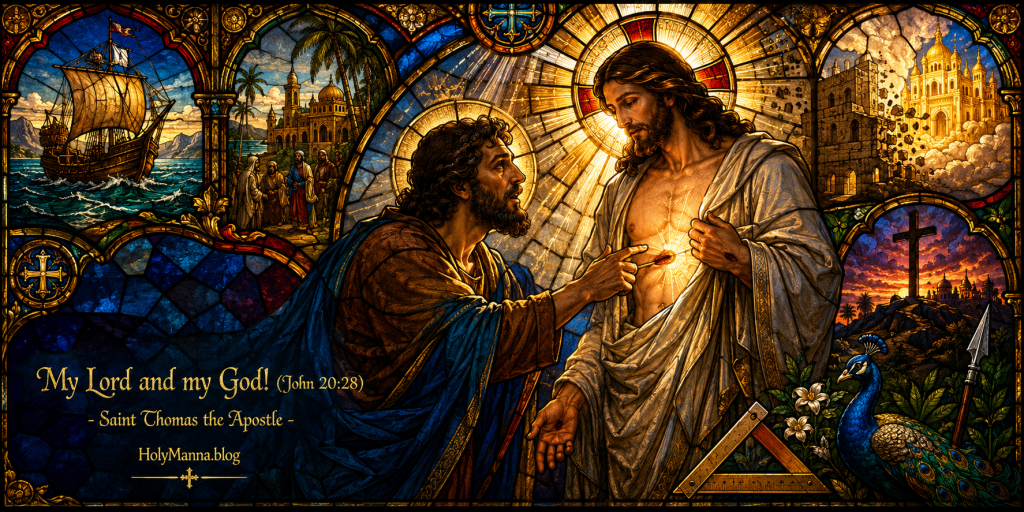
The Man Who Touched the Wounds and Carried the Gospel to the Ends of the Earth
There is something deeply comforting about Saint Thomas the Apostle. Not because his story is easy or smooth, but because it is so honest. He doubted out loud. He asked the questions the rest of us are sometimes too embarrassed to voice. And in the end, he became one of the most daring missionaries the Church has ever known, traveling farther from home than any of the other Twelve, carrying the Gospel all the way to the shores of India and sealing his witness with his own blood. The Catholic Church celebrates his feast day on July 3, and he is venerated as the patron saint of architects, builders, masons, theologians, the blind, and the entire nation of India. His story is a reminder that doubt is not the end of faith. Sometimes, it is the very beginning.
The Twin from Galilee
Very little is known about Thomas’s early life, and that is part of what makes him so fascinating. He was most likely born in Galilee, probably to a humble Jewish family. His name in Aramaic, Teʾoma, and in Greek, Didymos, both mean the same thing: “Twin.” John 11:16 actually identifies him directly as “Thomas, called the Twin,” which has led many to believe he had a literal twin brother or sister, though Scripture never names who that twin was. In the Syriac tradition, he is also called Judas Thomas, and the Eastern Church sometimes refers to him symbolically as the “spiritual twin of Christ” because of the depth of his call to share in the Passion and Resurrection of the Lord.
What is known is that Thomas was a real, complicated, flesh-and-blood human being whose personality jumps off the pages of John’s Gospel in a way that few other apostles manage. He was not one of the famous fishing brothers. He was not a tax collector with a dramatic call story. He was simply a man who heard the call of Jesus and followed, and who turned out to have a heart full of both fierce loyalty and honest struggle. That combination would define his entire life.
A Man of Courage and Hard Questions
The first time Thomas speaks in the Gospels, what comes out of his mouth is not doubt. It is courage. In John 11, Jesus announces His intention to return to Judea to visit the recently deceased Lazarus. The disciples are understandably nervous. Judea is hostile territory. The authorities in Jerusalem have been looking for a reason to arrest Jesus, and going back there feels like walking straight into danger. The other disciples push back, but Thomas silences them all with one of the most overlooked declarations in the New Testament: “Let us also go, that we may die with him” (John 11:16). That is not the voice of a coward. That is the voice of a man who loves his Master enough to walk into death beside him.
The second time Thomas speaks, the setting is the Last Supper. Jesus is preparing His disciples for what is coming, telling them He is going to prepare a place for them and that they know the way. Thomas, with the blunt honesty that characterizes him throughout John’s Gospel, says what everyone in that room was probably thinking: “Master, we do not know where you are going; how can we know the way?” (John 14:5). It is a completely reasonable question. And the answer Jesus gives in response to Thomas’s confusion is one of the most profound statements in all of Scripture: “I am the way and the truth and the life. No one comes to the Father except through me” (John 14:6). Thomas asked a hard question, and the Lord met it with the fullness of divine revelation.
This is worth sitting with for a moment. The great declaration of John 14:6 exists in the Gospel because Thomas was willing to say out loud what he did not understand. His honesty did not offend Jesus. It gave Jesus an opportunity to teach.
The Moment That Changed Everything
Then comes the moment Thomas is most famous for, and it is important to understand it correctly. After the Crucifixion and burial of Jesus, the disciples are hiding behind locked doors, devastated and afraid. On the first day of the week, the Risen Christ appears to them. But Thomas is not there. John’s Gospel does not explain why he was absent that day. What it does tell us is that when the other disciples found him and told him what had happened, Thomas could not bring himself to believe it.
“Unless I see the mark of the nails in his hands and put my finger into the nailmarks and put my hand into his side, I will not believe” (John 20:25). That is a raw and honest statement from a man who had watched his Lord brutally executed. He had seen the nails. He had seen the spear. He had seen the tomb sealed. And now his friends were telling him that death had been reversed. Thomas needed more than a secondhand account. He needed an encounter.
Eight days later, Jesus gave him exactly that. He appeared again in the upper room, this time with Thomas present, and He went directly to His doubting apostle: “Put your finger here and see my hands, and bring your hand and put it into my side; do not be faithless, but believing” (John 20:27). And in that moment, everything broke open inside Thomas. He fell before his Lord and uttered what theologians recognize as the most explicit confession of Christ’s full divinity in all four Gospels: “My Lord and my God!” (John 20:28).
Saint Gregory the Great, one of the greatest popes and doctors of the Church, reflected on this moment with characteristic wisdom: “Do you really believe that it was by chance that this chosen disciple was absent, then came and heard, heard and doubted, doubted and touched, touched and believed? It was not by chance but in God’s providence. In a marvelous way God’s mercy arranged that the disbelieving disciple, in touching the wounds of his Master’s body, should heal our wounds of disbelief.”
Think about that. Thomas’s doubt was not an accident. It was a gift, arranged by Providence, so that his eventual confession would strengthen every believer who has ever wrestled with faith. Every Catholic who silently prays “My Lord and my God” at the moment of consecration during Mass is participating in an echo of Thomas’s great turning point. His doubt became one of the strongest witnesses to the Resurrection in all of Christian history.
The Reluctant Apostle Who Went Farther Than Anyone
After Pentecost, when the Holy Spirit descended and the apostles received the fire and courage to go out into the world, something remarkable happened to Thomas. The man who had once said “I will not believe” became one of the most indefatigable missionaries the Church has ever produced. Tradition tells us he first evangelized Parthia, then moved through Persia and into Media, carrying the Gospel through lands that were entirely beyond the borders of the Roman Empire.
And then he went to India.
According to ancient tradition, Thomas arrived on the Indian subcontinent around 52 A.D., landing at the port of Cranganore on the Malabar Coast in what is now the state of Kerala. This tradition is not just a pious story. It is supported by a remarkable chain of witnesses. The third-century theologian Origen recorded it. The great historian Eusebius of Caesarea confirmed it. Saint Ephrem the Syrian, a Doctor of the Church, composed hymns about it in the fourth century. Saint Gregory of Nazianzus, Saint Ambrose of Milan, and Gregory of Tours all independently testified to it. Pope Benedict XVI himself affirmed in a general audience in 2006 that “an ancient tradition claims that Thomas first evangelized Syria and Persia, then went on to Western India, from where he also finally reached Southern India.”
Saint Ambrose of Milan put it simply and beautifully: “Even those kingdoms which were shut out by rugged mountains became accessible to them, as India to Thomas.”
And Saint Ephrem the Syrian, writing of Thomas’s mission in one of his famous hymns, captured the theological beauty of the whole endeavor: “It was to a land of dark people he was sent, to clothe them by Baptism in white robes. His grateful dawn dispelled India’s painful darkness. It was his mission to espouse India to the Only-Begotten.”
The Palace Built in Heaven: A Story Worth Telling
One of the most beloved stories surrounding the life of Saint Thomas concerns a king, a palace, and a lesson about where real treasure is stored. This story comes to us through ancient tradition and cannot be verified as historical fact, but it has been told and retold across centuries because it captures something deeply true about the spirit of the apostle.
According to the story, when Thomas arrived in India, he was brought before a powerful king named Gondophares, who was searching for a skilled architect and builder to construct a magnificent new palace. Thomas, who was indeed known as a craftsman, presented himself for the job. The king was pleased and handed over an enormous sum of money for the project, then departed to travel through his kingdom, expecting to return and find his palace well underway.
But Thomas did not build a palace. He took every coin the king had given him and distributed it to the sick, the poor, and the suffering people of the region. He preached the Gospel. He baptized. He healed. He built something the king could not yet see.
When Gondophares returned and found no palace, his fury was immediate. He confronted Thomas directly. The apostle replied calmly that the palace had indeed been built, and it was more magnificent than anything the king could have imagined. It simply was not visible in this life. It was waiting for the king in the Kingdom of Heaven, constructed from acts of charity given in the name of Christ.
The enraged king threw Thomas into prison. But then something happened. The king’s own brother, Gad, died suddenly. His soul was carried by angels through the heavens, where he was shown palace after palace of breathtaking beauty. He begged the angels to let him stay in even the humblest room of one particular palace, which outshone all the others. The angels refused. That palace, they told him, had already been built by Thomas and given to his brother, King Gondophares. Gad then asked permission to return to the living so he could tell his brother. The angels granted his request, and Gad was restored to life.
He went immediately to the king and told him everything. Gondophares released Thomas from prison. Both brothers received baptism. The two of them spent the rest of their lives giving generously to the poor, building up their own heavenly treasure. The story cannot be verified as historical, but it has endured for nearly two thousand years because it perfectly illustrates what Thomas understood better than almost anyone: the only architecture that lasts forever is built from love.
There is an interesting historical footnote worth mentioning. For centuries, King Gondophares himself was considered a legendary figure. Then, in 1872, archaeologists discovered coins and a votive inscription bearing his name, confirming that a king named Gondophares actually ruled in the region during the first century. That discovery gave scholars pause. It showed that the ancient traditions surrounding Thomas’s mission to India contained real historical memory.
Hardships, Persecution, and the Final Witness
The deeper Thomas traveled into India and the more people he converted, the more enemies he made. In and around the region of Mylapore, near what is now Chennai, the local Brahmin priests grew increasingly hostile as the apostle’s preaching drew people away from the old religious structures. According to tradition, they pursued him, harassed him, and made several attempts on his life. There is a story told among the Thomas Christians of India that during one of these pursuits, Thomas fled into a cave and miraculously carved his way through the stone wall to escape, leaving the imprints of his hands and feet in the rock, which are still venerated at the site today. This story also cannot be verified, but it has been passed down faithfully for generations.
What is affirmed by the earliest written records is that Thomas was martyred on July 3 in the year 72 A.D. on a hill near Chennai now known as Saint Thomas Mount. The ancient account holds that while Thomas was praying on that hill, he was surrounded by enemies, and a spear was driven through him. Saint Ephrem the Syrian, writing in the fourth century, records it directly: the Apostle was killed in India, and his relics were subsequently taken to Edessa.
Thomas did exactly what he had proposed to his fellow disciples all those decades before, when they stood at the edge of dangerous Judea and he told them, “Let us also go, that we may die with him.” He went all the way with the Lord. Even unto death, in the farthest country imaginable.
The Legacy That Outlived the Apostle
The story of Saint Thomas did not end with his martyrdom. If anything, his influence grew. Following his death, part of his relics were transported to Edessa in Syria, where the early Christian community venerated them for centuries and where a great shrine was built in his honor. The poet and Doctor of the Church Saint Ephrem the Syrian composed numerous hymns at Edessa in honor of Thomas, celebrating him as the great Apostle of the East.
In 1258, some of the relics were brought to Ortona, in the Abruzzo region of Italy, where they remain to this day in the Cathedral of Saint Thomas the Apostle, which Pope Pius IX raised to the rank of a minor basilica in 1859. A portion of the relics still rest in the San Thome Cathedral Basilica in Chennai, India, built over the traditional site of his burial. His skull is believed to rest at the Monastery of Saint John the Theologian on the Greek island of Patmos.
The most extraordinary post-death legacy of Thomas, however, is the living community he left behind. The Saint Thomas Christians, also called Nasranis or Thomas Christians, are a community of millions of Catholic and Christian faithful in the state of Kerala, India, who trace their origins directly to the apostle’s arrival in 52 A.D. They have maintained an unbroken tradition of faith for nearly two thousand years. They used Syriac as their liturgical language for centuries. They built churches where Thomas built churches. They kept the name Thomas alive for generation after generation, to the point that Thomas remains one of the most popular names among Christians in Kerala even today.
There is also a powerful story, beloved in medieval Catholic tradition, that connects Thomas to the Assumption of the Blessed Virgin Mary. According to this account, Thomas was the only apostle who was not miraculously transported to Mary’s bedside in Jerusalem before her death, because he was still in India. After her burial, however, he was supernaturally brought to her tomb, where he alone witnessed her bodily Assumption into heaven. As a sign of what he had seen, Mary’s girdle fell from heaven into his hands. When the other apostles went to the tomb and found it empty, they were skeptical of Thomas’s account until they saw the empty tomb themselves. It is a beautiful irony. Thomas, who had once been the skeptic among the Twelve, became the one witness who had seen what the others had not. This account was declared apocryphal by Pope Gelasius I in 494, but it was enormously popular in medieval art and spirituality and is still tenderly remembered as part of the rich tradition surrounding this extraordinary apostle.
What Thomas Teaches Us
There is a reason the Catholic Church gives Thomas his own feast day and does not simply fold him into the general memory of the apostles. He teaches something that no one else teaches quite so well.
He teaches that honest doubt, brought to Christ rather than run away from Christ, can become the foundation of the most unshakeable faith imaginable. Thomas did not pretend. He did not fake it. He said what he really felt, and Jesus met him exactly where he was. That is the pattern of every authentic conversion story. The Lord does not demand that people arrive already believing. He asks them to show up, to bring their real selves, to put their hands in the wounds if that is what it takes.
Thomas also teaches that faith is meant to be carried outward. Once he encountered the Risen Christ, he did not settle into a comfortable life in Jerusalem. He went east. He went farther than anyone. He preached to kings and to the poor alike. He gave away wealth that did not belong to him to build treasure in heaven. He constructed churches in places no one from Judea had ever dreamed of going. He died for his faith on the far side of the world, and his witness is still bearing fruit almost two thousand years later.
Is there a Thomas moment in your own life, a moment when the faith felt distant or impossible, when you needed something more than secondhand testimony? Have you brought that honest doubt to the Lord and let Him meet you there? And once faith is renewed, what is the Lord asking you to build with it, and for whom?
Thomas answered those questions with his entire life. He went to die with his Master, and in doing so, he lived more fully and impacted more souls than he ever could have imagined standing on the shores of Galilee.
Engage With Us!
The life of Saint Thomas the Apostle is an invitation to stop pretending that faith is always easy and to start trusting that Christ can handle our hardest questions. His story belongs to all of us because at some point, every believer has stood in that upper room, hearing the news of the Resurrection secondhand and wondering if it is really true.
Share your thoughts and reflections in the comments below! Here are some questions to get the conversation going:
- Thomas is often called “Doubting Thomas,” but he was also one of the most courageous and far-traveling apostles in the entire Church. How does this fuller picture of Thomas change the way you think about him?
- Thomas asked Jesus directly, “How can we know the way?” and received one of the most powerful answers in all of Scripture. Is there a question about your faith that you have been afraid to bring to God? What would it look like to bring it to Him honestly, the way Thomas did?
- Thomas gave away the king’s money to the poor and built a palace in heaven instead. Where in your own life is God asking you to invest in eternal treasure rather than earthly comfort?
- The Thomas Christians of India have kept their faith alive for nearly two thousand years, tracing their spiritual lineage back to a single apostle. Who passed the faith on to you, and who are you passing it on to?
- Saint Gregory the Great said that God arranged Thomas’s absence and doubt by divine providence, so that his confession would heal the wounds of disbelief in all of us. Has God ever used a moment of weakness or doubt in your life to produce something stronger on the other side?
Saint Thomas went to the ends of the earth with nothing but his faith, his hands, and his love for Jesus. He asked hard questions, he doubted out loud, and he ended up becoming one of the greatest missionary witnesses the Church has ever known. That same invitation is open to every single person reading this today. Bring the questions. Bring the doubts. Touch the wounds if you need to. And then go build something that lasts forever. The grace is there. The Lord is patient. And the world is still waiting to hear the Good News.

 Holy Manna!
Leave a comment