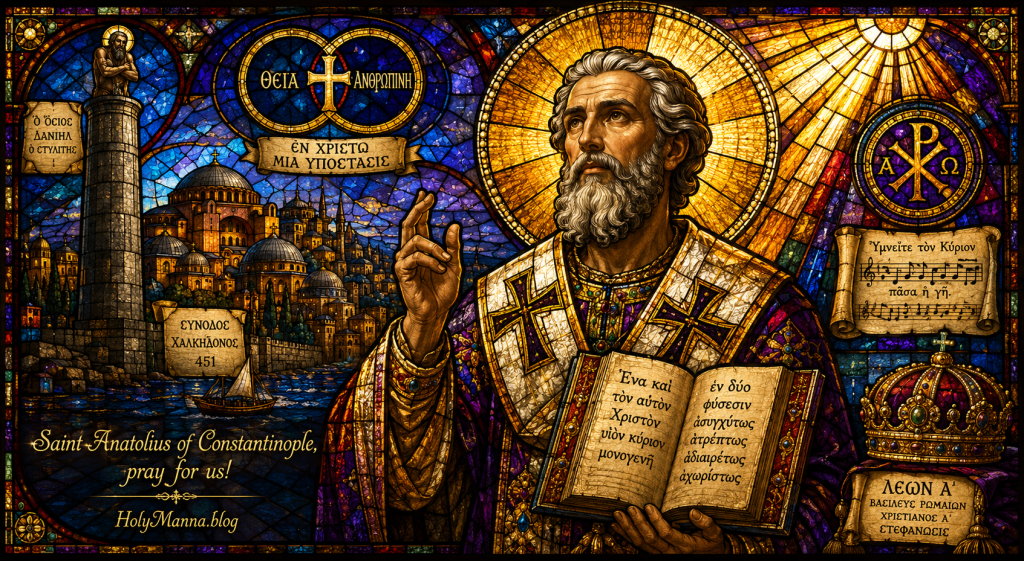
The Man the Heretics Made and Could Not Break
There is something almost cinematic about the life of Saint Anatolius of Constantinople. Picture the fifth century, an era when the Roman Empire was fracturing at its seams, when emperors rose and fell on the whims of powerful court eunuchs, and when the question of who Jesus Christ truly was had split the Church into warring factions fierce enough to turn councils into brawls. Into this chaos steps a quiet scholar from Alexandria, trained by one of the greatest theological minds the Church had ever produced, elevated to the most powerful episcopal throne in the East by a scheming heretic, and then watched in horror by that same heretic as he turned around and helped dismantle everything that heretic had built.
That is the story of Saint Anatolius of Constantinople. His feast day falls on July 3rd, and the Church honors him as a Patriarch, a Confessor, a prophet, a miracle worker, and a defender of the truth that Jesus Christ is at once fully God and fully man. He is not a household name the way Saint Augustine or Saint Francis is, and that is precisely why his story deserves to be told. The saints who labored in the eye of the storm, who navigated impossible political terrain with integrity and came out on the other side vindicated by both the Church and by history, are exactly the kind of witnesses a generation hungry for authenticity needs to hear about.
A Child of Alexandria, a Son of the Great Cyril
Saint Anatolius was born in Alexandria, Egypt, around the year 400 AD, into a world that was still learning what it meant to be a Christian civilization. Alexandria was not just any city. It was the intellectual capital of the ancient world, a place where philosophy, theology, mathematics, and mysticism all collided in magnificent and sometimes explosive ways. To grow up in Alexandria in the early fifth century was to grow up in the middle of the greatest theological debates the Church had ever faced.
It was there that a young Anatolius came under the influence of one of the towering figures of Christian history: Saint Cyril of Alexandria. Cyril was a force of nature, a theologian of extraordinary depth and a churchman of equally extraordinary tenacity. He had fought ferociously against Nestorianism, the heresy that denied the unity of Christ’s divine and human natures, and it was largely through his efforts that the Council of Ephesus in 431 had condemned Nestorius and proclaimed the Virgin Mary as Theotokos, the God-Bearer. Anatolius sat at that man’s feet, absorbed his theology, was ordained a deacon by him, and was trusted enough by him to serve as his apocrisiarius, his official representative, at the imperial court in Constantinople.
Think about what that means in human terms. Anatolius was brilliant enough to be sent as the personal envoy of one of the most formidable minds in the Church to the most powerful court in the Eastern world. He was a diplomat, a theologian, and a man of prayer all at once. These are not qualities that appear overnight. They are formed slowly, painfully, through years of study, fasting, humility, and service to others. From his earliest years, Anatolius was being shaped by God for a mission he could not yet see coming.
Installed by a Heretic, Claimed by the Truth
After the death of Saint Cyril in 444, the See of Alexandria passed into far less trustworthy hands. Dioscorus of Alexandria was in many respects the opposite of his predecessor. Where Cyril had fought to preserve the fullness of Christ’s nature, Dioscorus championed a heresy called Monophysitism, the claim that Christ possessed only one nature, the divine, and that His human nature had been entirely absorbed into it. This was not a small theological quibble. If Christ is not truly human, then there is no true bridge between humanity and God. If He did not take on real human flesh, then His suffering on the Cross was a kind of illusion, and the redemption He won is not truly ours. Everything was at stake.
Dioscorus was not content to simply teach his error. He weaponized imperial politics to impose it. In 449, he engineered what Pope Leo I famously called the Robber Synod, a so-called council held in Ephesus that was less a gathering of bishops and more a mob scene. Delegates carried weapons beneath their cloaks. Imperial troops enforced the outcomes by force. The reading of Pope Leo’s doctrinal letter was suppressed entirely. The holy Patriarch Flavian of Constantinople, who had resisted the heresy, was physically assaulted during the proceedings and died shortly afterward of his injuries. It was one of the darkest moments in the history of the Church’s councils.
In the aftermath of this catastrophe, Dioscorus needed a man he could trust on the throne of Constantinople. He chose his own secretary, Anatolius, and had him installed as the new Patriarch. The plan was clear: with his own creature on the most important Eastern see, Dioscorus would control the destiny of the Church in the East. What he did not account for was the soul of the man he had chosen.
The moment the political winds shifted with the deaths of Emperor Theodosius II in 450 and the rise of the orthodox Emperor Marcian and the holy Empress Pulcheria, Anatolius acted swiftly and decisively. He publicly and formally condemned both Eutyches and Nestorius, the twin heralds of the two great Christological heresies. He subscribed to the letters of his old mentor Cyril against Nestorianism and to Pope Leo I’s great doctrinal masterwork, his Tome to Flavian, against the Monophysite error. He agreed to the rehabilitation of the bishops who had been unjustly deposed at the Robber Synod. He even ordered the exhumation of the body of the martyred Flavian so that it could receive an honorable burial in the Church of the Holy Apostles in Constantinople. Whatever Dioscorus had expected from his handpicked patriarch, it was not this.
The Council That Defined Christ for All Time
If Anatolius had done nothing else with his life, his contribution to the Council of Chalcedon in 451 would have been more than enough to secure his place in the memory of the Church. This was the Fourth Ecumenical Council, and by any measure it was among the most consequential gatherings in Christian history. Six hundred and thirty-six bishops poured into the Church of Saint Euphemia in Chalcedon. It was the largest assembly of Church leaders the world had ever seen, a record that would stand for nearly fourteen centuries until the First Vatican Council in 1870.
Anatolius presided at that council alongside the papal legates, seated immediately after the representatives of Rome in a gesture that spoke volumes about his understanding of the Church’s proper order. Together they wrestled the question of Christ’s nature to the ground and produced a definition that has never been improved upon. The Council of Chalcedon declared that Jesus Christ is “perfect in divinity and perfect in humanity, true God and true man, made known in two natures without mingling, without change, indivisibly, inseparably.” Two complete natures, one divine Person. Not a blending, not a confusion, not a division, but a union so profound that no human language can fully capture it.
Anatolius was instrumental in convincing the bishops from Illyricum and Egypt, many of whom had been sympathetic to Dioscorus, of the orthodoxy of Pope Leo’s Tome. He helped formulate the very language of the council’s statement of faith. And when Dioscorus was brought to account, not for his heretical doctrine alone but for his brutal conduct at the Robber Synod, including the deposition and physical assault of Flavian, it was before this council that he was condemned and stripped of his see.
The man Dioscorus had installed to serve his purposes had helped destroy him. There is something deeply providential about that.
The First Christian Coronation
Here is one of the most surprising and least-known facts about Saint Anatolius, one that most Catholics have never heard. The historian Edward Gibbon, writing in The Decline and Fall of the Roman Empire, records that when Emperor Leo I came to the throne in 457, it was Anatolius who presided over his coronation, and that this ceremony set the precedent for every Byzantine imperial coronation that followed for the next thousand years.
Think about the weight of that. The way Christian emperors were crowned, the sacred ritual that tied imperial power to the blessing of the Church, traces its origins to this one moment. Anatolius stood at the intersection of faith and history and helped shape both in ways that would echo for a millennium.
The Controversy He Carried and the Humility He Showed
The life of Saint Anatolius was not without its complications, and honesty demands that they be addressed. The most significant was Canon 28 of the Council of Chalcedon, a resolution passed near the council’s conclusion that declared the See of Constantinople equal in dignity to the See of Rome, making it second only to Rome among all the patriarchal sees. This move effectively displaced the older and more venerable sees of Antioch and Alexandria, and Pope Leo I was not pleased.
Leo rejected Canon 28 firmly, arguing that it violated the canons established at the Council of Nicaea. He wrote with characteristic directness that the privileges of the churches were determined by the decrees of the Nicene Synod and could not be overturned by ambition. Some of the historical criticism of Anatolius has centered on whether he pushed this canon out of personal pride and a desire to elevate his own seat at the expense of others.
Anatolius responded not with defiance but with one of the most remarkable acts of deference in the history of the Eastern Church. In his letter to Pope Leo, now known as Epistle 132, he wrote: “It was the most revered clergy of the church of Constantinople who were eager about it, and they were equally supported by the most revered priests of those parts, who agreed about it. Even so, the whole force of confirmation of the acts was reserved for the authority of Your Blessedness. Therefore let Your Holiness know for certain that I did nothing to further the matter, knowing always that I held myself bound to avoid the lusts of pride and covetousness.”
That is not the letter of an ambitious man trying to grab power. That is the letter of a man who understood exactly where ultimate authority resided and was not ashamed to say so. The Bollandists, the Church’s most rigorous and respected hagiographers, examined every serious accusation ever leveled at Anatolius and rendered their verdict clearly: he is a true Catholic, a saint, and a prophet. As the Catholic Encyclopedia records, the Pope himself blamed Anatolius not for error in the faith but only for having permitted himself to be consecrated by a schismatic. That is a very different charge from heresy, and it is one that his subsequent life more than answered.
When a Heretic Hunter Was Healed by the Man He Investigated
Among the stories told about Saint Anatolius, none is quite so unexpected or so beautiful as the one involving Saint Daniel the Stylite. Daniel was an ascetic monk who had come to the environs of Constantinople and taken up residence in the church of the Archangel Michael in a place called Anaplus. He was a disciple of Saint Symeon the Stylite, that extraordinary figure who had spent years atop a pillar in Syria, and Daniel would eventually take up a similar way of life himself.
Before that happened, a faction of jealous clergy denounced Daniel to Patriarch Anatolius, accusing him of heresy. Anatolius took the accusation seriously, as any good shepherd would, and eventually summoned Daniel to appear before him. What he found when he met this pillar-monk was not a heretic but a man of stunning purity of faith. Anatolius was greatly edified by Daniel’s clear and orthodox confession of faith. And then something else happened.
Anatolius was gravely ill. He called upon Daniel and asked him to pray for him. Daniel prayed. The patriarch recovered. The man who had been brought in under suspicion of heresy left as the patriarch’s personal miracle worker and one of his most fervent admirers. The sources record that Anatolius was so moved by his encounter with Daniel that he was reluctant to let him return to his hermitage, and Daniel departed accompanied by a rejoicing crowd. It is a story that captures something essential about the communion of saints: God’s grace has a way of arriving through the very door we least expect.
A Patriarch Who Could Also Sing
One aspect of Saint Anatolius that deserves far more attention than it typically receives is his contribution to the sung prayer of the Church. Anatolius was a hymn writer of genuine talent and lasting influence. He composed liturgical hymns for Sundays, for the great feasts of the Lord including the Nativity and the Theophany, and for the feasts of martyrs including Saints Panteleimon, George, and Demetrius of Thessalonica.
What made his hymns revolutionary was not just their content but their form. Anatolius broke with what had been described as the tyranny of classical Greek meter and opened up a new path for sacred poetry, one that privileged the weight of theological meaning over the rigid constraints of inherited literary convention. He was, in the best sense, a musical rebel in the service of the Gospel. His hymns, including what are known in English as Fierce Was the Wild Billow and The Day Is Past and Over, are still sung in Eastern Christian communities fifteen hundred years after he wrote them. The man died in 458. His songs are still alive. That is a kind of immortality that speaks for itself.
The Death of a Shepherd
Saint Anatolius died on July 3, 458, after serving as Patriarch of Constantinople for nearly nine years. The precise circumstances of his death remain disputed among historians, but the tradition preserved in Catholic sources is consistent and sobering: the followers of Dioscorus, the heretic he had helped condemn at Chalcedon, are said to have murdered him. He died as he had lived, in the middle of the battle for the truth, a casualty of the hatred that the defense of orthodoxy so often provokes in those who have rejected it.
One ancient biographer, writing with unmistakable awe, declared that the miracles of Anatolius in the course of his combats for the faith were as numerous as the sands of the sea. The claim cannot be verified in its totality, but the spirit behind it captures something true: this was a man who walked through fire repeatedly and emerged not just unburned but shining.
What This Saint Teaches a Generation That Hates Being Played
There is a reason the story of Saint Anatolius resonates so powerfully today. This is a generation that has a finely tuned radar for manipulation. People can smell inauthenticity from a mile away, and they are deeply suspicious of anyone who seems to be using a platform or a position for personal gain. Anatolius was placed in exactly that position, installed by a manipulator who expected him to be a tool, and he refused to play along. He chose the truth over the patron who put him in power. He chose fidelity to Rome over ambition for his own see. He chose humility over the comfort of being right.
What would it look like to carry that kind of integrity into the choices that come up every day, when it would be easier to go along with the crowd than to quietly, firmly, hold the line?
Anatolius also teaches something about the patience required for vindication. For centuries his reputation was under a cloud. Serious men leveled serious accusations at him. He was not immediately exonerated, and the historical process of clearing his name took time. But truth is patient. The Bollandists eventually did their work, examined every charge, and found a true Catholic, a saint, and a prophet. Can the willingness to trust that God’s assessment of a life will ultimately outweigh every human verdict bring a kind of peace that contemporary culture, obsessed with immediate reputation management, has almost entirely lost?
His life with Saint Daniel the Stylite also offers a corrective to the tendency to dismiss those who seem strange or countercultural in their approach to faith. Anatolius initially investigated Daniel as a potential problem. He ended up healed by him. Some of the deepest encounters with God’s grace come through the people least expected to carry it.
And finally, the hymns. Anatolius prayed with words he crafted himself, words that outlasted him by fifteen centuries and counting. What would it mean to invest in a prayer life that goes deep enough to become a legacy, not necessarily through published poetry but through the kind of habitual, daily, earnest conversation with God that quietly shapes everything around it?
Engage With Us!
The life of Saint Anatolius of Constantinople is one of those stories that rewards sitting with it for a while. He was complicated, embattled, accused, vindicated, healed, and ultimately taken from this world as a witness to the faith he had spent his life defending. There is so much here to chew on, and the conversation in the comments below is always better when more voices join it. Share your thoughts, your reactions, and your questions. No reflection is too small or too simple to be welcome here.
- Anatolius was installed by a heretic who expected him to be a puppet, and instead he became one of the great defenders of orthodoxy. Have you ever found yourself in a situation where someone expected you to go along with something wrong, and what did it cost you to choose differently?
- His letter to Pope Leo I is one of the most striking acts of institutional humility in Church history. In a culture that prizes self-promotion and never admitting weakness, what does genuine humility in a position of leadership actually look like, and where have you seen it modeled well?
- Anatolius investigated Saint Daniel the Stylite as a potential heretic and ended up being healed through his prayers. Is there someone in your life whose faith you have underestimated or dismissed, and what might it look like to approach them with more openness?
- His hymns are still being sung fifteen hundred years after his death. What is one small habit of prayer or devotion in your own life that you would want to outlast you in the lives of the people you love?
Go out there and live the faith with everything. Saint Anatolius fought for the truth that Jesus Christ is fully God and fully man, and that truth is not just a theological formula. It is the ground on which every act of love, every sacrifice, every moment of choosing integrity over comfort stands. Let his life be a reminder that the Church is made of real, complicated, striving, grace-filled human beings who said yes to God even when it was costly. That same invitation is on the table today. Say yes.
Saint Anatolius of Constantinople, pray for us!
Follow us on YouTube, TikTok, Instagram and Facebook for more insights and reflections on living a faith-filled life.

 Holy Manna!
Leave a comment