Feast of Saint Thomas, Apostle – Lectionary: 593
When God Comes Back for the One Who Was Missing
There is something deeply human about Thomas’s story, and that is exactly why it has endured for two thousand years.
On the Feast of Saint Thomas the Apostle, July 3, the Church places before her children three readings that together tell a single, stunning story: God does not give up on the ones who are missing, who are doubting, or who feel like they do not quite belong. He comes back. He walks through locked doors. He meets people exactly where they are, and He invites them into something far greater than they imagined possible.
The Gospel of John shows us Thomas standing on the outside of an experience he did not get to share. He was absent when the Risen Christ appeared, and no amount of secondhand testimony could bridge that gap for him. His response has made him famous for all the wrong reasons. People call him “Doubting Thomas,” but what he really was is honest, grieving, and deeply in love with a Lord he thought he had lost forever.
Ephesians 2 answers Thomas’s story with a sweeping architectural vision of what the Church actually is: a living temple, built on the foundation of the Apostles, held together by Christ the cornerstone, and growing into a dwelling place of God in the Spirit. Thomas, the doubter who became the confessor, is one of those foundational stones.
And then Psalm 117, the shortest psalm in the entire Bible, says it all in two verses: God’s mercy is mighty, His faithfulness is forever, and every nation on earth is invited to say so. Thomas would eventually carry that invitation to the ends of the known world.
Together, these readings are an invitation to anyone who has ever felt like they were on the outside looking in.
First Reading: Ephesians 2:19–22
You Are Not a Stranger Here
There is a particular kind of loneliness that comes from feeling like an outsider, like everyone else got the memo and you somehow missed it. Maybe that is what the early Gentile Christians felt when they first encountered the faith of Israel, a faith with centuries of history, covenant, and tradition that did not originally include them. Paul wrote his letter to the Ephesians to address exactly that feeling, and what he says in these four verses is nothing short of revolutionary.
The Letter to the Ephesians was written to a community that was wrestling with a profound identity question: where do Gentile believers fit in God’s story? They were not born into the covenant people of Israel. They did not grow up with the Torah or the Temple. They were, in the language of the ancient world, xenoi and paroikoi, foreigners and resident aliens, people who lived near the house but had no key to the door. Paul’s answer to their identity crisis echoes across every century and speaks just as powerfully today.
Ephesians 2:19-22 – New American Bible (Revised Edition)
19 So then you are no longer strangers and sojourners, but you are fellow citizens with the holy ones and members of the household of God, 20 built upon the foundation of the apostles and prophets, with Christ Jesus himself as the capstone. 21 Through him the whole structure is held together and grows into a temple sacred in the Lord; 22 in him you also are being built together into a dwelling place of God in the Spirit.
Detailed Exegesis
Verse 19: “So then you are no longer strangers and sojourners, but you are fellow citizens with the holy ones and members of the household of God.”
Paul opens with a declaration that overturns the entire social order of the ancient world. In the Roman Empire, citizenship was everything. It determined your rights, your protections, your standing in court, and your place in society. To be a xenos was to be without those protections. To be a paroikos was to live somewhere without fully belonging there. Paul takes both of those categories and abolishes them for the baptized. Through Christ, the outsider becomes a citizen, and the citizen becomes something even greater: a member of the family. The Greek word oikeioi goes beyond civic belonging. It is the word for household members, for family. God is not offering the Gentiles a visa. He is offering them adoption.
Verse 20: “Built upon the foundation of the apostles and prophets, with Christ Jesus himself as the capstone.”
Paul shifts the image from family to architecture, and the shift is deliberate. A household needs a foundation, and Paul names it with precision. The Church rests on the Apostles and prophets, the witnesses of the Old and New Covenants, and at its most critical structural point stands Christ Himself. The Greek word akrogoniaios refers to the cornerstone or keystone, the stone without which the entire structure loses its integrity. This verse is also a quiet but powerful affirmation of the Church’s Apostolic nature. The Twelve were not administrators or early adopters. They were the very foundation stones of something God was building to last forever. Thomas, whose feast the Church celebrates today, was one of those stones.
Verse 21: “Through him the whole structure is held together and grows into a temple sacred in the Lord.”
The Greek verb synarmologoumene is an architectural term describing the precise interlocking of stones fitted together with care and intention. Paul is saying that the unity of the Church is not accidental or merely organizational. It is structural, engineered by Christ Himself. And then he adds something remarkable: it grows. This is not a finished monument. It is a living temple under perpetual, Spirit-driven construction. The Church today is still being built.
Verse 22: “In him you also are being built together into a dwelling place of God in the Spirit.”
The word synoikodomeisthe, “being built together,” is present tense and passive, meaning this is something God is actively doing right now. The believers are simultaneously the building material and the inhabitants. And the purpose of all this construction is staggering: God intends to live here. Not visit. Not pass through. Dwell. The Holy Spirit, as the Catechism of the Catholic Church teaches in paragraph 797, is to the Body of Christ what the soul is to the human body.
Teachings
Saint John Chrysostom, preaching on this very passage in his Homilies on Ephesians, emphasized that Paul’s use of “household” was intentional and profound. Chrysostom noted that servants live in a household, but children inherit it. By calling the Gentile Christians oikeioi tou Theou, members of God’s household, Paul was announcing their inheritance, not merely their welcome.
The Catechism of the Catholic Church in paragraph 756 draws directly on this architectural image: “Often, too, the Church is called the building of God. The Lord compared himself to the stone which the builders rejected, but which was made into the corner-stone.” The Church is not a human organization that Christ later endorsed. It is a divine construction that Christ personally anchors.
CCC 797 deepens this further: “What the soul is to the human body, the Holy Spirit is to the Body of Christ, which is the Church.” Every believer who has been baptized into the Church is a living stone in a temple where God Himself has chosen to take up residence. That is not a metaphor to be admired from a distance. It is a reality to be lived.
Saint Augustine, in De Civitate Dei, contrasted the earthly city, built on human pride and destined to crumble, with the City of God, built on divine love and destined to endure. Paul’s vision in Ephesians 2 is nothing less than a description of that heavenly city already taking shape in history, one baptized soul at a time.
Reflection
This reading has an immediate and personal application for anyone who has ever felt like they do not quite belong in the Church, like they are too new, too sinful, too full of questions, or too far from where they think a good Catholic should be. Paul’s answer is direct: the feeling of being an outsider is real, but the reality of belonging is more real. God is not waiting for anyone to clean themselves up before He lets them through the door. He has already built the door, and Christ is the cornerstone that holds the whole thing together.
The practical invitation here is to take seriously what baptism actually accomplished. It did not merely enroll someone in a religion. It adopted them into a family and conscripted them as a living stone in a temple God is building through history. That means every act of faith, every Sunday Mass, every rosary prayed in a car on the way to work, every honest conversation about God with a skeptical friend, is a stone being laid.
Have you ever felt like an outsider in the Church, and if so, what would it mean to truly believe that God calls you a member of His household? In what ways might God be calling you right now to be a living stone, someone whose faith and witness holds up the people around you?
Responsorial Psalm: Psalm 117
The Shortest Song With the Biggest Invitation
There is something almost surprising about Psalm 117 showing up in the middle of a feast day dedicated to an Apostle who asked for proof before he would believe. The psalm does not argue, does not explain, and does not offer evidence. It simply commands: praise. And then it gives a reason so vast and so simple that it barely needs two verses to say what it needs to say. God’s mercy is strong, and His faithfulness lasts forever. That is it. That is the whole song.
But do not let the brevity fool anyone. Psalm 117 is the shortest psalm in the entire Psalter, and yet Saint Paul found it significant enough to quote directly in his Letter to the Romans when making his case that the Gospel was always meant for every nation on earth. The ancient rabbis called it a psalm of the messianic age, a song that would only make complete sense when the Gentiles finally joined Israel in praising the God of Abraham. On the Feast of Saint Thomas, the Apostle who carried the Gospel all the way to India, that messianic vision becomes biography.
Psalm 117 – New American Bible (Revised Edition)
The Nations Called to Praise
1 Praise the Lord, all you nations!
Extol him, all you peoples!
2 His mercy for us is strong;
the faithfulness of the Lord is forever.
Hallelujah!
Detailed Exegesis
Verse 1: “Praise the Lord, all you nations! Extol him, all you peoples!”
The imperative here is universal and unconditional. The psalmist does not say “praise the Lord, Israel” or “praise the Lord, those who have been faithful.” He addresses every nation and every people without exception. The Hebrew word for nations is goyim, which refers specifically to the non-Israelite peoples, the Gentiles. This is not an afterthought or a theological footnote. It is the entire point of the verse. The God of Israel is not a tribal deity contained within one people’s story. He is the God of all creation, and the invitation to praise Him crosses every border, every language, and every culture that has ever existed. In the liturgical context of Thomas’s feast, this verse is the sound of a door being thrown open to the whole world.
Verse 2: “His mercy for us is strong; the faithfulness of the Lord is forever. Hallelujah!”
The theology of this verse is carried by two Hebrew words that deserve careful attention. The first is hesed, translated here as “mercy” but carrying a meaning far richer than that single English word can hold. Hesed is covenantal love, the faithful, steadfast, unbreakable loyalty of God toward His people. It is the love that does not walk away when things get difficult, the love that keeps showing up even when the other party has failed. The second word is emet, translated as “faithfulness,” and it means truth, reliability, and constancy. God’s hesed is described as strong or prevailing, and His emet endures forever. Together, these two words paint a portrait of a God who is not moody, not conditional, and not finished with anyone yet. The psalm closes with Hallelujah, a Hebrew word meaning “Praise the Lord,” which is not merely a musical flourish but a theological declaration: God is worthy of praise not because life is easy, but because He is faithful even when it is not.
Teachings
Saint Paul quotes Psalm 117 directly in Romans 15:11, writing: “And again, ‘Praise the Lord, all you Gentiles, and let all the peoples praise him.’” Paul uses this verse as evidence that the inclusion of the Gentiles in God’s covenant was never Plan B. It was embedded in the Old Testament itself, waiting for the moment when Christ would make it fully visible. On the Feast of Saint Thomas, whose mission to Persia and India was the literal fulfillment of this universal call, the connection becomes impossible to miss.
The Catechism of the Catholic Church in paragraph 218 reflects on the nature of God’s hesed in terms that illuminate this psalm beautifully: “In the course of its history, Israel was able to discover that God had only one reason to reveal himself to them, a single motive for choosing them from among all peoples as his special possession: his sheer gratuitous love.” God’s love is not earned and cannot be. It is given freely, extended universally, and sustained faithfully. That is what Psalm 117 is celebrating in its two compact verses.
Saint Augustine, reflecting on the Psalms in his Expositions of the Psalms, wrote that the praise of all nations was the fruit of the Apostolic mission, that the Apostles were sent precisely so that this psalm might be fulfilled. The universal praise commanded by the psalmist was made possible by men like Thomas, who left everything and went to the ends of the earth so that people who had never heard the name of Jesus could one day sing Hallelujah.
The Catechism also speaks directly to the missionary dimension of this universal call in paragraph 849: “The missionary mandate… has its source in the divine love of the Trinity: ‘As the Father has sent me, even so I send you.’ Since God ‘desires all men to be saved and to come to the knowledge of truth,’ mission is necessary.” Thomas was not just fulfilling his own calling when he went to India. He was fulfilling the ancient song of Psalm 117.
Reflection
Psalm 117 has a way of cutting through the complexity of the spiritual life and getting to the absolute foundation. At the end of every doubt, every struggle, every season of feeling distant from God, this psalm offers two anchoring truths: His mercy is strong, and His faithfulness is forever. Those are not inspirational platitudes. They are battle-tested theological claims rooted in thousands of years of God keeping His promises to people who sometimes kept theirs and sometimes did not.
The practical invitation from this psalm is to make praise a discipline rather than a feeling. In the Catholic tradition, this is exactly what the Liturgy of the Hours is designed to do: structure the day around praise so that praise becomes the frame through which everything else is interpreted. A person does not have to feel joyful to praise God. Thomas certainly did not feel joyful the week after the Crucifixion. But Psalm 117 commands praise anyway, because the reason for praise is not the circumstances of the moment. The reason is the character of God, which does not change.
There is also a missionary dimension worth sitting with. Thomas heard the universal call of this psalm and responded by going to people who had never heard the Gospel. Most people are not called to travel to India, but every Catholic is called to the people immediately around them, the coworker, the sibling, the neighbor, the friend who has never been inside a church and might never go unless someone they trust invites them.
Is there someone in your life who has never truly encountered the love of a God whose mercy is strong and whose faithfulness lasts forever? And what would it look like to let the praise in this psalm become less of a feeling to be waited for and more of a practice to be chosen, even on the hard days?
Holy Gospel: John 20:24–29
The Man Who Needed More Than a Story
Every generation has its Thomas. He is the person in the back of the room who needs more than someone else’s enthusiasm before he is willing to commit. He is the one who loves deeply, grieves deeply, and precisely because of that depth, cannot afford to be wrong. The world tends to read Thomas as a cautionary tale about weak faith, but the Church has always known better. Thomas was not weak. He was honest, and his honesty became the occasion for one of the most powerful encounters with the Risen Christ in all of Scripture.
The Gospel of John places this scene exactly one week after the Resurrection. The disciples had already seen the Lord. They had received the Holy Spirit and been commissioned for their mission. Thomas had missed all of it, and no amount of their excitement could substitute for what he had not experienced himself. His response to their testimony was blunt and specific: he needed to see the nail marks, to touch the wounds, to put his hand into Christ’s side. What sounds like stubbornness was actually the cry of a man whose world had been shattered by the Cross, a man who had once said, “Let us also go to die with him” (John 11:16), and who now could not process the idea that death had not won.
John 20:24-29 – New American Bible (Revised Edition)
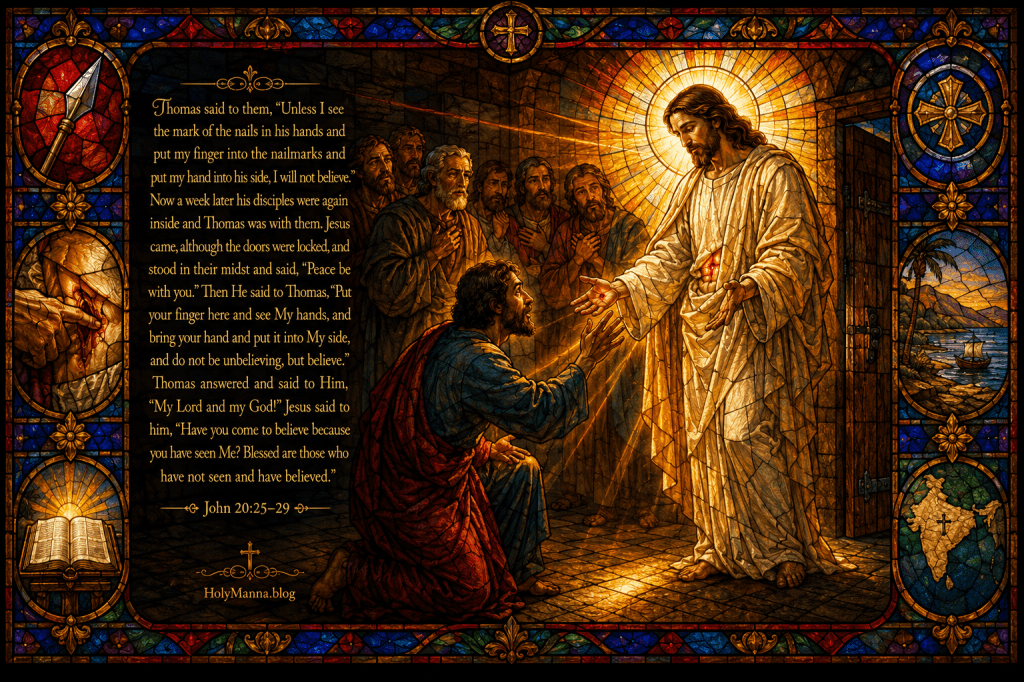
24 Thomas, called Didymus, one of the Twelve, was not with them when Jesus came. 25 So the other disciples said to him, “We have seen the Lord.” But he said to them, “Unless I see the mark of the nails in his hands and put my finger into the nailmarks and put my hand into his side, I will not believe.” 26 Now a week later his disciples were again inside and Thomas was with them. Jesus came, although the doors were locked, and stood in their midst and said, “Peace be with you.” 27 Then he said to Thomas, “Put your finger here and see my hands, and bring your hand and put it into my side, and do not be unbelieving, but believe.” 28 Thomas answered and said to him, “My Lord and my God!” 29 Jesus said to him, “Have you come to believe because you have seen me? Blessed are those who have not seen and have believed.”
Detailed Exegesis
Verse 24: “Thomas, called Didymus, one of the Twelve, was not with them when Jesus came.”
John identifies Thomas by both his Aramaic name and his Greek nickname, Didymus, both meaning “twin.” More importantly, John notes carefully that Thomas was one of the Twelve. He was not a peripheral figure or a casual follower. He was part of the foundational circle, one of the men on whose witness the entire Church would be built. His absence the first time Christ appeared is recorded without explanation or judgment. Scripture does not tell us why he was not there, and responsible faith does not fill that silence with speculation. What matters is that he was missing, and what God did about that is the whole point of the passage.
Verse 25: “So the other disciples said to him, ‘We have seen the Lord.’ But he said to them, ‘Unless I see the mark of the nails in his hands and put my finger into the nailmarks and put my hand into his side, I will not believe.’”
Thomas’s demand is precise and physical. He does not ask for a vision or a feeling or a sign in the sky. He asks to touch the specific wounds of the Crucifixion, the hands and the side. This specificity matters because it reveals what Thomas was actually wrestling with. He had watched Jesus die. He knew what crucifixion looked like. If the Risen Lord was truly the same Jesus who had been nailed to that Cross, then the wounds would be there. Thomas was not rejecting the possibility of resurrection. He was insisting that the resurrection be real and bodily, not symbolic or spiritual in some vague sense.
Verse 26: “Now a week later his disciples were again inside and Thomas was with them. Jesus came, although the doors were locked, and stood in their midst and said, ‘Peace be with you.’”
The detail that the doors were locked is not incidental. John mentioned it in the first appearance as well (John 20:19), and it is repeated here to make a point: the Risen Christ is not constrained by physical barriers. He passes through locked doors not because He is a ghost but because His glorified body operates according to a different order of reality than the one that locked those doors. And His first words, as always, are peace. Before He addresses Thomas’s doubt, before He shows His wounds, He offers peace. That sequence is the Gospel in miniature.
The fact that this return happened exactly one week later carries liturgical weight that the early Church did not miss. Sunday after Sunday, the Church gathers as those first disciples gathered, behind whatever doors they have locked against the world, and the Risen Christ enters again, offers peace again, and makes Himself present in the Eucharist.
Verse 27: “Then he said to Thomas, ‘Put your finger here and see my hands, and bring your hand and put it into my side, and do not be unbelieving, but believe.’”
Christ offers Thomas exactly what Thomas asked for. He does not rebuke the request. He does not lecture Thomas about faith before evidence. He simply shows up and says: here are the wounds you needed to see. The Greek word translated as “unbelieving” is apistos, meaning without faith, and its opposite is pistos, faithful or believing. Christ is not shaming Thomas for a character flaw. He is calling him out of a state and into a relationship. There is an enormous pastoral kindness in the way Jesus handles this moment, and it has everything to say to anyone who has ever felt that their doubts disqualify them from belonging to the faith.
Verse 28: “Thomas answered and said to him, ‘My Lord and my God!’”
This is the summit of The Gospel of John. John opened his Gospel with “In the beginning was the Word, and the Word was with God, and the Word was God” (John 1:1). Now, at the close of the resurrection narrative, a human being who has just touched the wounds says the same thing in his own words: You are my Lord and my God. The Greek uses the definite article with both titles, ho Kyrios mou kai ho Theos mou, making this an absolute and unambiguous identification. This is not poetry. This is theology on its knees.
Verse 29: “Jesus said to him, ‘Have you come to believe because you have seen me? Blessed are those who have not seen and have believed.’”
Christ does not withhold the blessing from Thomas. He blesses him and then extends an even greater beatitude to every believer who comes after. This verse is the theological bridge between the apostolic generation and every subsequent generation of Christians. It is Christ looking down through every century and blessing everyone who would believe without the physical evidence Thomas received.
Teachings
Saint Augustine’s reflection on this passage in his Tractates on the Gospel of John, Tractate 121, is among the most important in the entire patristic tradition. Augustine wrote that Thomas’s doubt was not a failure but a divine provision: “He doubted so that we might not doubt.” Thomas’s hands became instruments of proof for all future believers. The wounds he demanded to touch became the wounds he proclaimed to the ends of the earth.
Pope Benedict XVI, in Jesus of Nazareth: Holy Week, reflected that Thomas represents a faith that has passed through darkness and emerged not as intellectual assent but as total personal surrender. The words “My Lord and my God” are not a proposition about Jesus. They are an act of worship.
The Catechism of the Catholic Church in paragraph 645 addresses the nature of Christ’s risen body directly: “By means of touch and the sharing of a meal, Jesus dispels their doubts and invites them to recognize that he is not a ghost, but above all that the risen Christ is the very one who was crucified, bearing still the marks of his Passion.” The wounds are not defects in the resurrection body. They are the permanent marks of redemptive love carried into eternity.
CCC 448 speaks to the title Thomas uses: “In the New Testament, this title is given to Jesus in his divine identity. He exercises this divine sovereignty by his crucifixion and resurrection.”
Reflection
Thomas’s story is good news for anyone who has ever sat in the back of a church wondering if all of this is actually real. God did not send Thomas an angel or a vision. He came Himself, through locked doors, and offered His wounds to be touched. That is the kind of God Christianity is built on: one who meets honest doubt with a personal encounter rather than a theological argument.
The invitation here is to bring doubts honestly to prayer and to the sacraments rather than letting them fester in isolation. Thomas was with the community when Christ returned. He had not walked away. He stayed in the room, even in his uncertainty, and Christ came to him there.
What doubt have you been carrying that you have not yet brought honestly before God? And what would it mean to stay in the room, to keep showing up at Mass, to keep praying, even when the faith does not feel certain, trusting that Christ knows exactly where you are and is already on His way back for you?
The God Who Comes Back Through Locked Doors
Thomas was absent. He doubted. He demanded proof. And God came back for him anyway, walked through a locked door, and offered His wounds to be touched. That is the story at the heart of this feast, and it is not just Thomas’s story. It is the story of everyone who has ever felt like they missed something, like they arrived too late, like their doubts put them on the wrong side of the door.
Ephesians 2 says that no one who comes to Christ remains a stranger. The outsider becomes a citizen. The citizen becomes family. And the family, imperfect and doubt-filled as it is, becomes a living temple where God Himself has chosen to dwell. Thomas is one of the foundational stones of that temple, not despite his absence and his demand for proof, but as the man whose honest struggle produced the highest confession of faith in the entire Gospel: “My Lord and my God.”
Psalm 117 reminds every reader that God’s mercy is not fragile, and His faithfulness does not have an expiration date. Those two truths are the ground beneath every shaky step of faith. They were true for Thomas in his grief. They are true for anyone carrying doubt today.
The call to action is simple but not easy: stay in the room. Thomas did not walk away from the community in his doubt. He stayed, and Christ came to him there. The same is true at every Mass, every confession, every honest prayer offered from a heart that is not entirely sure but is still showing up.
God is not waiting for anyone to have it all figured out before He walks through the door. He is already on His way, wounds and all, saying the same thing He said to Thomas: “Do not be unbelieving, but believe.”
Engage With Us!
Every feast day is an invitation, and the Feast of Saint Thomas is one of the most personal ones the Church offers. These readings have a way of finding people exactly where they are, in the doubt, in the longing, in the quiet hope that God has not forgotten them. Share your reflections in the comments below, because your story matters and your voice is part of the living temple these readings describe.
- Ephesians 2:19–22 tells us that every believer is a living stone in a temple God is actively building. What does it mean to you personally to be called a member of God’s household rather than a stranger, and in what ways might God be inviting you to be a stronger foundation for the people around you?
- Psalm 117 anchors everything in two truths: God’s mercy is strong and His faithfulness lasts forever. On the days when faith feels distant or life feels heavy, which of those two truths do you find yourself needing most, and why?
- In John 20:24–29, Thomas stays with the community even in his doubt, and Christ comes back specifically for him. Is there an area of your faith where you have been tempted to walk away, and what would it look like to stay in the room and trust that Christ is already on His way?
- Thomas went from demanding physical proof to proclaiming “My Lord and my God,” and then carried that confession to the ends of the earth. What moment in your own life has moved you from doubt to deeper faith, and how has that experience shaped the way you share your belief with others?
The road of faith is not a straight line, and that is perfectly fine. Thomas proves it. Keep showing up, keep asking the honest questions, and keep trusting that the God whose mercy is strong and whose faithfulness is forever is walking through every locked door to find you.
Sacred Heart of Jesus, we trust in You!
Immaculate Heart of Mary, pray for us!
Saint Michael the Archangel, defend us in battle!
Follow us on YouTube, TikTok, Instagram and Facebook for more insights and reflections on living a faith-filled life.


Leave a Reply