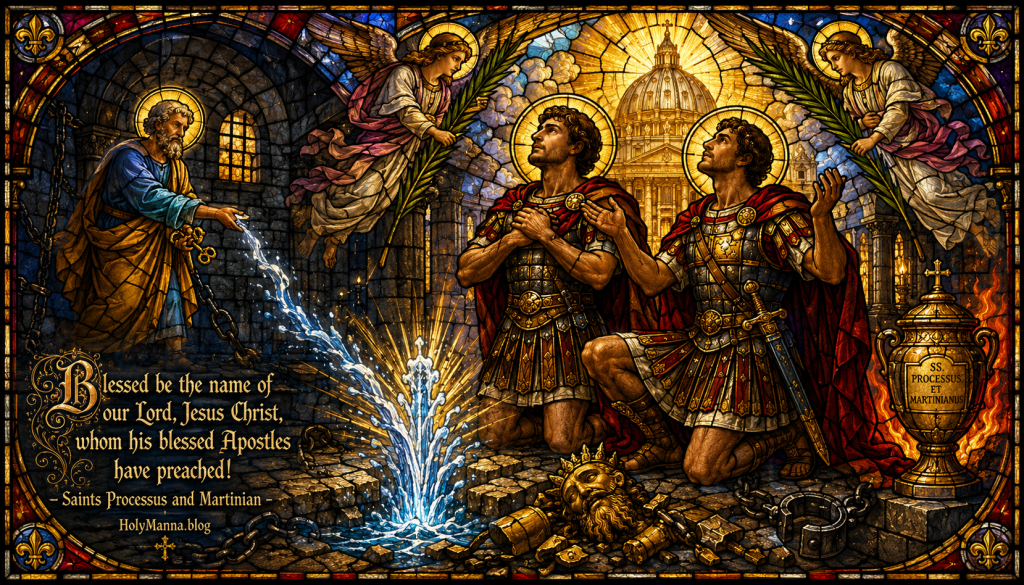
Soldiers of Caesar Who Became Soldiers of Christ
Most of the saints the Church holds up for admiration lived lives of obvious holiness. They were monks who prayed for hours, missionaries who crossed oceans, mystics who levitated during Mass. Saints Processus and Martinian did none of those things. They were Roman soldiers. Prison guards. Employed by the most powerful empire the world had ever seen to keep dangerous criminals locked up and away from the public. Their story does not begin in a monastery or a chapel. It begins in a dungeon.
And that is exactly what makes them worth knowing.
The Church celebrates these two remarkable men on July 2, though their feast was removed from the universal General Roman Calendar in the 1969 reform and given to local calendars. They remain firmly inscribed in the Roman Martyrology, the official list of saints recognized by the Catholic Church, and their feast may still be celebrated on July 2, especially in the Extraordinary Form of the Mass. They were venerated in Rome from at least the 3rd or 4th century, making their cult one of the oldest in the Christian world. And at the heart of their story is one of the most astonishing scenes in all of early Church history: the moment a spring of water burst from the stone floor of Rome’s most terrifying prison, and two battle-hardened Roman soldiers fell to their knees to be baptized.
Born Into the Empire, Assigned to Its Most Famous Prisoner
Little is known about the personal backgrounds of Processus and Martinian before their encounter with Saint Peter. What history and tradition have preserved is their role: they were guards at the Mamertine Prison, the most notorious detention facility in the ancient city of Rome. Built as a cistern dating back to the 7th century BC, the Mamertine sat at the foot of the Capitoline Hill overlooking the Roman Forum. It was not a prison in any comfortable modern sense of the word. The ancient historian Sallust described the lower chamber as being twelve feet below the ground, where neglect, darkness, and stench made it hideous and fearsome to behold. Prisoners lowered into its pit rarely came back out alive.
Among the most famous men to disappear into that darkness were Jugurtha, King of Numidia, and Vercingetorix, the fearless leader of the Gauls who had defied Julius Caesar. The Mamertine was where Rome sent its most dangerous enemies, and it was where, according to sacred tradition, the Empire sent its two greatest threats to the established order: the Apostles Peter and Paul.
Processus and Martinian were the men standing guard over them.
It is not difficult to imagine what those two soldiers must have thought when these prisoners arrived. Peter and Paul were not warriors or foreign kings. They were aging Jewish missionaries who spoke of a crucified rabbi from the occupied territories as if He were the God of the universe. They were being held for refusing to acknowledge Nero’s absolute divine authority. In the eyes of Rome, they were criminals. In the eyes of the Church, they were the two pillars upon which Christianity itself would stand.
A Spring From Stone and the Baptism That Changed Two Lives
What happened next inside that prison is one of the most beloved stories in the tradition of the early Church, though it comes to us through ancient Christian accounts that cannot be verified as strict historical record. These accounts, received and treasured by the Church for centuries, tell us something extraordinary.
As Peter preached the Gospel from inside his chains, Processus and Martinian listened. Day after day, they heard the words of Christ spoken by the man who had walked with Him, denied Him at a fire in a courtyard, wept bitterly, and been restored. They heard about the Resurrection. They heard about eternal life. Gradually, these two soldiers came to believe.
The story goes that when the time came for Peter to baptize them, there was no water to be found in the prison. So Peter prayed, and a spring burst forth from the stone floor of the Mamertine dungeon. In that miraculous water, Processus and Martinian were baptized, along with a reported forty-seven other prisoners who had also been converted by the Apostle’s preaching. This miraculous spring, according to centuries of Christian tradition, never dried up and never overflowed. It was still being venerated by pilgrims long after the prison’s stone walls crumbled into history, and visitors to the site today can still see the spring in the floor of the lower chapel beneath the Church of San Giuseppe dei Falegnami, which now stands above the ancient prison.
This miracle carries enormous theological weight. The Catechism of the Catholic Church teaches in CCC 1213 that Baptism is “the basis of the whole Christian life, the gateway to life in the Spirit, and the door which gives access to the other sacraments.” God, the tradition seems to say, was not going to let a lack of water stand between two seeking souls and the sacrament that would save them. When Peter prayed, heaven answered.
Iron Rods, Fire, and a Cry That Would Not Be Silenced
Here is where the story takes the turn that makes Processus and Martinian not just converts but martyrs.
When word reached their commanding officer, a man named Paulinus, that the two guards had not only been converted but had helped Peter preach and had possibly assisted in his escape from the prison, his reaction was swift and merciless. He ordered Processus and Martinian to renounce their new faith immediately. According to the accounts preserved in the Church’s tradition, the two men not only refused but made their defiance spectacularly clear. When Paulinus commanded them to offer sacrifice before a golden statue of Jupiter, the chief god of the Roman pantheon, they spat on it.
That was not the act of men who were confused about what they believed. That was the act of men who had made their decision and were prepared to live and die by it.
What followed was a brutal campaign of torture. The Roman Martyrology records it without flinching: Processus and Martinian were struck on the mouth, placed on a rack, scourged with thongs and metal-tipped whips, beaten with rods, and exposed to fire. Each torment was designed to break them and make them walk away from the God who had reached them in a dungeon. And through all of it, through every strike and every flame, a single declaration poured from their lips over and over again:
“Blessed be the name of our Lord, Jesus Christ, whom his blessed Apostles have preached!”
They were not silent sufferers. They were witnesses, proclaiming the name of Jesus Christ from inside the machinery of their own execution.
There is a striking echo here of the witness of the early Christian martyrs throughout the Acts of the Apostles, and it is no coincidence. Processus and Martinian had been formed in the faith by the very man who stood at the center of those early acts. Peter had told them to always be ready to give an account of the hope that was in them, and they were giving it, one blow at a time.
During their ordeal, according to the tradition of the Church, a pious and noble woman named Lucina came to the prison to visit and encourage them, offering what comfort and help she could to the two soldiers who had given up everything.
And then something happened that the Church’s tradition presents as an unmistakable sign of divine judgment. Paulinus, the man who had ordered and presided over their torture, was struck blind. He died three days later. When his son ran to the city’s ruler to demand that the martyrs be executed, the order was given. Processus and Martinian were led out and beheaded by the sword, around the year 67 AD. Lucina buried their bodies in her own cemetery along the Via Aurelia, the ancient road running west out of Rome.
Two soldiers of Caesar went into that prison. Two soldiers of Christ came out of it, straight into eternity.
A Pope, a Homily, and a Basilica That Remembers Them Still
The story of Processus and Martinian did not end at the executioner’s blade. In many ways, it was only just beginning.
Their bodies were interred along the Via Aurelia at what historians place as the second milestone from Rome. From at least the 3rd century, Roman Christians were making their way out to that spot to venerate their graves. By the 4th century, a basilica had been built directly over their tomb. This was not unusual for the early Church, as the graves of martyrs became the anchors of Christian worship, and communities gathered around them to celebrate the Eucharist and seek the intercession of those who had died for the faith.
What is extraordinary is who showed up to preach at that basilica on their feast day.
Saint Gregory the Great, one of the most towering figures in the entire history of the Catholic Church and the pope who shaped the medieval liturgy and gave his name to Gregorian chant, preached his thirty-second homily on the Gospel at the shrine of Processus and Martinian. In that homily, Gregory did not merely offer pious reflections. He testified to what was happening at that spot in real time. He told his congregation that the sick were recovering their health at the tomb. He told them that people possessed by evil spirits were being freed. He told them that those who had committed perjury were being tormented by those same spirits, as if the saints were presiding over a court of divine justice from beyond the grave. Gregory was not a credulous man. He was one of the most careful and systematic theologians of his age, and when Gregory the Great said miracles were happening at a shrine, that testimony carries serious weight.
The ancient basilica along the Via Aurelia eventually fell into ruin. But the memory of Processus and Martinian was too deeply embedded in the Church’s consciousness to disappear. When Pope Paschal I, who reigned from 817 to 824, undertook a sweeping effort to transfer the relics of Roman martyrs from crumbling suburban cemeteries into the safety of Roman churches, he included the bones of Processus and Martinian among the treasures he brought to the old Basilica of Saint Peter on the Vatican Hill.
Today those relics rest in a porphyry urn beneath the altar dedicated to Processus and Martinian in the south transept of the present St. Peter’s Basilica. Porphyry is a deep, rich purple stone that was reserved in the ancient world almost exclusively for emperors and the very highest ranks of Roman society. There is something quietly triumphant about the fact that two soldiers who defied an emperor now rest for eternity in stone once reserved for emperors themselves, inside the greatest church in Christendom, just steps from the tomb of the Apostle who baptized them.
Above that altar hangs a stunning mosaic depicting their martyrdom, completed in 1737 by the mosaicist Pietro Paolo Cristofari, based on one of the most important paintings of the Italian Baroque era.
That original painting, which now hangs in the Vatican’s Pinacoteca, was completed in 1629 by the French Caravaggesque master Valentin de Boulogne. Commissioned by Cardinal Francesco Barberini, nephew of Pope Urban VIII, the work was created to hang directly above the altar of Processus and Martinian in St. Peter’s and is considered the crowning achievement of Valentin’s career. In the canvas, the two martyrs lie stretched on a rack, their torturers at work with the grim efficiency of professional soldiers. An angel descends from above, clutching the palm of martyrdom. In the corner, the idol of Jupiter looms while the commanding officer presses his hand to his face, struck blind mid-scene by God. Contemporaries who saw the painting alongside Nicolas Poussin’s nearby Martyrdom of Saint Erasmus judged Valentin’s work superior in its raw emotional power, its use of light, and the force of its realism.
The feast of Processus and Martinian also spread far beyond Rome. The great English scholar and Church Father Bede recorded their feast in his martyrology in the 8th century, confirming that these two Roman prison guards were being honored in the churches of early medieval England. Their story had crossed the sea.
What Two Forgotten Soldiers Say to Us Right Now
It is easy to read the story of Processus and Martinian and think of it as something that happened a very long time ago to people who were very different from us. But look a little closer, and the parallels are uncomfortable in the best possible way.
Processus and Martinian were not looking for God when God found them. They showed up to work one day, did their job, and found themselves standing in the presence of a man whose faith was so real, so unshakeable, and so evidently from another world that they could not look away. Many people today have a version of that experience. It might have been a grandmother who prayed the Rosary without ever missing a day, or a friend who bore suffering with a peace that made no rational sense. Faith is contagious when it is real, and Peter’s faith was as real as it gets.
Processus and Martinian also remind us that conversion is not a passive event. When they accepted Baptism, they accepted everything that came with it, the joy and the cost. The Catechism teaches in CCC 1285 that Confirmation perfects what Baptism began, strengthening the Christian “to spread and defend the faith by word and action as true witnesses of Christ.” Processus and Martinian embodied that grace completely. They spread the faith by dying for it, and they defended it on a rack.
There is also something powerful about where all of this happened. They were not in a cathedral or at a retreat. They were at work, in a dark and filthy dungeon, doing a job they probably never would have chosen if the choice had been up to them. God did not wait for them to find a better environment. He sent the Prince of the Apostles directly into their workplace.
Is there a place in your own daily life, a job, a classroom, a relationship, where you have been so focused on the task in front of you that you might be missing the Someone who is trying to speak to you?
The other thing that cannot be overlooked is their courage under torture. When everything the Empire could bring to bear was aimed at making them deny Christ, they did not deny Him. They announced Him. Over and over, through every instrument of Roman cruelty, their response was the same: “Blessed be the name of our Lord, Jesus Christ, whom his blessed Apostles have preached!”
That is not the response of people who believed in a vague spiritual force or a pleasant set of moral teachings. That is the response of people who had met the living God and were not willing to pretend otherwise, not even when it cost them everything.
What would it look like to have that kind of settled certainty about your faith, not the arrogant certainty of someone who has never doubted, but the quiet, unshakeable certainty of someone who has been genuinely found by Christ?
The prayer the Church offers for the feast of these saints says it beautifully: “O God, You surround us and protect us by the glorious confession of Your holy martyrs, Processus and Martinian; grant us both to profit by their example and to rejoice in their intercession.”
To profit by their example. Not just to admire it from a safe distance but to let it change something. For most people today, that does not mean facing a rack or a blade. But it might mean refusing to stay quiet about the faith in a workplace that treats religion as embarrassing. It might mean choosing not to laugh at the joke that mocks the Church. It might mean staying faithful through a difficult marriage, a difficult parish, or a dry and discouraging season of prayer, the way Processus and Martinian stayed faithful through things far harder than any of those.
Saints Processus and Martinian were ordinary men who encountered an extraordinary God and said yes with everything they had. That has always been what saints are made of, and it is what each of us is invited into as well.
Engage With Us!
Thank you for spending time with the incredible story of Saints Processus and Martinian today. Their witness is one of the most stirring in the entire early Church, and there is so much to sit with in their journey from prison guards to martyrs. Please share your thoughts, reactions, and reflections in the comments below. This community exists for real conversation about the faith, and every voice adds something valuable.
Here are a few questions to help get the reflection going:
- Processus and Martinian encountered the living faith of Saint Peter while simply doing their jobs. Have you ever met someone whose faith was so real and compelling that it made you want to know more about God?
- The miraculous spring in the Mamertine Prison is still visible today, a physical reminder that God provides what is needed for the sacraments and for our souls. How has God provided for a need in your own spiritual life in an unexpected way?
- Processus and Martinian chose to spit at the idol of Jupiter and face torture rather than deny Christ. What are the “idols” in modern life, things like comfort, approval, success, or reputation, that tempt us to stay quiet about our faith?
- Gregory the Great personally testified that miracles were happening at the tomb of these martyrs, including healings and the freeing of those who were possessed. Does the idea that the saints are active intercessors who can still act in our world today feel real to you, or is it something you are still wrestling with?
- Their words during torture were, “Blessed be the name of our Lord, Jesus Christ, whom his blessed Apostles have preached.” If you were reduced to a single sentence to describe your faith, what would it be?
Keep going. Keep praying. Keep saying yes to God in the ordinary moments of everyday life, because that is exactly where He is most likely to show up. Saints Processus and Martinian, pray for us!
Saints Processus and Martinian, pray for us!
Follow us on YouTube, TikTok, Instagram and Facebook for more insights and reflections on living a faith-filled life.

 Holy Manna!
Leave a comment