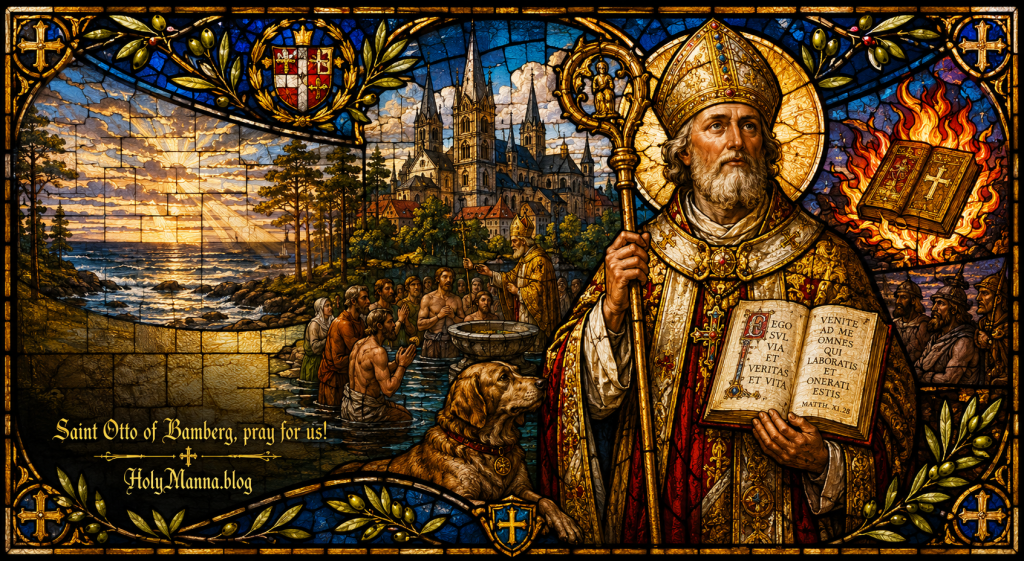
The Apostle Who Changed the Map of Christianity
July 2 belongs to a saint whose story most Catholics have never heard, and that is a genuine shame. Saint Otto of Bamberg was a German bishop who lived at one of the most turbulent crossroads in Church history, navigated imperial controversies with grace, built up the Church from the ground using his own hands and personal resources, and then in his sixties embarked on a missionary journey that resulted in over twenty-two thousand baptisms. He did not die a martyr. He was not known for dramatic mystical visions. What he was known for was something arguably more relatable and more challenging: faithful, tireless, practical service to God and to the people God placed in his care, even when the political ground beneath his feet kept shifting. For that faithfulness, Pope Clement III canonized him in 1189, fifty years after his death, and the Church has honored him every July 2 ever since.
Saint Otto is the patron saint of the Archdiocese of Bamberg in Germany, the co-patron of the Archdiocese of Berlin and the Diocese of Stettin-Kammin in Poland, and he is invoked against rabies, hydrophobia, and mad dogs. That last piece of patronage will make a great deal more sense once the full story unfolds, and it is very much worth staying for.
From the Courts of Kings to the Courts of Heaven
Otto was born around 1060 in Swabia, in what is now the southwest corner of Germany. His family was noble but not wealthy, one of those landed households that carried status without surplus. Since his elder brother stood to inherit the family estates, Otto was pointed in a different direction from a young age and sent to school, most likely at Hirsau Abbey or one of the monasteries connected to it. For a younger son of the nobility in medieval Europe, this was a natural and respected path. For Otto, it would turn out to be exactly where God was already at work.
His early formation was thorough and shaped him in lasting ways. Around 1088, he entered the household of Duchess Judith of Poland, the sister of Emperor Henry IV. This was not simply a social appointment. It plunged Otto into the highest levels of European politics and diplomacy, and he was even given the significant task of overseeing the construction of the Cathedral of Speyer during this period, which speaks to the level of trust and capability he had already demonstrated at a relatively young age.
By 1090, Otto had entered the direct service of Emperor Henry IV himself, and around 1101 he was appointed imperial chancellor, which was essentially the top administrative post in the Holy Roman Empire. This was a man who had climbed about as high as a person could climb in medieval Germany without wearing a crown. He was respected, capable, deeply connected, and trusted by the most powerful people of his day. And then, as God tends to do with people He has shaped through unlikely circumstances, He redirected all of that influence toward something eternal.
In 1102, Emperor Henry IV appointed Otto as Bishop of Bamberg. What followed is one of the defining moments of his character. The emperor had made the appointment without proper papal sanction, and Otto refused to be consecrated by a bishop who was not in full communion with Rome. He held firm on that point, even though he could have simply accepted the honor and moved on with his life. Henry IV ultimately agreed, and the two of them journeyed to Rome together, where Otto was consecrated by Pope Paschal II himself on May 13, 1106. The man who could have taken a shortcut chose the harder road instead, because for Otto of Bamberg, being right with the Church was never negotiable.
How One Bishop Won a People for Christ
The years Otto spent building up the Diocese of Bamberg are a masterclass in what good episcopal leadership looks like in practice. He restored and completed Bamberg Cathedral, which had been severely damaged by fire in 1081. He improved the cathedral school, built churches and hospitals throughout his territory, and expanded the city of Bamberg considerably. When the Monastery of St. Michael was destroyed by an earthquake around 1117, he rebuilt it from the ground up. He also helped the poor out of his own resources whenever the people were in need, and he lived simply and frugally in his private life, even though his position entitled him to far more comfort.
His greatest love, though, was monasticism. He founded or restored over twenty monasteries across the dioceses of Bamberg, Würzburg, Ratisbon, Passau, Eichstätt, Halberstadt, and Aquileia, entrusting them to Benedictines, Premonstratensians, and Cistercians. He reformed troubled monasteries and shepherded struggling communities back toward their proper charisms. For all of this, he earned a title that has stuck with him across nine centuries: “Father of the Monks.”
There is also a remarkable historical detail attached to his years as bishop that most people never know. Around 1112, with the Archbishop of Mainz imprisoned and unable to fulfill his duties, it was Otto who stepped in and formally clothed a young fifteen-year-old noblewoman as a Benedictine nun at Disibodenberg Abbey. That young woman was Saint Hildegard of Bingen, one of the greatest mystics and Doctors of the Church in all of Catholic history. The man who would become the Apostle of Pomerania was also, in a quiet and practical way, the bishop who opened the door to one of the most extraordinary spiritual voices the Church has ever known.
But the chapter for which Otto is most remembered had not yet begun. Around 1122, Duke Bolesław III of Poland asked Otto to take on a mission that others had already tried and failed: the conversion of the pagan Pomeranians who lived along the Baltic coast in what is now northern Poland and northeastern Germany. A Spanish bishop named Bernard had already attempted this mission, traveling to Pomerania barefoot and in poor clothing, hoping to win the people through his austerity. The Pomeranians took one look at him, assumed he was a penniless beggar hoping for a handout, and expelled him from the region.
Otto’s approach was completely different, and wisely so. He set out in 1124 accompanied by twenty clergy from his own diocese, a substantial number of servants, sixty warriors provided by Bolesław, and a generous supply of provisions and gifts. It might sound counterintuitive to evangelize by arriving wealthy, but Otto understood something essential about the Pomeranians. Because he was already visibly prosperous, they could trust that he was not there to exploit them or drain their resources. He had nothing to gain materially, and that cleared the path for his message to be received.
His method of evangelization has been described by the Heralds of the Gospel magazine as “evangelization through beauty,” captivating the natives with the magnificence of liturgical ornaments. Otto did not come with arguments and ultimatums. He came with the splendor of the sacred, the gentleness of genuine pastoral care, and the credibility of a man who clearly lived what he preached. He won the Pomeranians not by overwhelming them but by drawing them in.
The results were extraordinary. Otto established eleven churches and baptized 22,165 people across the towns of Pyrzyce, Kamień, Szczecin, and Wolin. He returned to Bamberg in 1125 having transformed an entire region. When some pagan customs began reasserting themselves a few years later, he did not hesitate. He went back to Pomerania in 1128, supported by Wartislaw I, Duke of Pomerania, won over all the nobles at the Diet of Usedom, converted additional communities, and dispatched priests from Bamberg to establish a lasting Christian presence in the region. For all of this, he received the title that defines his legacy: “Apostle of Pomerania.”
There are two stories from his missionary journeys that have been passed down through generations of Catholic tradition. The first tells that during one of his missions, the tribal chiefs of Pomerania challenged the truth of his faith by throwing his copy of the Gospels into a fire. If the book truly contained the Word of God, they reasoned, it would not burn. According to this story, the book emerged from the fire completely unharmed, and this event played a significant role in opening the hearts of the Pomeranians to the message Otto carried. The second story holds that during his second journey, a severe drought was afflicting the region and Otto prayed earnestly for rain, after which rain promptly fell. The Pomeranians attributed this to his intercession, and it deepened their trust in him and in the God he served. Both of these stories come from Catholic tradition and cannot be independently verified, but they have traveled through the centuries as part of the memory the Church carries of this remarkable man.
Caught Between Two Worlds
No life of faithful service in the Church comes without its share of suffering, and Otto’s was no exception. The great trial of his earlier years was the Investiture Controversy, the defining political and ecclesial conflict of his entire era. At its heart, the controversy was a battle over whether civil rulers or the pope had the authority to appoint bishops. Emperor Henry IV had been fighting this battle with Rome for years, and Otto, as both a former imperial chancellor and a bishop, was caught squarely in the middle.
He never became a partisan of either extreme. He remained loyal to the emperor in matters of statecraft while holding firm on the primacy of the pope in ecclesial appointments, and that careful balance made him a target for both sides. In 1118, the papal party had him suspended at the Synod of Fritzlar, a real and painful blow to a bishop who had only ever tried to serve the Church with integrity. He accepted it without schism, without public bitterness, and without abandoning his post. He simply waited, continued his work in Bamberg, and trusted that fidelity would eventually speak for itself.
And it did. By 1121, Otto was playing a central role in the peace negotiations at the Congress of Würzburg, which led directly to the historic Concordat of Worms in 1122, the agreement that finally resolved the Investiture Controversy. The man who had been suspended by one faction and pressured by another ended up helping broker the peace that brought both sides together.
His missionary journeys also carried their share of hardship. He was expelled from towns by pagan Pomeranians who did not want to hear what he had to say. He faced open hostility, organized resistance, and the frustration of watching communities he had converted slide back into pagan customs after he returned home. He was also thwarted in his final wish of consecrating a bishop for Pomerania before he died, with the Archbishops of Magdeburg and Gniezno blocking the appointment on the grounds of competing metropolitan claims. He did not get to see that piece finished. Only after his death, in 1140, was his former companion Adalbert consecrated as Bishop of Wolin to serve the people Otto had won for Christ.
He was not a martyr in the traditional sense. He did not shed blood for the faith. But he spent nearly four decades absorbing the friction of a fractured Church, serving with generosity when treated with suspicion, and pouring his personal resources into work that would outlive him by centuries. That is its own kind of witness.
A Life That Kept Bearing Fruit Long After Death
Otto died on June 30, 1139, in Bamberg, at around seventy-seven years of age. He was buried in the Michaelsberg Abbey, the very monastery he had rebuilt after the earthquake of 1117. He had founded it, restored it, and now he rests in it still.
At his funeral, Bishop Embrice of Würzburg delivered the oration and reached for the words of the prophet Jeremiah to capture the man’s life. He applied to Otto these words: “The Lord called thy name, a plentiful olive tree, fair, fruitful, and beautiful.” It is hard to imagine a more fitting tribute. The olive tree in Scripture is a symbol of peace, abundance, and faithfulness, all things Otto had embodied across his long years of faithful service.
The Catholic Encyclopedia records that miracles were reported both during his missionary journeys and at his tomb after his death, and his reputation for holiness spread rapidly across the region. Just fifty years after his death, in 1189, Pope Clement III formally canonized him, confirming what the faithful in Bamberg and Pomerania had already known in their hearts for decades.
There is also a story connected to his sacred imagery that helps explain one of his more unusual patronages. According to a story that has traveled through the centuries alongside his memory, a dog once protected Otto from a wild boar during a hunting expedition. This story cannot be independently verified, but it became so intertwined with his image that in sacred art, Otto is frequently depicted as a bishop accompanied by a dog. It also gave rise to his patronage against rabies, hydrophobia, and mad dogs, a distinctly medieval form of intercessory association, where an event involving an animal in a saint’s life becomes the basis for invoking that saint’s protection against animal-related dangers.
His feast is celebrated on three separate dates across two nations. In the United States, his feast falls on July 2, as recorded in the Roman Martyrology. In Germany, it is remembered on June 30, the actual date of his death. In Pomerania and some dioceses of northwestern Poland, it is observed on October 1. The fact that his memory crosses borders between Germany and Poland, two nations that have shared a long and complicated history, is itself a testimony to the reach of his mission. His memory functions, even now, as a bridge between peoples.
Three separate biographies were written about him in the decades immediately following his death: by Wolfger of Prüfening, Ebo of Michelsberg, and Herbord of Michelsberg. Three independent biographies in one generation is a remarkable testament to how deeply he was admired by those who had witnessed his life and work up close.
What Otto’s Story Is Really Saying to You Today
It is easy to look at a saint like Otto of Bamberg and feel a certain distance. He was a bishop in medieval Germany. He traveled to Pomerania by horse and on foot. The world he inhabited feels far removed from the commute, the notifications, and the noise of modern life. But the core of who he was is not distant at all.
Otto was a man who used the position and resources he had been given not to secure his own comfort but to serve others. He was a diplomat who chose integrity over convenience when it would have been easy to look the other way. He was a pastor who funded hospitals and monasteries out of his own pocket. He was a missionary who believed that people are drawn to the beauty of truth when it is presented with love rather than coercion. None of that has an expiration date.
What would it look like to bring “evangelization through beauty” into everyday life? The way a home is kept. The peace that radiates from a person who actually prays and means it. The generosity that shows up without being asked or announced. The refusal to cut corners when doing the right thing costs something real. Otto did not win twenty-two thousand Pomeranians to the faith by arguing them into the pews. He won them by showing up as a credible witness, someone whose life made the Gospel believable.
He also endured suspension, opposition, and the frustration of unfinished work with a patience and resilience that is genuinely worth sitting with. Is there an area of life right now where faithfulness feels unrewarded, where the work is good but the fruit is slow to come? Otto’s story is an invitation to trust that God accounts for every act of faithful service, even the ones that do not reach their conclusion within a single lifetime. Adalbert was consecrated Bishop of Wolin in 1140, after Otto was already gone. The work kept going. It always does.
And then there is the image of that olive tree from the words spoken over him at his funeral. “The Lord called thy name, a plentiful olive tree, fair, fruitful, and beautiful.” An olive tree does not produce fruit quickly. It takes years, sometimes decades, to reach its full fruitfulness. But when it does, it is extraordinary. Saint Otto of Bamberg was that kind of person: steady, deeply rooted, slow to rush, and in the end, extraordinarily fruitful for the Kingdom of God.
Engage With Us!
The story of Saint Otto of Bamberg is one of those reminders that God builds His Church through ordinary people who simply say yes — and then keep saying it, even when it is costly and even when the full fruit of their labor will not arrive until after they are gone. There is so much in this saint’s life worth reflecting on, and the comments section is the perfect place to do it. Share your thoughts and start the conversation below.
- Otto’s missionary strategy was to come with beauty and abundance rather than argument and pressure. Where in your own life could you adopt a posture of “evangelization through beauty” rather than trying to win people over through debate?
- He was suspended by the very Church he loved, for political reasons he could not fully control, and he responded with patience rather than bitterness. Have you ever felt misunderstood or treated unjustly within the Church or a community you love, and what did that experience teach you about what fidelity really costs?
- Otto never got to see the bishop for Pomerania appointed in his own lifetime. What unfinished good work are you being asked to trust God with right now, even if you may not live to see its completion?
- His whole life was a bridge between two worlds, the world of imperial power and the world of the Gospel. How is God asking you to use the specific gifts, connections, or resources in your life to serve something greater than yourself?
Every saint is really just someone who said yes to God more consistently than they said no. Saint Otto of Bamberg said yes in the halls of emperors and on the roads of Pomerania, in the frustration of unfinished work and in the joy of watching thousands enter the waters of Baptism. That same call belongs to every Catholic alive today. Go live it with everything you have.
Saint Otto of Bamberg, pray for us!
Follow us on YouTube, TikTok, Instagram and Facebook for more insights and reflections on living a faith-filled life.

 Holy Manna!
Leave a comment