Thursday of the Thirteenth Week in Ordinary Time – Lectionary: 380
When God Refuses to Be Quiet
There is something deeply human about trying to silence a voice that makes us uncomfortable. It happens at family dinners, in boardrooms, and, as today’s readings remind us with startling clarity, even in the holiest of places.
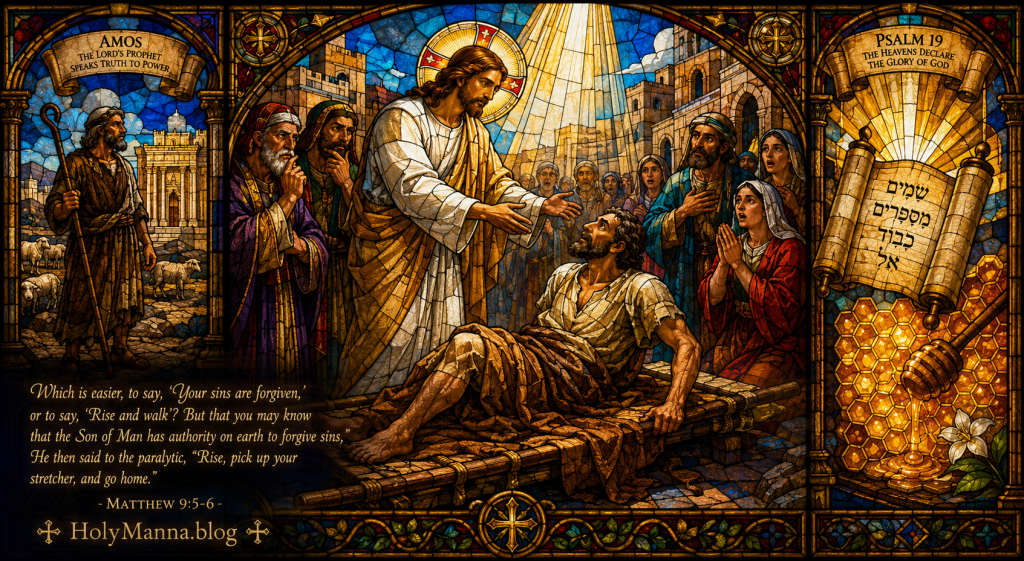
On this Thursday of the Thirteenth Week in Ordinary Time, the Church sets before us a conversation that has been unfolding since the beginning of salvation history: the tension between the living word of God and the human instinct to domesticate it, manage it, and ultimately shut it down. Amos is a herdsman who gets interrupted by God and sent into hostile territory to speak an unwelcome truth. Psalm 19 answers back that the word he carries is “more desirable than gold” and sweeter than honey dripping from a comb. And in Matthew 9, Jesus, the Word made flesh, walks into Capernaum and does what only God can do: He forgives, He heals, and He refuses to be contained by anyone’s expectations.
The thread connecting all three readings is this: God’s word is alive, it is sovereign, and it will accomplish what it was sent to do, regardless of who tries to stop it. In the 8th century BC, the political and religious establishment of the Northern Kingdom tried to silence a shepherd from Tekoa. In first-century Galilee, learned scribes tried to reduce Jesus to a blasphemer. In both cases, the word of God simply kept moving.
What would it look like to receive that word today, not just hear it, but truly let it in? That is the invitation these readings place before every Catholic who walks through the doors of daily Mass, and it is absolutely worth sitting with.
First Reading – Amos 7:10-17
The Prophet Nobody Asked For
Eight centuries before Christ, the Northern Kingdom of Israel was riding high. Under King Jeroboam II, the nation had expanded its borders and filled its treasury, but beneath that prosperity, the poor were being crushed and the worship of God had been hollowed out into a comfortable, royally sponsored religion. Bethel, whose name literally means “House of God,” had once been the sacred ground where Jacob woke from his dream and declared with trembling that God was truly present in that place. By Amos’s time, it had become the king’s personal sanctuary, a place where the priesthood served political power as readily as it served the Lord. Into this comfortable arrangement walked Amos of Tekoa: a sheep breeder and sycamore farmer from Judah who had no prophetic credentials and absolutely no interest in making friends at court. God had simply taken him from behind the flock and told him to go speak. So he went.
Amos 7:10-17 – New American Bible (Revised Edition)
10 Amaziah, the priest of Bethel, sent word to Jeroboam, king of Israel: “Amos has conspired against you within the house of Israel; the country cannot endure all his words. 11 For this is what Amos says:
‘Jeroboam shall die by the sword,
and Israel shall surely be exiled from its land.’”12 To Amos, Amaziah said: “Off with you, seer, flee to the land of Judah and there earn your bread by prophesying! 13 But never again prophesy in Bethel; for it is the king’s sanctuary and a royal temple.” 14 Amos answered Amaziah, “I am not a prophet, nor do I belong to a company of prophets. I am a herdsman and a dresser of sycamores, 15 but the Lord took me from following the flock, and the Lord said to me, ‘Go, prophesy to my people Israel.’ 16 Now hear the word of the Lord:
You say: ‘Do not prophesy against Israel,
do not preach against the house of Isaac.’
17 Therefore thus says the Lord:
Your wife shall become a prostitute in the city,
and your sons and daughters shall fall by the sword.
Your land shall be parcelled out by measuring line,
and you yourself shall die in an unclean land;
and Israel shall be exiled from its land.”
Detailed Exegesis
Verse 10: “Amaziah, the priest of Bethel, sent word to Jeroboam, king of Israel: ‘Amos has conspired against you within the house of Israel; the country cannot endure all his words.’”
Amaziah’s first move is not theological but political. He does not attempt to refute Amos’s message or challenge its accuracy. Instead, he frames it as a national security threat and routes it directly to the king. The word “conspired” is a serious accusation, the kind reserved for traitors and coup plotters. Amaziah has no interest in whether Amos is right. He is interested in making the noise stop.
Verse 11: “For this is what Amos says: ‘Jeroboam shall die by the sword, and Israel shall surely be exiled from its land.’”
Amaziah’s summary of Amos’s message is selective. The prophecy of exile is real and central to Amos’s preaching, but what Amaziah omits entirely is the reason for it: Israel is heading toward exile because the nation has abandoned justice and covenant fidelity. Amaziah strips the moral content from the message and leaves only the political threat, which is the oldest trick in the book when it comes to discrediting a prophet.
Verses 12-13: “To Amos, Amaziah said: ‘Off with you, seer, flee to the land of Judah and there earn your bread by prophesying! But never again prophesy in Bethel; for it is the king’s sanctuary and a royal temple.’”
The insult here is layered and deliberate. Calling Amos “seer” in this dismissive tone is the ancient equivalent of calling someone a fortune-teller. The instruction to “earn your bread by prophesying” accuses Amos of being a hired professional, one of the prophetic guild members who made their living telling powerful people what they wanted to hear. Amaziah is not just throwing him out. He is attacking his credibility. And the reason he gives for banishing him is the most revealing detail in the passage: Bethel is “the king’s sanctuary,” not God’s sanctuary. The king’s.
Verses 14-15: “Amos answered Amaziah, ‘I am not a prophet, nor do I belong to a company of prophets. I am a herdsman and a dresser of sycamores, but the Lord took me from following the flock, and the Lord said to me, Go, prophesy to my people Israel.’”
This is one of the most remarkable self-defenses in all of Scripture. Amos is not arguing from credentials. He is arguing from a call. He is not a professional prophet. He is a working man who was interrupted by God, and the Hebrew verb “took” carries the weight of divine compulsion. The same word is used of God taking David from shepherding to kingship in 2 Samuel 7:8. Amos did not apply for this mission. He was chosen for it, and that is the only authority he needs.
Verse 16: “Now hear the word of the Lord: You say: ‘Do not prophesy against Israel, do not preach against the house of Isaac.’”
Amos turns Amaziah’s command to silence into the very occasion for a new oracle. The attempt to stop the word of God produces more of it. The irony is pointed and intentional: Amaziah’s order to be quiet becomes the premise of a judgment against him personally.
Verse 17: “Therefore thus says the Lord: Your wife shall become a prostitute in the city, and your sons and daughters shall fall by the sword. Your land shall be parcelled out by measuring line, and you yourself shall die in an unclean land; and Israel shall be exiled from its land.”
The judgment against Amaziah is personal and precise. Everything he tried to protect by silencing Amos, his family, his land, his comfortable position within the system, will be stripped away. The detail about dying in an “unclean land” carries enormous theological weight. To die in exile, outside the covenant land, cut off from God’s people, was a form of spiritual desolation in the Israelite worldview. Amaziah silenced the prophet to protect his world. The prophet’s God dismantled it anyway.
Teachings
The confrontation between Amos and Amaziah is not simply ancient history. It is a pattern that runs through all of salvation history and finds its ultimate expression in the rejection of Christ Himself. St. Jerome, who wrote extensively on the Minor Prophets, saw Amos as a model of prophetic courage for priests and bishops who are tempted to soften God’s word to avoid offending powerful patrons. St. Augustine read the encounter as a prototype of the persecution of the prophets, noting that the institution most responsible for guarding God’s word can become, in its corruption, the very instrument of its suppression.
The Catechism of the Catholic Church connects this prophetic tradition directly to the Christian vocation of every baptized believer. CCC 783 teaches that “the holy People of God shares also in Christ’s prophetic office” and that this office is exercised “by spreading abroad a living witness to him, especially by means of a life of faith and charity.” Every Catholic inherits a share of what Amos carried into Bethel. The form differs, but the essence is identical: speak the truth of God faithfully, regardless of the cost. CCC 702 further reminds the faithful that the Holy Spirit spoke through the prophets precisely to prepare the world for the coming of Christ, and that their words continue to form and challenge the People of God today.
Reflection
Amos did not set out to be a troublemaker. He was minding his flock and tending his sycamores when God interrupted his life with a mission he never requested. And when a powerful, credentialed priest told him to be quiet, he did not apologize, negotiate, or retreat. He delivered the message he had been given, with full knowledge of what it would cost him.
What is the word that God has placed in your life that feels too inconvenient or too costly to speak out loud? Every Catholic faces moments when fidelity to the Gospel creates real friction with the surrounding culture, with colleagues, with family members, with the comfortable assumptions of modern life. Amos models what it looks like to hold the line, not out of stubbornness, but out of a clear-eyed awareness that the word came from God and therefore is not his to withhold.
Is there a place in your life where an “Amaziah” has succeeded in silencing what God placed in your heart? The prophetic call does not belong only to the ordained or the formally trained. It belongs to every person who has been baptized into the prophetic office of Jesus Christ.
Responsorial Psalm – Psalm 19:8-11
More Than Gold, Sweeter Than Honey
After watching Amos get thrown out of Bethel for speaking God’s word with too much honesty, the Church pauses and invites the faithful to sing about why that word was worth defending in the first place. Psalm 19 is one of the crown jewels of the entire Psalter, widely regarded across centuries of Catholic tradition as among the most beautiful poems ever written about the relationship between God and human beings. The portion proclaimed at today’s Mass comes from the psalm’s second half, which shifts from a hymn about God revealed in the natural world to a meditation on God revealed through His law, His Torah. That shift is significant: the first half of the psalm uses the generic name El for God, while the second half uses the personal, covenantal name YHWH, the LORD, the God who entered into relationship with Israel, who made promises and kept them, who interrupted a shepherd’s daily routine and sent him to speak truth to power. The psalm is the Church’s answer to Amaziah: yes, God’s word is inconvenient and disruptive, but it is also perfect, trustworthy, right, clear, pure, and true, and there is nothing in this world more valuable.
Psalm 19:8-11 – New American Bible (Revised Edition)
8 The law of the Lord is perfect,
refreshing the soul.
The decree of the Lord is trustworthy,
giving wisdom to the simple.
9 The precepts of the Lord are right,
rejoicing the heart.
The command of the Lord is clear,
enlightening the eye.
10 The fear of the Lord is pure,
enduring forever.
The statutes of the Lord are true,
all of them just;
11 More desirable than gold,
than a hoard of purest gold,
Sweeter also than honey
or drippings from the comb.
Detailed Exegesis
Verse 8: “The law of the Lord is perfect, refreshing the soul. The decree of the Lord is trustworthy, giving wisdom to the simple.”
The Hebrew word behind “perfect” is tāmîm, meaning whole, complete, and without defect. This is the same word used to describe the unblemished animals required for Temple sacrifice. God’s law is not flawed legislation in need of revision. It is complete in itself. The word translated “refreshing” literally means restoring or turning back, sharing its root with the Hebrew word for repentance, teshuvah. The law does not merely inform the mind. It restores the soul to what it was created to be. The second line adds that God’s decree is “trustworthy,” meaning reliable and faithful in the same way God Himself is faithful to His covenant, and this word gives wisdom not to the brilliant or the powerful but to “the simple,” those humble enough to receive it.
Verse 9: “The precepts of the Lord are right, rejoicing the heart. The command of the Lord is clear, enlightening the eye.”
The Hebrew word for “precepts” (piqqûdîm) suggests careful, precise instruction, the kind of detail that leaves nothing to guesswork. And rather than producing anxiety or burden, these precise precepts produce joy. They “rejoice the heart.” The second line describes God’s commands as “clear,” meaning radiant and shining, and their effect is to enlighten the eye, to give moral clarity to a world that would otherwise be lost in the darkness of confusion and moral relativism.
Verse 10: “The fear of the Lord is pure, enduring forever. The statutes of the Lord are true, all of them just.”
This verse takes a notable turn by pairing “the fear of the Lord” alongside the other terms for God’s law, treating reverential awe for God as itself a kind of divine gift and moral orientation. It is “pure” (ṭĕhôrâh), morally uncontaminated, and unlike earthly things, it “endures forever.” The statutes are described as “true” and “just,” rooting divine law firmly in the twin pillars of truth and justice, which in Hebrew thought are never separated from one another.
Verse 11: “More desirable than gold, than a hoard of purest gold, Sweeter also than honey or drippings from the comb.”
Gold represents concentrated, lasting material wealth. Honey dripping from the comb is immediate sensory pleasure at its most natural and uncomplicated. The psalmist places God’s word above both, not as pious exaggeration but as a claim about what actually satisfies the deepest hungers of the human person. No amount of gold addresses the soul’s longing for truth. No earthly sweetness lasts the way God’s word lasts. This is not an abstraction. It is an invitation to taste and see for oneself.
Teachings
St. Augustine, in his Enarrationes in Psalmos, saw Psalm 19 as a movement from creation to incarnation, with the sun of the psalm’s first half serving as a type of Christ, and the law of the second half finding its ultimate fulfillment in the person and teaching of Jesus. For Augustine, the word celebrated in these verses is not merely a legal code but a living communication of God’s own wisdom, which becomes fully embodied in the Son of God.
St. John Chrysostom insisted that the comparison of God’s word to honey is not merely poetic flourish but a description of genuine spiritual experience. Those who truly pray the Scriptures, who meditate on them daily and allow them to form their desires and their decisions, discover a consolation that surpasses any earthly pleasure. The sweetness, he argued, is real, and it is lasting in a way that nothing else in this life manages to be.
The Catechism of the Catholic Church reflects this same conviction with great clarity. CCC 101 teaches that “God is the author of Sacred Scripture” and that He inspired the human authors in such a way that their words are truly His words. CCC 1950 states that “the moral law is the work of divine Wisdom” and finds its fullness and unity in Christ. The law that Psalm 19 praises is not abolished or set aside. It is fulfilled. And CCC 2585 describes the Psalms themselves as “the masterwork of prayer in the Old Testament,” through which the Holy Spirit teaches the faithful to pray in union with Christ across all ages and in every circumstance of life.
Reflection
There is a quiet challenge embedded in the extravagant language of Psalm 19. The psalmist calls God’s word more desirable than gold and sweeter than honey, and that claim deserves an honest response. But how many Catholics would genuinely say that Scripture occupies that place of honor in their daily lives? It is worth sitting with that question without rushing past it.
The invitation of this psalm is not to feel guilty about neglecting the Bible. It is to become curious again, to approach God’s word the way one approaches something genuinely precious and nourishing. What would it look like to spend five minutes with a single verse of Scripture each morning, not analyzing it or mining it for information, but savoring it the way the psalmist savors honey? The Church has always proposed the practice of lectio divina, the slow and prayerful reading of Scripture, precisely because the word of God is not meant to be consumed quickly like a news headline. It is meant to be tasted.
Is there a particular verse or passage that has stayed with you across the years, one that keeps returning to your memory in moments of difficulty or decision? That verse is not there by accident. It is God’s word doing exactly what Psalm 19 promises: refreshing the soul, enlightening the eye, and rejoicing the heart of anyone humble enough to receive it.
Holy Gospel – Matthew 9:1-8
The Word That Walks Into the Room and Changes Everything
By the time Jesus steps out of the boat and back into Capernaum, Matthew’s Gospel has already shown Him commanding storms and casting out demons. The reader has watched nature and the spiritual underworld yield to His authority. Now Matthew brings the story to its theological climax with a scene that is quieter in its drama but far more radical in its claim: a paralyzed man is lowered before Jesus on a stretcher, and Jesus, before doing anything visible, forgives his sins. What unfolds next is not simply a miracle. It is a declaration of identity that divides the room and changes everything. This is the moment where the question that runs beneath the surface of the entire Gospel breaks fully into the open: exactly who is this man from Galilee, and what authority does He actually carry?
Matthew 9:1-8 – New American Bible (Revised Edition)
The Healing of a Paralytic. 1 He entered a boat, made the crossing, and came into his own town. 2 And there people brought to him a paralytic lying on a stretcher. When Jesus saw their faith, he said to the paralytic, “Courage, child, your sins are forgiven.” 3 At that, some of the scribes said to themselves, “This man is blaspheming.” 4 Jesus knew what they were thinking, and said, “Why do you harbor evil thoughts? 5 Which is easier, to say, ‘Your sins are forgiven,’ or to say, ‘Rise and walk’? 6 But that you may know that the Son of Man has authority on earth to forgive sins”—he then said to the paralytic, “Rise, pick up your stretcher, and go home.” 7 He rose and went home. 8 When the crowds saw this they were struck with awe and glorified God who had given such authority to human beings.
Detailed Exegesis
Verse 1: “He entered a boat, made the crossing, and came into his own town.”
Matthew calls Capernaum “his own town,” a detail that signals homecoming but also carries a note of contrast with what just happened in the Gadarene territory, where the townspeople, after witnessing the exorcism, asked Jesus to leave. Capernaum receives Him, or at least comes to Him, and that openness is precisely what makes the miracle possible.
Verse 2: “And there people brought to him a paralytic lying on a stretcher. When Jesus saw their faith, he said to the paralytic, ‘Courage, child, your sins are forgiven.’”
Three details in this verse deserve careful attention. First, Matthew says Jesus saw “their” faith, the faith of those who carried the man, not only the paralytic’s own faith. This is the scriptural foundation for intercessory prayer and for the entire theology of the communion of saints: the faith of others can carry a person to Christ when they cannot get there on their own. Second, Jesus addresses the man as “child” (teknon in Greek), a word of deep parental tenderness, before any healing has taken place. The man has not asked for anything. He is still lying on the stretcher, and Jesus is already calling him His child. Third, and most significantly, Jesus forgives sins before healing the body. The spiritual wound is addressed first because it is the deeper wound.
Verse 3: “At that, some of the scribes said to themselves, ‘This man is blaspheming.’”
The scribes are not wrong in their theological framework, only in their conclusion. Every faithful Jew in that room understood that forgiving sins is a divine prerogative. The entire sacrificial system of Israel, the Day of Atonement, the Psalms of repentance, all of it rested on the conviction that only God can forgive. If Jesus is merely a rabbi from Galilee, then what He just said is blasphemy. The scribes have identified the right question. They have simply refused to follow it to its only honest answer.
Verse 4: “Jesus knew what they were thinking, and said, ‘Why do you harbor evil thoughts?’”
The ability to read interior thoughts without being told is, in the Hebrew Scriptures, a characteristic of God alone. 1 Chronicles 28:9 declares that “the Lord searches all hearts and understands every intention of the thoughts.” Jesus does not need anyone to inform Him of what is happening inside the scribes. He simply knows, and He names their interior disposition not as innocent skepticism but as “evil thoughts,” a deliberate and strong word that reveals a posture of hostile rejection rather than honest inquiry.
Verse 5: “Which is easier, to say, ‘Your sins are forgiven,’ or to say, ‘Rise and walk’?”
This is one of the most elegant rhetorical moves in all of the Gospels. Both statements require divine authority to accomplish. But only one of them produces an immediately verifiable result. Forgiving sins is invisible. Healing a paralytic is not. Jesus is not suggesting that either is easy or trivial. He is making a precise logical argument: He will perform the visible miracle as public evidence that He has also accomplished the invisible one.
Verse 6: “But that you may know that the Son of Man has authority on earth to forgive sins” he then said to the paralytic, “Rise, pick up your stretcher, and go home.”
The title “Son of Man” is Jesus’s own preferred self-designation, used approximately 81 times across the four Gospels and never applied to Him by anyone else. It draws directly from Daniel 7:13-14, where the Son of Man receives from the Ancient of Days “dominion and glory and kingship; all nations and peoples of every language will serve him. His dominion is an everlasting dominion that shall not pass away.” By claiming this title in the context of forgiving sins, Jesus is not softening His claim to divinity. He is intensifying it with Scriptural precision. The phrase “on earth” matters enormously: forgiveness was already understood to be available before God in heaven. Jesus is announcing that it has now arrived in physical, personal, embodied form, wherever He stands.
Verse 7: “He rose and went home.”
Matthew is characteristically spare. The miracle speaks entirely for itself.
Verse 8: “When the crowds saw this they were struck with awe and glorified God who had given such authority to human beings.”
The crowd’s response is the proper response to an encounter with divine power: holy fear and praise. The phrase “to human beings” is not an afterthought. Writing with the full awareness of the post-Resurrection Church in mind, Matthew is already anticipating Matthew 16:19, Matthew 18:18, and John 20:22-23, where Christ shares His authority to forgive sins with the apostles and their successors. The crowd’s praise is a foreshadowing of the Church’s entire sacramental life.
Teachings
St. John Chrysostom, in his Homilies on Matthew, argued that forgiving sins is actually a greater demonstration of divine power than healing bodies, because it addresses the deepest wound in human existence. He also noted that the scribes’ error is not in their theology of forgiveness but in their failure to recognize who Jesus is, reasoning correctly from the wrong premise about His identity.
Pope John Paul II drew directly on this passage in his apostolic exhortation Reconciliatio et Paenitentia, describing the scene as the scriptural foundation for the Sacrament of Penance. He wrote that Christ’s intention is “not merely to fix the body but to restore the whole person,” beginning with the relational rupture between the soul and God that sin creates.
The Catechism of the Catholic Church ties this passage explicitly to the sacramental life of the Church. CCC 1441 teaches that “only God forgives sins” and that Jesus “exercises this divine power: ‘Your sins are forgiven.’ Further, by virtue of his divine authority he gives this power to men to exercise in his name.” CCC 1442 adds that “Christ has willed that in her prayer and life and action his whole Church should be the sign and instrument of the forgiveness and reconciliation that he acquired for us at the price of his blood.” The paralytic who was carried in on a stretcher and walked out on his own two feet is the living image of what happens in the confessional every single day.
Reflection
The man on the stretcher did not walk to Jesus. He could not. He was carried there by people who believed on his behalf, laid down at the feet of the One who called him “child” before doing anything else. That sequence, being carried by the faith of others, being met with tenderness before anything is fixed, being forgiven before being healed, is the experience the Church offers in the Sacrament of Reconciliation, and it is available to every Catholic who has been away from it for any length of time.
When was the last time the Sacrament of Penance moved from something on the calendar to an actual encounter with the Christ who says, with complete tenderness, “Courage, child, your sins are forgiven”? The scribes in this story had all the right theology and completely missed the moment. The paralytic had nothing except his need and the faith of his friends, and he walked home carrying his own stretcher.
Is there someone in your life who needs to be carried to Christ right now, someone whose faith is too thin or too bruised to get them there on their own? The crowd in Capernaum glorified God for giving such authority to human beings. That authority lives in the Church, in her sacraments, and in the faithful people who carry one another to the feet of Jesus without making a big deal about it.
The Word That Will Not Be Stopped
Today’s readings tell one story from three different angles, and the story is this: God’s word is alive, it is sovereign, and it will reach the people it was sent to reach, no matter who tries to stand in its way.
Amos had no credentials and no institutional backing. He had a call, and that was enough. When Amaziah told him to be quiet, the word of God simply got louder. Psalm 19 explains why that word was worth every bit of the conflict: because it is perfect, trustworthy, illuminating, and more nourishing than any earthly treasure or pleasure. It is the only thing that actually restores the soul rather than merely distracting it. And then, in the streets of Capernaum, the Word Himself stepped out of a boat, looked at a paralyzed man lying on a stretcher, called him “child,” and forgave his sins before anyone even asked. Then He told him to get up. And the man got up.
That is the arc of salvation history in eight verses. God speaks. Institutions resist. The word accomplishes its purpose anyway. And the people who receive it with humility walk away changed in ways they could not have manufactured on their own.
The invitation from today’s Mass is not complicated. It is simply this: stop managing the word of God and start receiving it. Let it be more desirable than whatever feels most precious right now. Let it be sweeter than whatever has been substituted for genuine spiritual nourishment. Let the One who called a paralyzed man “child” say that same word over whatever has gone immovable in this season of life.
The word has never stopped. The only question worth asking today is whether the door is open to let it in.
Engage With Us!
These readings are too good to sit with alone, and the comment section below exists precisely for moments like this one. Whether something in today’s Mass struck a nerve, brought unexpected consolation, or raised a question worth exploring, this community wants to hear it. Every reflection shared here becomes part of a conversation that, in its own small way, does exactly what Amos did: it keeps the word of God moving.
- In Amos 7:10-17, Amaziah tries to silence a prophet because the message is politically inconvenient. Has there ever been a moment in your life when you felt pressure to stay quiet about your faith, and what did you do with that pressure?
- Psalm 19:8-11 describes God’s word as more desirable than gold and sweeter than honey. What is one concrete step you could take this week to let Scripture occupy a more nourishing place in your daily life?
- In Matthew 9:1-8, Jesus calls a paralyzed man “child” before healing him or asking anything of him. Is there an area of your life where you need to receive that same tenderness before you can move forward?
- All three readings point to the same truth: God’s word is alive and refuses to be stopped by any human resistance. Where in your life right now is God’s word trying to break through, and what is standing in its way?
Every single day is an invitation to receive the same word that restored a paralyzed man, nourished a shepherd who became a prophet, and has been refreshing souls since the beginning of time. Go forward today with the confidence that the God who called that man “child” calls each of us by the same name, and live every moment with the love and mercy He came to give.
Sacred Heart of Jesus, we trust in You!
Immaculate Heart of Mary, pray for us!
Saint Michael the Archangel, defend us in battle!
Follow us on YouTube, TikTok, Instagram and Facebook for more insights and reflections on living a faith-filled life.

 Holy Manna!
Leave a comment