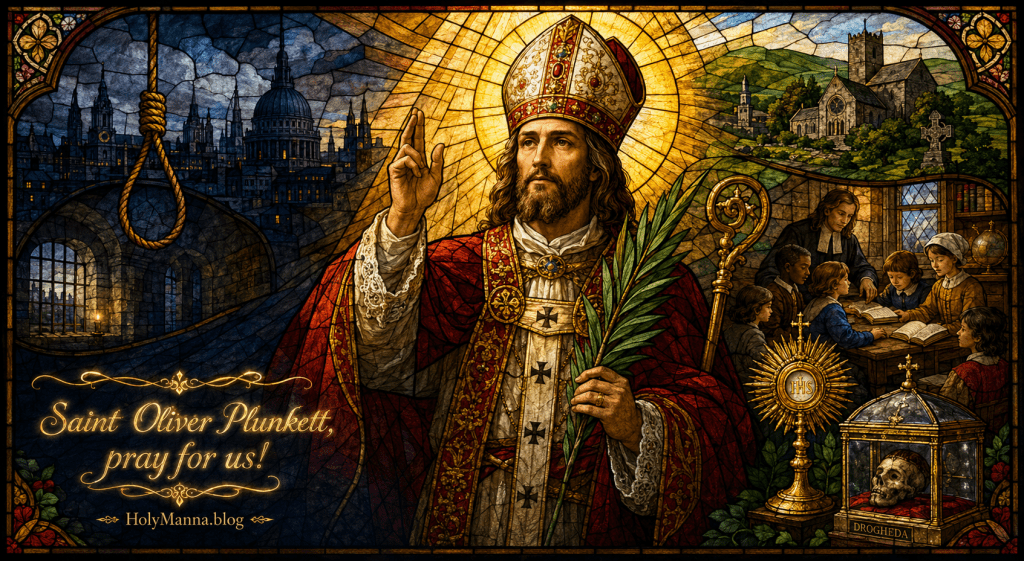
How an Irish Archbishop Gave Everything for the Faith
There is a church in Drogheda, Ireland, where pilgrims from around the world come to kneel before something that stops you cold the moment you see it. Behind glass, in an ornate reliquary, rests the preserved head of a man who was executed in London in 1681 for the crime of being a Catholic priest doing his job. The scorch marks from the execution fire at Tyburn are still visible on his left cheek. His name is Saint Oliver Plunkett, and his story is one of the most dramatic, heartbreaking, and ultimately triumphant in the entire history of the Irish Church.
Oliver Plunkett was the Catholic Archbishop of Armagh and Primate of All Ireland, the last victim of the so-called Popish Plot, and the last Catholic martyr to die in England. He was a scholar, a diplomat, a tireless pastor, a peacemaker, and a man who looked death in the face and said “Deo gratias” — God be thanked. Today he is the patron saint of peace and reconciliation in Ireland, his witness transcending religious boundaries to speak to all who work for peace. If there were ever a saint tailor-made for a world that desperately needs both courage and mercy, it is this one.
Born for the Faith on All Saints Day
Oliver Plunkett was born on November 1, 1625, in Loughcrew, County Meath, Ireland, to well-to-do parents with Hiberno-Norman ancestors. There is something poetic and providential about a future saint being born on All Saints Day. The Church would not have planned it that way, but God clearly had a sense of humor and a plan.
Oliver came from the very top tier of Irish Catholic nobility. He was a grandson of James Plunkett, 7th Baron Killeen, and was related by birth to a number of landed families, including the recently ennobled Earls of Roscommon, as well as the long-established Earls of Fingall, Lords Louth, and Lords Dunsany. This was not a family that scraped by. The Plunketts were prominent, educated, and deeply Catholic in a time when being prominently Catholic in Ireland was becoming increasingly dangerous.
Until his sixteenth year, his education was attended to by Patrick Plunkett, Abbot of St. Mary’s, Dublin, who would later serve as bishop, successively, of Ardagh and Meath. This cousin-uncle was one of the great formative influences of Oliver’s life, and Oliver always spoke of him with deep respect and genuine affection, the kind of relationship that shapes a young man’s entire sense of what it means to serve God and serve others.
The problem facing young Oliver was simple and brutal: there were no seminaries left in Ireland. Oliver studied for the priesthood in Rome because the Cromwellian conquest had systematically dismantled Catholic institutional life on the island. If you wanted to become a priest, you had to leave. And so in 1646, the young Oliver Plunkett made a journey that would change everything.
Along with John Brennan from Kilkenny, a lifelong friend and later Archbishop of Cashel, Oliver accompanied Father Peter Scarampi, who had been sent by the Pope as an envoy to the Confederation of Kilkenny, on his journey back to Rome. The voyage itself nearly ended in disaster. After an eventful crossing in which the threat of capture was averted by near shipwreck, the group finally reached Rome and Oliver began studying at the newly founded Irish College. He had barely started his priestly journey and already his life had hung in the balance. It would not be the last time.
A Scholar, a Servant, and a Future Pope’s Friend
Once in Rome, Oliver Plunkett thrived. As a student of the Irish College of Rome, his record was particularly brilliant. The Rector attested that he “devoted himself with such ardour to philosophy, theology, and mathematics, that in the Roman College of the Society of Jesus he was justly ranked amongst the foremost in talent, diligence, and progress in his studies, and he pursued with abundant fruit the course of civil and canon law at the Roman Sapienza, and everywhere, at all times, was a model of gentleness, integrity, and piety.”
He was ordained a priest in 1654 and immediately put himself to work, not just in the classroom but in the streets. For three years after his ordination, Oliver served as Chaplain with the Oratorians at S. Girolamo della Carità and visited the sick in the nearby Hospital of the Holy Spirit. This was not glamorous priestly work. This was hand-in-the-wound, face-to-face service to the suffering.
One of the most remarkable testimonies to Oliver’s character during these Roman years came from a man who would later sit on the Chair of Peter himself. His friend, Monsignor Odescalchi, later Pope Innocent XI, testified: “I often assisted him when he tended the poor and ragged and needy, many of them covered with vermin. He gave them shelter and clothing at his own expense, he washed and fed them with his own hands.” A future Pope personally watched Oliver Plunkett wash the filth off of Rome’s forgotten people with his own hands. That one fact tells you everything about who this man was at his core.
Throughout the period of the Cromwellian usurpation and the first years of Charles II’s reign, Oliver most effectually pleaded the cause of the suffering Church, whilst at the same time he discharged the duties of theological professor at the College of Propaganda. He spent twenty-two years in Rome in total, studying, teaching, serving the poor, and advocating tirelessly for his suffering homeland. Then in 1669, the call came that he had been preparing for his entire life.
In March 1669, the Primatial See of Armagh became vacant and Pope Clement IX personally chose Oliver, whose worth was well known throughout Rome, to be the successor of Saint Patrick. He was consecrated Archbishop of Armagh on November 30, 1669, at Ghent in Belgium, because even this sacred ceremony had to take place outside Ireland. He set sail for home carrying the weight of the entire Irish Church on his shoulders.
Rebuilding the Church on Irish Hillsides
When Oliver Plunkett stepped ashore in Ireland in March 1670, he was returning to a homeland he had not seen in nearly a quarter century. What he found was devastating. Churches had been demolished. Seminaries were gone. Catholic education was outlawed. The clergy were demoralized, disorganized, and in some cases scandalously lax. The people had faith, but lacked instruction and organisation.
He did not waste a single day feeling sorry about it. He got to work.
Within three months he had administered the Sacrament of Confirmation to about 10,000 of the faithful, some of them being sixty years old, and writing to Rome in December 1673, he was able to announce that “during the past four years” he had confirmed no fewer than 48,655 people. To bring this sacrament within the reach of the suffering faithful he had to undergo the severest hardships, often with no other food than a little oaten bread. He had to seek out their abodes on the mountains and in the woods, and as a rule, it was under the broad canopy of heaven that the Sacrament was administered, both flock and pastor being exposed to the wind and rain.
Sit with that image for a moment. The Primate of all Ireland, soaking wet on a windswept hillside, surviving on oaten bread, administering Confirmation to a sixty-year-old who had never received the sacrament because there had been no bishop available to do it. That is what it looks like when a shepherd truly loves his sheep.
Oliver also tackled something that required a different kind of courage entirely: clerical reform. He found drunkenness and moral laxity among some of the Irish priests, and he addressed it without flinching. He wrote with characteristic directness: “Let us remove this defect from an Irish priest, and he will be a saint.” He dismissed clerics with questionable morals, built discipline back into his clergy, and worked ceaselessly to establish the schools and seminaries that would produce a properly formed priesthood for the next generation.
Then came perhaps the most surprising achievement of his entire episcopate. He was able to establish a Jesuit College in Drogheda in 1670. A year later, 150 students attended the college, no fewer than 40 of whom were Protestant, making this college the first integrated school in Ireland. Read that again. A Catholic Archbishop, in the middle of virulent anti-Catholic persecution, built the first school in Irish history where Catholic and Protestant children were educated side by side. In the 17th century. In Ireland. That is not just impressive; it is almost incomprehensible given the climate of the times.
Oliver also took it upon himself to seek out the Tories, Catholic politicians who had been banned from office and had their lands confiscated, and who had turned to plundering to survive. Knowing their souls were in jeopardy due to the life they were living, he made it his mission to confront them at great peril to his own life. This was not a man who stayed safely behind the walls of whatever church he could find. He walked into danger to bring the Gospel to people no one else wanted to touch.
The Storm Breaks
The window of relative tolerance that Oliver had worked within slammed shut in 1673. A new wave of anti-Catholic persecution began, forcing Archbishop Plunkett to do his pastoral work in secrecy and disguise and to live in hiding. Many of his priests were sent into exile, schools were closed, Church services had to be held in secret, and convents and seminaries were suppressed.
Oliver refused to abandon his people. He wrote to his brother bishops with words that reveal the depth of his pastoral soul: “I am exhorting the brethren to constancy and not to abandon their flocks, but to imitate the pastors of the first three centuries and withdraw to some corner of their districts until the storm passes. I shall retire to a hut in some wood or mountain in my diocese with some candles and books. We shall not abandon our flocks unless compelled to do so, we shall first try out the prisons and other torments, already we have suffered so much on the mountains, in huts and in caves, and have acquired the habit of suffering to the extent that it will be less inconvenient in the future. For if the captains fly, it is in vain to exhort the single soldiers to stand in battle.”
He meant every word. He stayed.
The instrument of his destruction was a man named Titus Oates, one of history’s most accomplished and devastating liars. Titus Oates, voted in 2005 the worst Englishman of the seventeenth century by BBC History Magazine, was a former Anglican minister of ill repute who had gone to study with the Jesuits at St. Omers in France. Rather than convert, he gathered information, invented a sprawling conspiracy, and claimed that Catholics were plotting to assassinate the Protestant King Charles II so that his Catholic brother James could seize the throne. Catholics and the Jesuits in particular were falsely accused of plotting to kill Charles II, the Pope was accused of planning an invasion of England, and outlandish trials soon took place in London, followed by cruel executions at Tyburn.
No Catholic in England or Ireland was safe. At length Oliver was seized and cast into prison in Dublin Castle on December 6, 1679, and a whole host of perjured informers were at hand to swear his life away.
A Trial That Shamed Its Own Nation
What followed was one of the most disgraceful legal proceedings in English history.
Archbishop Oliver was brought to Dundalk for trial and, although not allowed any defence counsel, he raised no objection to the all-Protestant jury, knowing that he himself was well known and respected there. His accusers were disreputable characters who were themselves wanted men in Dundalk, and so the trial soon fell through. The people who knew him would not convict him.
So his enemies moved the trial to London, where nobody knew him and anti-Catholic hysteria was at its peak. In Ireland the character of those witnesses was well known and no jury would listen to their perjured tales, but in London it was not so. He was not given time to bring his witnesses from Ireland. They were held up by bad weather on the Irish Sea.
Archbishop Plunkett was found guilty of high treason in June 1681 “for promoting the Roman faith,” and was condemned to death. In passing judgement, the Chief Justice said: “You have done as much as you could to dishonour God in this case; for the bottom of your treason was your setting up your false religion, than which there is not any thing more displeasing to God, or more pernicious to mankind in the world.”
There it is in plain English, spoken by a judge in an official courtroom. Oliver Plunkett was condemned to death for being Catholic. The Chief Justice said so out loud. The packed jury returned a guilty verdict after only fifteen minutes of deliberations. Saint Oliver replied simply: “Deo gratias.” God be thanked.
He had been offered his life in exchange for betraying his brother bishops. His response was unambiguous: “If I were a man that had no care of my conscience, and did not think of God Almighty or conscience or heaven or hell, I might have saved my life; for I was offered it by divers people here, so I would but confess my own guilt and accuse others.” He would not do it. Not for anything.
From his cell in Newgate Prison, he wrote letters of extraordinary beauty. He marveled at his own lack of fear and explained it with a reflection that is deeply Christological: “But how am I, a poor creature, so stout, seeing that my Redeemer began to fear, to be weary and sad, and that drops of His blood ran down to the ground? I have considered that Christ, by His fears and passions, merited for me to be without fear.”
He wrote of death itself with the calm of a man who had already surrendered everything: “I ought therefore cheerfully desire it, heartily covet it, and joyfully embrace it, it being a sure way, a smooth path by which I may in a very short time pass from sorrow to joy, from toil to rest, and from a momentary time or duration to a never-ending eternity.”
The Last Martyr of Tyburn
On July 1, 1681, the Sheriff demanded his prisoner, who was carried on a sledge to be hanged, drawn, and quartered. In his passage to the place of execution, he made many ejaculatory prayers, full of the love of God and charity to his neighbors.
His fellow archbishop and lifelong friend, John Brenan of Cashel, witnessed the procession to Tyburn and described what he saw: “He displayed such a serenity of countenance, such a tranquility of mind and elevation of soul, that he seemed rather a spouse hastening to the nuptial feast, than a culprit led forth to the scaffold.”
From the scaffold, he addressed the crowd and declared his innocence calmly and completely. Then he spoke the words that echo across the centuries: “I do forgive all who had a hand directly or indirectly in my death and in my innocent blood.” He prayed: “I beseech your Divine Majesty by the merits of Christ and the intercession of his Blessed Mother and all the holy angels and saints to forgive me my sins and to grant my soul eternal rest.” He knelt and recited the Miserere psalm. His final words were the dying prayer of Christ himself: “Into Thy hands, O Lord, I commend my Spirit.”
An eyewitness of the execution declared that by his discourse and by his heroism in death he gave more glory to religion than he could have won for it by many years of a fruitful apostolate.
After his death, his body was mutilated and a fire was prepared to destroy his remains. His head was thrown into the flames. But devoted friends rushed forward and pulled it from the fire. The scorch marks may still be discerned on the left cheek of his preserved head, which rests in Drogheda to this day. What the executioners tried to destroy, God preserved. That is not a small detail. That is a sign.
The very next day after his execution, the bubble of conspiracy burst. Lord Shaftesbury, the chief instigator of the persecution, was consigned to the Tower, and his chief perjured witness Titus Oates was thrown into gaol. Oliver’s death was the last act of the fraud. His martyrdom broke it open.
The Head That Crosses Centuries
The journey of Saint Oliver’s relics after his death is one of the most remarkable stories in all of Catholic history.
Two close friends of the martyr took possession of his remains. The head was placed in a round tin box and the two forearms were disjointed and placed in a long tin box. The rest of his body was buried in St. Giles Cemetery. In the first months of 1684, the body was transferred to the Benedictine monastery at Lambspring in Germany, and after two hundred years was enshrined at Downside Abbey in England.
The head traveled a different road. Father Corker, who had been imprisoned alongside Oliver and served as his spiritual director in Newgate, was eventually freed. He had the head enshrined in an ebony case with silver mountings and took it with him to Rome. In 1714 the head was brought to Ireland, where Dr. Hugh McMahon, the martyr’s second successor in the Primacy, commended it to the care of the nuns at the Siena Convent in Drogheda, of which Mother Catherine Plunkett, grandniece of Oliver, was then in charge.
Since June 29, 1921, the head has rested in Saint Peter’s Church in Drogheda. Pilgrims from across the world come to kneel before it, and many report answered prayers and healings through his intercession. Archbishop Hugh McMahon himself attested that many miracles were performed by these sacred remains.
The Church formally recognized two miracles for Oliver’s canonization process. The first occurred in 1921, around the time his head was being transferred to St. Peter’s Church. A man named Jimmy Walsh, a resident of Ballycastle, Co. Antrim, became severely ill with tuberculosis. His condition was so dire that his family began praying to Oliver Plunkett, whose beatification process was in progress at the time. Miraculously, Jimmy recovered entirely from his deadly disease, confounding his doctors. The medical experts admitted they could not explain his unanticipated recovery, and the Vatican later recognized this as a miracle following thorough examination.
The second verified miracle came in 1957. A devout Catholic woman was suffering from recurring tumours and underwent surgery multiple times, but each time the tumour would grow back even larger. She prayed earnestly to Saint Oliver Plunkett for healing. Eventually the lumps ceased to reappear after her final surgery. Her doctors were completely baffled, having expected her condition to deteriorate, and this miraculous recovery was later verified by the Church after scrupulous investigation, paving the way for Plunkett’s canonization.
For the canonization, the customary second miracle was waived, a reflection of how overwhelming the Church’s conviction of his sanctity had become. Saint Oliver Plunkett was canonized on October 12, 1975, by Pope Paul VI, becoming the first new Irish saint for almost seven hundred years. An estimated twelve thousand Irish pilgrims traveled to Rome for the ceremony.
At the canonization Mass, Pope Saint Paul VI declared: “In his pastoral activities, his exhortation had been one of pardon and peace. With men of violence he was indeed the advocate of justice and the friend of the oppressed, but he would not compromise with truth or condone violence: he would not substitute another gospel for the Gospel of peace. And his witness is alive today in the Church, as he insists with the Apostle Peter: ‘Never pay back one wrong with another.’ O what a model of reconciliation: a sure guide for our day!”
Peace, Providence, and a Nation Transformed
Saint Oliver Plunkett’s impact on Ireland did not end with his canonization. It deepened.
His canonization ceremony was particularly meaningful, occurring during the height of the Troubles in Northern Ireland. Pope Paul VI pointed to Plunkett as a model of reconciliation, a man who served all Irish people regardless of division. In 1997 he was formally made patron saint for peace and reconciliation in Ireland.
Then consider these extraordinary historical details that seem far too precise to be mere coincidence. Cardinal Tomás O’Fiaich noted in his biography of Saint Oliver that the Truce which brought to an end the Irish War of Independence came into force on his feast day in 1921. The momentous first meeting of the new Northern Ireland Assembly also took place on a feast day of Saint Oliver. The man who was killed for preaching peace keeps showing up, providentially, at Ireland’s most decisive moments of peace.
In 1981, on the three hundredth anniversary of his martyrdom, Cardinal Tomás Ó Fiaich flew to London’s Clapham Common by helicopter, carrying Plunkett’s head, where twenty enrobed bishops and thousands of pilgrims gathered for Mass on the very soil where Oliver’s enemies once held power. That is a scene almost too dramatic to be believed, and yet it happened.
Today, approximately one hundred churches, apostolates, schools, sports facilities, streets, and estates around the world bear his name, and even an aeroplane of the Irish national airline is named after him. The man who was convicted for promoting the Catholic faith now has a plane carrying the Irish flag across the skies with his name on its fuselage. God does indeed have a sense of humor.
What This Saint Is Asking of Us
Saint Oliver Plunkett lived in a world that looks a lot more like ours than we might be comfortable admitting. He lived in a time of political manipulation, false accusations, media hysteria, and institutional cowardice. He watched powerful people use the machinery of the state to crush the faithful. He watched colleagues cave under pressure. He had every opportunity to save himself by simply staying quiet, by accusing others, by walking away.
He chose differently. Every single time.
What would it look like to have that kind of backbone today? Not in the dramatic, headline-grabbing way, but in the quiet daily decisions to refuse to hide what you believe, to stay faithful to your community when it gets hard, to forgive people who genuinely wrong you rather than nursing grievances that feel so justified.
Oliver Plunkett spent years soaking wet on Irish hillsides, surviving on oaten bread, bringing the sacraments to people the world had forgotten about. He built a school where Catholic and Protestant children could learn together in a moment of bitter division. He walked into danger to offer the mercy of God to violent men. He forgave his killers from the scaffold.
Where in your own life is God calling you to stay when walking away would be so much easier? The faith is not asking for Tyburn-level heroism every day, but it is asking for something real. It is asking for the kind of commitment that Oliver modeled: show up, serve your people, refuse to compromise what you know to be true, and extend mercy even when the other person does not deserve it.
Oliver wrote from his prison cell that he could face death with serenity because Christ had already faced his fears and passions on his behalf. That is not stoicism. That is the Gospel. That is what the Eucharist does when you let it. Is there something you have been afraid to surrender to God because you are not sure He will catch you if you let go?
The man whose preserved head still draws pilgrims from across the world spent the last weeks of his life in a cold prison cell writing letters about how death was a smooth path from sorrow to joy. He had found something worth dying for, which meant he had found something genuinely worth living for. The question Saint Oliver Plunkett puts to each of us is simply this: have you found yours?
Engage With Us!
This story is too good, and too important, to keep to yourself. Saint Oliver Plunkett walked into one of the darkest chapters in Catholic history and emerged from it as a light that has not gone out in over three centuries. His life is an invitation to take the faith seriously, to love generously, to forgive radically, and to hold the line even when everything is against you.
Take a few minutes to sit with these questions and share your thoughts in the comments below. Every reflection matters, and this community grows stronger when we think out loud together about the things that count.
- Saint Oliver Plunkett confirmed over 48,000 Catholics in four years, traveling on foot through mountains and rain to reach people who had been cut off from the sacraments. Who in your own life has gone out of their way to bring the faith to you, and have you ever thanked them?
- Oliver wrote from prison that he had no fear of death because Christ had already merited that grace for him through his own suffering. Is there an area of your life where you have been relying on your own strength instead of letting Christ carry the weight?
- The Archbishop built the first integrated school in Irish history, educating Catholic and Protestant children together in a moment of violent division. What is one concrete step you can take this week toward building peace or understanding across a division in your own community?
- Oliver was offered his life if he would accuse his brother bishops of crimes they did not commit. He refused without hesitation. When has standing by your integrity cost you something real, and how did that experience shape your faith?
- The last words Oliver Plunkett spoke were the words of Christ on the Cross: “Into Thy hands, O Lord, I commend my Spirit.” What would it look like for you to surrender one specific fear or burden into God’s hands today, trusting that He is enough?
Saint Oliver Plunkett, patron of peace and reconciliation, pray for us. May the example of his courage, his mercy, and his unshakeable love for Christ inspire every reader to live the faith with the same fire. The world needs people who know what they believe and refuse to be ashamed of it. Go be one of them.
Saint Oliver Plunkett, pray for us!
Follow us on YouTube, TikTok, Instagram and Facebook for more insights and reflections on living a faith-filled life.


Leave a Reply