Wednesday of the Thirteenth Week in Ordinary Time – Lectionary: 379
When Religion Becomes a Costume
There is something deeply uncomfortable about the readings for July 1, 2026, and that discomfort is precisely the point.
The three readings placed before us today share a single, urgent question running beneath the surface of every verse: Is your faith real, or is it just a performance? That question is not asked gently. It comes through the voice of a shepherd-turned-prophet thundering at a prosperous and self-satisfied nation, through a Psalm in which God Himself takes the stand as a witness against His own people, and through a Gospel scene so raw and disruptive that an entire town begs Jesus to pack up and leave after He sets two men free. Taken together, these readings form one of the most challenging liturgical combinations in Ordinary Time.
The historical backdrop matters enormously here. When Amos spoke, the northern kingdom of Israel was enjoying a period of remarkable economic prosperity under King Jeroboam II, around 760 BC. The sanctuaries were packed. The festivals were elaborate. The music was loud and the offerings were generous. To any outside observer, Israel looked like a thriving, God-fearing nation. But Amos, a simple shepherd and fig-tree farmer from the southern town of Tekoa, arrived with a message nobody wanted to hear: God was not impressed. Underneath all that religious activity, the courts were corrupt, the poor were being crushed, and the worship had become a beautifully decorated lie.
Psalm 50 picks up the same thread, presenting God as a divine prosecutor calling His people to account. He is not angry that they brought sacrifices. He is exposing the fact that their sacrifices meant nothing because their lives told a completely different story. And then the Gospel carries this ancient confrontation into the New Testament with startling force. Jesus crosses into Gentile territory, a place His fellow Jews considered spiritually compromised and ritually unclean, and He liberates two men from demonic bondage so severe that no one could even walk near them. The response from the townspeople is not gratitude or wonder. It is fear and the request that He leave immediately.
That reaction from the Gadarenes is the thread that stitches everything together. Israel in Amos’s day kept God at the comfortable distance of religious ceremony. The wicked of Psalm 50 recited the commandments from memory while casting His words behind them. And the people of Gadara, confronted with the most dramatic evidence of divine power imaginable, chose the familiar arrangement of their compromised lives over the disruptive grace of Jesus Christ.
The readings today do not ask whether someone attends Mass or knows the prayers. They ask something far more personal and far more searching: When Jesus shows up in your actual life, with all the disruption and transformation He brings, will you welcome Him in, or will you beg Him to leave?
First Reading – Amos 5:14-15, 21-24
The Prophet Nobody Wanted to Hear
There is a reason Amos is not the most popular book at a Bible study. He does not comfort. He confronts. And the words God gave him to speak roughly 2,700 years ago land with the same force today as they did on the people of ancient Israel who first heard them, mostly because the human tendency he is diagnosing has never really gone away.
To understand what Amos is doing in this passage, it helps to picture the world he walked into. The northern kingdom of Israel around 760 BC was, by every visible measure, doing well. King Jeroboam II had overseen a period of military success and economic expansion. The sanctuaries at Bethel and Gilgal were busy. The festivals were lavish, the offerings generous, the music elaborate. If someone had asked an Israelite whether their nation was honoring God, the answer would have been an enthusiastic yes, backed by a full liturgical calendar and overflowing collection plates. Into that scene walks Amos, a shepherd and fig-tree farmer from Tekoa, a small town in the south, who had no prophetic credentials, no institutional backing, and absolutely no interest in telling people what they wanted to hear. God sent him north with a message that cut straight through the religious pageantry to the rot underneath it.
Amos 5:14-15, 21-24 – New American Bible (Revised Edition)
14 Seek good and not evil,
that you may live;
Then truly the Lord, the God of hosts,
will be with you as you claim.
15 Hate evil and love good,
and let justice prevail at the gate;
Then it may be that the Lord, the God of hosts,
will have pity on the remnant of Joseph.21 I hate, I despise your feasts,
I take no pleasure in your solemnities.
22 Even though you bring me your burnt offerings and grain offerings
I will not accept them;
Your stall-fed communion offerings,
I will not look upon them.
23 Take away from me
your noisy songs;
The melodies of your harps,
I will not listen to them.
24 Rather let justice surge like waters,
and righteousness like an unfailing stream.
Detailed Exegesis
Verse 14: “Seek good and not evil, that you may live; then truly the Lord, the God of hosts, will be with you as you claim.”
The phrase “as you claim” carries the entire weight of the indictment. Israel had been invoking God’s presence in their liturgies and asserting His favor in their public worship, but Amos is pointing out the gap between their claims and their conduct. God’s presence is not a liturgical inheritance that gets renewed automatically by showing up at a feast. It is a lived reality that flows from a life genuinely oriented toward good. The conditional structure of this verse reflects the covenant logic at the heart of the entire Hebrew tradition: the relationship with God has terms, and those terms involve how one treats the neighbor, not just how one treats the altar.
Verse 15: “Hate evil and love good, and let justice prevail at the gate; then it may be that the Lord, the God of hosts, will have pity on the remnant of Joseph.”
The “gate” in ancient Israelite society was the civic and legal center of a town, the place where disputes were settled, contracts were made, and the vulnerable sought protection. For justice to prevail at the gate meant that the entire infrastructure of public life had to reflect God’s own character. The phrase “remnant of Joseph” is a quietly devastating detail. By Amos’s time, the slide toward exile had already begun. The word “remnant” implies that a catastrophic loss is coming, and even then, God leaves the door open for mercy, but only on the other side of genuine conversion.
Verse 21: “I hate, I despise your feasts, I take no pleasure in your solemnities.”
The Hebrew word for “hate” here is sane, the strongest possible word for aversion. God is not mildly disappointed with Israel’s worship. He is expressing something close to revulsion. And the target of that revulsion is not paganism. It is the very festivals He Himself had commanded in the Torah. This is the interpretive key to the whole passage: God is not rejecting liturgy. He is rejecting liturgy that has been completely severed from the moral and social transformation it was meant to produce and symbolize.
Verse 22: “Even though you bring me your burnt offerings and grain offerings I will not accept them; your stall-fed communion offerings, I will not look upon them.”
The offerings being described here were the prescribed, legitimate sacrifices of the Mosaic law. They were not being done wrong in a ritual sense. They were being done wrong in a human sense. The people bringing them walked out of the sanctuary and returned to exploiting the poor, corrupting the courts, and living in flagrant contradiction to everything the sacrifice was meant to express.
Verse 23: “Take away from me your noisy songs; the melodies of your harps, I will not listen to them.”
The worship music of ancient Israel was not a small affair. The Temple liturgy involved trained Levitical musicians, elaborate instruments, and carefully composed hymns. God’s rejection of it here is meant to be jarring, because it is. Beautiful sacred music offered by people whose lives are indifferent to the suffering of the poor is not pleasing to God. It is noise.
Verse 24: “Rather let justice surge like waters, and righteousness like an unfailing stream.”
This is the climax of the entire passage and one of the most memorable lines in prophetic literature. The image is not a polite request for modest social improvement. It is a vision of total transformation, a flood-level surge of justice that overwhelms everything in its path the way a river in full flood overwhelms the landscape. Amos is calling for the complete reorientation of an entire society around God’s own priorities.
Teachings
The Church has never read Amos as an anti-liturgical text, and that distinction matters enormously. The tradition is unanimous that the Eucharist and the sacramental life of the Church are irreplaceable. But the tradition is equally unanimous that the liturgy is meant to form people who go out and live differently. The Catechism of the Catholic Church teaches in paragraph 2100 that “outward sacrifice, to be genuine, must be the expression of spiritual sacrifice,” and that true worship involves the offering of one’s entire life to God, not merely the performance of prescribed rituals.
Pope Benedict XVI made this connection explicit in Deus Caritas Est when he wrote that “a Eucharist which does not pass over into the concrete practice of love is intrinsically fragmented” (DCE 14). That sentence is Amos translated into the language of the New Covenant. The Mass is not a box to check. It is a transformation to undergo, and the proof of the transformation is visible in how one lives outside the church building.
St. John Chrysostom, the great fourth-century Bishop of Constantinople and Doctor of the Church, made the same point with characteristic bluntness in his Homilies on Matthew, writing that “no act of liturgy has value before God if it is offered by hands stained with injustice toward the neighbor.” Chrysostom’s preaching on the connection between the Eucharist and care for the poor was so consistent and so pointed that it contributed to his eventual exile from Constantinople by the imperial court, which had grown tired of being told that their lavish lifestyle was incompatible with their Sunday worship.
Jesus Himself echoes Amos directly in Matthew 5:23-24, where He instructs His disciples to “leave your gift there at the altar, go first and be reconciled with your brother, and then come and offer your gift.” The sequence matters. Reconciliation with the neighbor precedes the offering at the altar, not because the liturgy is unimportant, but because the liturgy is so important that it cannot be offered with integrity by someone whose life is in deliberate contradiction to its meaning.
Reflection
The challenge Amos lays out is not abstract, and it is not limited to ancient Israelites with a taste for elaborate festivals. Every Catholic who has ever sat through Mass while mentally rehearsing a grudge, or who has received Communion on Sunday and treated a coworker with contempt on Monday, knows exactly what Amos is talking about. The gap between religious performance and genuine transformation is not a problem unique to the eighth century BC.
The invitation in this reading is to close that gap, not by attending fewer Masses, but by taking what happens at Mass seriously enough to let it actually change something. What would it look like to carry the justice and righteousness Amos describes into an ordinary Tuesday? It might mean speaking up when a colleague is being treated unfairly. It might mean examining whether the way money is spent reflects the priorities God keeps naming through the prophets. It might mean sitting quietly before God and asking Him to show where worship has become a costume rather than a conviction.
Where in daily life has faith become more of a performance than a reality? That is not a comfortable question, but it is the one Amos insists on asking, and it is the one God insists on answering.
Responsorial Psalm – Psalm 50:7-13, 16-17, 23
God Takes the Stand
If Amos delivered the opening argument, Psalm 50 is where God Himself walks into the courtroom. This is not a gentle hymn of praise or a quiet meditation on God’s goodness. It is a covenant lawsuit, a formal divine indictment in which the Lord summons heaven and earth as His witnesses and calls His own people to account. The genre is known in biblical scholarship as a rib, the Hebrew term for a legal dispute, and it draws on the ancient Near Eastern treaty tradition in which a sovereign holds his vassals accountable for violating the terms of their agreement. In this case, the sovereign is God, the vassals are Israel, and the charges are serious.
Psalm 50 belongs to the Asaph collection, a group of psalms associated with the Levitical musicians of the Temple. Asaph was one of the chief musicians appointed by King David, and the psalms bearing his name tend toward a prophetic, confrontational tone rather than the more personal lament style associated with David himself. This particular psalm was likely used in liturgical settings as a kind of self-examination prompt, a moment built into the worship calendar where the community was invited to ask whether their sacrifices actually meant what they claimed to mean. The fact that God is the speaker throughout makes it one of the most dramatically unusual psalms in the entire Psalter.
Placed alongside Amos today, this psalm functions as a divine echo. Where Amos spoke for God, here God speaks for Himself, and He is making the same point with even greater intensity.
Psalm 50:7-13, 16-17, 23 – New American Bible (Revised Edition)
7 “Listen, my people, I will speak;
Israel, I will testify against you;
God, your God, am I.
8 Not for your sacrifices do I rebuke you,
your burnt offerings are always before me.
9 I will not take a bullock from your house,
or he-goats from your folds.
10 For every animal of the forest is mine,
beasts by the thousands on my mountains.
11 I know every bird in the heights;
whatever moves in the wild is mine.
12 Were I hungry, I would not tell you,
for mine is the world and all that fills it.
13 Do I eat the flesh of bulls
or drink the blood of he-goats?16 But to the wicked God says:
“Why do you recite my commandments
and profess my covenant with your mouth?
17 You hate discipline;
you cast my words behind you!23 Those who offer praise as a sacrifice honor me;
I will let him whose way is steadfast
look upon the salvation of God.”
Detailed Exegesis
Verse 7: “Listen, my people, I will speak; Israel, I will testify against you; God, your God, am I.”
The psalm opens with a courtroom summons. God calls His people to attention not as a distant deity issuing decrees from the heavens, but as a covenant partner who has standing to bring charges. The phrase “God, your God, am I” is a deliberate echo of the opening of the Ten Commandments in Exodus 20:2, grounding this entire indictment in the covenant relationship established at Sinai. This is not a stranger issuing complaints. This is a God who rescued Israel from slavery and entered into a binding relationship with them, and He is now calling that relationship into account.
Verse 8: “Not for your sacrifices do I rebuke you, your burnt offerings are always before me.”
This verse is essential for understanding what follows correctly. God is not rebuking Israel for failing to bring sacrifices. The offerings are there, consistently and in abundance. The problem is not negligence. The problem runs much deeper than that, which is exactly why what comes next is so jarring.
Verse 9: “I will not take a bullock from your house, or he-goats from your folds.”
God begins to dismantle the transactional logic that had quietly infected Israel’s worship. The implicit assumption behind much ancient sacrifice, both in Israel and throughout the surrounding cultures, was that the deity needed something from the worshiper, food, service, tribute, and the worshiper provided it in exchange for divine favor. God here begins to expose that assumption as fundamentally mistaken.
Verses 10-11: “For every animal of the forest is mine, beasts by the thousands on my mountains. I know every bird in the heights; whatever moves in the wild is mine.”
The argument builds with stunning scope. God does not need Israel’s bulls and goats because He already owns every living creature in existence. The worshiper bringing a bull to the altar is not giving God something He lacked. He is simply returning a small portion of what already belongs entirely to God. This reframes the entire purpose of sacrifice from provision to acknowledgment.
Verse 12: “Were I hungry, I would not tell you, for mine is the world and all that fills it.”
This is one of the most theologically charged lines in the entire Psalter. God’s self-sufficiency is absolute. He has no needs that human beings can supply. He is not dependent on Israel’s worship for His sustenance or His security. This stands in stark contrast to the gods of Israel’s neighbors, who were understood to be genuinely dependent on human provision. The God of Israel operates on an entirely different plane, which means that when He asks for worship, He is not asking for His own benefit. He is asking for ours.
Verse 13: “Do I eat the flesh of bulls or drink the blood of he-goats?”
The question is rhetorical and almost ironic in its directness. God is cutting through centuries of religious misunderstanding with a single sentence. Sacrifice was never about feeding Him. It was always about forming the worshiper, about shaping a people who lived with a genuine awareness of their dependence on God and their obligation to reflect His character in the world.
Verse 16: “But to the wicked God says: ‘Why do you recite my commandments and profess my covenant with your mouth?’”
The psalm pivots sharply here, and the target shifts. The wicked being addressed are not pagans who never knew God’s law. They are people who know it fluently, who can recite the commandments from memory, who speak the language of covenant relationship with complete facility. The indictment is against religious fluency without religious transformation.
Verse 17: “You hate discipline; you cast my words behind you!”
The verb “cast behind you” is vivid and deliberate. God’s words are not being forgotten or overlooked. They are being actively rejected, thrown over the shoulder like something unwanted after it has served its social purpose. The recitation of the commandments has become a performance, a demonstration of religious identity that carries no actual authority over how one lives.
Verse 23: “Those who offer praise as a sacrifice honor me; I will let him whose way is steadfast look upon the salvation of God.”
The psalm closes with the positive counterpart to everything that preceded it. The Hebrew word here, todah, translated as “praise as a sacrifice,” refers to a specific type of thanksgiving offering in the Temple, one in which the worshiper brought their whole life before God in gratitude rather than in transaction. Many biblical scholars, including the liturgical theologian Louis Bouyer, have identified the todah as a direct liturgical antecedent to the Christian Eucharist, with the word Eucharist itself deriving from the Greek word for thanksgiving. The promise attached to this authentic worship is breathtaking: to live with genuine integrity before God is to be positioned to look upon His salvation, language the early Church read as messianic, pointing toward the recognition of Christ.
Teachings
The Catechism of the Catholic Church teaches in paragraph 2099 that “it is right to offer sacrifice to God as a sign of adoration, gratitude, supplication, and communion,” but paragraph 2100 immediately follows with the clarification that “outward sacrifice, to be genuine, must be the expression of spiritual sacrifice.” The entire arc of Psalm 50 is contained in that single sentence. The external act of worship has no value before God if it is not the authentic expression of an interior life genuinely ordered toward Him.
St. Augustine, in his Expositions of the Psalms, reflects on this psalm with characteristic depth, writing that “to recite God’s words without allowing them to reshape the will is not piety but pride, because knowledge without love inflates rather than builds up.” Augustine’s point is that familiarity with Scripture and the commandments, without the transformation they are meant to produce, actually makes one’s judgment worse rather than better, because it adds the sin of hypocrisy to whatever else was already present.
The connection to the Eucharist is one the Church has always taken seriously. Pope Benedict XVI wrote in Sacramentum Caritatis that “the substantial conversion of bread and wine into his body and blood introduces within creation the principle of a radical change, a sort of ‘nuclear fission’… which is capable of triggering a process of transformation in our reality” (SC 11). The Eucharist is not a ritual checkpoint. It is meant to be a transformative encounter that sends the worshiper out as a different person than the one who walked in.
Reflection
Psalm 50 has a way of making even well-intentioned Catholics uncomfortable, and that discomfort is a gift worth sitting with. It is entirely possible to know the prayers by heart, to attend Mass regularly, to check every box on the Catholic checklist, and still be the person God is describing in verse 17, someone who casts His words behind them the moment the parking lot empties out.
The psalm is not calling for less liturgy. It is calling for liturgy that actually means something, worship that flows from a life genuinely surrendered to God and genuinely oriented toward the neighbor. What would it look like to approach the Mass this week as a todah, a total offering of gratitude rather than a transaction or an obligation? That shift in posture, from obligation to gift, from transaction to surrender, is exactly what Psalm 50 is asking for.
When the words of the Creed are spoken on Sunday, do they carry the weight of a lived conviction or the familiarity of a script? That is the question this psalm refuses to let go of, and it is one worth carrying into the week ahead.
Holy Gospel – Matthew 8:28-34
The Town That Asked Jesus to Leave
There is a moment in this Gospel passage that tends to get overlooked because the dramatic details surrounding it are so vivid. Two men freed from years of demonic torment. A herd of swine rushing headlong into the sea. A confrontation between the Son of God and the powers of darkness that ends in about thirty seconds. But the detail that deserves the most attention, the one that ties directly back to Amos and the Psalm, comes at the very end: the whole town came out to meet Jesus, saw what He had done, and begged Him to leave.
That reaction is the point of the entire story.
To appreciate the full weight of what Matthew is describing, it helps to understand where Jesus is and why it matters. After calming the storm on the Sea of Galilee, Jesus and His disciples cross to the eastern shore and enter the territory of the Gadarenes, a region belonging to the Decapolis, a league of ten Hellenistic cities that was thoroughly Gentile in culture and population. The presence of a large herd of swine grazing nearby confirms this immediately for any Jewish reader: observant Jews did not raise pigs, which were considered ritually unclean under Mosaic law. Jesus has crossed not just a geographic boundary but a profound cultural and religious one. He has walked deliberately into territory His contemporaries would have considered spiritually compromised.
This crossing is itself a proclamation. The kingdom of God does not stop at the borders of Israel. The authority of Jesus extends into every corner of creation, including the places that religious convention had written off.
Matthew 8:28-34 – New American Bible (Revised Edition)
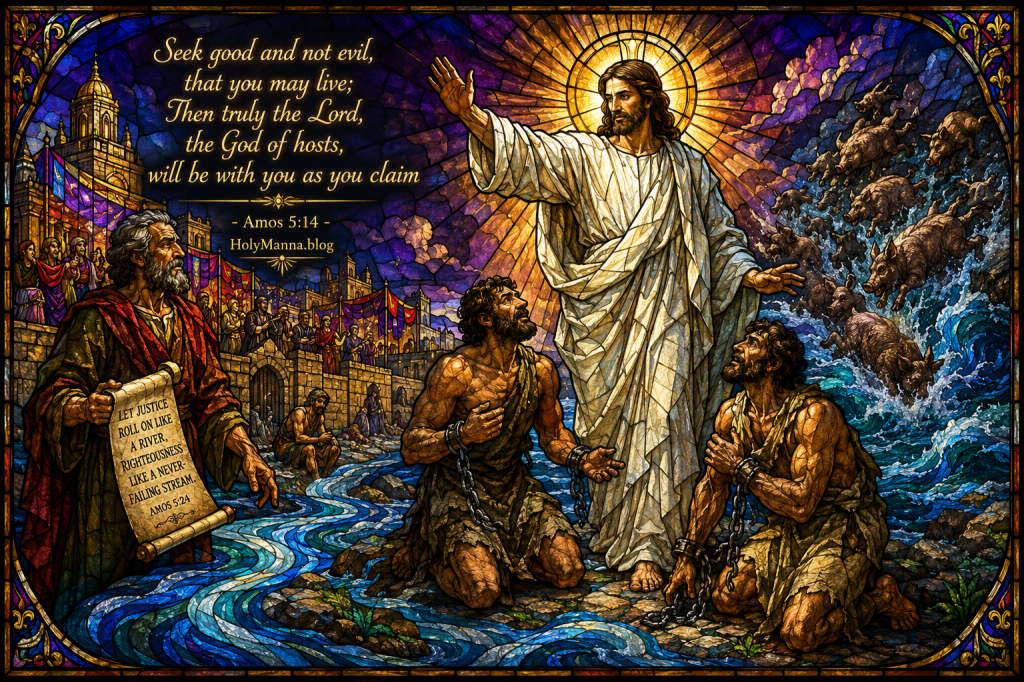
The Healing of the Gadarene Demoniacs. 28 When he came to the other side, to the territory of the Gadarenes, two demoniacs who were coming from the tombs met him. They were so savage that no one could travel by that road. 29 They cried out, “What have you to do with us, Son of God? Have you come here to torment us before the appointed time?” 30 Some distance away a herd of many swine was feeding. 31 The demons pleaded with him, “If you drive us out, send us into the herd of swine.” 32 And he said to them, “Go then!” They came out and entered the swine, and the whole herd rushed down the steep bank into the sea where they drowned. 33 The swineherds ran away, and when they came to the town they reported everything, including what had happened to the demoniacs. 34 Thereupon the whole town came out to meet Jesus, and when they saw him they begged him to leave their district.
Detailed Exegesis
Verse 28: “When he came to the other side, to the territory of the Gadarenes, two demoniacs who were coming from the tombs met him. They were so savage that no one could travel by that road.”
Matthew mentions two demoniacs while Mark and Luke focus on one individual. This doubling is a recognizable Matthean pattern, appearing also with the blind men in Matthew 20:30, and likely reflects the Jewish legal requirement of two witnesses for a testimony to be considered valid, drawn from Deuteronomy 19:15. The detail that the men came from the tombs is not incidental. In Jewish understanding, tombs were places of ritual impurity and association with death. These two men exist at the absolute margins of human society, excluded from the community of the living, untouchable by religious standards, dangerous by practical ones. The road being impassable because of them means that their suffering has become a barrier to ordinary human life, which is exactly what demonic bondage always does.
Verse 29: “They cried out, ‘What have you to do with us, Son of God? Have you come here to torment us before the appointed time?’”
This verse contains one of the most striking ironies in all of Matthew’s Gospel. The demons recognize Jesus immediately and address Him with the highest possible Christological title: Son of God. This is a confession that His own disciples are still working their way toward understanding. The demons know exactly who He is, and that knowledge fills them with terror rather than hope. Their question about the “appointed time” reveals that they understand themselves to be operating on borrowed time, aware that a final judgment is coming and hoping to delay their reckoning. St. John Chrysostom noted the painful contrast here: the powers of darkness confess what many human hearts refuse to acknowledge.
Verse 30-31: “Some distance away a herd of many swine was feeding. The demons pleaded with him, ‘If you drive us out, send us into the herd of swine.’”
The demons do not beg for mercy or for more time. They beg not to be sent into the abyss, a detail that Luke’s parallel account makes explicit in Luke 8:31. Their request to enter the swine is a negotiation born of desperation. They prefer any physical habitation to the void of judgment. The fact that Jesus is in a position to grant or deny this request is itself a declaration of absolute authority: the demonic operates only within the limits God permits.
Verse 32: “And he said to them, ‘Go then!’ They came out and entered the swine, and the whole herd rushed down the steep bank into the sea where they drowned.”
Jesus grants the request with two words. His authority requires no elaborate ritual, no lengthy prayer, no struggle. The immediate obedience of the demonic to His command underscores what the calming of the storm established just verses earlier: everything in creation, including the powers of darkness, is subject to Him. The swine rushing into the sea carries rich typological resonance for anyone steeped in the Hebrew Scriptures. The sea, in Jewish apocalyptic tradition, represents chaos and the abyss, and the image of an enemy being swallowed by the sea deliberately echoes the fate of Pharaoh’s army in Exodus 14, the great liberation narrative of Israel’s history. The demons, in the end, return to the realm that belongs to them.
Verse 33: “The swineherds ran away, and when they came to the town they reported everything, including what had happened to the demoniacs.”
The swineherds are witnesses who cannot be dismissed. They were present for the entire event and they report it accurately and completely to the town. Matthew notes that they reported everything, not a partial account or a confused rumor, but the full story of what happened both to the swine and to the two men. The town therefore receives the testimony with complete information before making its response.
Verse 34: “Thereupon the whole town came out to meet Jesus, and when they saw him they begged him to leave their district.”
The whole town. Not a skeptical minority, not a frightened fringe group, but the entire community comes out, sees Jesus, and asks Him to go. Two men have just been liberated from a bondage so severe that it made an entire road impassable. The evidence of divine power is standing right in front of them. And their unanimous response is to send Him away. The word translated “begged” is the same Greek verb used by the demons in verse 31, parakaleo, meaning to implore or entreat urgently. The townspeople are as desperate to be rid of Jesus as the demons were to find a new home.
Teachings
The Catechism teaches clearly that “Christ’s victory over Satan” is a central reality of the Gospel, and that Jesus “performed exorcisms and from this power to exorcize, the Kingdom of God was already present” (CCC 550). The Church has never treated the exorcism narratives as primitive mythology or embarrassing relics of a pre-scientific age. They are understood as genuine historical confrontations between the authority of Christ and the reality of demonic power, confrontations whose pattern continues in the Church’s own ministry.
CCC 1237 teaches that “since Baptism signifies liberation from sin and from its instigator the devil, one or more exorcisms are pronounced over the catechumen.” The Rite of Baptism preserves the Gadarene pattern: Christ enters, confronts the demonic, and liberates the person for a new life. The exorcism in Baptism is not theatrical. It is the Church taking seriously what Jesus demonstrated in the territory of the Gadarenes.
St. Gregory the Great, reflecting on this passage in his Homilies on the Gospels, observed that the townspeople’s reaction represents the most common human response to genuine divine disruption, which is the preference for a familiar and manageable misery over an unfamiliar and demanding grace. He wrote that “many people prefer to keep their sins rather than endure the labor of conversion, and so they ask Christ to depart from their borders, fearing the loss of earthly things more than the destruction of their souls.” Gregory’s insight connects the Gadarene response directly to the Israelite worship that Amos condemned: in both cases, people have organized their lives around a comfortable arrangement that they are unwilling to let God disturb.
Origen, in his Commentary on Matthew, pointed out that the demons’ knowledge of Christ is not saving knowledge. It is the knowledge of terror, not the knowledge of love, and it serves as a warning that intellectual recognition of who Jesus is does not constitute faith. James 2:19 makes the same point directly: “You believe that God is one. You do well. Even the demons believe that and tremble.” What distinguishes saving faith from demonic acknowledgment is not information but surrender.
Reflection
The Gadarene townspeople are not villains. They are people who had built a life around a problem they had learned to manage, and then Someone showed up who solved the problem in a way that made their old arrangement impossible. The two men are free. The road is open. Everything has changed. And change, even liberating change, is frightening when it arrives at a cost nobody budgeted for.
What is the herd of swine in daily life? Every person has something they are holding onto, some comfort, some arrangement, some familiar pattern of sin or avoidance, that they know, in their quietest moments, Jesus is asking them to release. The swine in the story represent whatever has more of a person’s attention and loyalty than the freedom Christ is offering.
The question this Gospel refuses to let go of is searingly simple: When Jesus shows up in the middle of real life, with all the disruption and transformation He brings, is the response to welcome Him in or to beg Him to leave? The demoniacs were healed. In Mark’s account, one of them wanted to follow Jesus immediately. He was sent home instead, with a mission: go and tell what God has done for you. That is the response Jesus is looking for. Not perfect understanding. Not zero fear. Just the willingness to stay when everything in the flesh wants to ask Him to go.
The God Who Refuses to Stay Comfortable
There is a thread woven through every reading today that is impossible to miss once it is seen, and impossible to unsee once it is named. God is not interested in being managed. He is not satisfied with being acknowledged on Sunday and ignored on Monday. He is not impressed by elaborate worship offered by people whose lives tell a completely different story. And when He shows up in a way that is undeniable and disruptive, the most common human response, across centuries and cultures, is to ask Him to please keep His distance.
Amos said it first. A shepherd from the south walked into a prosperous, religiously active kingdom and delivered a message that no one in that kingdom wanted to receive: God despises worship that is disconnected from justice, and He will not be fooled by beautiful liturgy offered by people who exploit the poor and corrupt the courts. The standard He sets is not modest. “Let justice surge like waters, and righteousness like an unfailing stream.” Not a trickle. A flood.
Psalm 50 confirmed it from a different angle. God Himself took the stand and made clear that He has never needed anything humanity has to offer. He owns every animal in every forest. He has no hunger that a bull can satisfy. What He wants is not a transaction but a transformation, a life so genuinely surrendered to Him that the worship flowing from it is the authentic expression of an interior reality rather than a social performance. “Those who offer praise as a sacrifice honor me,” He says, and that word “praise,” the todah offering of total gratitude, is the seed from which the Eucharist itself would one day grow.
And then Jesus crossed the sea into Gentile territory and proved the point in the most dramatic way imaginable. He freed two men that an entire community had given up on, men so tormented that they lived among the dead and made roads impassable. His authority over the demonic was absolute, immediate, and total. And the town, presented with undeniable evidence of that authority at work, begged Him to leave.
That is the image to carry through the rest of the day. The whole town, coming out to meet Jesus and asking Him to go. Because His presence cost them something. Because He changed things they had gotten used to. Because the disruption of His grace was more frightening than the familiar misery they had built their lives around.
The readings today are not a condemnation. They are an invitation. They are God leaning across every century between Amos and now and asking a question that is as personal as it gets: Will you let Me be real in your life, or will you settle for the version of Me that fits neatly into your existing arrangements?
The door is open. The road is clear. The only question is whether to walk toward Him or to join the crowd asking Him to leave.
Engage With Us!
The readings today are too rich to sit with alone. Drop a comment below and share what struck you most, whether it was the fire of Amos, the honesty of the Psalm, or the unsettling reaction of the Gadarene townspeople. This community grows stronger when the faithful share what God is saying to their hearts, so do not hold back.
- In Amos 5:14-15, 21-24, the prophet makes clear that God is not impressed by worship disconnected from justice and righteousness in daily life. Where in your own life might there be a gap between the faith you profess on Sunday and the way you treat the people around you the rest of the week?
- In Psalm 50:7-13, 16-17, 23, God reminds His people that He needs nothing from them, yet He desires a heart fully surrendered to Him. What would it look like for you to approach your prayer and worship this week as a todah, a total act of gratitude and surrender, rather than an obligation or a transaction?
- In Matthew 8:28-34, an entire town witnessed the power of Jesus firsthand and still begged Him to leave. What is the “herd of swine” in your own life, the comfort, habit, or arrangement, that you might be holding onto so tightly that you would rather ask Jesus to keep His distance than let Him change it?
- All three readings today ask the same fundamental question in different ways: Is your faith a genuine transformation or a carefully maintained performance? What is one concrete step you can take this week to close that gap and let God be fully real in your life?
Go out there and live it. Not perfectly, but honestly, with the love and mercy Jesus poured out without reservation. The world does not need more religious performance. It needs more people who have actually been changed by an encounter with the living God and cannot stop talking about it.
Sacred Heart of Jesus, we trust in You!
Immaculate Heart of Mary, pray for us!
Saint Michael the Archangel, defend us in battle!
Follow us on YouTube, TikTok, Instagram and Facebook for more insights and reflections on living a faith-filled life.

 Holy Manna!
Leave a comment