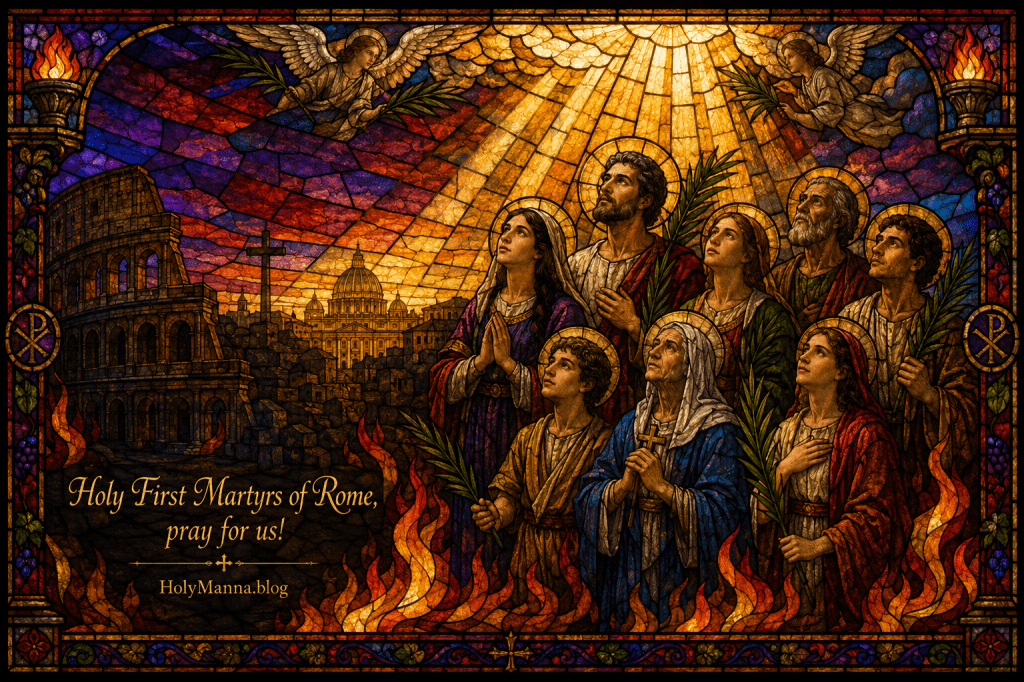
The Nameless Heroes Who Were Burned Alive for Christ
There is something deeply moving about honoring saints whose names history never recorded. Every other feast day in the Catholic calendar celebrates someone with a name, a biography, a face preserved in art. But on June 30, the Church pauses to remember an entire multitude of men, women, and children who died for Christ in the city of Rome, and not one of their names survived. They are known simply as the First Martyrs of the Church of Rome, or the Protomartyrs of Rome, and they are arguably the most important group of saints most Catholics have never thought deeply about.
They are revered as patrons of courage, steadfastness, and religious tolerance, and they hold a place of unique honor in the Litany of the Saints, one of the oldest prayers of the Catholic Church. The Orthodox Church also honors them on June 30 as pre-schism Western saints, making them one of the few groups of saints venerated by both East and West. Their feast, placed deliberately on June 30, the day immediately following the great Solemnity of Saints Peter and Paul, is the Church’s way of saying: yes, we remember Peter and Paul, but we also remember everyone else who died alongside them, the ordinary believers whose names only God knows.
Before there were cathedrals, before there were Cardinals, before there was a Vatican, there was a garden party in Rome lit by burning Christians. And somehow, the faith those Christians died for went on to transform the entire civilized world. That is the story of the First Martyrs of Rome.
A Church Born in the Shadows of Empire
To understand who these martyrs were, it helps to understand how Christianity arrived in Rome in the first place, because the story is more surprising than most people realize. The early Christian community in Rome did not begin with Peter or Paul. It predated both of their arrivals.
Within about a dozen years of the death and Resurrection of Jesus, there were already Christians in Rome. These were most likely Jewish pilgrims or merchants who had been in Jerusalem during or around the time of Pentecost, heard the preaching of the Apostles, believed, and carried the faith back home with them to the capital of the empire. When Paul wrote his famous Letter to the Romans around 57 or 58 AD, he was writing to a community he had never visited, a church that existed before he got there.
Rome at the time was home to a large and active Jewish population. Among the Jewish communities in the city, controversy over Jesus had apparently been brewing for years. The historian Suetonius records that the Emperor Claudius expelled all Jews from Rome around 49 or 50 AD because of disturbances caused by one “Chrestus,” a reference most scholars take as pointing to Christ. This means that even the tensions between Jewish Christians and non-Christian Jews had caught the attention of the Roman imperial government before the Apostles even arrived.
When Claudius died in 54 AD, many of those expelled Jews and Jewish Christians returned to Rome. By the time Paul finally arrived in the city, the Christian community was already composed of both Jewish and Gentile believers, meeting in house churches scattered across Rome, praying, breaking bread, sharing the faith, and living quietly in the shadow of one of the most powerful and brutal empires the world had ever seen. They had no idea what was coming.
The Night Rome Burned
In July of 64 AD, fire broke out in Rome and tore through the city with terrifying speed. For six days and seven nights, the flames consumed block after block of Rome’s densely packed wooden tenements. By the time the fire was contained, nearly three-quarters of the city had been destroyed.
The Emperor at the time was Nero Claudius Caesar, the fifth Emperor of Rome, who had been ruling since 54 AD. Nero was, by nearly every historical account, one of the most unstable and self-absorbed rulers Rome ever produced. He had his own mother murdered. He executed political rivals on a whim. He fancied himself a great artist and musician, a self-image that his terrorized court was obligated to enthusiastically affirm. When the fire broke out, rumors immediately spread among the Roman populace that Nero himself had arranged it, because he had long dreamed of demolishing portions of the city to build himself a grand new palace. The rumor was politically catastrophic for him.
Nero needed a scapegoat, and he found one in the Christians. This small, misunderstood religious community was already regarded with deep suspicion by many Romans. They refused to participate in the civic religious life of the city. They would not offer sacrifices to Roman gods. They gathered in private homes rather than public temples. Rumors circulated about their rituals, the breaking of bread and drinking of wine, and some Romans interpreted these practices as evidence of cannibalism and other dark rites. The Christians were accused of odium generis humani, “hatred of the human race,” simply because they lived differently than everyone else.
They were, in short, the perfect target for an emperor who needed to redirect public anger very quickly.
What Tacitus Saw
The Roman historian Tacitus, writing his Annals around 115 AD, gave the world what is now considered one of the most important pagan accounts of early Christianity, and one of the most chilling descriptions of state-sponsored persecution ever recorded. Tacitus did not like Christians. He called Christianity a “mischievous superstition.” But what he witnessed, or what he knew from those who witnessed it, clearly troubled even him.
He recorded first, in a passage that remains one of the most significant non-Christian historical references to Jesus in all of ancient literature, that “Christus, from whom the name had its origin, suffered the extreme penalty during the reign of Tiberius at the hands of one of our procurators, Pontius Pilatus.”
He then described what Nero did to the Christians of Rome: “Covered with the skins of beasts, they were torn by dogs and perished, or were nailed to crosses, or were doomed to the flames and burnt, to serve as a nightly illumination, when daylight had expired. Nero offered his gardens for the spectacle, and was exhibiting a show in the circus, while he mingled with the people in the dress of a charioteer or stood aloft on a car.”
Read that slowly. Christians were sewn into the skins of animals, still wet with blood, and released into areas where trained hunting dogs would tear them apart. They were crucified, just like their Lord. They were coated in pitch and wax, tied to stakes, and set on fire to serve as living torches illuminating Nero’s evening entertainment while he drove his chariot around dressed up like a performer. This was not a quick execution. It was a sadistic public spectacle designed to humiliate, terrify, and eradicate.
And yet, something unexpected happened. Even Tacitus noticed it. He wrote that even among the Roman populace, who had every reason to hate these accused arsonists, “there arose a feeling of compassion; for it was not, as it seemed, for the public good, but to glut one man’s cruelty, that they were being destroyed.”
Nero had miscalculated badly. When the people of Rome watched Christians die, they did not see criminals getting what they deserved. They saw human beings enduring unimaginable suffering with a dignity and composure that made no sense if what they believed was false. The spectacle meant to stamp out Christianity began instead to plant it more deeply in the Roman soul.
The Women Nobody Talks About
Among the most overlooked and most heartbreaking aspects of Nero’s persecution is the specific targeting of Christian women. Pope St. Clement I, writing his First Letter to the Corinthians around 96 or 98 AD, just one generation after the events, refers to these women with a detail that is shocking even by the standards of ancient history.
Roman public spectacles sometimes included theatrical executions in which victims were forced to reenact scenes from Greek mythology. Clement records that Christian women were “persecuted as Danaids and Dircae.” Dirce was a figure from Greek mythology who, as punishment, was tied to the horns of a wild bull and gored to death. The Danaids were mythological figures condemned to an eternal punishment. Christian women, mothers, daughters, wives of believers, were dressed in costumes representing these figures and killed in the arena as mythological characters, their deaths turned into entertainment.
Clement acknowledges their particular vulnerability and honors their particular courage, writing that these women, “though weak in body, received a noble reward.” The fact that Clement singles out these women specifically, just thirty years after their deaths, suggests these stories were still vivid in the memory of the Roman Christian community. These were not distant historical figures to him. They were probably sisters in the faith whose faces he could remember.
Peter’s Journey and the Story of “Quo Vadis”
Bound up with the First Martyrs of Rome is one of the most beloved stories in all of Catholic tradition. It cannot be verified as historical fact, but it has been treasured by the Church for nearly two thousand years as a window into the spiritual reality of those terrible days.
As Nero’s persecution intensified, St. Peter found himself in danger. His friends and fellow believers, terrified of losing him, reportedly pleaded with him to leave Rome, to flee and live so that he could continue leading the Church from elsewhere. Peter, after much persuasion, agreed to go. He slipped out of the city and walked south along the Via Appia Antica, the ancient road leading away from Rome.
As the story goes, on that road Peter encountered a vision of Jesus walking in the opposite direction, back toward Rome. Shaken, Peter asked him: “Quo vadis, Domine?” which is Latin for “Where are you going, Lord?” And Jesus answered him: “If you desert my people, I am going to Rome to be crucified a second time.”
The story says Peter stood there on that road, ashamed and transformed. He turned around, walked back into Rome, and accepted his martyrdom, crucified upside down at his own request because he did not consider himself worthy to die in the same manner as his Lord. There is a small chapel on the Via Appia Antica in Rome today, the Domine Quo Vadis chapel, which marks the traditional site of this vision and contains a stone bearing what tradition calls the footprint of Christ. Whether the story is historically verifiable or not, it captures something profoundly true about the spirit of those days: the temptation to run, the call to return, and the ultimate choice to lay down one’s life for the people God had given into one’s care.
The Bones Beneath the Altar
Here is a fact that never fails to stop people in their tracks. The circus of Nero, where many of these martyrs were crucified and burned, stood on what is now Vatican Hill. The very ground on which St. Peter’s Basilica was built, the largest and most famous church in Christendom, is the ground sanctified by the blood of the First Martyrs of Rome.
In 1626, during the construction of the foundations for Gian Lorenzo Bernini’s famous baldachin inside St. Peter’s Basilica, workers discovered tombs containing burned remains, ashes, and charcoal. These remains are believed to be connected to the very martyrs the Church now honors on June 30. There is a stone slab on the ground to the left of the basilica’s entrance, just beyond the narthex, marking the site of the ancient circus where these executions took place.
Archaeologists in the twentieth century uncovered part of the ancient necropolis beneath the basilica and identified the burial place of Peter himself, the first of the Apostles, who was buried by his fellow Christians in the open-air cemetery that once stood beside the circus. Every pilgrim who has ever stood in St. Peter’s Square, every tourist who has ever entered the basilica to gaze at Michelangelo’s Pieta or climb to the dome, has been walking over ground watered by the blood of these unnamed saints.
“The Blood of Christians Is Seed”
The greatest and most eloquent testimony to what the First Martyrs of Rome actually accomplished comes not from a pope or an emperor, but from an African Church Father named Tertullian of Carthage, writing around 197 AD. Tertullian addressed himself directly to the Roman governors of his day, and what he wrote reads less like theology and more like a provocation, delivered with the confidence of a man who had already seen the math work out.
Writing in his Apologeticus, Tertullian said: “We are not a new philosophy but a divine revelation. That is why you cannot just exterminate us; the more you kill the more we are. The blood of the martyrs is the seed of the Church. You praise those who endured pain and death, so long as they are not Christians! Your cruelties merely prove our innocence of the crimes you charge against us. And you frustrate your purpose. Because those who see us die wonder why we do, for we die like the men you revere, not like slaves or criminals. And when they find out, they join us.”
The original Latin phrase is “semen est sanguis Christianorum,” meaning “the blood of Christians is seed.” Tertullian was not making a pious observation. He was making an empirical argument. He was telling the Roman Empire: your strategy is not working. Every time you publicly execute a Christian, you create witnesses to something the pagan world cannot explain. People who die forgiving their killers and calling on the name of Jesus do not die like people who are suffering for a lie. And the crowd notices.
The Catechism of the Catholic Church articulates the theology behind this truth with precision. In CCC 2473 it teaches that “martyrdom is the supreme witness given to the truth of the faith: it means bearing witness even unto death. The martyr bears witness to Christ who died and rose, to whom he is united by charity. He bears witness to the truth of the faith and of Christian doctrine. He endures death through an act of fortitude.”
And in CCC 2474, the Church adds that “the Church has painstakingly collected the records of those who persevered to the end in witnessing to their faith. These are the acts of the Martyrs. They form the archives of truth written in letters of blood.”
The Church That Outlasted the Empire
Nero died by suicide in 68 AD at the age of 31, condemned by his own Senate and hunted by his own army. He had reigned for fourteen years. He had set out to extinguish a small religious sect in one city. Instead, he handed that sect its most powerful recruiting tool: the witness of men, women, and children who chose death over denial of Christ.
Within three centuries of Nero’s garden parties, Christianity had become the official religion of the Roman Empire. The Church that burned in Nero’s gardens became the Church that outlasted Rome itself. The words of Jesus in the Gospel of Matthew had proven literally, historically, undeniably true: “The gates of hell shall not prevail against it.”
The First Martyrs of Rome did not accomplish this by fighting back or escaping or organizing a political resistance. They accomplished it by dying well. They accomplished it by demonstrating, before the eyes of the entire Roman world, that their faith in the Resurrection of Jesus Christ was not a social convenience or a philosophical hobby. It was something worth dying for. And watching them die, many Romans began to wonder whether it might be worth living for.
The Art, the Novel, and the World They Changed
The story of the First Martyrs of Rome has never stopped inspiring artists and storytellers. The Polish painter Henryk Siemiradzki captured their deaths in his magnificent 1876 oil painting Nero’s Torches, also known by its alternate title Candlesticks of Christianity. The painting, which hangs in the National Museum in Kraków, Poland, depicts a line of Christian martyrs wrapped in pitch-soaked cloth and elevated on stakes, their bodies about to be set alight, while Nero reclines in golden splendor surrounded by musicians and courtiers. The painting is enormous, measuring over ten feet high and twenty-three feet wide, and its scale matches the moral weight of what it depicts. Siemiradzki also painted A Christian Dirce, depicting the particular horror of a Christian woman tied to the horns of a bull, exactly the kind of death Clement I described in his letter.
Siemiradzki’s fellow Pole, the novelist Henryk Sienkiewicz, wrote what became perhaps the most famous novel about these events: Quo Vadis, published in 1896 and translated into more than fifty languages. The novel tells the story of a young Roman soldier who falls in love with a Christian woman during Nero’s persecution and, through witnessing the faith and courage of the early Christians, comes to believe in Christ himself. The novel won Sienkiewicz the Nobel Prize in Literature in 1905, and it has been adapted into major films and television productions multiple times across the twentieth century. For generations of Catholics and curious readers worldwide, Quo Vadis has been the primary imaginative doorway into the world of Rome’s first Christian martyrs.
The Church dedicated to these saints in Rome, the Santi Protomartiri a Via Aurelia Antica, was built in 1968 and consecrated just as the Second Vatican Council’s liturgical reforms were taking effect. In 1985, Pope St. John Paul II himself visited this church, underscoring the deep significance these anonymous witnesses hold for the entire Catholic tradition.
What Their Lives Mean for Ours
What does the witness of nameless, anonymous martyrs who died two thousand years ago have to do with life in the twenty-first century? Everything, actually.
Most people reading this will never be asked to choose between their faith and their physical lives. But every single day, in smaller and less dramatic ways, the same essential choice the First Martyrs of Rome faced is being asked of ordinary Catholics everywhere. The choice to speak the truth about what the Church teaches in a conversation where that truth is unwelcome. The choice to keep Sunday sacred when the entire culture insists otherwise. The choice to raise children in the faith when the surrounding world treats that faith as embarrassing, outdated, or harmful. The choice to stay in a difficult marriage, to forgive a genuine enemy, to live generously when the culture says to accumulate.
None of these are easy choices. None of them involve fire or crucifixion. But all of them involve the same fundamental question the First Martyrs answered in Rome in 64 AD: is what you believe real enough to cost you something?
The Catechism makes clear that the call to witness does not end with the martyrs of the early Church. In CCC 2471 it teaches that “before Pilate, Christ proclaims that he has come into the world, to bear witness to the truth. The Christian is not to be ashamed of testifying to our Lord.” The martyrs are not simply historical heroes to admire from a distance. They are models of a calling that belongs to every baptized Christian.
Tertullian was right. The blood of Christians is seed. But seeds need good soil. The question worth sitting with today is whether the soil of daily life is being prepared to receive what the First Martyrs of Rome planted with their deaths. The way a person receives suffering with patience, forgives those who wrong them, speaks truth when it costs something, and loves generously without counting the cost, that is the daily, non-dramatic version of the same witness those unnamed men and women gave in Nero’s gardens.
The ancient prayer offered to these saints on their feast day captures it beautifully: “Holy First Martyrs of Rome, you endured torment, hatred, and abuse, ultimately shedding your blood because of your deep courage and love of Christ. Please pray that I may be counted among your number in Heaven by manifesting the same depth of love and courage that you did.”
Their names are unknown. Their courage is not. And through the mercy of God, the same Spirit that gave them the strength to die singing is available to give ordinary Catholics today the strength to live faithfully.
Engage With Us!
The First Martyrs of the Church of Rome have so much to teach us, not just about ancient history, but about what it truly means to believe in something with your whole life. Share your thoughts and reflections in the comments below. This community grows stronger when we learn from each other, and the story of these anonymous saints invites exactly the kind of deep, honest conversation that builds real faith.
Here are some questions to sit with and respond to:
- The First Martyrs of Rome died without ever being recognized by name. How does it feel to know that God knows every one of their names, even if history forgot them? What does that say about how God sees ordinary, hidden faithfulness in your own life?
- Tacitus, a pagan who disliked Christians, recorded that even non-Christians felt compassion watching these martyrs die because their courage was so evident. Has there ever been a moment in your life when the witness of someone’s faith in suffering moved or challenged you? What happened?
- Tertullian wrote that the blood of Christians is seed. Where do you see the Church growing or being strengthened today precisely because of sacrifice, difficulty, or opposition? How does that encourage you?
- The “Quo Vadis” story describes Peter’s temptation to run from Rome and his choice to return. Have you ever faced a moment where the easier path was to walk away from something God was calling you to stay in? What did you do, and what did you learn?
- The Catechism teaches in CCC 2473 that martyrdom is the supreme witness to the faith, and that all Christians are called to bear witness. What does bearing witness look like in your ordinary daily life right now, the non-dramatic, everyday version?
The First Martyrs of Rome did not have famous names, influential connections, or any power to protect themselves. What they had was faith in the Risen Christ, and they held onto it with everything they had. That same faith is available to everyone reading this right now. Go live it without apology, love people the way Jesus loved them, speak the truth with gentleness and courage, and trust that God is doing something with every faithful act, seen or unseen, that will outlast every empire that ever tried to stop it.
Holy First Martyrs of Rome, pray for us!
Follow us on YouTube, TikTok, Instagram and Facebook for more insights and reflections on living a faith-filled life.

 Holy Manna!
Leave a comment