The Stranger Who Set Gaul on Fire for God
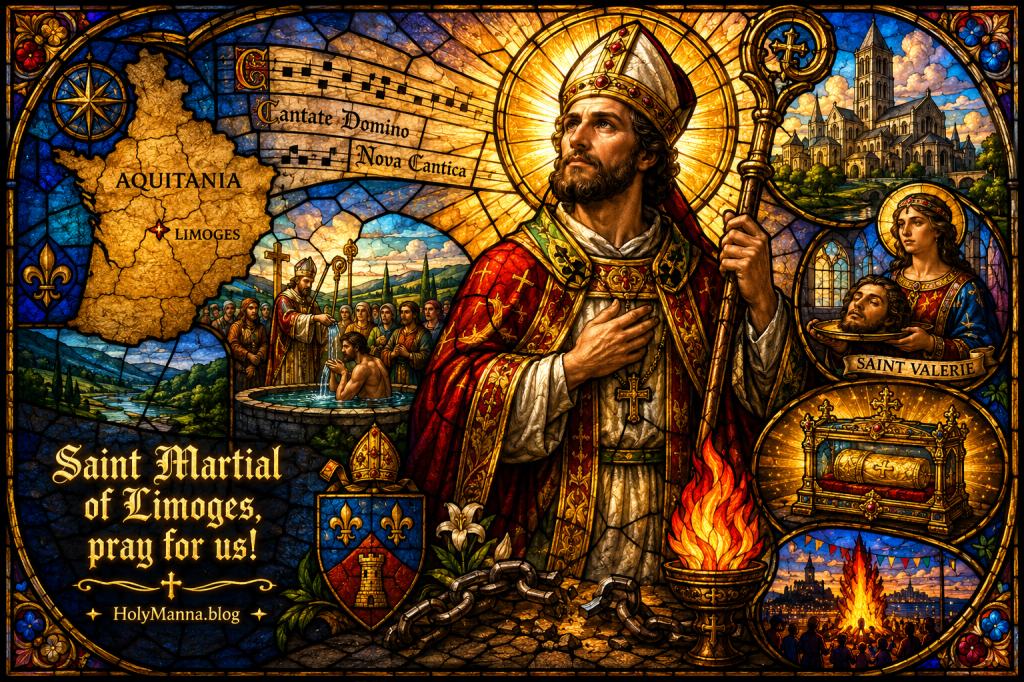
There is something deeply poetic about the way God works. He takes a stranger from a distant land, someone nobody in Gaul had ever heard of, and sends him to plant the seed of the Gospel in soil that had never known it. That is exactly the story of Saint Martial of Limoges, one of the most fascinating and underappreciated saints in the entire Catholic tradition. Celebrated on June 30th, Saint Martial holds the title of first bishop of Limoges, and is venerated across centuries and continents as “the Apostle of the Gauls” and “the Apostle of Aquitaine.” He is the man who brought Christ to southwestern France, and his influence stretches from a UNESCO-recognized miracle tradition in modern France all the way to carnival bonfires in northeastern Brazil. He is the patron saint of prisoners and is invoked against epidemics, and his patronage extends over the cities of Limoges, Avignon, Cahors, and the island of Lanzarote in Spain.
This is not a saint who made headlines by dying dramatically in a Roman arena. His story is quieter than that, and in many ways more remarkable for it. He walked into a pagan city as a foreigner, got beaten and thrown in prison for preaching Christ, and kept going anyway. He spent twenty-eight years pouring his life into a people who were not his own, and when he died at fifty-nine years old, he was surrounded by the very converts he had won for the Kingdom of God. What would it look like to give that kind of everything to the mission God has placed in front of you?
A Stranger From the East, Sent to the Ends of the World
The honest truth about Saint Martial is that the historical record is sparse. The primary source for what we know about him is Saint Gregory of Tours, the great sixth-century Church historian whose works remain essential to understanding early Christianity in Gaul. Gregory tells us that around the year 250 A.D., during the reign of the Roman Emperor Decius, Pope Fabian made a bold evangelical move. He gathered seven bishops and sent them out from Rome like arrows into the heart of pagan Gaul. Gatian went to Tours. Trophimus went to Arles. Paul went to Narbonne. Saturninus went to Toulouse. Denis went to Paris. Austromoine went to Clermont. And Martial was sent to Limoges.
Martial did not go alone. He brought with him two priests from the East, men named Alpinian and Austriclinianus, and the fact that he traveled with companions from the Orient strongly suggests that Martial himself was of Eastern origin. One medieval hymn, tentatively attributed to the poet Venantius Fortunatus, goes even further and hints that Martial was of highborn Jewish heritage, a descendant of the tribe of Benjamin. Whether or not that detail can be confirmed, the picture it paints is striking. Here is a man of the ancient East, carrying the faith born in Jerusalem, walking into the cold heart of the Roman province of Gaul to tell pagans about a crucified and risen Jewish carpenter who was also the Son of God. It is the universal logic of the Gospel made flesh in one missionary’s sandaled feet.
Martial arrived in Limoges as a complete outsider. The city, then known as Augustoritum, was a functioning Roman settlement full of temples to pagan gods and a population that had no framework for what he was about to tell them. He walked straight into that world and started preaching.
Walking Into the Lion’s Den, and Walking Back Out
The stories surrounding what happened next when Martial arrived in Limoges give us a vivid sense of the kind of courage this man carried. According to a story preserved in the Golden Legend, the great medieval compendium of saints’ lives, Martial went directly to the pagan temple when he arrived in the city. The pagan priests were not impressed. They beat him savagely and threw him into prison.
What happened next, according to this story, reads like something straight out of the Acts of the Apostles. The morning after his imprisonment, as Martial prayed in his cell, a light so blinding and so overwhelming descended upon him that no one could look directly at him. The iron chains that bound him shattered. The prison doors swung open on their own. The guards and jailers, overwhelmed by what they were witnessing, immediately begged to be baptized. And the very priests who had beaten Martial and thrown him in prison were struck dead by thunder and lightning. The others who were present came to Martial in the open prison and begged him to raise the dead priests back to life, promising that if he did, they would believe. According to the story, he raised them, they converted, and the mission of Limoges had its first unlikely harvest of souls. It should be noted that this account comes from the legendary tradition surrounding the saint and cannot be verified as historical fact, but it has nourished the faith of countless believers for centuries and reflects the kind of bold, apostolic courage that defined Martial’s real historical mission.
What is historically established is that Martial did succeed in converting the people of Limoges to the Christian faith, and that his memory was venerated there from the very earliest times. Gregory of Tours confirms this clearly, and the sheer persistence of devotion to Martial across more than seventeen centuries is itself a powerful testimony to the impact of his ministry.
There is also the remarkable story of Aurelian, a pagan priest of Limoges who, according to another beloved account, attempted to have Martial imprisoned. In this story, Aurelian was struck dead for his opposition to the saint, then miraculously raised back to life by Martial himself. Aurelian converted on the spot, was baptized, ordained, and eventually consecrated as bishop, becoming Martial’s own successor in the See of Limoges. The man who tried to silence the Gospel ended up becoming its guardian. Again, this account is part of the devotional tradition and cannot be historically verified, but the Church has treasured it as a powerful illustration of God’s capacity to transform even the fiercest opponents of the faith into its most devoted servants. Saint Paul would certainly have recognized the pattern.
Twenty-Eight Years of Pouring Out Everything
The work of evangelizing Limoges and the wider region of Aquitaine was not a short-term project. Martial poured twenty-eight years of his life into it. He traveled through Poitou, Berry, Auvergne, and Aquitaine, preaching, baptizing, building up communities of faith, and forming disciples. The Roman Martyrology summarizes his life with beautiful simplicity: “In Limoges, Aquitaine, the bishop Saint Martial with two priests, Alpinianus and Austriclinianus. Their life shone brightly in miracles.”
One of the most significant conversions attributed to Martial during his lifetime was that of a young noblewoman named Valerie. Her mother Susanna, before her death, had entrusted Valerie to the care of Saint Martial, and under his guidance, Valerie consecrated her virginity to Christ. The story of what happened to Valerie after that becomes one of the most haunting and beloved tales in the entire devotional tradition of Limoges, and it is inseparable from the legacy of Martial himself.
According to the story, a powerful Roman official arrived in Limoges and demanded that Valerie marry him. She refused, unwilling to break her vow of chastity to Christ. For this refusal, she was beheaded. But the story does not end at the moment of death. According to this account, the decapitated Valerie picked up her own severed head, walked to the church where Saint Martial was celebrating Mass, and placed her head in his hands at the altar. Martial, receiving the head of his spiritual daughter at the very moment of the Eucharist, was moved to the depths of his soul. Valerie is venerated as the first martyr of Aquitaine, and her connection to Martial made their cults almost inseparable in the popular imagination of medieval France. This story cannot be historically verified, but the image it carries, of a young woman choosing Christ over comfort and walking through death itself to bring that choice to her bishop, became one of the most powerful artistic subjects in the medieval Catholic world. Beautiful champlevé enamel reliquaries from Limoges depicting this scene survive to this day in major museums around the world, including the British Museum.
There is also a tradition that a vision of Christ appeared to Martial toward the end of his life, announcing to him that his death was approaching. The churches of Limoges observed this event on June 16th. Whether this account is historical or devotional in nature, it adds a deeply personal dimension to Martial’s story, the image of a faithful bishop, worn down by decades of missionary work, receiving the ultimate pastoral visit from the Lord he had served.
Martial died in Limoges at the age of fifty-nine, surrounded by the converts he had spent his life winning for Christ.
A Man Whose Influence Would Outlive the Roman Empire
To understand the scale of what Saint Martial left behind, it helps to remember that his mission was not just about one city. Limoges became the anchor, but the faith he planted spread across all of Aquitaine. The Church he founded would eventually become one of the most important in all of France, and the site of his burial would become something that drew pilgrims from across the entire Christian world.
After his death, Martial was buried outside the walls of the Roman city. From the very earliest times, according to Gregory of Tours, there were priests maintaining a presence at his tomb, observing and recording the miracles that occurred there. By the sixth century, a funerary chapel had been built above the tomb. By the ninth century, the tomb had become the center of a Benedictine abbey, formally established in 848 A.D. under the patronage of King Charles the Bald. The Abbey of Saint-Martial would become one of the five great pilgrimage churches of Western Christianity, built to the same grand design as Saint Martin of Tours, Sainte Foy of Conques, Saint Sernin of Toulouse, and the Cathedral of Santiago de Compostela. To put that in perspective, pilgrims walking the Camino to Compostela and passing within twenty-five miles of Limoges would not have missed the chance to venerate the relics of Saint Martial along the way. His tomb sat at the very heart of medieval Catholic pilgrimage culture.
The Abbey also became one of the most important intellectual and musical centers of the medieval Church. Its library was second in size and importance only to the library at Cluny. Its scriptorium produced some of the most significant manuscripts of early medieval music, including the earliest examples of Western polyphony, the musical form that gave birth to everything from Gregorian chant harmonization to the great choral tradition of the Catholic Church. The Saint Martial School of Music, active from the ninth through the twelfth centuries, shaped the development of sacred music across all of Western Christianity. In other words, the next time you hear a beautiful piece of harmonized sacred music at Mass, there is a thread that runs back to the monks who sang at the tomb of this third-century bishop from the East.
The Great Debate
No account of Saint Martial would be complete without addressing one of the strangest and most theologically significant controversies in the history of the French Church.
As the pilgrimage site at Limoges grew in wealth and prestige, a monk named Adémar de Chabannes became the driving force behind an ambitious campaign to elevate Martial’s status from missionary bishop to full apostle. Adémar was remarkably talented, a composer, historian, and scribe of the first order, and he poured his gifts into constructing an elaborate false biography of Martial. According to this fabricated account, Martial was born in Palestine, was a younger cousin of Saint Peter, had served at the Last Supper, witnessed the Passion of Christ, was baptized by Peter himself, was present at Pentecost and at the martyrdom of Saint Stephen, and was sent to Gaul by Peter personally as his apostolic delegate.
Adémar’s motivations were not purely cynical. He genuinely believed, or convinced himself to believe, that elevating Martial to apostolic status would bring greater honor to Christ through greater honor to the saint. And there was a practical dimension as well. If Martial were declared an apostle, the abbey could celebrate his feast day with an eight-day liturgical octave, dramatically increasing both the prestige of the abbey and the flow of pilgrims and revenue into Limoges. Adémar composed over a hundred original pieces of music to furnish this expanded apostolic liturgy, works of genuine artistry in service of a deeply problematic cause.
In 1031, Pope John XIX granted the apostolic title. For a time, it seemed Adémar had succeeded. But the Church, in her wisdom and her commitment to truth, does not let false history stand forever. By the seventeenth century, serious scholars were already challenging the apostolic claims. By the twentieth century, the full scope of Adémar’s forgeries had been definitively exposed. And as early as 1854, the matter had already been settled at the highest level. When the Bishop of Limoges petitioned Pope Pius IX to restore the apostolic honors to Martial, the Sacred Congregation of Rites refused unanimously, and Pius IX confirmed the decision in a formal decree. The Church’s verdict was clear and precise: Saint Martial was not one of the seventy-two disciples of Christ. He was the first preacher of the Christian faith in the Province of Limoges, and that is where the honors properly rest.
The important thing to take from this episode is not embarrassment but admiration for the Church’s integrity. When the historical record does not support a claim, even a beloved and long-standing devotional claim, the Church corrects it. Truth matters. At the same time, the Church affirmed that the veneration accorded to Martial was of very ancient and entirely legitimate origin. He did not need to be one of the Seventy-Two to be a great saint. Being the man who first carried Christ to Limoges is more than enough.
The Miracle That Still Echoes Every Seven Years
The most dramatic and best-documented miracle in the post-death legacy of Saint Martial happened in the year 994 A.D., and its effects are still felt today.
A devastating epidemic swept through the Limousin region, a disease known then as Saint Anthony’s Fire and identified today as ergotism, caused by a fungal contamination of grain. The illness caused burning sensations, convulsions, and gangrene, and it was killing people across the region without any medical cure available. In desperation, the bishop of Limoges made a decision rooted in faith. He ordered the monks to remove the body of Saint Martial from its tomb and carry the relics through the city in solemn procession.
What happened next was immediate and undeniable in the eyes of those who witnessed it. As soon as the relics were removed from the tomb for transport outside the city walls, the sick began to be healed. Through the night, as the relics rested in solemn vigil on the hill called Montjovis just outside Limoges, more and more of the afflicted recovered. The illness that had been devastating the region simply receded. The people of Limoges, shaken and grateful, credited the healing directly to the intercession of their founder and bishop.
This event was not forgotten. It gave birth to a tradition of public relic processions called the ostensions, in which the relics of the saints of Limousin are carried through the streets in elaborate ceremonial display. These processions happen every seven years and involve nearly twenty communities across the Haute-Vienne, Creuse, Charente, and Vienne regions of France. Every seven years, several hundred thousand pilgrims and faithful gather to participate. The tradition is so ancient, so continuous, and so deeply rooted in the life of the French Catholic community that UNESCO recognized it in 2013 as part of humanity’s Intangible Cultural Heritage. All of that traces back to the night in 994 when the relics of a third-century bishop from the East ended a plague.
The Miracula Martialis, a formal account of miracles attributed to the saint during the seventh, eighth, and ninth centuries, was written down shortly after 854 A.D. It establishes that the miracle tradition at Martial’s tomb was active for centuries before the great 994 healing. And in the fourteenth century, during a revival of his cult, an astonishing seventy-three miracles were formally recorded between 1378 and 1388 in a document called the Miracula sancti Martialis anno 1388 patrata. Seventy-three miracles in a single decade. The Church’s attitude toward these accounts is one of careful discernment rather than blanket rejection, and the veneration of Martial’s relics continued to draw the faithful across centuries precisely because those who came to him in need found themselves heard.
Saint Martial was also particularly honored in Bordeaux, where his pastoral staff was kept in the Basilica of Saint-Seurin and carried in public processions to invoke his protection during outbreaks of pestilence. His intercessory presence was felt not just in Limoges but across the whole of southwestern France.
A Saint With No Borders
One of the most genuinely surprising dimensions of Saint Martial’s legacy is what happened when Portuguese colonizers brought Catholicism to Brazil in the sixteenth century. His feast day, June 30th, falls at the very end of the Festas Juninas, the beloved June festivals of northeastern Brazil that celebrate Saints Anthony, John, Peter and Paul. In the state of Maranhão, Saint Martial’s feast closes the entire festival season with bonfires and popular celebration. In the city of São Luís, a monument was erected in his honor in 2007, marking the popularity of his festivities that have been celebrated there continuously since 1928. Each year, thousands of people gather for the Festejo de São Pedro e São Marçal, complete with the vibrant bumba-meu-boi tradition unique to that region of Brazil.
A third-century French bishop who was probably a Jewish man from the East, venerated in medieval France, celebrated in the Papal Palace at Avignon, honored as patron of Lanzarote in the Canary Islands, and closing out carnival celebrations in Brazil every June. Is that not exactly the kind of universal, boundary-crossing power that the Gospel has always had?
The relics of Saint Martial rest today in the Church of Saint-Michel-des-Lions in Limoges, having been moved there after the destruction of the great Abbey during the French Revolution. The Abbey itself, once one of the five greatest pilgrimage churches in all of Western Christianity, was razed to the ground in the nineteenth century, leaving only the scattered manuscripts of its library behind, some of which had been purchased for King Louis XV and now reside in the Bibliothèque Nationale de France. But the crypt beneath where the abbey once stood was rediscovered in 1962 during excavations beneath what is now the Place de la République in Limoges, and it has been open to the public since 1966. Anyone can walk down the steps beneath the modern city square and stand in the very crypt where Saint Martial was buried seventeen centuries ago. Admission is free.
What This Saint Has to Say to Us Right Now
It would be easy to hear the story of Saint Martial and think it belongs to another world, a world of Roman emperors and pagan temples and medieval plague processions. But the bones of his story are startlingly contemporary.
Martial was an outsider who showed up somewhere he wasn’t wanted, got beaten for it, and kept going. He spent twenty-eight years doing work that was hard, unglamorous, and geographically remote from the centers of power. He did not live to see the full fruit of what he planted. He did not build a famous cathedral or write a celebrated theological treatise. He just kept showing up, kept preaching, kept baptizing, and kept forming disciples in a corner of Gaul that most of the Roman world would never have considered important. And then he died surrounded by the people he loved.
That is a model of faithfulness that every single Catholic can recognize and aspire to. Most of us are not called to famous stages or viral moments. Most of us are called to the particular mission field that God has placed in front of us, our families, our workplaces, our neighborhoods, our parishes, and we are called to pour ourselves out there for twenty-eight years or however long God gives us, trusting that the fruit will come even if we don’t live to see all of it.
The lesson of the 994 miracle is equally relevant. When the people of Limousin were facing something beyond their control, something that no medical science of the day could stop, they turned to a saint who had been dead for seven centuries and asked for help. And the Church, in her wisdom, tells us that this is not superstition. It is the Communion of Saints in action. Catechism of the Catholic Church 956 teaches that the saints “do not cease to intercede with the Father for us” having entered more closely into union with Christ. Saint Martial’s relics did not heal that plague. God healed that plague, through the intercession of a man who spent his whole life learning to love God’s people. That is the logic of saintly intercession, and it is as alive today as it was in 994.
What would it mean for you to invoke the intercession of a saint who was himself a complete outsider, someone who had every reason to give up and go home but chose to stay? What mission has God placed in front of you that feels too hard, too obscure, or too unlikely to matter? And what would it look like to pour twenty-eight years into it anyway, the way Saint Martial did?
The story of this saint is an invitation to take the long view of faithfulness. It is an invitation to trust that the seeds planted in faithful obscurity will one day bloom into something that outlasts empires, survives revolutions, crosses oceans, and ends up closing carnival season in Brazil. Because that is exactly what happened when one stranger from the East said yes to God and walked into Limoges.
Engage With Us!
There is something in the story of Saint Martial that speaks to every person who has ever felt like a stranger, or who has wondered whether the quiet, unglamorous work of faithful living actually matters. His story is proof that it does, and the invitation here is to sit with that for a moment and share what it stirs up. Please share your thoughts, reflections, and questions in the comments below. This is a community of people on the journey together, and every voice matters.
- Saint Martial spent twenty-eight years in faithful missionary work far from home, in a place where he was not welcomed at first. Is there a place in your own life where God is calling you to a long, patient faithfulness that you have been tempted to abandon?
- The story of Aurelian, the man who tried to imprison Martial and ended up becoming his successor as bishop, is a striking reminder that God can transform even fierce opposition into devoted service. Is there someone in your life whose conversion seems impossible? How does Aurelian’s story change how you pray for them?
- The people of Limoges turned to the intercession of a saint who had been dead for seven centuries when they faced a plague they could not stop. How comfortable are you with asking the saints to intercede for you? What might be holding you back, and what would it look like to grow in that practice?
- Saint Martial is patron of prisoners. In what ways might you be living in a kind of interior prison, bound by fear, doubt, past sin, or self-doubt? How might the intercession of this saint who literally broke chains help you ask God for freedom?
- The legacy of Saint Martial crossed oceans and centuries and ended up in Brazilian carnival celebrations. What does that tell you about the seemingly small acts of faith and courage in your own life? How might your faithfulness today be planting seeds whose harvest you will never fully see?
The life of Saint Martial is a reminder that God does not need us to be famous, powerful, or certain of success. He needs us to say yes, to show up, and to keep going. So go love the people in front of you with everything you have. Pray boldly. Intercede fiercely. Plant seeds even when the soil looks hard. And trust that the God who turned one stranger from the East into the Apostle of the Gauls is more than capable of doing something extraordinary with the ordinary faithfulness of your everyday life.
Saint Martial of Limoges, pray for us!
Follow us on YouTube, TikTok, Instagram and Facebook for more insights and reflections on living a faith-filled life.


Leave a comment